Son of a Gun: An Ode to the Trumbos

Christopher Trumbo died today. And that saddens me greatly. As I sit here, tap-tap-tapping away at my computer, I have Johnny Got His Gun on in the background. Not only does it remind me of why I am here and why I became interested in the film world in the first place, but it also reminds me of why I became passionate about political issues, and where the two collided.

In the early ’90’s, when people were obsessively concerned about heavy metal music turning kids suicidal or into massive drug-fiends, heavy metal music was very busy turning me into a history buff and a cinephile. See, in 1988 Metallica released an album called …And Justice For All, which included a song called “One.” I didn’t get my grubby little adolescent paws on it until a few years later when I was hip-deep in the penny loafers and uniform skirt of an all-girls Catholic school (needless to say, being a metal fan in that location earned me more than a few detentions-that and the fact that I wore black nail polish on a regular basis). But I purchased …And Justice because I was a big Metallica fan and I had seen the video for “One” on MTV, most likely on Headbanger’s Ball with Riki Rachtman. When I saw that video, my life changed forever.

As many people are in their early teen years, I was a complete jerk to my parents. However, I had some presence of mind and enough brain cell capacity to reach out to my mother (who is exceptionally awesome) and tell her all about this video I had seen. I had also done my research in the academic journals of the time (Metal Edge, Circus, Hit Parader, and especially RIP) to find out more about this phenomenal piece of work. “One” seemed different to me. The sentiment was strange (ie outwardly political, and liberal at that!), the video structure was unusual…the entire assemblage was ground-breaking in my eyes.

The conclusions to my research were good and bad: the film was unavailable to be rented. The book however? My awesome mother got it for me. I ate it up like pie.
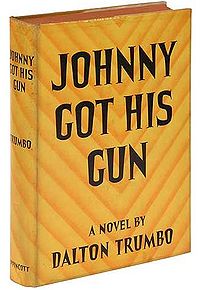
Johnny Got His Gun was my gateway drug. I became obsessed. I decided to find out all about the man who wrote the book, and all about the movie, and I quickly did so. I may have been the only underage kid who was spending time (without my parents’ consent or knowledge, of course!) outside Gazzari’s trying to get a date by talking about the blacklist and literary activities of Dalton Trumbo and how that tied into heavy metal. To this day, I am very thankful that approach never worked!

Due to the fact that the internet was not what it is now, it was not until I got to college that this obsession continued in full effect. As I began my film career, I renewed my interest in the subject when I was taking a film history course. To me, the Hollywood Blacklist was one of the most horrifying and awful marks on the industry that we’ve had. I could write for hours and hours simply on that but this is about the Trumbos.

In college, not only did I find that my own family had ties to the Blacklist, but I wrote several pieces exploring the ways that it brutalized people’s souls. At the end of the day, what I found was that Dalton Trumbo, the man who had started this whole journey and catalyzed my interest in this section of American filmic history was a man who, as his son Christopher Trumbo said, “wasn’t able to break the blacklist, to smash it into pieces or obliterate it or crumple it up into a ball and throw it in the trash can — but he was able to cripple it, and when his name appeared on the screen when ‘Spartacus’ and ‘Exodus’ opened within a few months of each other in New York, it became easier for other writers to get their names on what they had written without having to sign statements about what their political beliefs currently were or what they had been in the past or needing to justify themselves to their employers about anything at all.”


Dalton Trumbo's mugshot, prisoner #7551, upon being jailed for "Un-American Activities"


Trumbo’s “crippling” of the Blacklist served a great purpose and essentially opened the employment floodgates so that a great many people who had previously been economically and professionally cowed by this terrible tragedy were no longer handicapped in that regard. Dalton Trumbo, to me, was a hero. He had been a hero to me since I had first read about him as a teen, and he became even more of one as I read further.


The blacklist was a time of evil, and that no one on either side who survived it came through untouched by evil.

I believe that it was with the introduction of the Blacklist to my life that I realized the importance of the writing community to Hollywood, as a good portion of those that were Blacklisted (and almost all of the Hollywood Ten) were, in fact, writers. It was also at this point that I started visually “collecting” blacklisted writers’ and artists works, Trumbo being foremost on that list.

One of the first films Dalton Trumbo's name ever was allowed to be attached to, "breaking" the Blacklist

Kirk Douglas, by insisting that Dalton Trumbo be allowed on the set (and then putting his name on the film), essentially helped catalyze the "breaking" of the Blacklist


Life can never cage a man like this! And it never could...a great film of Trumbo's and very telling.

Tonight I returned home from the movies to the tragic news. Christopher Trumbo, Dalton Trumbo’s son, had passed away at the age of 70. My heart sank. A few weeks ago, I had snuggled myself up with some cross-stitch and blankets, and put on one of the best documentaries I have seen in many years, and (I will stress this) it was not just because of the subject matter.

In 2003, Christopher wrote a play called Trumbo: Red, White and Blacklisted. Directed by Peter Askin, this piece constructed a narrative about the Blacklist and Trumbo’s life based on his correspondence. It played off-Broadway, and had an intense amount of star-power attached to it at different points. In 2007, this became the basis for the documentary, Trumbo.

Trumbo is not only an excellent documentary, but it is a fabulous example of theater put onto film. It not only shows the talent that Dalton Trumbo himself had, but the skill that Christopher possessed in being able to communicate his father through two different mediums (theater and film) that were so thoroughly enmeshed on the screen. Christopher also adds an even deeper layer. Alongside the aforementioned play/film marriage, there are interviews scattered throughout, reminding us that this is not only players recreating correspondence, but real figures recalling real events. The Trumbo family as well as other Hollywood Ten families are contained within the text, relating their own lives with Dalton, while figures like Liam Neeson and Nathan Lane are reading the letters and playing their “parts” so to speak. There are also interesting connections. Kirk Douglas, a very significant figure in Dalton’s life is an interviewee, while his son is a participant in the performance/dramatic readings.

The following clip is one of my favorite sections from the documentary. But there are oh-so-many more!!


Not that Christopher didn’t have his own separate career. He did! Aside from being the assistant director and associate producer on Johnny Got His Gun and assistant director on Exodus, directly out of college, he also had a long and successful career in television (shows such as Falcon Crest, Quincy, Ironside). Christopher Trumbo was widely considered to be, as Peter Askin said, ” a very smart, funny, articulate guy. He was enormously gifted himself, and with the work he did in respect to his father.”

He was indeed his father’s son. He became one of the preeminent scholars on the Blacklist, devoting much of his life to being as learned about the subject as he possibly could. His sister, Nikola, noted that “His passion for the last 20 years or more was to learn as much as he could about the blacklist and then educate others about it, and I think he went about it using each of those attributes.”

Trumbo once wrote that making the film version of Johnny Got His Gun was his father’s response to the insanity of Viet Nam. It is tragic now that we don’t have anyone as poetic or striking as either Dalton or his son to make such bold and original filmic statements about the way of the world. Rewatching JGHG tonight, it reaffirmed my love for Dalton Trumbo, and my feeling that there is some writing talent that, like Haley’s Comet, only comes around every so often. With Christopher’s passing, and my recent viewing of his documentary, my heart breaks even moreso, as there is also one less historian who was Really There, and can talk about what it was Really Like to live through that kind of persecution.

I suppose that all we can do now is all we have ever done: watch, remember, and never forget.


I know that nothing can happen if I remain silent and that everything becomes possible when people find each other and take each other’s hand. I know that when enough of us are able to put aside our fears and find courage in the name and power of our common humanity, that when we do that one by one and then another and another, again and again, every day and day after day that we will become a great and irresistible multitude and that this war will end.

So be it.

—Christopher Trumbo


Fascinating Statistics….2010 in review

The stats helper monkeys at WordPress.com mulled over how this blog did in 2010, and here’s a high level summary of its overall blog health:

Healthy blog!

The Blog-Health-o-Meter™ reads Wow.

Crunchy numbers

Featured image

The average container ship can carry about 4,500 containers. This blog was viewed about 24,000 times in 2010. If each view were a shipping container, your blog would have filled about 5 fully loaded ships.


In 2010, there were 3 new posts, growing the total archive of this blog to 32 posts. There were 15 pictures uploaded, taking up a total of 810kb. That’s about a picture per month.

The busiest day of the year was June 25th with 321 views. The most popular post that day was G’night, Sweet King…RIP Michael Jackson, King of Pop, 1958-2009.

Where did they come from?

The top referring sites in 2010 were facebook.com, warcen.proboards.com, mahalo.com, search.aol.com, and mrpeelsardineliqueur.blogspot.com.

Some visitors came searching, mostly for michael jackson, ultimate warrior, wayne’s world, waynes world, and the ultimate warrior.

Attractions in 2010

These are the posts and pages that got the most views in 2010.

1

G’night, Sweet King…RIP Michael Jackson, King of Pop, 1958-2009 June 2009
6 comments

2

Drug Me: The WWE and The Death of Michael Jackson June 2009
2 comments

3

Forged in Fire: Heavy Metal and the Male “Bromance” August 2009
1 comment

4

Are You Mental?: Marty Goes for the Nutso With Shutter Island March 2010
3 comments

5

Thank You For Bea-ing a Friend…:RIP Bea Arthur,1922-2009 April 2009
1 comment

When I Think Back On All The Crap I Learned in High School: Ode To Kodachrome, 1935-2010

I started having pictures taken of me as soon as I was born. My godmother was a photographer/art teacher at UCLA, and I spent the very early bits of my life in weird artsy places and dark rooms at UCLA smelling chemicals, as well as her incense and (very likely) pot-smelling apartment in Santa Monica.

She had crazy amounts of cameras. Underwater cameras. Regular cameras. By the time I was 6, going to Samy’s was like going to the park or the grocery store or something. I dunno. It was just something we did. I knew names of film (Fuji, Kodak) and I kept hearing about this strange thing called an ISO…?

She took pictures. And my mother took pictures. There was a shutter flashing every two seconds. *click*  **zzzz** I still happen to think that the sound of a manual camera is one of the sexiest sounds on the planet. Put that and perhaps an Irish or Scottish accent next to my ear, and I might just automatically have no bones in my body and a huge shit-eating grin on my face.

We have fairly decent collections of family albums due to the fact that before digital cameras came in and caused us to simply look at something and delete its existence forever due to someone closing their eyes or a misjudged hand in the “incorrect place” we got them developed. And not only did we get them developed, but we had this strange exhibit called a “slide show.”

I know, I know, some of you may not remember this or know what this is. For those of you who do not know what a slide is, I will give you a picture:

All kidding put aside, these were very important and essential parts of my life. I doubt my parents (or my excruciatingly stoned godmother and her partner my sorta other godparent-ish guy) ever knew how much these little pieces of my very early childhood this meant to me, but all I can say is that I probably would not be a cinephile if I hadn’t had slide shows all the time as a kid. I remember laughter, my mom having a drink and the ice clinking, and the crack in the wall (our house was built in 1919, or something ridiculous like that), and great photos. Whether they were artsy photos, family shots, or a mix of the two, we had a good time.

The main thing was that it was not unlike 16mm film. The 16mm format, introduced in 1923, was utilized as a way to create “real” movies but at home. It may not have been 35mm, but hey- it was still film, right? And you could project ’em yourself, too? Not only that, it created a sense of community and brought the family together in a way that other things could not. It was one way that, historically, media absolutely built bridges instead of tearing them down. The process of creating a film together, and then watching it together was a bonding experience. Look at the opening of the TV show, The Wonder Years.

Within this clip, you see a family that is very clearly having Family Fun Times. Ok, yeah. It’s a television show. But it’s a television show that I grew up with. I also watched this show explore some pretty harsh issues of the time in a fairly sensitive and smart manner, so I would have to say that opening the show with a 16mm family film was a good call. It showed the historical reality that was going to be presented withing the fiction. Not bad for an 8:00pm ABC show, essentially aimed at a mid-range adolescent audience.

So back to slide shows. My slide shows in the ’80’s served a similar purpose to the 16mm home movies. They really brought us together. Seeing as my family had quite a bit of tragedy happen before I was even in Kindergarten, we needed some o’ that. Plus they were all hippies anyway. It was their thing, man. At any rate, I enjoyed the pretty pictures. And now, with the death of Kodachrome, I am starting to realize (perhaps) where the birth of my love for cinema came from.

When I went to summer camp, I took a photography class. It just made sense. I liked the visual image. I like the pictures. I like making pictures with my eyes. I like certain photographers as artists much better than most painters, sculpters, etc. The first camera I ever used was a Pentax K-1000 up at Camp Swig, in Saratoga, CA. It was awesome. If I remember correctly (and I believe pretty heavily in the Dorothy Parker quote “Women and elephants never forget”) I believe I ended up being the assistant to the camera teacher. Her name was Emily, she had dyed black hair, and she really liked this band I’d never heard of called Pavement and wore khakis. She was really really really cool. I think about her sometimes and wonder whatever happened to her. I have a feeling we’d be friends now. not just because I have a very good sense of who the hell Pavement is, but just because I think we would. I liked her a lot. She was my entrance into The Camera.

Then came High School…and thus the title for this piece. The darkroom at Fairfax High School in 1995 was no joke…to me, anyways. I learned stuff and had a great teacher. And I met one of my better high school friends who I am still in and out of touch with. My first Punk Rawk Pal that was my own age! Imagine THAT!  Yeah, so upon entering that scarlet chamber, I was given several options: engage in a drug deal (generally pot, but I might’ve been able to go harder. Never asked. Wasn’t interested), lounge around and talk about the exciting and engaging world of high school sexuality and politics (Oooo! Sounds thrilling when I have a chance to have 2-3 hours of darkroom time) or use some decent equipment to print pictures with. I chose the latter of the three. Every time. My only issue was negotiating the other idiots who were inside that space with me and the people who actually wanted to work. Regardless, it got done. And I got lovely work out of it.

My next darkroom, at Los Angeles County High School for the Arts? So. Much. Better. I had my work in our shows, it inspired me to go to Venice Beach on busses and get into photography as a True Love For Life. I think at Fairfax it might have been just a crush that I was considering moving in with. But I committed, hook, line and sinker at LACHSA. My only regret? I missed the day that we did pinhole cameras. I think I might’ve been getting my braces off or it was the dentist or something stupid like that. Someday…I want to do a pinhole camera.

The question now, however, is…will I get to? Perhaps some of you have seen the articles floating around people’s Facebook pages about the Death of Kodachrome. And almost all of you have heard the Paul Simon song “Kodachrome.”

Yesterday, after 75 years of glorious color, Kodachrome came to a screeching halt. Dwayne’s Photo, the building in Parsons, Kansas, and the last Kodachrome developing processor in the world, is being sold for scrap. People sent their rolls and reels in from all over the world to get them in by the deadline, spent retirement funds, traveled internationally, just so they could get those “greens of summer.”

I know what you must be thinking. Is it really that good? Can’t they get those colors digitally at this point? They can do anything with computers now! Can’t they reproduce Kodachrome? The easy answer is yes. You can get that color. The problem is you will never get the tone or, more importantly, the feel. Because I have had close relationships with Real Live Film Projectionists for years, I have been lucky enough to experience the warmth of Kodachrome, and it is simply a film look that is like no other (save perhaps Fuji, but that *still* doesn’t have the same thing that Paul Simon sang of- the dude wasn’t stupid!!).

The thing about Kodachrome is that it keeps its color. It was highly regarded for that reason. It started getting beat out by cheaper processes, but there were studies done and according to professionals, archivists, and the scientists-in-between like Wilhelm Imaging Research, Kodachrome “clearly is the most stable transparency film in dark storage; the film is especially outstanding in terms of its total freedom from yellow stain, even after extended aging.”  Unlike other films, even a roll that is undeveloped can keep its color. Look at these two photographs after 20 years lying in the Canadian rainforest, partially buried:

Picture of the best film roll, no white balance

Picture of the best film roll, white balance applied


So if that didn’t hit you, why don’t we try something a little harder. Here is a piece of film work where they seem to be testing out early incarnations of Kodachrome. No, this is not made today. This is actual honest-to-goodness, back-in-the-day, 1922 footage. I swear. If this doesn’t hit you on the glory of Kodachrome, I’m not sure what (if anything) will.

So, when I heard about Dwayne’s closing, and Kodachrome leaving us for good…my heart was broken. The amount of home movies and relationships that were created upon a format whose very emulsion had properties that outlasted the ones of other color film elements? Countless. The history that was made on Kodachrome photography? Beyond measure. National Geographic, for just one example. Familiar with this?

That’s Kodachrome. An iconic image. Documentaries were done about this photograph and the girl in it. Hey, Kodachrome, how ya doing? Naw, you’re not essential to American media culture. Not at all. We’ll just use the quicker, cheaper, ways. ‘S ok. We can fix all that with computers anyway. Digital! It’s the future!

What you can’t fix with computers is the warmth from the screen, the pure vibrancy of the colors of a printed photograph, the laughter amongst an audience, the bond between families making a home movie. These things take on lives of their own. It is no mistake that most artists consider their works to be “parts of themselves’ or their “children.”  In either situation, they are sentient beings or at least possessing blood, musculature and some possibility of animation.

The big joke was that Kodachrome was made by God and Man, as it was created by two musicians named Leopold Godowsky, Jr. and Leopold Mannes. Kodachrome was almost like a combination of the human and the divine. It could do what other color films could not do and for longer, and conduct great miracles (of the Canadian forest variety!). But it also shared a magic on-screen/paper/slide that others have not been able to match. It has touched people in a way that no other film has. Whether it was through a movie camera or the eye of a photojournalist, Kodachrome made an impact on American culture that was clearly almost religious. We have Kodachrome Basin State Park in Utah named after it! Last time I checked, I wasn’t going and picnicking at Ilford or Agfa State Park!

And then there’s Paul. Oh, Paul.

So yes. This is a eulogy. But perhaps it is only a temporary one.  I feel that with the onset of the technological age, unless something changes fast, it will be permanent. The funny thing is that in Paul’s song he says “everything looks worse in black and white” and now that is the only way that Kodachrome can be processed, by a company called Film Rescue International. Oh, irony. According to the New York Times, some folks’re still holding on to their rolls of film because they are hoping that Kodak might “see their lack of wisdom” in killing Kodachrome. And to me that is how it should be. We should always hold out a little hope for the future. After all, it is Kodachrome. It is, has been, and always will be, as Todd Gustavson of the Eastman House says, “more than a film, it’s a pop culture icon.”

The Cult of Hate: Godfather III

To start with, I really liked seeing Sicily. I spent some time there in 2001, and dammit- that place is gorgeous.

When Michael says to Kay that he wants to show her around Sicily because then maybe she’ll  really “understand the family,” I knew exactly what he meant. You would too, had you been to Sicily. It is unendingly beautiful and full of life. Coppola translated this magnificently to film. I think he even got a fairly decent sense of Real Italian Culture, too (or at least what I experienced in the time I spent in Italy), when he wasn’t dealing with Corleone drama.

While I wouldn’t say this is a great film, I would not say this is a film to be hated. In fact, I found this film to be a quite interesting coda to the series. In fact, what it ended up doing was discussing some features that have been subtextual in many mafia films, but never quite laid out as significantly as this. Perhaps it is because it is clear that this is the finale, and Michael Corleone is on his last legs. Perhaps that is the only way that this can come through. Perhaps it is because Francis wanted to feature his daughter and give her some significance. Either way, The Godfather III is actually more about the women as powerful figures than the men, and I found that fascinating.

I wonder if that is why it is the film that everyone scrunches their nose up upon its mention. The series is highly male-based. Having major actions in this film be based upon female characters is more than slightly counter-intuitive to the series as a whole and thus makes it a bit uneven. However, if one were to look at mafia/gangster films, the female presence and female power structure is alive and well.

Let’s start with Scarface (1932), directed by Howard Hawks and produced by Howard Hughes. There has been a great deal written about the main character, mob boss Tony Camonte (played by Paul Muni), and his unnatural sexual attraction and obsession with his sister. Not only does this underscore the fact that he is driven by what I call Mafia Moll Magnetism, but what occurs in the film just supports the theory. Not unlike a femme fatale, many Mafia Molls undo their men purely by containing their power in their sexuality. In Scarface, Tony is undone by his obsession for his sister. The irony of this circumstance (and what complicates the situation sometimes) is that Cesca (played brilliantly by Ann Dvorak) may be aware of the power she has over Tony but chooses not to manipulate him or use it against him. This is not the usual set of circumstances.

Skip forward a few years, and maaaaany gangster films later and you have another stellar example of Mafia Moll Magnetism, only…she is well aware of her position in the gang. White Heat (1949) was directed by Raoul Walsh and introduced us to Cody Jarrett (James Cagney), an iconic gangster figure the world had never seen the likes of before. Now, Cody not only had a double-dealing wife, Verna (Virginia Mayo), but he has a ruthlessly unscrupulous mother, “Ma” Jarrett (Margaret Wycherly) to whom he is beyond dedicated to.

Another facet of the Mafia Moll Magnetism is that no matter what happens, the “protagonist” (in this case, Cody) will generally select the Maternal Figure over anyone else, no matter what anyone might try to tell him. In the narrative, Verna and Ma…well, I don’t want to spoil it, but suffice to say that they had a bit of a power struggle. This also figures in highly within the women who are vying for their Don. Someone’s gotta be Alpha Female. However, at the end of the day, there will always be only be one Alpha Female to Cody: “Ma.” Therefore, no matter what happens to that character, in a sense, Mama still wins. The most famous line of the film, “Look Ma, top of the world!” is one where Cody is still talking to her, and it is clear that, once again, he has been undermined by his dedication to the Main Woman in his life.

It’s a slightly different story with two women who are simply competing for top position due to sexual positioning, but Mafia Moll Magnetism still functions the same way and it is to remove power and functionality from the main mafia unit and bring some of it back within their own realm. It can be seen in a similar way to the femme fatale in noir, only that the Mafia Moll will coalesce and go along with much of what is going on. However, at certain key moments she will assert herself and make herself known, figuring in as an extremely powerful and significant icon within Mafia Media.

How does this relate to Godfather III? Well, having never seen it before, I went to see it tonight and I found it to be a perfect example of this theory. First of all, in all three Godfather films I discovered that there is only one truly sympathetic character, and that is Tony Corleone. Poor kid just wants to sing opera for his dad who’s trying to take over the world…legitimately? Yeah. Right.

So what about Kay? She’s an innocent! Nah, not really. She stood by for too long. Let stuff happen. And her position in GIII is one of a manipulative mother. She trades one child for another. Mafia Moll Magnetism? You got it. In order for Tony to be able to sing opera, she gives Michael Mary. She had to know what would happen with that decision. Sorry, lady, I don’t buy it. You knew. You said you knew. You repeatedly stated you knew the family, etc. So…a child trade-off. Automatically makes Kay an unsympathetic character.

Then there’s Michael’s sister, Connie (Talia Shire). Wooooah, boy! She practically invented the whole concept behind my theory. In GIII, if it wasn’t for her, nothing would get DONE! It seemed to me that this film was about the waning of Michael Corleone, and the waxing of Connie Corleone. When he was down, she would get up, sharpen her nails, and get in command. She knew exactly about Mafia Moll Magnetism and how blood relations only booster that.

Then there’s poor little Mary Corleone (Sofia Coppola). Hmmm. Yeah, sure. It seems that she did know what she was getting into. And she wanted more. There was something about the way she positioned herself several times within the film that said, “I want in.” Even when Vincent (Andy Garcia) lied to her face, it appeared to me that she understood that perhaps this was just under the list of “things we don’t talk about/mention” which meant that she knew he was lying. The fact that Mary orchestrated the entire relationship with Vincent says that perhaps there is more to her than the innocent girl that she was portrayed as. I feel that, while the acting was lackluster, the character definitely contained the qualities that move towards this same goal: a manipulative figure within the familia.

In summation, I feel that Godfather III contained some properties that were far more complex and interesting than your average film. Additionally, it was beautifully shot which is always appreciated. I feel that there are enough shitty movies out there that deserve everyone’s unrequited hatred that this poor film should be left alone as it has some very interesting aspects to it, and definitely ones that I did not count on finding.

One Way or Another

In regards to the New Year, Benjamin Franklin said, “Be at war with your vices, at peace with your neighbors, and let every new year find you a better man.”

However, good ol’ Ben also tried to tenderize a turkey through electrocution, and ended up electrifying himself, so I can’t say that every one of his plans, suggestions or pieces of wisdom were 100% solid.

I’m more of a fan of the Mark Twain and Oscar Wilde school of thought.  Mark Twain said of New Year’s Day that it was “the accepted time to make your regular annual good resolutions. Next week you can begin paving hell with them as usual.” And Mr. Wilde? Well, he essentially followed in the same vein and stated plainly, “Good resolutions are simply checks that men draw on a bank where they have no account.”

In essence, New Year’s can be looked at in many ways.

I have one way of looking at 2010. It SUCKED. But I have one way of looking at 2011: it’s going to ROCK. HARD.

My personal highlights of 2010, the few that occurred, were all film related. The TCM Film Festival was amazing. The Reel Thing Conference in Hollywood and the AMIA/IASA Conference in Philadephia were unbelievable. In the spirit of that, I will celebrate that with a list of my favorite films of the year. In general, I feel that “top 10/25/etc” lists are slightly on the silly end of things and they almost shout “Look at me! Look what I watch! YOU should watch this stuff too!” And some people’s lists are exactly that. My list is not intended to be so. Maybe you’ll find something you’ll like or want to watch, but if not, no big deal. As I am on the path to trying to become an archivist, this is more for me to remember the films that I enjoyed in a particular year than anything else. So…welcome to my Filmic Forum of 2010.

General Rules:

-There is no order of ones I liked best to least based on numerical value, except for #1-3. Those are self-explanatory. Aside from those, I loved them all equally.

-This list is also based upon the films I’ve seen. I have not yet seen Blue Valentine, Dogtooth, Rabbit Hole, White Material, or I Love You Philip Morris (all films I want very much to see).

-The starred ones at the end are kinda my “special selections.” The ones without stars are the definite ones, without any qualms. The last 2 are quite good films, but not my very favorites.

1) True Grit

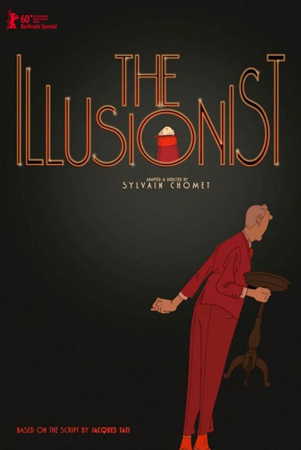
2) The Illusionist


3) Kick Ass


Valhalla Rising

The Ghost Writer

Animal Kingdom


Splice

The Fighter


Mother

The Girl With The Dragon Tattoo


Social Network*

Black Swan*

All I can say is that with the new Malick film coming out this year, and a few other things that look promising, let’s hope that 2011 is a better year for American film-making than it has been. We used to be good, but I’m losing my faith. This year’s list has quite a large amount of foreign work on it, and it seems like that is where the bravery, creativity and good film-making is going.

In any case, have a great new year, and hope your holidays were great!

I Must Make My Witness: Technojunkie-ism, Unemployment and the Loss of Anger

I’m sitting in a coffee shop. Surrounded by techno-junkies…and I…well, I might as well be one of them.
My “smart” phone is on the left of me, charging through my computer. I have my headphones on, listening to the clips that I’m playing and readying for this piece and my iPod is on the right of me, charger underneath, just in case the battery runs low.  It is truly amazing, this. What the hell am I doing? This isn’t me.

I look, for all intents and purposes, either like some weird Star Trek creature, with wires and mechanical technology hanging out all over the place (that is, if you include my tattoos & piercings), or some mad automaton you would call for assistance with your cellphone perhaps. “Hello, this is Verizon, how can I help you?”

The rest of the coffee shop? Not so much. They look happy. Dependent. Smiling. Ready to send off that next resume before hitting that next audition. But first, they’ll hit up Facebook to see what’s up, ya know? And that’s the hilarity. I come to this place with some regularity. It’s near where I live. I can take a pretty good gamble and say that amongst the very filled up shop (yesterday it was almost difficult to find a place to “plug-in”) most of ’em, myself included, are unemployed.

But this is Los Angeles. The LAND of the unemployed. After all, isn’t it still possible to get discovered? No, boys and girls, it’s not. Oh, and just to shatter your dreams even more, That Schwab’s story is an urban myth as well. Lana Turner, if she was discovered *anywhere* was most like discovered somewhere down the street. Schwab’s, on the other hand, much like the place I current am inhabiting, was also a  locale for the unemployed to “check in” and “catch up” and perhaps get a break from someone else who may have a lead.

When I lost my job, everyone smiled and laughed and said, “Hey!! Now you’re on FUN-employment!” and I looked at them like they were crazy because, really, it’s an insane way to look at the world. Insane, in every sense of the word. See, you take away someone’s work/worklife/space, and you take away their reason to get up in the morning or their reason to leave the house. Quite literally. Say what you will, but it is true. And I always knew this, which is why I never took my job for granted when I had it. I liked my job. I loved my job. I did anachronistic activities sometimes with anachronistic materials but that made me feel like a million bucks. Now? Well, I’ve totally read a mass of books. I’ve watched a bunch of movies. But I’ve gotten to the point where Law & Order episodes are repeating themselves and that. Is. Not. Good. I miss having a job.

Here is the basic problem: Working give us parameters and schedules and rituals and routines. Human beings need these things. We always have and we always will. Most importantly, work gives us purpose. Just like relationships with other people give us purpose. What happens when we lose one? What happens if we lose both?

See, we have social worlds that are significantly interwoven and related to our working lives. Take away one…well, I don’t think I have to explain what happens to the other. You would be surprised at how much you actually depend on your co-workers. Those people may not be your best friends; in fact, you may not even like them, but you need them. The nauseatingly interesting thing is this: we are learning to supplant all of our social interactions- even those with the most disliked of office co-workers- with those of technology.

So perhaps, then, due to your Iphone 8.5,000 and your awesome new Ipad and whatever the latest and greatest techno-toy is, when you get laid off you won’t be so lonely?

See, I’m not actually sure that this will be the case. Argue what you like, but I have historical back up. When I was in elementary school, I became madly obsessed with the transcendentalists. I thought they were incredible. I should not have been surprised, therefore, when I went straight into an obsession with the Beats. Just made sense. What didn’t was the fact that I was also reading Stephen King and ridiculously thick, poorly written gothic romance novels, searching incessantly for another “Jane Eyre” or “Rebecca”, but hey…who’s counting?

At any rate, there was this guy. Henry David Thoreau. I thought he was a rock star; his ideologies and his whole conception of the world were beyond anything I had ever heard before and it blew my mind. At one point in his career he decided to go and take a cabin in Massachusetts, alone.

By spending  a good long time there, he realized he had to leave. But not before having learned something extremely important. In his words, he left the woods:

…for as good a reason as I went there. Perhaps it seemed to me that I had several more lives to live, and could not spare any more time for that one. It is remarkable how easily and insensibly we fall into a particular route, and make a beaten track for ourselves. I had not lived there a week before my feet wore a path from my door to the pond-side; and though it is five or six years since I trod it, it is still quite distinct. It is true, I fear, that others may have fallen into it, and so helped to keep it open. The surface of the earth is soft and impressible by the feet of men; and so with the paths which the mind travels. How worn and dusty, then, must be the highways of the world, how deep the ruts of tradition and conformity! I did not wish to take a cabin passage, but rather to go before the mast and on the deck of the world, for there I could best see the moonlight amid the mountains. I do not wish to go below now. (Thoreau, Walden)

His desire not to “go below” speaks of something a bit more than simply non-conformity. Walden is, by no means a simple piece of literature. It is a gorgeous piece that discusses a litany of topics that, while having some sway on this discussion, would, literally, SWAY us off-course. Thoreau did not wish to “go below” because he recognized that his place was with other human beings, not in seclusion. To paraphrase and oversimplify, people need people in order to move forward through the world in a productive manner. He left for as good a reason as he came: solitude. The recognition that he had lived the “solitary life” and found it to be not as satisfying for the long-haul was a big step for a man as independent as Thoreau. So he left the woods.

The human connection is actually quite strong. Strong enough to leave the woods for, strong enough for people to give up organs for, strong enough for people to do lots of incredible things that make all the people on Oprah cry and go “Aw…” and “Wow!”  And that’s great. It’s the wonderful part of the Opposable World. But it seems to be changing a lot as we attempt to turn flesh and muscle into metal and wire, like in the latest Droid commercial…

So here is the problem: we are working very very hard at making very very sure that we do not need people at all. The more we do that, the more jobs are lost and the more unemployment we have. The more unemployment we have,  the more relationships and social worlds are lost and broken. See a pattern here? So, with all of this, and especially with the substantive rise of unemployment, don’t you think we should be more ANGRY?

You would, wouldn’t you? Paddy Chayefsky and Sidney Lumet certainly did, back in 1976. But back then, their major technological contender was the luminescent screen of the television, with some politicians and advertising schlumps vying to control people’s minds! What a thing to say…Oh Network, life was so much simpler then…*cue old-timey music and the squeak of a rocking chair*

I am not trying to downplay Network‘s content or the film itself by any stretch of the imagination. Every word, every bit of that narrative, every slice of that piece of cinema remains as true today as it was in 1976. What terrifies me is that in 1976, Paddy Chayefsky was discussing anger, and in 2010, due to a malaise come upon by what I call technojunkie-ism, no one gets angry anymore. Or heartbroken. Or even, dare I say it, really excited or happy. Being attached to these techno-toys, as shown in the Droid commercial, is turning us into robots, really sick robots, dangerously fast. There is even a new anxiety that is being written about called “disconnectivity anxiety” and it is EXACTLY what the words mean. It’s damn scary.

As you saw in the above clip, Peter Finch’s character, Howard Beale, walks into the studio to “make his witness.” What isn’t shown is that he has recently been fired and this is his last appearance on the show. He is, for all intents and purposes, unemployed. And he isn’t just unemployed, he has threatened suicide as a result…while he was on live television. The “last broadcast” in the above clip is supposed to make up for this “poor reaction” to being told he was, as the British say, being made redundant.

What we are shown here is his rage, pure and primal, beautiful and real in all of its intensity. As he asks the audience everywhere to join with him, we watch as he is being co-opted by Faye Dunaway’s character, and the remainder of the film just spirals gloriously from there. However, what is essential to this discussion is the way that Howard Beale expresses himself at this moment in time. He is being removed from and losing everything. He has spent his life working towards his goals, he has the aforementioned social connections (in fact, his best friend/co-worker was the one who had to give Beale the news) and now he has…nothing.

What Beale does, at this juncture, is appeal to the one community that he still has: his audience. He is no longer their television anchor; he is one of them. At the beginning, it seems that every time he says “we”, Beale might as well be saying “I.” However, his only somewhat-subtly disguised subjectivity does not take away from the effect his speech has on his “new peer group” due to the fact that he has now joined their ranks. In fact, if his rawness does anything, it only draws them in closer (thus making it easier for Faye Dunaway to continue to exploit him, and the television audiences, throughout the film).

His next dialogic switch from accusatory direct address to strong demand for everyone to stand up and assert themselves is key. Due to his recent termination, Beale has been left feeling invalid, not even human. He was going to take his own life on broadcast television due to the fact that the station had already done so. Beale gives adamant instructions. He states,  “All I know is that first you’ve got to get mad. You’ve got to say, ‘I’m a human being, goddamnit, my life has value!'” Beale, through his anger, has connected with another community (his audience) and gotten back some sort of personal value for himself.

Tragically, that same personal value that Beale regained doesn’t seem to come into play when it has to do with techno-toys. In fact, there doesn’t seem to be anything much “personal” about them, save, perhaps, the painfully bedazzled cell-phone case or an iPod with your name inscribed on the back. Even those aspects seem to speak more about the “value” than the “personal.” Due to our heightened dependence on the largess of the technological empire, whether it be within Network (1976) or reality, our connections to each other are failing deeply. Howard Beale says it perfectly at a different juncture in the film.

Yep, Howard Beale, I couldn’t agree with you more. We ARE in a lot of trouble. These days, it’s not just that one tube we have to contend with. There are chips and boards, and all sorts of wonderful items that create trouble. Oh, Howard, we’ve let you down. 30 years later, have we learned nothing? When you pleaded for us to turn off that set, who actually did? More importantly, was there anyone at that juncture who actually would have? Who didn’t want to see what “happened next”? And ah…therein lies the rub.

We are now a generation of people in need. We need to know, need to have, need to be updated, needneedneed. It is as though we went through two World Wars, Vietnam, Korea and other assorted conflicts, and then, upon getting new technology, decided it was high time to regress to child-like mentality again for everyone so that we can play. The most problematic feature of this (ok, so it’s all problematic, but the very worst one) is that we have no one to parent us or tell us no. Thus, we are losing our way (and each other) as fast as we can develop new toys to play with.

David Wong wrote a brilliant article entitled, “7 Reasons Why The 21st Century Is Making You Miserable” and he hits the nail on the head every single time. He mentions that our social interactions have degenerated to basically less than nothing, making it so that we rarely interact with strangers and we very (if ever) open our friend groups. This alone is heartbreaking. OK, so beyond our retracting our social claws, we also communicate increasingly poorly (almost exclusive through text and online), are almost never criticized (there is a difference between a criticism and an insult…he explains it quite well!), and because most of our friends are online or “virtual,” they are actually a great deal less demanding and therefore the friendship is much less fulfilling and deep. Those are a few of the reasons. I would love you to read the article. It is fantastic and alarmingly accurate.

What Wong hits on is something that I find scariest of all: it is all being taken in stride. Our separation from ourselves and our friends is being shrugged off like a drug charge on Paris Hilton. There is no Howard Beale out there, and if there was, who would listen? These instruments are too much part of our culture now, too convenient…If anyone got upset, all someone would have to do is offer them a free upgrade or a new model and *whoosh*…gone…They would be happy as hell, and gonna find a new app!

As we slip further and further into the abyss of some Cronenberg-ian nightmare, where our Smartphones become part of our hands and our iPods and their holders become permanent bicep attachments from jogging at the gym, it would be nice to think of Howard Beale every so often, and hope that maybe we can figure out a way to put down the techno-toys for a bit before it becomes too late. Unless it is too late. But I would like to think that it isn’t. We need to be responsible about our technologies and each other.

Realistically, I’m not sure I want to know everyone sitting at my coffee shop. But I’m unemployed, I’m lonely, and frankly…I’m game. If we don’t get along, fair enough. But to be perfectly honest, I would rather be out in the world right now trying to have conversations with sentient beings than cooped up in my room continuing a road to ruin and devastation along the lines of what David Wong discusses.

Dear Howard Beale,

Thank you for inspiring the anger in me, and reminding me that I, too, am a human being, goddamnit, and I have value.

I’m mad as hell, and I’m not gonna take it anymore!

Love,

Ariel

Every time he says “we”, Beale might as well be saying “I”

Martyrs & Misogyny: Simply Disturbing, or Disturbingly Simple?

I’m not going to lie. This particular article is going to have some **spoilers** in it. So if you have not seen the French horror film, Martyrs (2008) and you are as sensitive as I am about spoilers…stop now. I just can’t see any way of writing this without talking about the film in its bloody, intense, entirety.
So, in general, I don’t do straight up reviews. I usually have some other kind of trajectory. However, I feel like this film got me in a way that, while this is not exactly a straight up review…it’s close enough. But enough of that. As Julie Andrews said, in one of the only musicals I actually dislike, “let’s start at the very beginning, it’s a very good place to start…”
See, women and horror cinema have always have a pretty interesting relationship. While it has been anything but boring, it has definitely been less than complimentary much of the time. We are generally portrayed as Crazed Killers (ie Mrs. Voorhees, Friday the 13th), Helpless Victims (oh, just choose any slasher film and any girl that dares to have sex in it!), or, if we’re lucky, the Surviving Heroine. But that’s been the standard horror for the last 30 years. Then along came the two genres that collided (or perhaps it would be more accurate to say unhappily mated) to create the film of our current discussion: the amazing boom of foreign (especially French) horror films and that grand ol’ thing called torture porn (which can also be termed “extreme or ultraviolent horror” so as not to offend our delicate sensibilities, mind you).
Don’t get me wrong. I am no prude and I am not a woman who gets easily offended. By *any* stretch of the imagination. AT ALL. In fact, I have been loving the horror films that have been coming out of France and other countries recently. Ironically, some of them have been incredibly attentive to issues in/around the female body, in a way that I find remarkable and intensely smart.
However, upon watching Martyrs,  I became horrified…and not in a good way. I had been told by so many friends, “This film is amazing!” or “This film is SO DISTURBING!” and various sundry other hyperbolic statements, hyping it to a degree that I was quite enthusiastic about finally watching the damn thing. And mind you…it starts out with a bang! And continues quite well. There was even a point where I was a *little* bit scared(ish), when I was waiting for something to do the “jump out” horror film gag. But then……..the film turned on me.
And it turned HARD.
When I watched the introduction from the director afterwards, and he admitted himself that he didn’t know if he liked the film, it didn’t make me feel better but…well, maybe just a little. And perhaps the fact that I watched the TOTALLY UNCUT FUCK YOU WE’RE LEAVING EVERYTHING IN version made a difference too, but…I’m not sure. But I know when the big problem for me started. **MAJOR SPOILER HERE*** When the woman who is the head of the Secret Society Who Torture Folks To Get Ecstatic Facial Expressions says to Anna, after showing her all the photographs and telling her what they were about, “Don’t try to tell me that the notion of martyrdom is an invention of the religious. We tried everything, even children. It turns out that women…are more responsive to transfiguration. Young women. That’s how it is, young lady.”
That was the point where the movie completely lost me. I knew that Anna was going to be next, I knew exactly what was gonna happen, it was all pretty predictable. What wasn’t predictable, and what almost led me to turning the film off was the sheer amount of damage being done to the female form. I wasn’t forced to watch it, it was of my own volition, but I wanted to see the film out and in order to do so…I had to watch a woman’s body undergo some of the most needless and retarded scenes of violence I’ve ever seen. It was back-to-back shots of her chained up, getting punched around by a big burly guy (there were *several* of those), there was a violent hair-chopping off scene (gotta have some humiliation in there!! Wouldn’t be the same without it!), and her prone body looking more and more abused, and being less and less responsive.
And that was part of the problem.
OK, ok. So lemme get this straight- the idea of the second part of the film (because the first part- the truly AWESOME part- was a kickass revenge story) was that Anna reached some kind of fucking GLORY through being kidnapped by perverted psychos, chained up in their lair, beaten until close to death and then skinned alive? And then she reaches salvation and we are supposed to get….exactly what out of this??
What I saw was a director getting his kicks out of hitting girls because he was allowed to on screen. Which…ya know, Freedom of Speech and all, but my Freedom of Speech says that this is a poor way to deal with what could have been a great film.
The concept was amazing. The first act was intense, well-done, dramatically synthesized to a T, and the timing was wonderful. I was enjoying the fucker. But I’m sorry. I don’t think that the martyrdom concept can be achieved through MY being beaten over the eyeballs with her breaking body.
So the next time someone says to me that Martyrs was a disturbing film, I’m going to have to counter with: Please don’t mistake disturbing for offensive. There is a fine line, and if the film had remained just in control of itself, reeled itself in, not tried to kowtow to the Torture Pornographers of the world, it would have been a real masterpiece of what you can do with violence, the mind, and ideas of religiousity and pain.

Are You Mental?: Marty Goes for the Nutso With Shutter Island

See Shutter Island. No really, see it. Look at it. Physically. And listen. Carefully. To everything that they are saying because as much as this is a fiction film, it kinda isn’t. To all of the folks who called this film Shitter Island? I’m not sure what movie you watched & I’m thinking that maybe you are possibly either a) uneducated about the mental health system’s history in this country (especially on the east coast, especially in the Massachusetts area) or b) are kinda uncomfortable with it or c) both. Now I am willing to admit that the film had many storylines going on at one time, which could seem…jumbled, and mixed some things together a great deal, but I think….that might have been the point. See the film through, and you will know what I mean.

No spoilers here, ladies & gentlemen.

Back to my main point: this is a film in a long line of films about mental illness and institutionalization that serves a purpose- historicizing something that needed it. BADLY. See, Shutter Island, while based upon author Dennis Lehane’s sightings of Long Island (yes, there is one in Boston) as a child, is actually based upon occurrences that took place within the walls of Danvers State Hospital, located in Danvers, MA.

The “real” Shutter Island: Long Island has been a chronic disease hospital, “home for the indigent” and current location of several social service programs since the 1880’s. Up until the 1950’s, when a bridge was built, this island was only accessible by ferry.


Rumored to be the birthplace of the lobotomy, that was simply one of the larger hypes surrounding the locale. The lobotomy procedure was researched and developed in wholly other locations. Danvers itself was built in 1878 and considered to be one of the sites of some of the most horrific psychiatric “treatments” in history, regardless of their “no restraints” policy for the patients. While reporting to house about 600 patients at maximum, the hospital ended up housing 2400 (after only building a few extensions). Danvers was closed in 1992, and reopened again as “Avalon Apartments” in 2006. Yes, you too can pay rent to live on the site of horrible torture!! –Photograph of Danvers c/o http://www.kirkbridebuildings.com

See Danvers wasn’t just a mental institution, it was a mental institution that believed it was truly “groundbreaking” both in its philosophies and in its actions. While I can’t argue that the idea of having no restraints on your patients was a pretty big deal for a mental health industry that was incredibly ass-backwards in the first place, I can say, without any compulsion that torture and abuse would probably go on my list of “um, no, not really groundbreaking.” I dunno. Call me crazy.

See, what happened is actually pretty sad. The original superintendent, Dr. Thomas Story Kirkbride, for whom the main initial buildings were named for, really *did* want to change the world of modern psychiatry. Quick sidenote: if you want to see a great site on the Kirkbride Buildings, please check out the site from whence the above photograph of the Danvers Building site came from! Its truly incredible! Very informative and gorgeous photos! So, back to Dr. Thomas.  Serving from 1841-1883, he really believed in providing a beautiful environment where the peaceful setting would pacify the mind, and that the proper care and respect given to patients would help them in their rehabilitation or at least in their everyday survival.

Kirkbride was one of many who were adopting a new system based on ideas of moral treatment, a concept and an approach to the mentally ill that had developed over the years that essentially said: Oh, you know how we used to think that you loony guys were animals and stuff and just lock you up and throw food at ya? Oops! We screwed up…Uh, this lady called Dorothea Dix came and yelled at us last night and we, uh, learned something….

Kirkbride ended up establishing what is known as the Kirkbride Plan, which is a type of architectural plan that has been used in asylums all over the US, and it was created in order to give patients a bit more privacy and a decent amount more dignity as well. This was used in the design of Danvers. However, these nice architecture and moral treatment plans, as wonderful as they were,  did not prevent the  nightmare that was to come.

The sign for the door to the violent wards, at Danvers.

The door to the violent wards, at Danvers.

Due to the changes in not only in the mental health system, but economics, and patient density, Danvers State Hospital, once a proud institution of progressive methodologies and compassionate care became a site of terror and human destruction. Michael Ramseur, an expert on the history of Danvers and its lurid details discusses what he has discovered in terms of what Albert Deutsch,  a journalist who worked for social reform especially in the case of the mentally ill, wrote as part of his book, “Shame of the States.” Ramseur states that some of the photographs that Deutsch published were very close to what he had seen at Danvers. As Ramseur notes, “In these photographs, I saw the same deteriorated spaces as at Danvers…only as opposed to the abandoned spaces I had been drawing at Danvers, these spaces were full of patients, patients who were haggard and ghostly, often peering blankly into space but sometimes staring penetratingly into the camera. Poorly clothed and sometimes naked, these legions of lost souls were shown pacing aimlessly on the wards, lying on the filthy cement floors or sitting head-in-hand against the pock-marked wall.” (www.ramseursdanversstatehospital.com)

As time moved forward, away from the hippie-dippie “let’s take care of people by making everything look pretty” vibe, mental health professionals discovered psychosurgery. And- wait- the party’s just getting started- they discovered fun little neuroleptics like chlorpromazine aka Thorazine, and for a real jazzy start-’em-up good time, they found Electroconvulsive therapy and Insulin shock therapy. Of course, this all coincided with the fact that more folks were being stuffed in asylums all the time because hey- you’re gay? ASYLUM. You’re politically transgressive? ASYLUM. You’ve been a bad wife aka you’re seriously fucking depressed about your life/being in a submissive/nothing role and the feminist movement is about 25 years away? ASYLUM. So…yes, along with Mary Lee who is a paranoid schizophrenic and talks to several voices on an hourly basis, Joe Schmoe gets socked away because mum and dad caught him with another boy. Oh…and then there was a World War and its aftermath, too, wasn’t there?

WOW. Makes me kinda glad to be where I am today, know what I mean, Vern?

Shutter Island‘s biggest problem is its historical accuracy. If that is a film’s problem, then I’ll watch problematic films for the rest of my life. Everything it deals with: trauma, death, destruction, war, in/sanity, women’s issues, alcoholism…all timely issues for 1954. Scorsese’s skilled collection of one man’s journey through Shutter Island in search of a missing woman and then winding up with so-much-more deserves to be looked at in a very particular and special light.

This is no Mean Streets, this isn’t even Cape Fear. I’m sorry if that is what you thought that you were coming to see…but this film, regardless of all the moments that have no subtlety, is an extremely meticulous film, planned and executed in a way that made me…not sure if I *liked* it as much as I appreciated it and wanted to see it again. The problem with writing about this film is that it IS so meticulous and I refuse to give anything away, so I can only say this: I view this film as a tree, with deep roots and a solid body. I think that Scorsese did something very different with this film and I like that. The music was incredible, the acting/performances were SO strong, the production design beautiful, and it led me in places I didn’t know that I was going. If you felt uncomfortable, GOOD. If you felt weird about things, GOOD. And if you didn’t understand it completely? That’s ok, too. I, myself, look forward to a second viewing. I feel like this is going to turn out to be a great deal like Gangs of New York. I knew that I could appreciate it, but I wasn’t 100% on it because it made me feel…uncomfortable, I think. But I rewatched that a few nights ago and loved it…so?

This is also a Dennis Lehane story. The man behind Mystic River and Gone, Baby, Gone is probably not out to make your day a happy or comfortable one, and I’m really ok with that. Mystic River was probably my favorite movie of 2003 and I still rewatch it (although a laugh-fest it is not!). Lehane’s involvement of his Boston environs with an incredibly dynamic and detail-intensive mystery story is well done, and made me revisit the film throughout the day to see what *I* had missed (although, to be fair, some of that credit should really go to Laeta Kalogridis, the screenwriter, but it was still Lehane’s original piece.

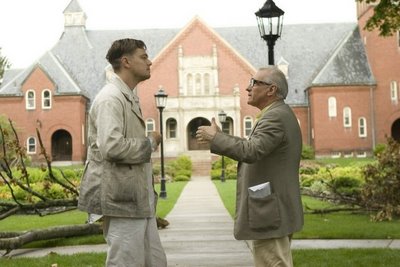
Leo & Marty get “Shuttered” away…

Shutter Island is also a very important piece in Scorsese’s works, as it does bring history to the forefront, and a history that has long been forgotten or, in the case of Danvers, paved over to make room for apartments. Archivist Kirsten Anderberg wrote an interesting piece on her research about the history of American asylums, and I think it’s worth a gander. We have a pretty gnarly history with the mentally ill and mental cruelty.

Filmically, we have shown this before, Shutter Island is not the first go. But it might be important to note that within the films that have been released and/or made, we have also seen it change history as in the case of Frederick Wiseman’s Titicut Follies (1967), a documentary made about the Bridgewater State Hospital for the criminally insane in Bridgewater, MA. The footage that was shown in this film and the abject cruelty that was put on camera may have effected at least some change, as Bridgewater changed its “force-feeding” and torturing ways…albeit not until 20 years later, after 7 patients died, and several 1st Amendment lawsuits regarding the film.

In conclusion, Shutter Island, while not a “Scorsese” film, is one to be taken seriously on a multitude of levels. It is a serious drama, a serious historical work, and a quite intelligent piece of local reflection, due to the hand (as in all of his works) of Bostonian Dennis Lehane. Scorsese should be allowed to take a day off once in a while, guys, to do a different thing. And this was a very complicated film. It should not be shrugged off or tossed aside.

Oh, and while we’re on the subject of not tossing stuff aside, I would advise all of you to check out the pictures that some folks took of the inside of Danvers State Hospital….They’re really amazing….here’s some links:

http://www.abandonedbutnotforgotten.com/more_danvers_pictures.htm

http://www.opacity.us/gallery97_dreary_skies.htm

http://www.opacity.us/gallery37_tiptoe.htm


Mother Knows Best

From the very opening of Grace, I had a feeling that it might be a slightly different kind of film. With its very delicate and feminine visuals and sounds, it opens as a film that is very much in accordance to what ends up being the subject matter: maternalism and child-rearing.  However, as it is indeed a horror movie, the light and airy features of these opening shots and the camera drifting languidly over Jordan Ladd’s recumbent naked form seem remarkably eerie when the promos so very clearly advertise death and something “unnatural.”

graceposter

So the opening, with its almost Downy-commercial-type cleanliness, seems to be underscoring not only the most physically sensual elements of the female but the very natural elements of the female body in general, as the first action we see in the film is the sex act (and what could be more natural than that?).

Throughout the film, what is “natural” seems to be a running theme, which I found to be quite interesting. At first, since there were so many discussions about health food, midwifery and non-traditional health methodologies in general, I initially took the film to be making a critique of all these kinds of hyper-liberal vegetarian/vegan sensibilities. However, I then realized Grace had much deeper-seated and smarter thematics then that. See, ANYONE can take a horror film and chuck in a few “Oh, check out the seitan-eating, soy-milk drinkin’, edamame chompin’ folks!” jokes. That’s simple. Put a few of those in, then have them be the first to suffer and/or die, and *presto*!!  Instant laughs from the horror community!  Hell, I’d probably laugh…if they were funny! But it takes a pretty special film to take these issues and involve them into a deeper seated narrative that discusses mother issues and what is natural to being a mother. It also was pretty impressive to me, as a female, that there was a male director who was able to hit on as many issues as he did in this film without it feeling in any way, shape or form invasive, exploitative or disgusting.

This was a horror movie. No doubt about it. But it was very sophisticated and brought a great many women’s issues to the forefront, whether intentionally or not. To a woman like me, who digs on women’s issues? I found that pretty exciting.

So let’s get my problems with the film out of the way first: the lesbian shit. There was one character who had a jealousy issue and…the actress wasn’t my fave and the lesbian jealousy weirdness angle is…a bit played out in my opinion. HOWEVER, it was done with a bit more class than normal, and I’m not sure if I could see another route to take if they were gonna have that involved, and it sorta was part of the story, so…I guess it was alright. I really do wish that there could have been a different way that the narrative could have gone without using the age-old (and somewhat tired) old college-relationship between 2 women that comes back as a central figure within the film, but…hey- it didn’t distract me SO much that I didn’t like the movie. It was the ONLY thing that I had ANY problem with and to say that? That’s pretty awesome. It means that this is a pretty damn good film.

On to the good stuff: EVERYTHING ELSE. This movie has tension coming out of every pore of celluloid. When we stayed for the Q&A, the composer discussed some of the aural reasonings why and I thought that those reasons ALONE were incredible. Turns out that Austin Wintory recorded actual baby cries and then mixed them into the music that he composed for the film. The reasoning for this, he said, beyond the actual sound which increased tension in and of itself, is that the pitch of a baby’s cry is the one sound that every human can hear (well, unless you’re deaf, I suppose), no matter what. Scientifically, he reported, the sound is at such a level that your body will respond to that sound in a way that it does not respond to anything else in the world. Indeed, I would say, this does seem to make sense, as somehow we can ALWAYS seem to hear babies crying whether we want to or not. Wintory used the example of being on an airplane and being able to hear a child in the very back of the plane and yet having it sound like the infant was right in your face. Ever been there? Thought so. At any rate, I am a huge sucker for music in film, and THIS FILM had it, and I will say that Wintory’s intermingling of baby sounds with the rest of his lullaby-esque tunes as well as the other scoring was incredible. A good score/good music can make or break a horror movie for me. Would Halloween have been the same without that tune? Psycho? Exactly. So…well done, Mr. Wintory, good addition!

Carrie_Piper_Laurie_Margaret_White

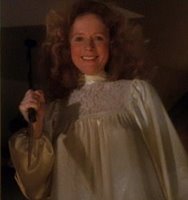
Margaret White *seriously* loved HER daughter!

On to the story now…Within the horror film genre, we have seen some pretty interesting mother figures,  have we not?

Norman tried to please you, Mrs. Bates, he really did!

Norman tried to please you, Mrs. Bates, he really did!


Dude, Mrs. Voorhees, we get it. We would've been pissed if Jason was our kid, too.

Dude, Mrs. Voorhees, we get it. We would've been pissed if Jason was our kid, too.

The mothers represented within Grace bring forth a whole new kind of mothering to the horror world that I feel has begun within the last few years, and I last saw represented within the astonishingly fantastic French film, Inside. It seems to me that there has always been a certain amount of fascination with the mother figure within the world of horror. Clearly, as shown above, that figure has not always been the figure of protection in, um, the most positive manner, shall we say? Now within films like Grace and Inside I feel like we may have turned a corner. I’m wondering, since men made BOTH of these films, if there hasn’t been a certain change within the way that these directors have come to synthesize the maternal representatives within the slasher genres at large, as well as other horror cinema venues. It seems that, with these films, we are starting to witness a kind of sea change that, frankly, is ALL TOO WELCOME.

Fuckin’ A, do I love a good horror movie. Slashing, hacking, blood, guts. You name it? I love it. I ADORE GORE. But I’m not one of those people who loves without discrimination. I *am* particular. But what I love, I do love very much. And I am extremely fascinated by this new turn in the world of horror. It seems that for years and years we have had a certain set of (for lack of a better term) Horror “Family” Values, many of which have been covered by academics such as Carol J. Clover, Barbara Creed, Harry Benshoff, just to name a precious few (as there are *so* many goodies!). These Horror Family Values have very stringent ideologies in regards to sexuality and motherhood. Essentially, in a horror movie, if you fuck, you’ll die and if you’re a mom, you’re a crazy homicidal bitch with no redeeming qualities whatsoever, emphasis  on the crazy, if-you-please. While I think we’re still all waiting for a film where kids can safely orgasm and survive past the post-coital beer (if they even get that far before a knife/axe/murdering-object-of-choice rips through their young nubile flesh), the Mother Issue seems to be making a change.

I hate spoilers, EVEN in reviews, so I’m not going to give anything away. But I will go so far as to say that starting in the film Inside and now continuing on with the film Grace, I’m seeing an evolution in the depiction of motherhood in horror which I quite like. While I could attempt to use some of my Freudian feminist film scholarship stuffs on this, I’m not sure I want to at this juncture. My feelings about this transition probably need more fodder in order for that kind of highly formulated (and quite possibly extensively boring to many) discussion on Sigmund and where he’s at today. I’d probably use the ol’ Virginia Slims adage, “You’ve Come a Long Way, Baby.”  I think that the concept that we are no longer treating the mother figure with anger and exposing her to the kind of harsh negativity within the horror film that we have been doing for YEARS is a big step.

It could definitely be argued that both of the mothers seen in Grace have elements of Teh Crazy in them, and Have Issues. However, on the whole, I feel that their portrayals actually have a kind of yin/yang sensibility to them, and do more for exploring female mother issues and issues of loss and attachment. And to say that there are characters in a horror movie that are explored with class and sensitivity is a pretty bold statement, but it must be said. This is a very mature film, and comes with high recommendations from me.

So, here’s to ya, boys. Its fascinating to see that it took a few young men to promote women and motherhood within the horror world. I like it. I like it a lot. I hope to see more people do it. It has actually brought the calibre of the horror film UP, significantly, which, in my eyes is DREADFULLY needed sometimes! End points? If you haven’t seen Inside, holy shit- SEE IT!!! And if you haven’t seen Grace? WELL, what’re you waiting for?

See ya in the front row!

Forged in Fire: Heavy Metal and the Male “Bromance”

Disclaimer: I will have you know that I hate the word “bromance.” I hate it with the burning heat of a thousand fires. That said, as a writer and a pop culture participant, I will retain the use of the damn word in my title as it has become part of popular language and is firmly recognized to mean the exact type of relationship which I wish to discuss within this piece. Thus, for brevity and, in truth, more for ease, I’ll use the word…. I still abhor it though.

So the other night I went with a friend to see Anvil! The Story of Anvil at the Nuart Theater.  I had heard many good things about it, but was not certain what to expect. Was it going to be ironic? Was it going to be serious? Were we going to be watching Spinal Tap or were we going to be witness to something completely new?

Now, I cannot say that I was introduced to anything new and different with Anvil. But that does not mean it’s a bad film, by any means. It’s GREAT. I just know how these documentaries (and rock’n’roll stories) go. They’ve been around for 30 years, never got the recognition they deserved, still busting ass to *try* to get *something* out of the dream. The main difference with this band is that these guys toured with big names a billion years ago, yet never made it while their peers did, yet they stuck it out. IN CANADA.

anvil1

In a way, it reminded me a bit of American Movie, only…not as depressing (I find that film to be a wee bit depressing. Many find it funny, but my sense of humor is often weird and picky like that…). I felt that Anvil afforded more dignity to the individuals represented in the film and there was rarely a sense of “making fun” of them, even when it came to bits where the band (and their songs and notions) were clearly beyond the pale of normalcy. In a time where it seems like everywhere you look things are chock full o’ snark, this was quite refreshing.

But…they are still Spinal Tap in their own way. However, looking at the ad campaign, they seem to be pretty aware of their stature in this whole engagement, and, as they say repeatedly (with a genuine zeal rarely heard anywhere I might add) they just want to rock.

So…….at the end of the day? Fantastic movie. We had a great time. Why the title? Because this film got me thinking. A LOT. About metal. And guys. And guys’ relationships with each other. And how metal is the catalyst, the solder, the very cornerstone, for some of the most intimate and tender, loving and loyal relationships between men I have ever encountered in my life.

I had this boyfriend once. Metal guy. Amazing vocalist. He was totally the guy I dreamed about dating when I 13 and hanging out on Hollywood blvd. at the rock shops by day, and surreptitiously on the Sunset Strip by night. Only I met this guy when I was in my 20’s, and in grad school, so it was a little late for me to be whisked off my cowboy-boot-clad-feet into the sunset. No matter, he was my Metal Boyfriend. Super hot, long hair, tattoos, the whole nine yards.

At any rate, we were together for quite some time. Practically living together. But he had this friend, from back in the “old days” of Hollywood, and this friend had since moved away, but they still talked. A lot. And even if they hadn’t talked, every story involved  this person. They had clearly spent a GREAT deal of time together and it meant something very very significant. Now, when they did talk, they watched football together or talked music, or things like that. But they still did it together. It always struck me as one of the most beautiful things I had ever come across, actually, to see my significant other who was very much not someone you would gauge as vulnerable by any stretch of the imagination, having this fantastic relationship with his Best Friend, across state lines. I absolutely loved it. I wanted to meet his friend SO bad. But we broke up and that was never to occur.

What does my ex-boyfriend have to do with Anvil? Well, everything, I’m afraid. You see, it’s sheer METAL BROTHERHOOD, as the band Manowar might say….

What seems to occur within the world of metal (and I will freely admit that it is not ALL metal- for example, I have not seen this happen as extensively within the world of Black Metal male relationships, or Death Metal male relationships, or even Doom Metal male relationships, but these are subsections, albeit large ones, of the larger “metal” body) is that the men within these music cultures seem to come together and couple in a way that they do not seem to do in other musical cultures; this especially occurs if they are in a band together.

Upon this coupling, this “bromance” if you will, a certain sovereignty is given to that relationship above and beyond all others. And the most fascinating part of this whole dynamic is that everyone else gets it and goes by it. Married? Well, your wife’ll know that she’s second best to your BFF. Because, the bottom line is, it’s not personal.

It’s a slippery slope and quite tricky but the bonding that these men do with their chosen male partner is so exceptional and unusual that it is like a marriage of a different sort altogether. So one might say that these men are both gay and poly-amorous at the same time, but that would be quite silly.

But society gives creedence to the relationships that women have with each other over those that they have with the men in their lives. It is one of the few things that we do get, undeniably, as women (although we do periodically get teased about that too, so perhaps not completely without strings attached…). So men should not get these relationships?

At any rate, I’m not really here to discuss the dynamic between the way society treats men’s and women’s relationships, but the relationships that men form themselves.

For some extremely ODD reason (to me, anyway) it seems to be that heavy metal/hard rock brings out these relationships. I will give you 5 prominent examples, some fictional, some real,  that show the kind of “bromance” of which I speak, each one more intense than the next.

1.  Wayne’s World

2. Anvil

3. Spinal Tap

4. Aerosmith

5. Rolling Stones

In each of these examples, you have real or imagined relationships between male rock characters that not only overstep the boundaries of what would be essentially seen as an acceptable “friendship” level but also border upon intimacies that mirror those of a romantical nature. We all know that Rock’n’Roll and sexuality are conjoined twins, but these relationships only go that extra step in making it a little bit more substantial.

Wayne & Garth’s relationship in Wayne’s World, while being entirely fictitious, is also parodic and based upon an entire generation of kids who were just like these characters. So, while humorous, this structure was also demonstative of a larger part of young male rock culture and young male social culture. It was, in fact, a perfect recreation of how they related to their media, their peers and themselves. But what is most important to be gleaned from all this, was that unlike many other subcultures that strove to isolate  and drive wedges in between people, supporting their right to be an “individual” and all that, metal and rock fostered a kind of community, albeit almost solely male.

wayne-garth-waynes-world-15834539

So in Anvil, when “Lips” says that if they don’t make it this time he’ll jump off a cliff, it only makes sense that his partner and bandmate, Robb, states simply, “No you won’t.” Lips then looks at Robb quizzically, and Robb just shrugs and says, “You won’t jump off the cliff cuz I’ll stop ya.”  As though it were nothing. Like Lips had asked him to pass the salt. It is that much a part of his being.

Realistically, the way that a band structures itself is not unlike that of a familial structure anyway, so it is not beyond reason that the key figures might play the roles of the paired-off/romantic leads. Even when there is infighting, it is always more painful to watch that infighting go on between the key players because you know that there is more love, more loyalty and more at stake in THAT relationship than in any other relationship in the band.

We all would be much more concerned if we heard that Mick and Keith were on the outs than if Mick and Ronnie Wood had a conflict.  And each time that Joe and Steven from Aerosmith have had issues? Well, we know that it has effected not only the band but the musical output, and even their solo work isn’t as much of a force to be reckoned with as it is when it is a full band. But these are just examples. Some out of many. You can take any number of such examples out of the rock world and do the same.

The point is  the relationships are there. There is a certain magic that comes to exist between two men that spend an inordinate amount of time together in all sorts of ways. This magic mirrors the romantic magic that comes to exist within the most deep, intimate relationships that you can ever have based on the kinds of things that these men share: creativity, life experiences, hardships, success, drive, ambitions, dreams, and, most of all, time.  One might argue that these relationships could exist anywhere, but I would argue against that. I would say that the ones that exist within rock music and certain time periods/genres and mentalities (as evidenced by the examples I have given previous) make these ones quite unusual.

Male relationships are, in and of themselves, strange beasts. So, too, is heavy metal music in all of its variants and especially its variants on sexuality and masculinity. However, the fact that we can find some of the most pure and tender, loyal and true relationships within that musical arena is fascinating and quite satisfying, to say the least, in a genre that many times supposes itself to be devoid of emotion and focused solely on carnal desires.