Get Into the Groove: Desperately Seeking Susan and Genre Revision

Whatever is funny is subversive, every joke is ultimately a custard pie… a dirty joke is a sort of mental rebellion.

            -George Orwell

When Susan Seidelman received a script entitled “Desperately Seeking Susan,” in 1985, it had already been floating around Hollywood for 4 years. When she saw the title, she knew that it was meant for her, practically sight unseen. The story, a screwball comedy with a feminist streak a mile wide, seemed almost too good to be true, especially considering who sent her the script, and who was already on board to support the film. Not only was the film’s content a powerful commentary on contemporary female identity, definitely unusual, but it was set to involve a female director (Seidelman), a female writer (Leora Barish), female producers (Sarah Pillsbury and Midge Sanford), two (at that point, uncast) female stars, and a female film executive (Barbara Boyle) who really fought for the production. For the time, that many powerful women involved in a single film production was almost unheard of. This was an incredible opportunity, and Seidelman answered their “want ad” with a resounding yes.

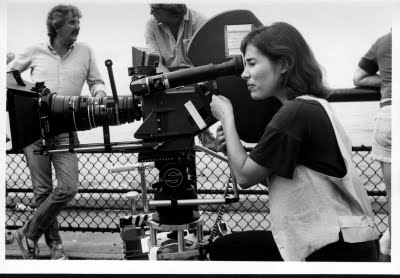
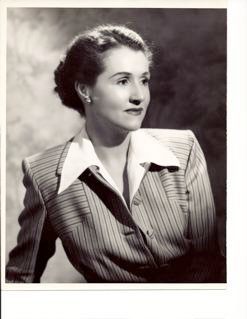
Susan Seidelman on the set of Desperately Seeking Susan

These days, what most people remember about Desperately Seeking Susan is not the multiplicity of ways that it subverts and reworks genres, nor the running commentary it gives on class and sexuality, but the fact that the film stars an extremely youthful and (at the time) barely known Madonna. Although Madonna is a crucial aspect of this production, I would like to present an analysis of the film that lays bare more than a mere “star vehicle” for Ms. Ciccone. I propose that Desperately Seeking Susan’s goal was to look at past film genres with strong female roles, and rework and “mesh” them into an entirely new kind of film; a film that was as much a new kind of  “Woman’s Film” as it was a good old romantic comedy.

In 1972, a little bit over 10 years before this film was made, the Equal Rights Amendment was passed, guaranteeing women equal rights. That same year, sex discrimination was banned in schools and in Eisenstadt vs. Baird, the Supreme Court guaranteed that the right to privacy included the single person’s right to use contraception. The next year, Roe vs. Wade gave women the right to safe and legal abortion, while the year after that saw the ruling of Corning Glass Works vs. Brennan, which ruled that employers cannot justify paying women a lower wage just because that is what they got at the “going market rate.” These years and the next few saw huge leaps for women and the feminist movement. It is no wonder that this film, made in 1985, would choose to make such a bold statement about wanting to break free from the suburban doldrums, a loveless marriage, and a life lived for someone else in favor of a life that is fulfilling, exciting, and personally rewarding.

The appearance of Desperately Seeking Susan after an entire film decade that had been devoted to the exploration and celebration of masculinity could not have been a huge surprise, however. With a few exceptions like Alice Doesn’t Live Here Anymore and a plentitude of underground experimental films, the 70’s film structure tended to focus on a cadre of young talented men, who were each expressing their own personal “vision.” The irony is that the explosion of feminism happened at the same historical moment, and it seemed to fall on deaf ears. Julie Christie notes, “What it seemed like to me was like boys had been let out of school. So it was like, ‘School’s out!’ so the energy was unbelievably high, and I think that is what characterizes North American filmmaking of the 70’s, is the energy. That inimitable American, male energy. And it’s fantastic, but it wasn’t a great time for women.”[1]  So, when an entire decade passed without recognition of the gender politics that were flying as fast at the bullets in Vietnam, women like Susan Seidelman decided that they had to bring their voice to the screen. Thus Desperately Seeking Susan was born.

It's a life so outrageous it takes two women to live it!!

Although Desperately Seeking Susan was criticized at the time for being “sheer nonsense despite the odd, forlorn laugh”[2] and the plot laughed off as “outrageously contrived,”[3] this film, which opened in March of 1985, made a very respectable amount of money on its opening weekend, and ended up as a big hit. The film tells the story of Roberta Glass (played by Rosanna Arquette), a bored and unhappy housewife from Fort Lee, New Jersey, obsessed with the personal ads, and Susan (played by Madonna), a carefree, somewhat promiscuous street-wise party girl, with a penchant for getting in trouble.  After Roberta reads several messages in the paper to Susan from Susan’s lover/boyfriend Jim, Roberta’s curiosity gets the best of her, and she goes looking for Susan, using the personals as her trail. What she doesn’t know is that Susan has gotten mixed up in a criminal scheme that even she isn’t aware of, and Roberta herself becomes enmeshed in the same scheme. After Roberta purchases a jacket that Susan sells to a second-hand shop, and gets a heavy bonk on the head while wearing the jacket, everyone (Roberta included- amnesia works wonders-) thinks that Roberta is Susan. Meanwhile, Susan ends up searching for Roberta, because inside the cast-off jacket is a key, literally, to her whole life which she has left in a locker. The rest of the film tells the tale of their search for each other, a criminal’s search for the stolen goods that “Susan” (really Roberta) possesses, as well as Roberta’s eventual self-discovery (in more than one way), through the very strangest parts of New York City.

Much of the theoretical work that has been done on this film involves ideas of identity, self-discovery, desire and female spectatorship. However, they all seem to hit on one aspect in passing that seems central to the viewing enjoyment of this film: Desperately Seeking Susan is not a “new” film. It is a child of many genres. Be that as it may, it still adds a new element. As Jackie Stacey notes in her essay comparing All About Eve to Desperately Seeking Susan, the central aspect of Susan (like Eve) is that it involves a heroine “whose desires and identifications move the narrative forward.”[4] Karen Hollinger, as well, has noted, “In many ways, Desperately Seeking Susan consciously revises conventions associated with earlier woman’s films.”[5] While other classic genres may have had central female characters, it is not often that an entire film’s progression is dependent upon the woman’s perspective. Due to that factor, we can see that this is where Susan makes liberal use of the genre of the “woman’s film.” Like Mildred Pierce or All About Eve or a multitude of other films in this genre, Desperately Seeking Susan does the precise thing that Mary Ann Doane has suggested is a central aspect of the woman’s film genre: it “obsessively centers and re-centers a female protagonist, placing her in a position of agency…”[6] By looking at the agency that is given to both female leads, we can see that the texture of the film was very much inspired by the desire to create a new film that would (and could) relate to contemporary women. Instead of the melodrama of the early women’s films, the makers of Desperately Seeking Susan replaced it with zany comedy and romance, thus bringing in yet another essential genre: the screwball comedy.

I would argue that the utilization of the female-character-as-driving-force serves as the glue to piece together a film that is essentially derivative of other genres, into a new film that is as self-conscious about its “quotations” as it is about its additive dimensions. However, the genre that is most present within the text of Desperately Seeking Susan is that of the screwball comedy.

Wes D. Gehring defines the screwball comedy of the 30’s and 40’s as possessing “five key characteristics of the comic antihero: abundant leisure time, childlike nature, urban life, apolitical outlook, and basic frustration (especially in relationships with women).”[7] While, for the majority of this discussion, I would ask that Gehring’s definition be opened up to include the term “comic heroine,” his analysis is quite helpful. Comparing Gehring’s definition of the screwball comedy to Desperately Seeking Susan, not only do the creators of the film take pause to recognize the screwball comedy influence[8], but at the time of release, one magazine went so far as to write, “Like the screwball comedies of yore, it [Desperately Seeking Susan] places people in a highly improbable situation and requires that they consult their own sorely tested inner logic to find a way out.”[9] The very fact that Susan came off as a screwball comedy to the naked eye is enough to link it to Gehring’s definition.

Seidelman’s film takes Gehring to an entirely new level, linking it to the strongly feminist discourse that is the backbone of this film. According to the definition, Roberta Glass fits Gehring’s description of the comic anti-heroine in the screwball, to a “T.”  Roberta has an abundance of leisure time (she is a suburban housewife), is portrayed as very childlike (even her husband infantilizes her, patting her on the head, etc), exists within urban confines (the majority of the film takes place not in Fort Lee, New Jersey, but on the crazy city streets of New York), has no overt political perspective (except to remember her real identity, which has a slightly political undercurrent), and is in the thick of an utterly frustrating relationship with Des (played by Aidan Quinn) on one side and Gary (played by Mark Blum), her husband, on the other side.

However, unlike the comic anti-heroes of Preston Sturges’ Sullivan’s Travels or Howard Hawks’ Bringing Up Baby, the idea of a female-centered screwball comedy is somehow revolutionary. All of the assets that we would come to expect out of a male protagonist in one of these pictures come with very different attachments for a woman. Desperately Seeking Susan somehow manages to subvert genre conventions, and flip them on their respective heads. For example, the “leisure time” that Roberta supposedly has, is depicted with a rather ironic twist. From the opening shots of Roberta in the beauty salon to her visit to New York City, she is using her leisure time under the auspices of pleasing someone else: her husband.  It is not her leisure time; it is pointedly his.

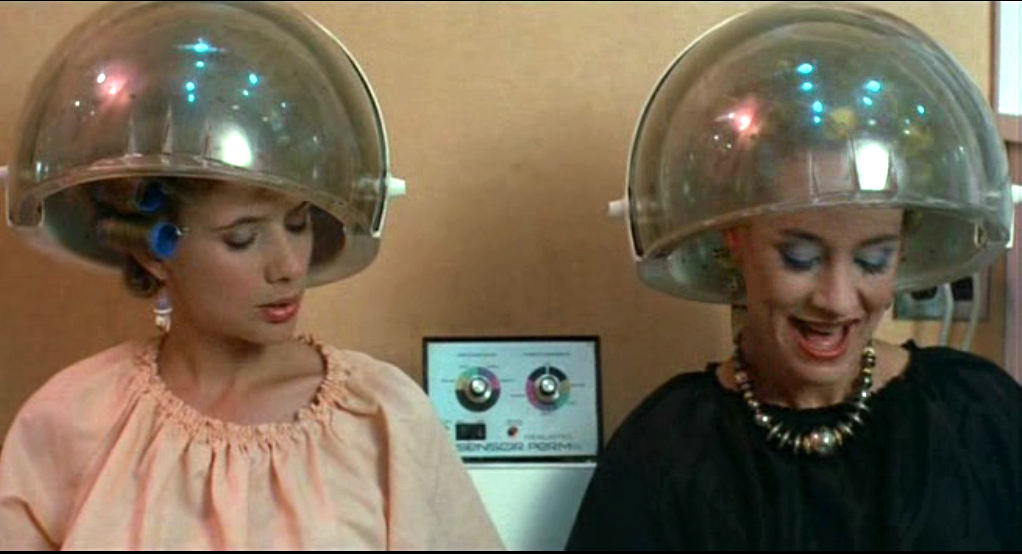
Although Roberta clearly enjoys the luxury of the salon, an important section of the conversation there revolves around the fact that, while it is her birthday, she is concerned about how Gary will like her new haircut. Roberta isn’t too certain, as her look reveals. We can see Roberta straining against her confines, even here. The scene, opening up to the strains of a 1950’s girl band singing “It’s In His Kiss (the Shoop Shoop Song),” displays various women in various stages of being “beautified,” from leg-shaving, to nail-polishing, to hair-cutting. Susan Seidelman states,

           Because the film is very much about identity, who somebody is on the outside versus who they want to be on the inside, we decided to open the film in a beauty parlour because that is so much about female identity, and appearance and transformation. I think in the original script the opening was set in a department store…and ultimately, in one of the many rewrites, it was changed to a beauty salon because I think the idea of being remade, which is what beauty salons are about…you go in being one person and you come out hopefully transformed into somebody else, is really the essence of what the whole movie is about.[10]

Thus, amidst the highly feminized world of the salon and amidst reminders of all kinds of superficial beauty, we are introduced to our heroine. It is here that she does two things that solidly state her position in her world (which she reveals is not quite her world after all) and it is here that she begins to, as Seidelman discusses, transform. Initially, she relinquishes control of her haircut, because her sister-in-law, Leslie, and her hairdresser reassure her that, “He’ll love it.” However, it is at this point that she flat-out states her discontentment with her life. Sitting under the hairdryer, we watch as Roberta’s transformation begins.

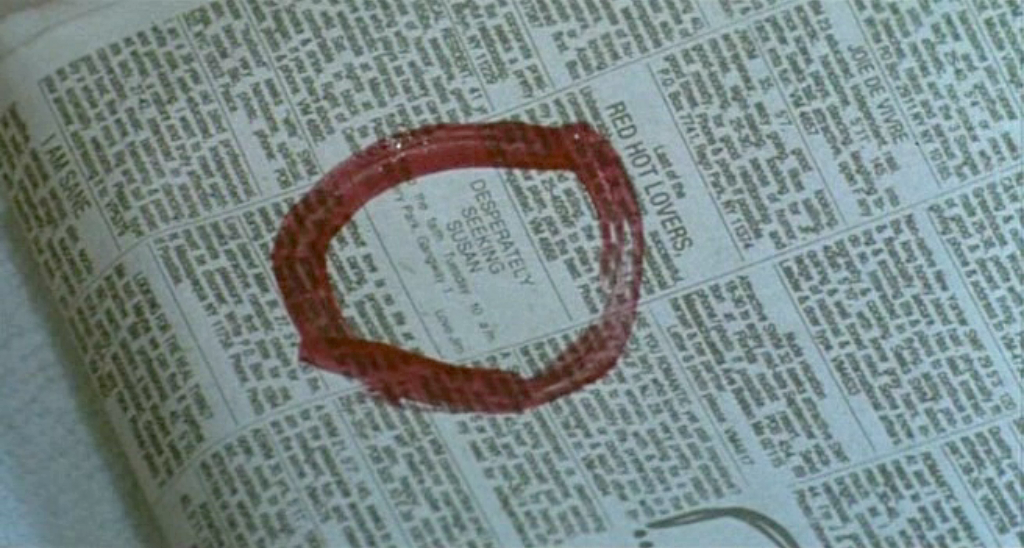
She sighs, commenting on the love affair that she has been watching develop in the personal ads between two people named Jim and Susan (all the messages begin “Desperately seeking Susan”), “Desperate…I love that word…it’s so romantic…” To which her slightly horrified sister-in-law replies, “Everyone I know is desperate, except you,” and gestures at Roberta. Indignant, Roberta looks out from the hairdryer and says, “I’m desperate!” She is met with peals of laughter from Leslie, to which Roberta responds, “Sort of…” and looks dejectedly back at her newspaper. But the look turns into one that is almost akin to that of a stubborn child being told that they can’t do something: they’ll do it anyways, no matter the consequences. The next shot centers on Roberta’s fingers, holding a blood-red nail polish brush, circling the ad in the personals, with a very steady hand. Thus we have borne witness to the first stage of Roberta’s transformation and the beginning of her attempts to reclaim her own identity, from the people and the situations beneath which she has been living for a long time.

When she goes into the city the next day, Roberta’s husband asks her to pick up the car stereo for him, and remind the clerk that she is his wife, because they get a discount. It is almost as though Gary wants Roberta to remember, as she is leaving the stability of the suburban world for the chaos of New York. It seems that by saying this to her, he reminds her that she is his wife, and his property.  However, this is where the whole situation begins to change. When she reclaims this leisure time as her own, and uses it to pursue Susan, she forgets the car stereo, and, upon arriving back in Fort Lee, timed perfectly to the chicken beginning its twirl around the rotisserie and her housewife-ly duties of synchronized cooking with Julia Childs, her husband inquires about the stereo. This is the point where we realize that Roberta Glass has begun to break free of that ownership. Wearing the jacket that Susan sold to the vintage store and Roberta bought right after, mixing eggs in perfect time to Julia, she reveals to Gary that she has forgotten all about the stereo. She has repossessed that leisure time, both sartorially and actually. It should also be noted that visually, as well, she is the one in control. She is the one the camera follows, and through the different settings there is an evolution. She moves from a location that deprives her of personal power and agency to one where she willfully commands it, based upon personal desire. The personal desire to follow Susan overpowers everything else. That desire is so powerful, that she forgets the car stereo, and with it, forgets Gary’s claim upon her, in order to follow her claim upon herself. We as viewers are drawn into this world, into this location from which Roberta Glass operates, wanting nothing more than for her to escape, and supporting her desires above all else. We are desperate for her to become that “desperate” that she says she is.

Throughout the rest of the film, we are shown a number of ways in which Roberta is breaking free of her stuffy, suburban housewife life. She hits her head while running from the criminal who mistakes her for Susan, after he sees her wearing the jacket that used to belong to Susan. What the amnesia does is serve as a catalyst for the formation of a new and more pleasing personal identity for Roberta. Having to confront the fact that she does not know who she is, Roberta must “find herself.” She thinks she is Susan, being in possession of all of Susan’s personal effects through the locker key she finds in the jacket pocket, not to mention having people consistently mistake her for Susan, as a result of the jacket.

As we have seen, from the very beginning of the film, Susan is Roberta’s polar opposite. She is sexually liberal, streetwise, and self-assured. More importantly, from what we can see, Susan is also a great deal happier than Roberta. Roberta’s amnesia and subsequent quest for her true identity while thinking (and acting) as if she were Susan, becomes our way of seeing that Roberta’s emancipation from her life lived for others can only be achieved through her own self-discovery, even if it is through someone else’s “identity.” How can she escape Julia Childs and a husband who basically ignores her? She must leave it all behind, and become someone else, even if it is not intentionally. As Karen Hollinger succinctly states, “Roberta’s temporary assumption of Susan’s identity as a result of her amnesia allows her to merge with her ideal and experience a psychological rebirth. She finds a new identity by introjecting the positive qualities she finds in Susan into her own personality.”[11]

Frank Capra, a director of many screwball comedies, said that he used comedy to “warm people to my subject…I get them in the spirit of laughter and then, perhaps, they might be softened up to accept some kind of moral precept.”[12] The creators of Desperately Seeking Susan utilized this same method. It is a very funny film, but the message behind it cannot be ignored or denied. The feminism that may not have seen the light of day in the cinema of the 70’s is vibrant and alive with Arquette’s Roberta and Madonna’s Susan. It is a disruption of the traditional view of woman as homemaker, and a forced recognition of woman as full-fledged person, unto herself. This commanded viewpoint was done, a la Capra, through the use of casual humor and relaxed laughter.

Andrew Kopkind noticed that Desperately Seeking Susan was a film that was definitely communicated in “classic Hollywood forms. Leora Barish’s script contains all the ritual elements of farce, even to the obligatory climax where all the significant characters arrive in the same room to sort out the confusion…[but] neither she [Roberta/Arquette] nor Madonna [Susan] is redirected to a conventional existence, which is the way farces usually end…it is unmistakably a woman’s-eye view…”[13] The acknowledgement, then, is that this film, while standing on the shoulders of well-loved and received standards, is creating new standards of its own. Without changing the formula of what makes a screwball comedy pleasurable, Desperately Seeking Susan pulled a “Capra” and inserted some truly important things to think about, in between the laughs and the ridiculous nature of the plotline. And, after a decade of boys celebrating school being out, it was high time the girls hit the playground, and hit the playground they did.


[1] A Decade Under the Influence. Dir. Richard LaGravenese and Ted Demme. 2003. DVD. Independent Film Channel/Docurama/New Video Group, 2003.

[2] Simon, John. “Desperately Seeking Susan.” National Review 37 (1985): 48-50.

[3] Kopkind, Andrew. “Desperately Seeking Susan.” The Nation 240 (1985): 568.

[4] Stacey, Jackie. “Desperately Seeking Difference.” Feminism & Film. Ed. E. Ann Kaplan. New York: Oxford University Press, 2000. 450-464.

[5] Hollinger, Karen. In the Company of Women: Contemporary Female Friendship Films. Minneapolis: University of Minnesota Press, 1998.

[6] Doane, Mary Ann. “The Woman’s Film: Possession and Address.” Home is Where the Heart Is: Studies in Melodrama and the Woman’s Film. Ed. Christine Gledhill. London: British Film Institute, 1987.

[7] Gehring, Wes D. Screwball Comedy: A Genre of Madcap Romance. New York: Greenwood, 1986.

[8] Commentary track. Desperately Seeking Susan. Dir. Susan Seidelman. 1985. DVD. MGM Home Entertainment, 2000.

[9] Author Unknown. “Beautiful Dreamer in a Minefield- Rosanna Arquette.” Time 1 April 1985: 76.

[10] Seidelman, Susan. Commentary track. Desperately Seeking Susan. Dir. Susan Seidelman. 1985. DVD. MGM Home Entertainment, 2000.

[11] Hollinger, ibid.

[12] Frank Capra, quoted in Schiekel, Richard. The Man that Made the Movies. New York: Atheneum, 1975.

[13] Kopkind, ibid.

Sam Fuller: Cinema of Conflict and Contradiction

It is currently June, 2011.  I’m almost to the 10 year mark of when I graduated from UC Santa Cruz.

When I was at UC Santa Cruz, I did the normal school thing, but I also wrote for a film magazine called EyeCandy. It was a fun little journal, just a few of us, and I was really able to introduce folks to cinematic areas that they may not have encountered before.

While we were separated for a spell, I am glad to have “hooked up” again with writing as my primary partner. It’s a good one. While film will always be my boyfriend, writing about film makes a good life partner for me.

One of the things that came up recently around the internet was the screen test that Sam Fuller did for The Godfather part II.  When that came up, I realized that I wanted to go back and reread the article I had written for EyeCandy on Sam Fuller oh-so-many-years-back…see how it held up and IF it held up. All I remembered about that time period of my life was being very passionate about Fuller and having most other film students I knew being extraordinarily passionate about, oh, Kevin Smith or (if I was lucky) some of the more interesting queer film makers like Tod Haynes.

In any case, back in 2001, I was a one-woman-Sam-Fuller-conversion-machine. So…I wrote a silly article to try to educate people and cajole them into joining Team Fuller. Do you know HOW  many arguments I had over the naming of Short Round in Indiana Jones? Yeah, sorry boys at UC Santa Cruz in the late ’90’s/early ’00’s, SOMETIMES girls can be right about films involving your geek heroes. *ahem*

Maybe you’ve read the other stuff on here, maybe not. In any case, here is what my writing looked like back in the Spring of 2000. I have added some pictures (because I can), but otherwise, I’ve left it essentially unchanged. In a sense, I am also using this space to archive my own writing and past work. Hey man, my blog, my rules.

While I edited a little bit for grammatical errors that my own conscious could not abide with the publication of, I would hope that you would be slightly kind…I did write this 10-ish years ago. It’s not terrible, but it’s not something I would hand to Fuller himself. Aside from Billy Wilder, when people ask me who my favorite director is, I think I would have to say it’s this guy right here. When I found him in my late teens/early 20’s,I got obsessed. He uses some of my favorite actors, introduces me to new ones, screws with people’s concepts of what things should/shouldn’t be, and does what he thinks is right. His ethos is strong and, most important of all, entertaining. And as an added bonus, he has some really kick-ass women characters! So here you go. Enjoy the way I tried to introduce Santa Cruz to Sam Fuller.

I wish I could get a larger size of this, but this was the cover for one of the magazines. Not bad, eh?

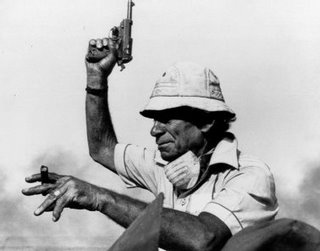
“You can’t show war as it really is on the screen, with all the blood and gore. Perhaps it would be better if you could fire real shots over the audience’s head every night, you know, and have actual casualties in the theater.”—Sam Fuller

Sam Fuller was a real American. He was a reporter and he fought in the war. He was also, however, a filmmaker. Within his chosen cinematic occupation, he worked towards the portrayal of the country he killed and could have died for. He was extremely patriotic. However, Fuller’s patriotism worked in a very different way than the traditional stars-and-stripes, Fourth-of July barbecue patriotism. Sam Fuller worked to rupture America open, and show what was really inside: the contradictory situations portrayed in his films only exposed the deep-seated issues that lie within American society, but are not polite to discuss. But Fuller was not polite about it either. It has been written about Fuller that he “doesn’t flatter his audiences; he rubs our noses in our own dirt.” One could not mistake a Fuller film. He has an exceptionally unusual style of filmmaking, especially for the time.

One of the most fascinating issues about Sam Fuller is the question that comes up every time when viewing his films: How was he allowed to make that?  For the 50’s and 60’s, Fuller’s films were exceptionally radical, and decisively individual. In a time where almost everyone else was being forced to homogenize their films, Fuller was a complete anomaly. One possible explanation is that his films were primarily “B films”. As a result of that reduced budget and economized shooting schedule, that may explain why he got away with everything he got away with. As well, it must be considered that mainstream Hollywood saw “B” films to be merely secondary cinematic fodder alongside the “A-list films”, opening up opportunity for a great deal more personal expression.

A Sam Fuller film can deal with anything from pedophilia to racism, interracial romance to insanity. His stories were unique in their dealings with women, as he portrayed them as sexual free agents, as well as independent heroines who were not about to “wait around.” He utilized Asian-Americans as real and central characters within his films, instead of portraying them as ethnic stereotypes.

This was still a major revolutionary narrative for the time. CRIMSON KIMONO (1959)

In Crimson Kimono (1959), we can see a perfect example of the ways in which Fuller plays with racism and our own socially constructed stereotypes and expectations. The plot is that of a Japanese-American man and a Caucasian man who fought together during the war, and became inseparable friends as a result of one saving the others life. They return to the US and get an apartment together in LA and become private investigators. The twist in the film comes when they both fall in love with the same Caucasian woman, and she, in turn, falls in love with the Japanese-American man. Pretty weighty stuff for 1959! Not only does this deal with the extremely controversial topic of interracial romance, but it also is a forerunner of the ideology within Sam Fuller’s films that woman should have the same freedom sexually and romantically as men. They should be able to choose, not be chosen.

Fuller’s filmmaking style and plot development are a cinematic war being waged against the things within society that are accepted but are unacceptable. The Fuller landscape is harsh and confusing, placing emphasis upon the aspects of the world that require a more in-depth consideration, such as race, the role of women, and corruption.   It is an offensive action, striking against social mores, and traditional roles.

Fuller’s cinema is one that is overtly contradictory. But he utilizes those contradictions in order to point out the traditional concept of things not always “being as they seem.” However, Fuller’s films are anything but traditional. His characters vary from strippers and prostitutes to journalists and soldiers. The one commonality that most of his films seem to contain is the alternative portrayal of corruption. In his films it is the strippers and thieves that are ethical and good, and the policemen and other “uprights” that are morally bankrupt. This is accurate about every film he has made. In Naked Kiss(1963), it is not the prostitute who is the corrupt, evil force, it is the very paragon of society within the town, and he’s capable of some pretty nasty stuff!

Fuller is the master of irony. In Shock Corridor (1963), a film based primarily within a mental institution, the main character is a journalist who is obsessed with winning the Pulitzer prize. In order to do this, he gets himself committed in order to investigate a murder that occurred within the asylum walls. While inside, he meets the main witnesses of the crime. The first one he meets is Stuart, a young man who, in the outside world, became involved in the Communist party due to his participation in Korea. However, he was placed in the institution because he is no longer involved with Communism, and he was dishonorably discharged due to his affiliation with Communist influences so…he now thinks that he is a general in the Confederate army!

I know why I went over to the commies— ever since I was a kid my folks fed me bigotry for breakfast, and ignorance for supper.

Then he meets Trent, a young man who was one of the first people in his area to be placed into the situation of racial integration in his school.  Tragically, he cracked under the pressure. This young African-American student thinks that he is a leader in the Ku Klux Klan.

In films like Naked Kiss (1963), and China Gate (1957), Fuller gives unusual depictions of strong, independent women, who were allowed to be sexual without being punished for it, and were not ashamed of any of their actions. They took these things in stride, and never required help from a man, because they could do it by themselves. Once again, Fuller called it as he saw it, knowing that this was the “unacceptable” ideology of the time, but knowing that it was the reality of the situation.

Fuller said that camera movement, and actors’ movement was inconsequential, and “what matters is that the emotion of the audience should move…” In the end, it is really up to the viewer to let the film take its effect. His films revolve around making you think about and question realities and truths. He states that this battle is endless. At the end of a few of his films, the closing titles read “the end of this story will be written by you” or “this story has no end.” This intelligent Fuller ambiguity only serves to have the pin pulled out and the grenade thrown to you.

To Hell With You: Blazing a Trail Through Hollywood with John Constantine

Seeing that it is now June and Comic Con is nipping at my writerly fingertips (as it does every year), I figured I would drag one out from the vaults to entertain and/or annoy you all with.

For the last 5 or so years, I have been a participant in the Comic Arts Conference, which is kinda like the Red Headed Stepchild of the Con. We don’t consider it that way, of course, and anyone who is interested in the academic side of the comic book world wouldn’t see it that way either, but anyone who spends the night outside the convention center in hopes of catching a glimpse of a sparkly vampire could really care less that many of us pour a goodly amount of time and energy into these papers. After all- it is an academic conference.

In any case, what I am presenting for you here is the piece that I wrote for the panel I was on in 2007.  I remember liking it. In any case, my opinions haven’t changed much so…here you go- now you too can feel like you were there…minus the crowds, the smelly fankids, and the overzealous everybody. Enjoy!

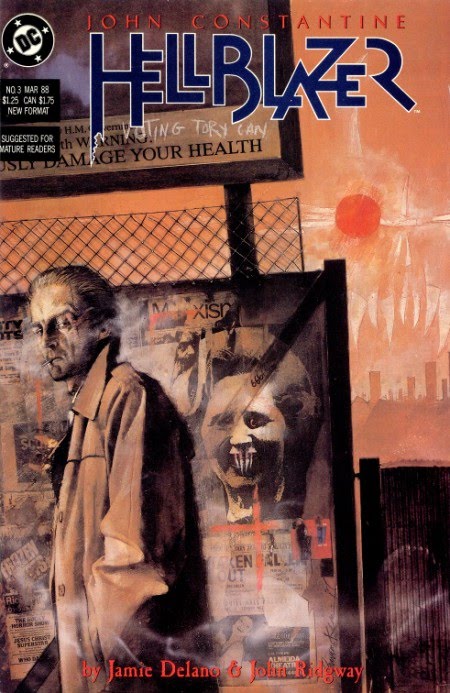
He’s been compared to James Bond, Phillip Marlowe, Mike Hammer. Critics have described the film as everything from “a clever fantasy/horror noir with a dash of broad comedy,” to one that “lacks the richness of its source material” and is “entirely beyond redemption.” Whichever way you slice it, the 2005 filmic adaptation of John Constantine: Hellblazer seems to be quite a source of discussion and debate, whether or not you were even a fan of the comic. It is common knowledge that all comic to film adaptations go through many stages on their way to becoming their own media object . Whether the parent text is used exactly or whether it is paraphrased, one can usually see the skeleton of the originating document underneath any new additions. Sometimes, however, when a given filmmaker is dead set on extricating him/herself from the previous incarnation of the work, the adaptation can lead to a obscuring of the source material, causing a rift to grow between that which was adapted and the adaptation itself. Director Francis Lawrence’s desire to create his own version of John Constantine and the universe in which he dwelt overshadowed his ability to portray a character that maintained any veracity to the original work. While some amount of this is to be expected, Lawrence’s methodology for addressing John Constantine led to a film that not only removed the character’s cultural trappings but also eradicated his larger theological basis. In doing so, Lawrence erased the things to which every author of Hellblazer had remained loyal to throughout the entire comic book series, thereby creating a character that was decidedly not John Constantine.

I have been working with filmic adaptations of comics for the last several years. Through the careful study of production methodologies, narrative changes, and textual similarities how smooth the transition from comic text was (or was not) became more apparent. The overall success of each film as compared to that of its progenitor is a key ingredient within adaptation analyses. However, the longer I studied Constantine, the more I found myself unable to defend it as a valid interpretation of the comic book. Not only did this movie willfully exchange the narrative complexities and character depth in the comic for easily digestible storylines and generic protagonists, but it also blatantly lifted items from another film in order to fill out the less, shall we say, “full” areas. By leaning heavily upon previously established film iconography and reformatting the substance of the comic book text to match, the writers and director of Constantine created a new media object that cast out all substantial elements of the initial comic and produced what could only be called a ghost-adaptation.

NO TRENCHCOAT, NO ACCENT, NO SERVICE

Locating the film within US confines instead of the UK was a change, but it really wasn’t that much of an issue. After all, it had been done countless times within the comic book with little to no detraction. However, changing John Constantine into an American freelance exorcist, who stockpiles Judeo-Christian weaponry, and doesn’t make a habit out of hustling, witchcraft and trickery as daily routine was more than slightly ridiculous. As far as the comic was concerned, no matter who was writing or drawing him, John Constantine was none of these things. In making these alterations in his career and religious orientations, John Constantine was changed from the protagonist seen in the comic book Hellblazer to a new character, one that was invented specifically for the screen that shared little more than the name.

However, it was something else entirely that created the ultimate disparity.  To add insult to injury, this film committed the cardinal sin against a comic book character: they erased his history. What if Superman had not come from a different planet? What if a spider had not bitten Peter Parker? Either situation is analogous to what the creators of this film did to John Constantine. While it is essential in adaptations to “edit” the parent text for time and cinematic rhythm, it is not essential to completely alter or eradicate it. Sure, Constantine’s history is very involved and can’t really be boiled down to a single incident like a spider bite (unless you count Newcastle!). But just because a character has a complex background doesn’t mean that you throw the baby out with the bathwater!  Changing Constantine’s story to one that damns him to hell because of a suicide attempt as a teenager, changes his entire character, pathology, and situation. While it could be said that this was simply an attempt to save time and “edit” the comic to fit its screen counterpart, I would argue that the erasure of John Constantine’s history reveals a slightly larger problem: the erasure of his identity, period. The character played by Keanu Reeves in the film, is not the character within the pages of the comic. By taking him out of the UK, and making him an American with a whole new background, the wedge between comic book and film is driven deep enough to make it irreconcilable.

Made by the same man who gave you Britney Spears’ “I’m a Slave 4 U” video and Jennifer Lopez’ “Waiting For Tonight,” the film version of Hellblazer was certainly updated quite a bit from the comics. As the director himself stated in one of the documentaries on the DVD, “[Constantine is] based on a comic book, but I didn’t want it to feel like a comic book movie.”[1] Unfortunately, this may have been his biggest downfall. Frankly, it wasn’t about John Constantine’s trench coat and aesthetic, nor was it about his country of origin. Both things could have been worked with, and perhaps forgiven to an extent. However, as it turns out, in this circumstance, playing with those items was like playing with fire. Lawrence’s desire to dissociate himself from the text that he was supposed to be drawing his inspiration from left him empty-handed, causing both the film product and the source material to suffer from this decision.

In the introduction to Garth Ennis and Steve Dillon’s Hellblazer: Fear and Loathing (issues 62-67), Warren Ellis makes a solid point about John Constantine as he is portrayed throughout the entire comic book series, no matter who was writing or drawing him.

Frequently painted as a mystic investigator in some kind of bastardized Chandlerian tradition…John is one of horror fiction’s more complex characters…Since his creation, John Constantine has gone from the young English occult wideboy of Alan Moore’s initial vision to the troubled and aging adrenaline addict of Jamie Delano’s bleakly poetic writing…The strength of the character, that has him remain so clearly the same man even when viewed through two or three different writers’ eyes, is that he is a terrific mouthpiece for anger.[2]

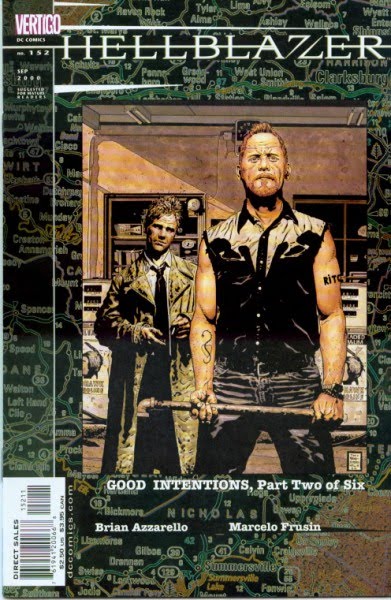
While I believe that Ellis’ simplification of Constantine as a “mouthpiece for anger” tends to be a bit reductive, his underlying analysis is spot-on. John Constantine has been written and rewritten by no less than 10 different authors. While each of these individuals showcase different qualities of John Constantine and his varying desires/pursuits/intentions, at the end of the day, they all remain faithful (more or less) to the basic skeleton built by Mr. Moore back in 1985. Even Brian Azzarello, when he took up the reigns of the comic upon Warren Ellis’ abrupt departure noted that while his own approach to comic book writing wouldn’t change, his portrayal of John Constantine would require extra conscientiousness. “I’m going to have to be sensitive to this guy’s past,” he stated in an interview with Sequential Tart, “Readers have expectations with Constantine; if I don’t deliver they’re going to scream foul. Not that I’m not going to toy with those expectations, but at this point we know who he is, and what he’s capable of.”[3]   Azzarello, an American writer who excels at noir-type fiction, knew that “you can take the boy out of England, but you can’t take England out of the boy.” He knew that a character that was so deeply British would suffer enormously from any dilution of that cultural heritage.

Even with that in mind, John Constantine’s Britishness made it more challenging for anyone who was not British to write the comic. Brian Azzarello’s run tends to be a good example of this, as his portrayal of Constantine did suffer slightly from what seemed to be his own unfamiliarity with British culture. While the storylines were excellent, his attempts at accented dialogue were forced, and his American characters were far more fleshed out and confidently written than his protagonist. Where his American characters were expressive and extroverted, speaking freely and often, Azzarello tended to keep Constantine silent and stoic, qualities that he never really possessed in his previous incarnations by British writers. The discrepancy between Azzarello’s quiet and reserved Constantine and the more aggressive and loud American characters seemed to signify something more than a narrative choice. To a certain extent, it seems that Azzarello might have been slightly uncomfortable with bridging the nationality gap with Constantine’s dialogue and cultural components, causing him to take less chances with the character.

Considering that Azzarello himself is not British, and that, as previously stated, he wished to remain as faithful to the character as he could, Azzarello’s choices made a good amount of sense. However, they were also very revealing in a cultural capacity. Azzarello’s run was indeed a fascinating look at how one might interpret a foreign culture and attempt to negotiate it within the terms that you, yourself, are intimately familiar. Unfortunately, at the end of the day, the portrayal of John Constantine did suffer as a result of his silence and non-participatory stance, whereas the American characters in that run truly triumphed.

Within the comic book’s infancy and adolescence, the reader is reminded, over and over, that the protagonist is an incredibly culturally entrenched persona. John Constantine’s northern accent, working-class persona and addiction to Silk Cut cigarettes speak of a certain “Britishness” that, to be fair, would be almost impossible to translate onto American soil.

Azzarello attempts to negotiate cultural difference using cigarettes as the tool. Clearly, Constantine is not not a fan of the ones in the US.

Beyond his own affectations, certain famous London pubs and general British landmarks and cities consistently find their way into the visuals, populating the comic with innumerable reminders that John Constantine is unmistakably a Brit. From stories about football hooligans to his travels to see his family in the north, the geography of John Constantine is as much part of his identity as his bad attitude and knack for hustling everyone from his own pals to the devil himself.

By editing this character’s physical attributes, sartorial expressions, and homeland, the film adaptation makes his identity into something different and diluted. It is almost as if the name “John Constantine” has simply been reappropriated to fit a dark, brooding American who smokes too much and can see ghosts. Upon being asked about the aesthetic and nationality changes that were made for his role in the film, Keanu Reeves told Dark Horizons[4] that as far as he was concerned, the only change that was really made about the character was hair color and accent. Unfortunately, it should be noted that this was also a statement made by an actor who told Wizard magazine that he had only “read sections” of the comic books, and “looked more towards the script that I had. Most of what I’ve gotten has come from having a feeling of who Constantine is inside.”[5]

Ideally, seeing who the character is on the inside should be enough to give a fair portrayal on screen, no matter how bad the actor or the acting. On the other hand, not reading the original text is clearly going to buy the character a one-way ticket to Hell, pun intended. On the other hand, if Keanu was simply looking towards the script for inspiration, this means that the fault lies primarily with the writing and not with his apparent disregard for the parent text. The distancing from “comic book movies” that Francis Lawrence had desired made its way into the script, as well, causing an even greater disparity between texts as the actors gauged their performance by what was given to them within the pages of the multi-authored film layout, not with that which existed in the original work.

With additional items that were changed in the script, there was no way to avoid having a film that was barely even shaped by the Hellblazer series. Alongside the cultural amputation in the character, the script itself was an indiscriminate muddle of parts, few of which were from the comic text or original writing. Through the commentary of several actors who readily admitted that they used only the script for reference and had never picked up the comic at all, we can see that the diegesis progressed by the script failed to convey the kind of “spirit” of the comic that Francis Lawrence and the writers talked about wanting to capture. The narrative changes that were made as well as the multitude of alterations to John Constantine himself served to distance the film from the comic book in approximately the same fashion as Lawrence wished to distance his film from the rest of the “comic book films,” which is to say Far Too Much for it to retain the kind of fidelity it desperately needed.

THE EXORCIST REDUX: “THE POWER OF HOLLYWOOD COMPELS YOU!!”

A good portion of my research does involve looking at the natural connective tissues that are formed in comic to film transitions, such as those I have found in films like Hellboy and Sin City. As I studied Constantine and its companion piece, Hellblazer, I was unable to find the same kind of organic growth as I did with the aforementioned comics and films. Instead, what became more and more apparent with each subsequent viewing and reading was that this film interpretation not only struggled to dissociate itself from the comic book, it attempted to align itself with the properties and narratives more befitting the generic restrictions of religious horror films of the 70’s, in particular William Friedkin’s film, The Exorcist. This departure from the comic book made the film version of Hellblazer resemble a remake more than it did a comic book adaptation. As a result, its position within the world of comic-to-film-adaptations is highly questionable, and can be seen as yet another attempt at using a newly popularized genre to try and make a few bucks. Tragically, this comes at a very high cost to the integrity of the actual work, and the trajectories of the comic book series as a whole.

Lawrence’s work may fit into the genre of “comic book movies,” but that identity can only go one of two ways. On one hand, the adaptative identity can be good; it can emulate a type of cinematic hypertext, leading the viewer back to the source material, and perhaps creating new fans or refreshing the memories of old ones. However, on the other hand, this identity can be that which conforms to its own generic restrictions. In this case, as Gerard Genette has written, the piece will, like a genre itself, proceed  “by contagion, [or] imitation, [it has] the desire to exploit or modify a current of success and, as the vulgar phrase goes, ‘jump on the bandwagon.’”[6] Thus, when producer Lauren Shuler-Donner stated that upon receiving the script she saw an opportunity to make a “very classy classic horror film like The Exorcist,”[7] she was basically already mapping out the film’s fate. Donner and the screenwriters wanted to “capture the spirit” of the comic book within the confines of a big-budget horror flick. The director wanted the film to bear a resemblance to the primary text, but not feel like a “comic book movie.”  With that in mind, we can see exactly how this film traveled down the darker path of exploiting both the horror genre as well as the comic book genre.

Director Lawrence pursued the adaptation of this comic through a long standing cinematic horror tradition mixed with a desire for wide public consumption; a methodology that the comic book writers involved with Hellblazer couldn’t have been less concerned about. They stayed true to horror, as it was a horror comic, but they could have cared less about “making it big.” They just wanted to keep telling a great story. Tragically, what the film did was perform a highly publicized castration on the parent text, leaving the most crucially important aspects within the comic and lifting only that which could be digested by the American public within Judeo-Christian terms- ironic for a comic primarily about magic and things of the occult nature. Lawrence’s film simplifies the Constantinian universe to one singular battle between good and evil- heaven and hell- God and Satan. In doing so, the foundation of the original text is transmogrified and refocused. Instead of looking critically at the institution of religion as a whole (like Hellblazer did and still does), the film Constantine only involves Judeo-Christian (in particular, Catholic) theology.

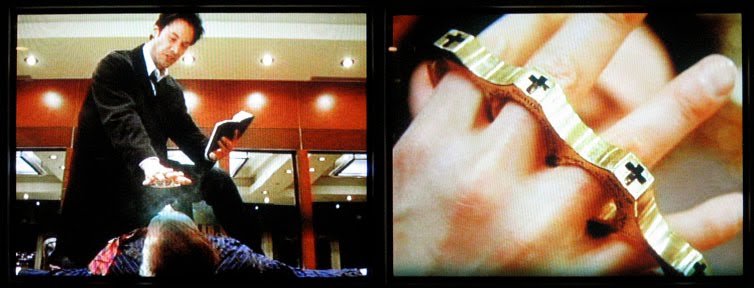
If anyone were to doubt this film’s trajectory, they need only watch the first appearance of John Constantine. Our protagonist’s entrance not only confidently casts him in a role traditionally belonging to Catholic teachings, but also allocates this scene, visually and thematically, to another, widely familiar, cinematic instance. In this scene, we bear witness to a young girl with long stringy hair wearing white or lightly colored nightclothes. Previously seen climbing the ceiling, she is now tied to her bed, writhing and speaking in growls and snarls and a demonic tongue. Constantine enters the girl’s room, and, after a few attempts, finally exorcises a demon from the body, leaving her previously evil and distorted countenance to relax back into that of an innocent; no longer the vessel for a predatory demon.

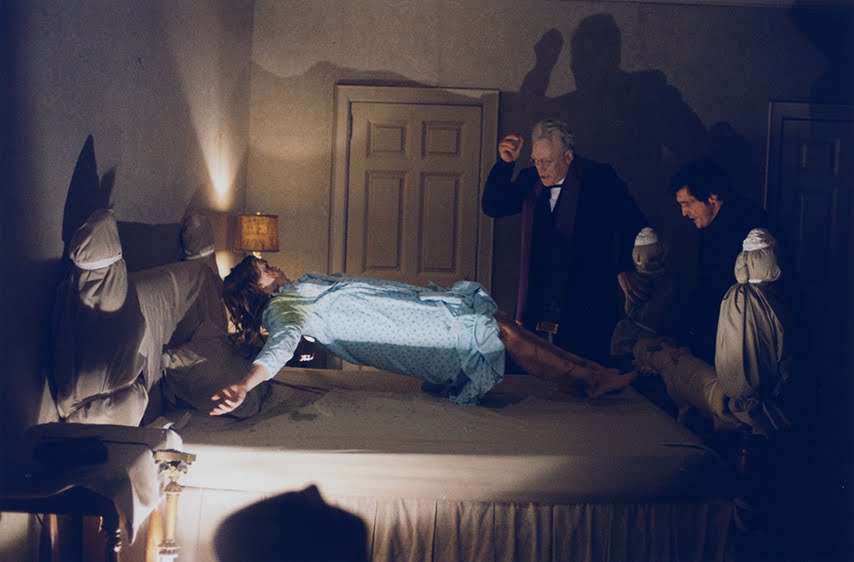
You don’t need to have read Hellblazer to recognize this scene, after all- it’s not in the comic books. Within this dramatic opening, you have the very basic component parts of the beginning exorcism scenes in William Friedkin’s The Exorcist. The significance of this is immense. Not only is John Constantine being posited as a surrogate Father Karras, but he also produces the same result: the casting out of the demon from the young girl’s body, and her return to innocence. While Constantine may perform certain exorcism-type activities within the Hellblazer series, none of them come anywhere close to the way that this one is visually or thematically represented. This scene includes enough familiar horror iconography so as to “jump on the bandwagon” and attempt to include a wider audience who may not be familiar with the comic, but are all-too-familiar with the now cliché Exorcist schema.

In his book, The Satanic Screen, Nikolas Schreck identifies Friedkin’s film as a

“big-budget Bible-thumper,” a title that could easily be applied to Constantine as well. Schreck’s main criticism was that Friedkin positions Woman as “literally the gate to Hell.” (Schreck, 169) While the female body has been used time and time again as the vessel for horror (see practically any Cronenberg film for further reference), Francis Lawrence’s Constantine utilizes the female body in much the same “gateway “ role as Friedkin. Not only is there the opening exorcism scene, but also the remainder of the film centers on a Catholic female, Isabel, who has seemingly taken her own life. In doing so, she has used her body to engage with Hell. Suicide, according to Catholic doctrine, damns Isabel to eternal hell, and means she cannot be buried in sacred ground. The film follows Isabel’s sister Angela (played by Rachel Weisz) as she enlists John Constantine’s help to try to prove that her sister did not in fact commit suicide and therefore deserves a good Catholic burial.

This very narrative substantiates Schreck’s argument, and makes Constantine a definite competitor for the “big budget Bible-thumper” contest. While the opening of the film is meant to establish Constantine’s religious identity, the more thematic and stronger correlative comes at the end, making these two scenes like bookends, sandwiching the film into the familiar Friedkin terms.

As the film gets ready to head into the final confrontation between good and evil, we are confronted with another “situation.”  Through a series of incidents involving the Spear of Destiny and Mexico, Angela has now become possessed. Once again, an exorcism is needed. Constantine begins the exorcism; laying hands on Angela, with his young apprentice Chas looking on. Within the comic book, Chas is a character about 20-30 years older than he is in the film, and he couldn’t care less about anything mystical or magical except for possibly trying to decipher where he might find a good pint. In Lawrence’s interpretation, he is approximately 20 years younger than Constantine, with an eagerness and fan-doration for Constantine that would leave most Harry Potter lovers in the dust. However, the way the two characters are positioned in the film is not unlike the way that Father Karras and Father Merrin are positioned, age difference included, in The Exorcist.

As the exorcism continues, it becomes clear that Constantine needs assistance, as Angela’s belly is looking like it might repeat a scene from Alien. So the young apprentice begins to chant along with his mentor, their voices rising in volume and power. The exorcism continues, an older and a younger exorcist, combining their powers to banish Satan from the body of the innocent Catholic girl.

The cadence of their voices practically mirrors that of Father Damien Karras and Father Lankester Merrin in the 1973 film. In those final thrilling scenes of Friedkin’s piece, the possessed young girl is eradicated of her demons by the powers of actors Jason Miller and Max Von Sydow repeating with increasing volume, “The power of Christ compels you! The power of Christ compels you!” and chanting over her body with all their might. Eventually, the spirit is exorcised from little Regan and inhabits Father Karras, who, in a final act of self-sacrifice, throws himself out the window in order to exterminate the demon from the innocent form and the mortal plane. Poor guy… No one told him there would be sequels…

Karras, the younger priest, and Chas, the apprentice, are parallel characters in that they both provide a central act of self-sacrifice in the face of evil. After Constantine and Chas succeed in ridding Angela of her demons, so to speak, Chas looks up at Constantine and smiles broadly. “We did it!!!” he exclaims, with great joy, at which point we are witness to his body being suddenly torn away from Angela and Constantine, and smashed again and again and again into the ceiling with great invisible force, and dropped to the ground like a rag doll. Just before Chas expires, however, he has the opportunity to utter the most unintentionally appropriate line in the whole film. He looks up at Constantine who has run to his bleeding and broken body, and says haltingly, “It’s not like the books, is it John?” To which John replies, “No, Chas, it’s not.” Although this was referring to a previous conversation the two characters had had, what this line really does is give a full disclosure of how this film, with its familial ties to other films and divergent issues of faith and culture really is “not like the books.”

We have cast John Constantine in the bifurcated roll of exorcist as well as Judeo-Christian representative. Through this introduction, and a little boost from a film so well recognized as to become part of common parlance and culture[8], the character of John Constantine is marked within a set of primarily Catholic terms. The problem of this demarcation is that this is not who this character has been defined as, within the pages of the comic. In fact, this definition is about as far from Hellblazer as you can get. Indeed, as one fan of the comic noted in an online forum discussion,

John Constantine has given the Judeo-Christian god the finger, outwitted the devil on his own battlefield, pissed on the king of vampires in a drunken victory, and can con any man into giving him a smoke. That is who John Constantine has always been. True, he may have sought small redemptions. After all, he is human. But the…storyline depends so much on mythos other than that derived from the Judeo-Christian point of view.[9]

BETTER THE DEVILS AND THE ANGELS YOU KNOW

The Hellblazer universe, borne out of Alan Moore’s run of Swamp Thing, was never meant for such reductive measures as were given by the film. Yes, it is a comic text that wheels and deals in religious iconography. In fact, any given run contains more religious issues than an episode of the 700 Club. However, unlike that show, it does not concentrate on religioN, it concentrates on religionS. Where Lawrence went monotheistic for the sake of easy audience digestion, the multiple authors of Hellblazer went pluralistic, indicting and exploring any aspect of the larger concept of capital “R,” Religion that they saw fit to print. Hellblazer was impartial when it came to the treatment of religion and spirituality. Linking Margaret Thatcher and demon yuppies in one story, discussing figures from Chilean folklore like the invunche in another, and following witchcraft-bound killers in yet another, John Constantine had no proclivity towards any particular brand. Thus, by casting him in the role of freelance exorcist/ Father Merrin surrogate/ Catholic superhero, the foundation and real substance of the comic is eradicated, leaving nothing but a phantom of what had previously existed.

So, in the end, what happens when you base your film on a theology and religious narrative that is so disparate from what this character has ever been or done in the originating material?  The answer can be found within the pages of the film reviews. To use one of the oldest and most easily accessible stories within our myth-laden culture, the battle between good and evil, may be easier, but it is also lazy. And the laziness showed. Very few reviews from this film were positive, whether the writer had read the parent text or not. Sure, the establishment of a protagonist that plays to what Max Braden called “Catholic Rules Sinball”[10] creates an easy entrance to the film for a non-comic-reading public. However, in the end, it hurts the cinematic translation as well as the comic book world. Indeed, as Barb Lien-Cooper accurately observed,

    Bad reviews of comic book movies reflect badly on all comic book movies and, by a VERY slight extension, all comic books. When you read the reviews of Constantine, notice if and when the critics talk about the fact it’s a comic book…The easiest way for the comic book boom to go bust is to produce movies that make the public feel that all comics must be as bad as the movie adaptations. We can’t coast on the good will of the Spider-man movies, the two X-Men movies, The Road to Perdition, Ghost World, and American Splendor forever.[11]

And she’s right. Creating a ghost-adaptation like Constantine is not only damaging to the newly-established genre of comic book films, a genre only now able to start exploring its capabilities, but it also endangers the comic book community at large. Indeed, if it has taken us this long to establish ourselves as “real literature,” a film that erases the truly admirable aspects of the comic book is only going to make the struggle for recognition that much harder.


[1] Lawrence, Francis. Special Features “Conjuring Constantine.”Constantine. DVD. Warner Brothers, 2005.

[2] Ellis, Warren. Introduction. “We Never Liked You Anyway.” in Ennis, Garth. John Constantine, Hellblazer: Fear and Loathing. New York: DC Comics, 1997.

[3] Vega-Rasner, Lauren. “Blood Letters and Badmen: Brian Azzarello.” Sequential Tart. Volume 2, Issue 8. August 1999. http://www.sequentialtart.com/archive/aug99/azzarello.shtml

[4] Franklin, Garth. “Constantine: Set Report.” February 20th, 2004. http://www.darkhorizons.com/news04/const2.php

[6] Genette, Gerard. Palimpsests: Literature in the Second Degree. Lincoln: University of Nebraska Press, 1997.

[7] Shuler-Donner, Lauren. Special Features. “Conjuring Constantine.”Constantine. DVD. Warner Brothers, 2005.

[8] Films such as Scary Movie 2 and Repossessed as well as TV shows like “The Simpsons” and “Saturday Night Live” have all make liberal use of the original Friedkin film.

[9] Big_chris, “Constantine” http://www.popcultureshock.com/reviews.php?id=3882, accessed November 11, 2006.

The Trouble With You Is…You Got No Character!: Confessions of a Charactor Actor Junkie

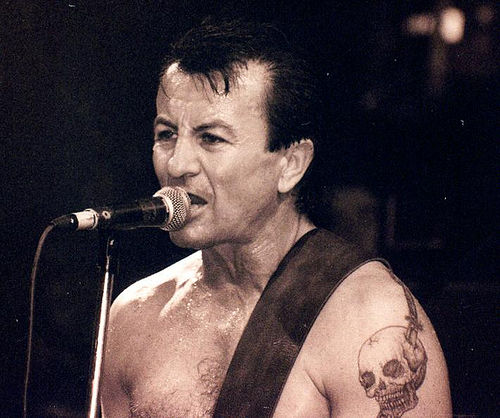
Sitting here, watching Sahara (Zoltan Korda, 1943) on TCM, I was struck by what we are actually missing in today’s cinema and what makes it less than what it used to be: good character actors. See, I think that what created GOOD Hollywood, the Hollywood I love and worship, the films I come back to again and again and again, were not always the Glenn Fords, Rita Hayworths, Bogey & Bacalls, or the like. Nope, not even close. Don’t get me wrong, I have a favorite screen “couple” (Tracy & Hepburn), and I dig all that stuff, but…we had quality character acting even up until the mid-to-late-80’s, I would say. For heaven’s sake, I would (and could) argue that Lee Ving of the band FEAR was an awesome character actor. So actually into the ’90’s. But it was definitely on its way out. Even at that point, good character acting was primarily being shoved onto television and the Silver Screen was being relegated for “more important” content.

From Flashdance & Get Crazy to Clue & The Taking of Beverly Hills, Ving definitely made a place for himself as a character actor

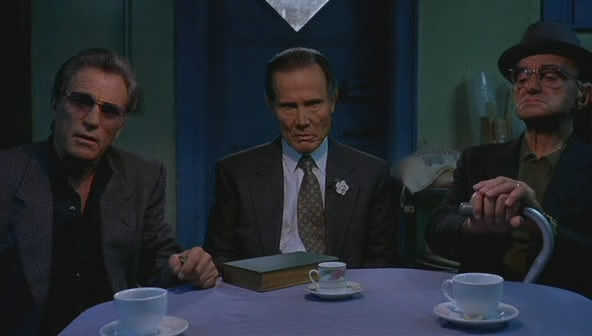
While Wikipedia defines character actors as people who play “a particular type of role rather than the leading ones. Character actor roles can range from bit parts to secondary leads.” My focus is not so much on the ones that play secondary leads. I’m also interested in the supporting cast. Actors that play incredibly important roles but come in and out of a picture and you always recognize them and say, “Hey! It’s THAT guy/gal again!” That’s how I fell in love with Elisha Cook Jr and Walter Brennan. It was how I became enamored of George Kennedy. It’s why Thelma Ritter and Agnes Moorehead will always have a big huge places in my heart, and then, of course, really- how could anyone NOT love Dub Taylor or Ernest Borgnine?  It is also how one of my absolute favorites, Henry Silva, became totally etched on my psyche and (I’m guessing) upon Jim Jarmusch’s too. When Silva appeared in Ghost Dog(1999) he appeared alongside a few other equally well-known character actors. In doing so,  he was so self-referential as a well-known character actor that his character actor “ness” seemed to be the gag! And it was a good one! Well done, Mr. Jarmusch!

From L to R, Cliff Gorman, Henry Silva and Gene Ruffini

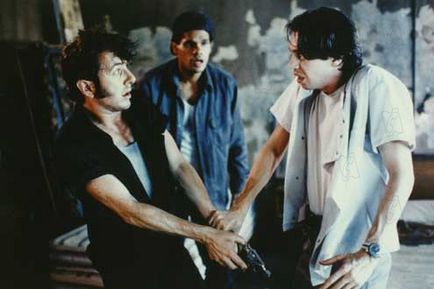
The reality is this: back when men were men and women wore Edith Head, the nutritional supplement of the cinema was your character actors. It was what nourished your films, not relegated them to the “Indie” category. Taking out your vegetables and just leaving the meat gives you an unsupported filmic narrative. Additionally, by taking out those ingredients, you also remove the familiar thread that runs through a multitude of genres, eras, and even media. Directors like Jim Jarmusch and the Coen brothers are outstanding in their ability to utilize character actors in the traditional sense. They flesh them out, give them purpose, sometimes simply within a few scenes and then…they are gone. These characters either disappear completely, or they simply fade into the tapestry of the storyline. But they are not there to be the focus, they just serve as support beams. However, even if these actors quickly disappear, in the next movie? They are used again. And the familiarity of That Guy/That Gal is there! And you know them from a Jarmusch or Coen brothers movie, specifically. However, there are not many filmmakers working like that today, and the films made by these filmmakers seem to have been relegated to a status that is not the same as every other film being released. They do not get the same production or distribution possibilities, they do not get the same publicity, and they simply do not get the same treatment. They never have. They have always been within the categorization of “indie” films. And if I wanted to stretch this out a bit further, I could include other directors who do the same thing. Spike Lee’s early work (like Jarmusch and the Coens’) was considered to be a catalyst of the Independendent Cinema movement, and he also used amazing character actors like Ruby Dee, Ossie Davis, Danny Aiello, and he practically launched John Turturro’s career.  The difference between Spike Lee’s work and the other two directors mentioned above (even though all three men shared actors over the years like Steve Buscemi and John Turturro) is that Spike Lee got “successful” first. That success gave him the ability to put a great deal more money into his pictures and have the meat and potatoes all the time. Not that Jarmusch or the Coens minded, artistically. From what I can tell, they were like good cinema parents. They wanted to make damn sure that we had a full meal with every food group represented on the plate, and were willing to take a few risks and minor setbacks for that. Please do not misunderstand me- I am not calling Spike Lee a sellout. If you ask me, you cannot get a more well-balanced meal than Clockers (1995). But for some reason, he was able to get funding and go somewhere with his work that these guys were not. I find that interesting. Especially since they all were based upon the idea of using character acting as the backbone of their films. Looking at the Independent Cinema Movement of the ’90’s, they used the same character actors for very different reasons than Hollywood did, back in the day. We can look at these films retroactively and say, “Wow! How marvelous! Look at Steve Buscemi in Jarmusch’s Mystery Train!

Joe Strummer and Steve Buscemi struggle over a gun in Mystery Train (1989)

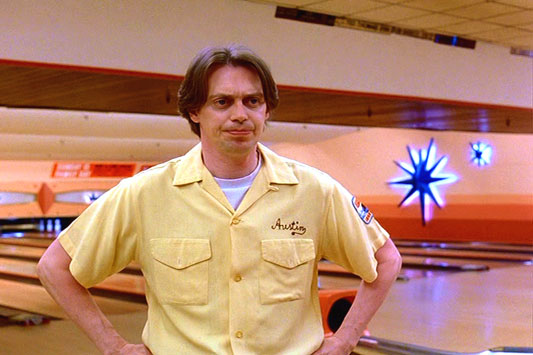
Only a few years later he would be helping the Coen brothers get much bigger with Lebowski!”

“Phone’s ringing, dude,”- Steve Buscemi’s character of Donny in the Coen Bros’ film The Big Lebowski (1998)

Or you can look at the fact that Jarmusch has used Spike Lee’s brother Cinque in multiple films. Or that Turturro has been bouncing back and forth between the Coens and Lee for years now, doing movies for both. Unlike the studio days, these filmmakers were using each other’s talent out of necessity. The main concept of independent filmmaking was “independent,” also translating to “severe lack of funds.” They had to work with what they got, including how much they could pay people. This meant You Use The People You Know.

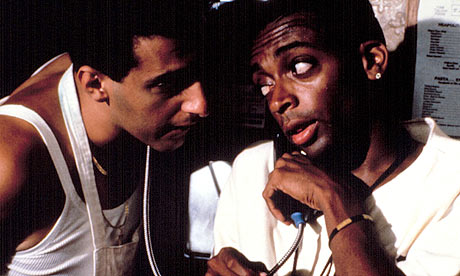
John Turturro and Spike Lee in Do the Right Thing (1989)

Thus, the shared casts between these filmmakers had just as much to do with the budgetary restrictions as it did with their creative choices.

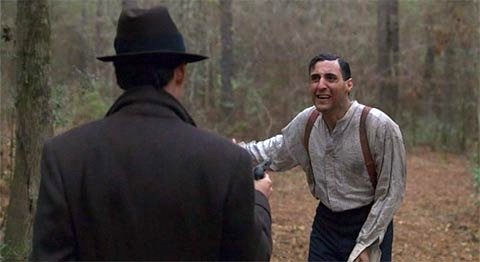
John Turturro in the Coen brothers’ Miller’s Crossing (1990)

Interestingly enough, it led to a very heavy reliance on casts that were chock full of character actors that served as a kind of connective tissue between their films and their compatriots’. It’s depressing to me that the last time that this kind of narrative and consistent cinematic thickness could be witnessed  was within the “Indies.” That was a long time ago. I firmly believe that one of the reasons that so many films today are lacking in depth, plot, and any kind of genuine entertainment value is due to the lack of character actors, be them comedic or dramatic. If you stop to think about it, a good character actor can play to any genre. They might get type-cast, and generally be known for one thing (like Walter Brennan and the Western), but the greatest asset a character actor can have is exactly what a character actor is known for: ELASTICITY in performance. My favorite players have had exactly that, and I miss it like hell. I go to movies now, and it’s almost like going to a park made completely out of cement and iron. I look for the trees, the flowers, the things that make me want to stay at the park, hang out, read a book in the sunshine, and there is simply nothing there. To give you an idea of what is missing, aside from my discussion of the Indie Film Movement, I would like to give you a couple of Character Actor Studies. By briefly looking at the careers of some of these early performers and their works, it should become transparent that when we sit down for a lovely 7-course meal at the Silver Screen these days, all we seem to be getting served is the steak, and that ain’t worth the money being paid! LET’S HEAR IT FOR THE BOY(S)! In the world of character acting, there is a great deal more attention paid to the men and there are, indeed, many more well-known and recognizable male character actors. There are many female character actors, but unless you consistently watch older films, they seemed to have mostly gone into the world of television during their later years, while the men continued to shine on the big screen (as well as the smaller one). But this is Tinseltown after all, and unfortunately that is the traditional unfair gender dynamic that was set up back when the Industry began.  That said, it has no bearing on how insanely talented these three men are, and how, without them, Hollywood would not be what it is today. And if anyone was curious, I would be willing to swear to that on a stack of whatever holy book you prefer. I honestly believe that without the help of Elisha Cook Jr.,  Walter Brennan, and George Kennedy our films would be suffering from severe anemia. Walter Brennan Best known for his work in Westerns, Walter Brennan was actually a great deal younger than most of the parts that he played. Due to the fact that he was always working, he was also always recognizable and ultra familiar. He was nominated for 4 Academy Awards, and won three of them. His performances as an “old timer” from whatever era the film was supposed to be set in, generally worked to his advantage. He played grumpy old men or preachers (Sergeant York, 1941),

 eccentric historical figures (The Westerner, 1940) and innumerable men named “cap/cappy” or “pop” or “gramps” or “grandpa.” The figure that Brennan cut was the congenial older trailhand or the corner store owner in the Western town. Shift the narrative to a sea drama, and Brennan was the sea-weary captain. One more time and he was a prospector. In all of these cases, the same things stuck out: his voice, his facial expressions, and, especially, the attitude that he had to the other actors that were within his scenes.  While his acting was strong and individualistic enough to have warranted him award nominations, he positioned himself in such a way that it deferred to the star without losing any of his own strength as an actor. Indeed, Brennan essentially invented the character that has been parodied in so many different films, cartoons, and other media objects. While his voice is generally what people use for the imitation (it is one-of-a-kind), his multiplicity of characters created an iconic figure to repeat and have within various genres. People know who Walter Brennan is, even if they don’t know who Walter Brennan is. For example, if one were to describe Stumpy, his character in Rio Bravo (1959), a person would know exactly of whom were speaking.

All we would have to say was that he was the older cooky sheriff chewing tobacco or smoking a cigar, with a loud laugh and a cracking voice and a bad case of messed up teeth. He likes an occasional drink and was essentially not very useful yet considered absolutely indispensable to the main character (in this case, John Wayne) of the film. Dollars to donuts, anyone you talk to would conjure up Walter Brennan. He made that much of an impression upon film and media culture. Elisha Cook Jr.

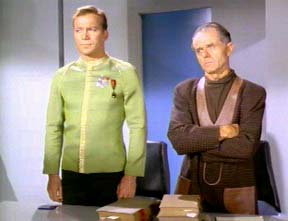
Captain Kirk (William Shatner) and Samuel T. Cogley (Elisha Cook, Jr-credited as Elisha Cook, however) in Star Trek episode “Court Martial” (1967)

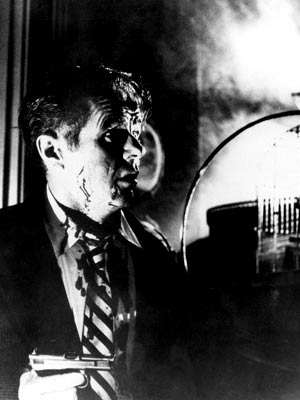
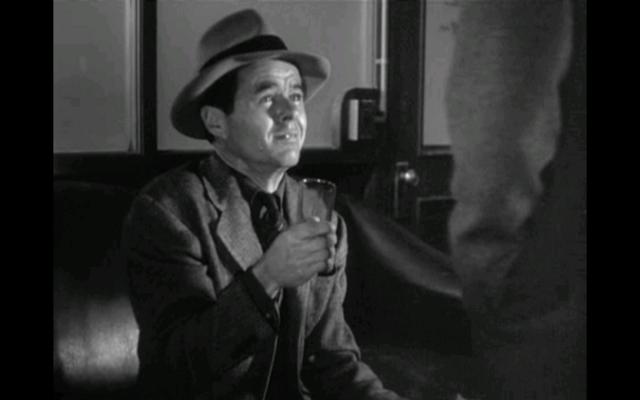
Elisha Cook Jr.’s resume reads like film and television history.  He played characters that were as varied as gangsters, doormen and the severely mentally disabled. He was in everything (and I honestly do mean everything- he is one of the most visually recognizable character actors ever) from The Maltese Falcon (1941), Don’t Bother to Knock (1953) and The Killing (1956)

playing George Peatty in Stanley Kubrick’s THE KILLING (1956-billed as Elisha Cook)

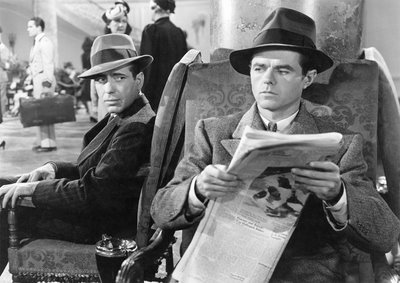
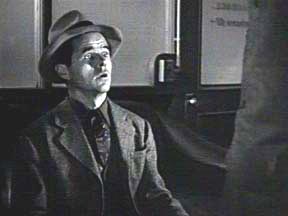
to Shane (1953), Rosemary’s Baby (1968), and Carny (1980). His tv movie appearances are countless (among them Tobe Hooper’s Salem’s Lot-1979, and the Richard Matheson-penned The Night Stalker-1972), and his television appearances weren’t half bad either- Star Trek (1967),  S.W.A.T. (1975), Quincy, M.E. (1977, 2 episodes), Magnum, P.I. (1981-1988, 12 episodes) and of course ALF (1988).  Elisha Cook Jr. was, clearly, a character acting force to be reckoned with. In my world, if he pops up in a film or tv show that I’m watching, that automatically makes it better. While that may seem like an exceptionally fannish comment (and I’ll admit- it is, but only slightly), I can back up why I think it will be better. When a certain director and/or casting director cast Cook , they were, similar to Walter Brennan-selection, seeking out a certain flavor for the piece. But the special thing about Elisha Cook, Jr (and the way that he differs from Brennan) was that his acting capacity was so wide. While he was certainly selected for that deer-in-the-headlights facial innocence that he had perfected (even in criminal roles), Cook had a complicated and layered innocence, making the film or TV show that much more intense. Elisha Cook, Jr. garnered empathy and sympathy in ways that most actors never could, simply using his eyes, facial features, and small stature. No matter what role he played or how evil the character was meant to be, one always sided with Elisha Cook, Jr. It was a unique talent that he had by playing with his visual aesthetic in tandem with his vocal intonations. In short, he was a great actor. While there are many roles that he has played throughout his career, my favorite has to be Harry Jones in The Big Sleep (Howard Hawks, 1946).

Playing small-time hood Harry Jones in The Big Sleep (Howard Hawks, 1946), I DARE you not to be moved by his pathos.

In all honesty, the look that he gives the other fella playing the gangster in one of the darker scenes in the film just breaks my heart. That may have been the film that made me an Elisha Cook Jr.-addict. While there were many other actors of his same height and general physicality who played similar roles, only Cook had the kind of talent it takes to bring affection to hoodlums and hen-pecked husbands alike. Unlike Walter Brennan who is primarily recognized based upon his singular vocalizations, Cook is a character actor that is familiar based upon his aesthetics and his characters’ ability to aggregate sympathy. George Kennedy I’ve accepted the fact that many people don’t watch older movies anymore. My friends and associates do, but the outside world-at-large? Not very often. However, there is a very decent proportion of those people who know who George Kennedy is. All you have to do is mention Cool Hand Luke (Stuart Rosenberg, 1967). Just ask about this scene:

 In a film chock full of amazing talent, how is it that we remember George Kennedy almost as well as we remember Paul Newman? Harry Dean Stanton is in that movie, as is Dennis Hopper. Those are names that folks would recognize. However, George Kennedy’s character strength is what made him so recognizable.  Where Brennan was practically genre-specific and most definitely recognizable by voice and Elisha Cook Jr. had a face and persona that could break a thousand hearts and inspire love for even the lowdown dirty no-gooder characters, Kennedy’s forcefulness and bold demeanor gave him significance. Kennedy was masculine, tough as nails and super badass and many of his roles reflected those things. Like many other character actors, Kennedy found much of his career in television. His roles in Have Gun, Will Travel (7 episodes, 1960-63), The Asphalt Jungle (3 episodes, 1961), Bonanza (2 episodes, 1961-64),  and McHale’s Navy (2 episodes, 1963-63) only increased his popularity and solidified his “larger than life” persona. He even had his own television show, Sarge, which featured Kennedy as a cop-turned-priest who just can’t stop solving those crimes! Sarge brought big names out too- Vic Morrow, Martin Sheen, Leslie Nielsen (who he would later work with on the Naked Gun films) as co-stars and folks like John Badham and Richard Donner to direct. 

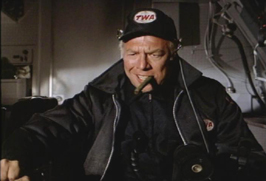
Within Kennedy’s “character presence,” there was one feature that he carried on to almost every role he played: perseverance. While in some films it could be labeled as “stubbornness” or “hard-headedness” that was part of the Kennedy charm. It could make a character heroic (Airport, 1970)

playing Joe Patroni, the determined airline mechanic who does things his own way in order to try to save the day in Airport (George Seaton, 1970)

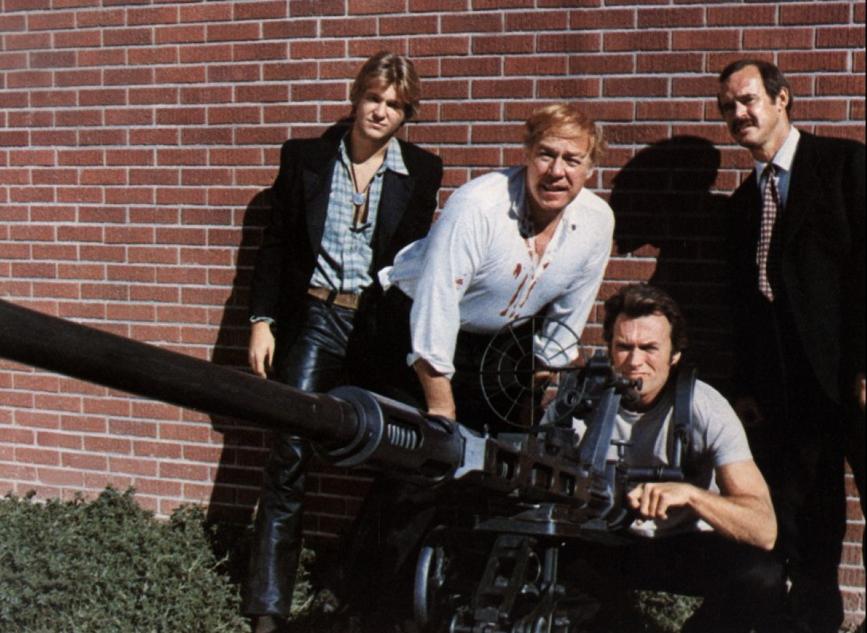
or brutal (Thunderbolt and Lightfoot, 1974).

playing the nasty Red Leary, determined to get his share (and way) of everything no matter what (Thunderbolt and Lightfoot, Michael Cimino, 1974)

It could catalyze a sense of martyrdom (Delta Force, 1984) or it could cause tunnel-visioned determination that doesn’t pan out so well (Lonely are the Brave, 1962). In addition to this, Kennedy’s physicality is a very distinctive part of his oeuvre.  It is so much a part of his “characterization” that he played four roles in four different shows/films where the character’s descriptive nickname was “Big” (ie “Big” Jim or “Big” Buck). Where Brennan went with the voice and Cook entangled facial expression with physicality, Kennedy’s impressive physical stature made him a perfect candidate for characters needing a tough persona and thus will be remembered as such. FEMALE TROUBLE Before we discuss the ladies, I would ask that you slide on over to Celluloid Slammer and check out their little ditty on character actresses, because truly…it’s fantastic. In the world of character acting, the men get a lot of love, but the women need some lovin’ too, and that post made me happy. Now that you’ve done that, shall we begin? Thelma Ritter

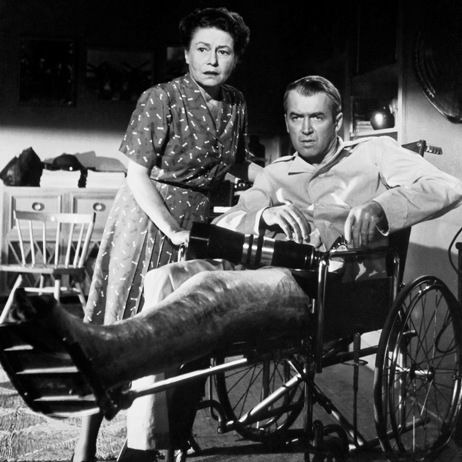
Thelma Ritter with Jimmy Stewart in Rear Window (Alfred Hitchcock, 1954)

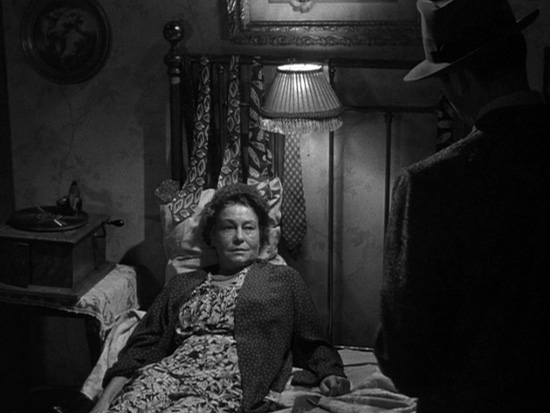
The exquisite Thelma Ritter was probably in a very healthy chunk of the films that you were forced to watch in film school. Whether you liked them (or her, for that matter) is really none of my business, but the fact that a such a mousy-seeming woman could make such a significant place for herself in some of the best films that Hollywood made is still a very commendable feat. Ritter is another actress that you know her face, but you can’t remember from where or why. That is her gift. The first reason is that she’s in darn near everything, and they’re all pretty decently popular titles. The other reason is that Thelma Ritter is the kind of character actress that doesn’t impose herself on the film or the narrative. She almost becomes as crucial an element to the story as the storyline itself: you couldn’t imagine the film without her, and yet she is the least imposing figure you could think of. While she generally plays nurses, housekeepers or caretakers in general, she has also been cast in several roles that document her dramatic abilities without question. Her roll as the poor police informant Moe Williams in Sam Fuller’s Pickup on South Street (1953) is nothing short of brilliant. Both dramatically strong and crushingly heart-breaking, Ritter plays Moe’s part as real as they come, up until the very last moment. To me, that is her most memorable performance and also my favorite.

If Thelma’s Moe doesn’t break you, you have no heart.

However, Ritter’s work is extensive and each role, no matter how seemingly insignificant, is as unforgettable as she is, the sign of a good character actress. Unlike many character actresses, her career was almost exclusively in film. In general, most character actors/actresses have healthy resumes on both the little and the big screen. However, Thelma Ritter’s work existed almost entirely on the big screen, mostly due to the fact that she was unendingly usable. She fit into almost any context and any genre and there seemed to be roles cut out just for her. She invented an archetype, really (“the Thelma Ritter type”).  And her list of films is GOOD GRAVY astounding. While Sam Fuller’s film may have only gained respectability within recent years, she rocked it as Birdie in All About Eve (Joseph L. Mankiewicz, 1950), did a turn as Maude Young in Jean Negulesco’s Titanic (1953), and continued on to pieces like Pillow Talk (Michael Gordon, 1959) and The Misfits (John Huston, 1961). Now I’m not saying the lady didn’t do television- she most certainly did (there’s an “Alfred Hitchcock Presents” that I’m dying to get my hands on!), but the cinematic roles that she played helped to carve out and create a character type. In my mind, Thelma Ritter is somewhat of a legend. She can go from nosy neighbor to helpful housekeeper in the span of 1 film, yet always maintain that certain something. Her Ritter-ness has yet to be matched. I have not seen another actress who can carry that serenity on her face or the same playfulness or the grim determination, at times within the same film. My take on her is that, through being a character actress, she was able to use her wide variety of skills to dance through an industry that tried to pigeon-hole you into being one thing. I think she truly enjoyed her work and the variety of roles it gave her. I certainly love watching her. Agnes Moorehead While many people have grown up knowing her simply as Samantha’s mother Endora, Agnes Moorehead had a very brilliant career that started way before her turn as the technicolor witch on Bewitched. Though not conventionally attractive, Moorehead certainly had the power to be so. She played a multitude of characters over her career, ranging from her regular appearances in Orson Welles’ films to the aforementioned television series. I was pleasantly surprised to catch a lovely little film the other day called Mrs. Parkington (Tay Garnett, 1956), starring Greer Garson and Walter Pidgeon. What I found to be the real kicker was that Agnes Moorehead, playing the Baroness Aspasia Conti in the film, is actually constructed as a beautiful and sexualized character. Played in opposition to the protagonist, she is regal and beautiful but aging, and discusses these issues in such a way that is unusual and terribly unique. The reality of the situation is that the way that Moorehead is dressed and made-up, she is every bit as attractive as the lead, but that doesn’t gel with the narrative (nor does it gel with the characters that Moorehead plays on a continual  basis), so she does become a secondary figure. But she is still seen as being a sexually attractive female, something that Moorehead did not get to do too often.

Agnes Moorehead as the lovely Baroness in Mrs. Parkington (1944)

Moorehead was, many times, part of the Old Maid/Crochety Woman character actress circuit. These were the female characters in films who, according to much recent film theory, are the flimsily disguised lesbian characters. They played the matronly aunts, the stern heads of orphanages or prisons, or other spinster-esque figures that had no romantic implications…at least not with men. Indeed, there were many allegations that Agnes herself was gay, but those went unproven. However, many characters that Moorehead played fall into a type that has been considered a little “less than hetero.” Her relationship with the Mercury Theater and thus Orson Welles brought her some amazing roles and showcased the strength of her performative skills. Moorehead’s ability to take charge of a scene just within a few lines can be seen in films such  as Citizen Kane (1941) and Jane Eyre (1943). But if you truly want to see a great performance, get your paws on a film Welles and the Mercury Theater gang did called Journey Into Fear (1943). Not unlike my Thelma Ritter/Pickup on South Street reasoning, my favorite Agnes Moorehead film roles are the ones that showcase a different image than her usual one and underscore her talents. Therefore I feel that Mrs. Parkington is a really fine film for exploring a different side of the Moorehead persona as far as sexuality is concerned. However, my real favorite is Journey Into Fear. While her role as Mrs. Mathews has some of the familiar qualities that she carries through her career (she plays the prototypical bullying-wife role), she also gets to shine with a few truly brilliant comedic turns. Part of that is the writing and the chemistry she clearly shares with the other actors, but a good portion of that is all her own. Later on, that comedy is quite visible in Bewitched (which she was on from 1964 to 1972) but up until then, her comedy stylings were somewhat more concealed. A great radio-star and a fine actress, Moorehead, like Ritter, created a character standard.  While Ritter’s was the kind and dependable housekeeper/neighbor/nurse, Moorehead virtually defined the matronly female figure. Her physicality and stern features in addition to her unwaveringly strong and full voice cut a striking figure on the cinematic canvas. I have always considered Moorehead to be more of the George Kennedy-type. You knew what you were getting, and what you wanted to use her for. Unfortunately, after seeing Mrs. Parkington,  I realized how wrong I was. She got type-cast, an unfortunate side effect of being a character actress. I suppose if you are good at something, that can tend to happen. It is an unfortunate occurance, however, seeing as she did have other skills that got explored (to an extent) earlier on in her career. I do wonder sometimes what it would’ve been like to see her play something perhaps a bit less austere. But then I watch her interact with Eleanor Parker in Caged(John Cromwell, 1950) and…well, I just love it so much I guess I accept things how they are. Father…er…Hollywood knows best?

While definitely a more sympathetic character than the women prison guards, Moorehead’s turn as Ruth Benton in Caged doesn’t stray much from her typography of roles given.

Mercedes McCambridge Not every character actress has been pleased about the roles that they have played or perhaps their character actress status, regardless of how well they completed the task. Mercedes McCambridge is one of those figures. Her lot in Hollywood was certainly much more tragic and difficult that the above two ladies and I have definitely heard people refer to her as a “cult” figure in a slightly condescending manner, which truly breaks my heart. Indeed, McCambridge herself said, “One of the most destructive things in my life was the kind of parts I played in pictures. I studied Shakespeare and the classics, and I end up shooting Joan Crawford and killing a horse that Elizabeth Taylor was in love with. I’m serious. I played the worst harridans, the most hard-bitten women, the absolute heavies, and it just about did me in.”

People can call Johnny Guitar a “cult classic” all they want. I’ll just call it one of my favorites that I can put on, oh, just about anytime. A chick Western by Nick Ray- what’s not to love??

Well, Mercedes, here is the problem- you play the heavy so damn well!  Being a fan of noir, I’ve seen a good amount of mean and bitter characters in the movies. But Old Hollywood rarely gave women a chance to explore that area. We were allowed to do the manipulative and vindictive femme fatale (and some of them could get pretty damn mean) but for the most part, women didn’t get to be rough and hard. I don’t know. Perhaps it was some kind of Delicate Flower Syndrome in tandem with the desperate fear that we actually have the capacity to be rough, hard-bitten bitches when we wanna be. Guess I can’t blame Hollywood too much. In any case, we got that freedom later, so can’t complain too much. But Mercedes did it early and she did it with style, even if those weren’t the roles that she wanted to play. McCambridge actually had a great deal in common with Agnes Moorehead. Like Moorehead, she was extremely successful in radio and her career there flourished for years right alongside her film and television work. Not only that, but she too was a member of the Mercury Theater, thus getting in with Mr. Welles which most likely led to her legendary (but uncredited) role as the androgynous gang leader in Touch of Evil (1958).

Mercedes as the gang leader who had a bad case of scopophilia when it came to Janet Leigh getting raped…

Previous to that role, of course, she was plenty active. She had developed a very clear and defined position within Hollywood. In fact, she won an Academy Award her very first time out of the gate! Her screen debut was in Robert Rossen’s All the King’s Men (1949), and she nabbed a Best Supporting Actress Award. Not too shabby. Throughout her career she worked intermittently on television, film and radio. She also continued to do work on the stage, something that many character actors/actresses pursued. While people tend to be more aware of her roles in films such as Giant (George Stevens, 1956) or Johnny Guitar (Nicholas Ray, 1954),  McCambridge managed to demonstrate her theatrical ability in pieces such as Joseph L. Mankiewicz’s Suddenly, Last Summer (1959). The Tennessee Williams/Gore Vidal-penned script alongside the stellar cast of primarily stage-trained actors really gave her a good launchpad to create the character of Mrs. Grace Holly. While this role may not have been the best example of female strength (I’m not certain you can depend on Tennessee Williams to give you particularly positive examples of either gender-to be honest, he’s a fairly equal opportunity misanthrope), McCambridge manages to imbue the character with at least a modicum of sympathetic attributes, which is a feat. While her presence in television and film was powerfully based within the Western genre, doing everything from Cimarron (Anthony Mann, 1960) and Run Home Slow (Ted Brenner, 1965) to multiple episodes of shows like Bonanza (1962-1970) and Rawhide (1959-1965), her most famous role (for the majority of the populace) is in a film where she never ever appears: The Exorcist (William Friedkin, 1973).  CAUTION: CLIP NSFW, LANGUAGE & CONTENT IS…HORROR FILM.

Her voice was clearly an asset for most of her career. She had utilized it to great advantage on radio, and lent it to create one of the most iconic villains in all of horror movie history. While we may remember little Linda Blair as the visual token, it is Mercedes McCambridge’s aural flair that gave The Exorcist its maddeningly wonderful tone. Friedkin’s refusal to credit her for her work was unforgivable and beyond reproach, however she did win the court case that followed so the end result was satisfactory, I suppose. Like Agnes Moorehead and Thelma Ritter, Mercedes McCambridge was a woman who worked hard at what she did in many different genres and mediums. Her personal life was quite a bit more rough that Ritter’s or McCambridge’s, but she overcame those obstacles, making her, to me, just as tough as the women that she played. McCambridge has a varied resume that gets shoved into the cult basket quite a bit due to her associations with horror or kitch-Western, but I will always see her as the hard-working and thoroughly quality character actress that she strived to be, and love her for it. Ulterior Motives I’m not going to lie. I have some ulterior motives for writing this piece aside from the unbound celebration of character acting. My grandmother and my mother were both character actresses, and to me? I think that’s just about the most awesome thing in the world. But honestly- this started out to be completely free of personal intentions. I swear! It just became difficult when along the way I began to think about…well, my personal involvement. So, here’s my end of things. As I have gotten older,  I have gotten more interested in the world of character actors/actresses. I never really knew what that was or what it meant. I just knew that was “what Nana was.” When I started watching Sam Fuller movies, and I came across Paul Dubov‘s name (I came across his face a bunch of times first and loved him, so I looked him up- isn’t that how you start your adoration for any character actor/actress?) I was floored to find out that he was my Nana’s best friend’s husband. That was my first inkling that there was something a bit cooky in my life. It probably should’ve been my first clue that character actors were gonna be my “thing,” as they do involve a bit of research and I do love me some research but hey- how was I supposed to know? DUDE. I spent YEARS of my childhood swimming in the Dubov pool and going to Sizzler with his wife and my grandma. How much cooler did that make Underworld U.S.A (Sam Fuller, 1961) and Irma la Douce (Billy Wilder, 1963)? A LOT. And…I never knew. So, maybe no one else cares that I have a love for Paul Dubov and I am now appreciating that I got to swim in his pool when I was tiny, but…hell, I love it. It seems to me, the more that I start to learn about my grandmother and her life in Hollywood, the more there seemed to be this interesting circuitry amongst the character actors; a kind of relationship-connectivity that the bigger stars never had. There was definitely more intimacy. It seems like a “duh” moment, but for someone who loves these people as much as I do, and is just starting to really investigate my grandmother’s pretty extensive Hollywood career, it’s an interesting thing to note.

My grandmother, Irene Tedrow

The flexibility of a character actor seemed to provide them with things that the Big Stars don’t get. My grandmother was afforded a successful career in television, film and an extraordinarily active life on the stage. She was another woman who began on the radio, and spent many successful years there as well. Some of my fondest memories involve her singing or reading to me (yeah- ain’t nothin’ like a highly-trained Shakespearean actress reading you stories to put you to bed as a kid- natch!). Oh, and she made damn fine cous cous. But I digress…However, my digression proves the other flexibility: she had time to put into a thriving family life. Many of the bigger stars had to forgo this aspect and their children and grandchildren suffered the consequences. My mother and uncle did not. Neither did my brother and I. My grandmother was working all the way up until the day she had a stroke in her 80’s, but (and I would have to ask my mom/uncle about this) I don’t think that she ever felt the work/family strain as massively as the Big Hollywood Talent. Interesting. I don’t think she was unusual in this, either. Thelma Ritter took a few years off of her established stage career to raise her kids…Does it go with the territory?

My grandmother in Norman Jewison’s The Cincinatti Kid (1965) with Tuesday Weld, Steve McQueen and Karl Swenson

Character actors are unique in a multitude of different ways. Their lives and careers are different, they have different trajectories, and different methodologies. Personally, I find them more exciting than your average Big Star, due to the fact that they have such range and depth in roles. Even if a character actor is known for something (like Crispin Glover is known for being a bit “off”), I still enjoy each different permutation of that something, even if the actor tends to stick to what he/she is known for. I will fully admit to being a character actor junkie, and I don’t need or want any help for it. In fact, the more movies I watch, the worse the disease becomes! Oh, more noir…Yep, add Charles McGraw to that list. Oh, more NYC cop/gangster/exploitation flicks? Joe Spinell, you are right there, baby. I began writing this before I started really investigating my grandmother’s career as a character actress, mostly because I felt that, as media scholars/film or television lovers/people of the modern age, we should not only know who these people are, but appreciate what they have done for us. I would’ve loved to have written on more people and written more about the people I did write about, but short bits seem to work. Character actors help us in many ways. If we didn’t have the character actors in cinema, there would be no reality to a film. If you sit and think about it, the character actors in any picture are what actually ground it, even in a fantasy or sci-fi film. Who is the character that always points out the common sense option or helps out in a moment of crisis? Many times, your character actor. They are the string to that filmic balloon, and are desperately necessary. We just don’t always recognize it, as they have always served as the unsung heroes of cinema, in my eyes. Well, today I sing for them. Loud and clear. Thanks, guys. We appreciate you. Nameless to many, but recognizable by face or voice to millions, you are loved. Thank you for your hard work. Keep it up! We’ll be watching!

This is the Night (and the Days!): TCM Classic Film Festival, Part II

Some people collect stamps. Others go in for Fabergé eggs. I seem to be one for collecting film viewings…on 35 or 16mm, preferably, and on the big screen (of course). Thus a film festival like the Turner Classic Film Festival is really and truly my venue. So after the amazing viewings I had already aggregated, I was ready, willing and able for more.

:::DAY 2:::

“You know there ain’t no forgetting…”—THE OUTLAW JOSEY WALES

Saturday morning, bright and early, I grabbed some coffee and a breakfast sandwich from my local shop, and headed out to Hollywood Blvd on my bike once more, arriving just in time to grab my seat for This is the Night (1932). Directed by Frank Tuttle, this little pre-code gem was Cary Grant’s first picture and couldn’t have been more delightful if it had TRIED. Generally, if I have a passing thought during a film that keeps coming back, I will have that be my theme. The one I had for this picture? I haven’t laughed this hard since Animal House (1978). I happen to think that Animal House may well be one of the perfect films in the world so…this was a pretty high compliment. Literally, my sides were aching by the time the film was over. I have not enjoyed myself that much in the theater in ages.

This Is The Night was the first screening I went to that was TOTALLY sold out within a few minutes of me sitting down. It was CRAZY!

The acting was perfect, the construction and comic timing was just insanely smart, and I was left feeling remarkably depressed that there are literally dozens upon dozens of films that I have come across that use virtually the exact same story line with some of the identical gags and they are JUST not done as well. It was definitely a “good morning” to me. Not that this was news to me, of course, but a decent reminder. It instantly became one of my all-time favorite pre-code films and…when I say that I’m obsessed with pre-code films? I like pre-code films like bees like honey and scandal loves politicians.

In addition to the film, Foster Hirsch was there to conduct a Q&A with Cary Grant’s daughter, Jennifer (who is the spitting image of mom, Dyan Cannon with a bit of Cary thrown in…needless to say, she’s no slouch). Hirsch is a favorite of mine from way back due to his amazing noir writings and he’s a great guy for a Q&A. Smart, funny, and charming, he discussed things with Jennifer and let her tell interesting tidbits without prying. It was a good Q&A.

Then it was time. Time for what? Time to check one off the list. A notch on my cinematic bedpost. Part of my collection, as it were.

Last year, after seeing Eli Wallach do a Q&A for The Good, the Bad and the Ugly  and then seeing the film in the big Chinese, I made a solemn swear to myself, right then and there, that I was going to do EVERYTHING in my power to see EVERY Clint Eastwood movie (primarily Westerns, but all the stuff I missed which is…well…most of the early stuff, to be 100% honest) in the theater. The Good, The Bad & the Ugly  made me cry because it was SO. DAMN. BEAUTIFUL. Beautiful? Yes, beautiful. It is film-making at its finest. The music, the visuals; it is a veritable ballet or symphony. With that in mind, the minute I saw that Josey Wales  was on the schedule, digital or not, I was going to see the film. And see it I did!

Once again, I met up with Dennis before the show began. I went inside the Chinese, and he came down with some friends and we all sat and chatted together about things we’d seen so far, and other assorted things. I remember thinking, GOD, I LOVE TCM CLASSIC FILM FESTIVAL!! and then Ben Mankiewicz came up and introduced the film. He talked about how Josey didn’t quite have the popularity or recognition back when it was released that it has now. It was called a “Prarie Death Wish” and that it came out at slightly the wrong time, yet it made money. However, the most incontrovertibly interesting part of the entire introduction was Mankiewicz’s discussion of the author of the original Josey Wales material, Asa Carter.

The Outlaw Josey Wales, in the big Chinese?? THAT is the way that film was intended to be seen. SERIOUSLY.

Carter was not only a supporter of George Wallace, but he was kind enough to start his own section of the KKK. A few years later, he was on Oprah’s best-seller list. Due to the fact that he wrote under the name “Forrest Carter” and people are excruciatingly poor researchers, not to mention that they have zero memory, no one remembered the “Asa Carter” and only saw this fabulous piece of literature lauded by Oprah, The Education of Little Tree.

While I think that the literature is possibly quite good, I’m not sure it can override or forgive Asa’s personal activities. But they can be held in separate places, perhaps. I don’t know. I’d have to read Little Tree  first. In any case, this personal data about Asa Carter made me wonder about the film that Eastwood had created. Since I am always fascinated by adaptations, upon seeing Josey Wales I had to stop and wonder about the similarities and divergences. I found Mankiewicz’s discussion of the film’s genesis remarkably funny and revelatory, not to mention quite original as far as an introduction to a film was concerned.

The film itself was everything I could have asked for…and more. It was funny and generously beautiful. Eastwood was gracefully stolid to a fault, and the phrase that kept coming to my mind, over and over during the film was “character jambalaya.” Not having seen the film before, it was a joy and a pleasure to be able to witness what I did on a screen like the Chinese.

Josey Wales is like a really good chunky soup, like a jambalaya. It is chock full of substantial bits and pieces of things, sometimes the very same elements (the soup analogy would be carrots, meat, etc), and each time you dip your spoon in for more? You come up with a different combination. Sometimes you’ll get the same bits with each bite, but sometimes you’ll be missing the carrots or you’ll run out of meat (the film equivalent would be the dismissal of a certain character, through whatever means that character gets, well, dismissed). Needless to say, I loved it and am eagerly awaiting my next chance to fill in the spaces on my Clint Eastwood movie dance card.

Immediately upon the cessation of the film, Dennis and I had to leave to catch what was to become one of the hits of the festival: a little-known British war film called Went the Day Well? (1942). There were a large amount of reasons I wanted to see this film. As a film scholar and Viewing Collector, it was rare. Those were the first reasons. However, more importantly, as a burgeoning film archivist/preservationist, I felt insanely guilty over not going to Kevin Brownlow’s in-person panel over at the Roosevelt Hotel (I couldn’t!! I had to see Outlaw Josey Wales!!) and was bound by my own personal decree to hear him present this fine piece of celluloid. And WHAT a piece it was!!

Seeing Kevin Brownlow speak was inspirational. I have to say that growing up in Hollywood like I have, I have been lucky enough to come into contact with a great deal of extraordinary people. While I was impressed by each of those on a separate basis, seeing Kevin Brownlow speak was pretty awesome (in the true sense of the term, let us make Harlan Ellison happy). He is not only jovial and self-effacing, but incredibly entertaining and, from my perspective (hell, from any self-respecting film lover’s perspective), a substantial figure of pride for film preservation everywhere. Good grief, the man is the only guy in his field to have won an Oscar for what he does! Because of this status, I knew the film was also going to be special. I figured he wouldn’t talk in front of just any old film. I figured right.

Kevin Brownlow is a rockstar. SERIOUSLY.

I knew from the outset that it was going to be grim and gritty. I don’t think that anything that Graham Greene has had a hand in has ever not been at least a teensy bit brutal in that respect. And if you know me…well, you know I like brutal. So, I was VERY MUCH IN. Call me crazy or just an old-fashioned girl, but I’m a sucker for old school nihilism! And I got it. In spades.

This film was so good I very much considered going to see it when they screened it a second time on Sunday. But…so many films, so little time! It played INCREDIBLY well with an audience. Some of the best audience reactions I’ve heard in a very long time and by far the best audience reactions from the entire TCM Classic Film Festival. While it was indeed a packed house, a packed house does not always guarantee a reaction. The film must provide that. This film gave it to us hard and spared no one. Somehow this film sits squarely between the hips of  really messed up “home invasion” flick and war-time/patriotism-spy stuff. Went the Day almost invents its own damn genre.

I hesitate to truly describe anything about the film as I am deathly afraid of saying too much. The horrific aspects were enough to satisfy a gorehound like me, and the driving, pounding suspense was enough to drive even a Hitchcock junkie to nail-biting. Yep, this movie totally won.

On the way out, we ran into the always amazing, wonderful and lovely Michael Torgan, my long-time good friend and head of the New Beverly Cinema.

Film Fans Unite and Take Over!!

We all chatted for a bit and then all went our separate ways for a while, Dennis and I agreeing to meet back up for our next agreed feature. What can I say? The man has AMAZING taste and he’s more fun to hang out with and watch movies with than almost anyone I’ve ever hung out and watched movies with. Being TCM Classic Film Fest buddies with Dennis ruled!! I felt like the cool kid in school, man!

I believe that at this point we had run into my super great pal Peter, as well.  I had run into him several times during the festival, but due to Festival Craziness, I cannot for the life of me remember what movies it was between! However, I do know that he got to go and see Reds (1981) and he and I chatted about that for a while. He said the Q&A with Beatty and Baldwin was pretty epic!

After a short interim, I returned to the Chinese and the cinema for Pennies From Heaven (1981). I wanted to see this film for many reasons. Primarily because I had never seen it on a big-screen before and the Busby Berkeley-ness of it all made me want to know how that would go down…in color. Additionally, let’s get blatantly honest here- I wanted to see the Christopher Walken dance/striptease large and in-charge. He is such a magnificent dancer and on a big screen…I did want to see that play out. Those things said, I’m not certain that I made the right choice. This is the only film during the entirety of the festival that I feel a little badly about, due to the fact that another film was playing at the same time that I would’ve loved to have seen on a big screen-Niagara (1953). But… what can you do, right?

Why am I disappointed? Well, Pennies isn’t a bad film, per se. I just…don’t know. Somewhere it sits with me wrong. I think that perhaps that is where it has its glory? Perhaps its disjointedness and its dark mutilated humanity is where its beauty lies? I’m just not sure. It is an uncomfortable film. And perhaps I was just not entirely prepared for that after the smooth cinematic excursions I had been traveling on. In any case, I may do a further study on the film, but suffice to say that, while I enjoyed it, it wasn’t as wonderful an experience as I wanted it to be and I will take full responsibility as that may simply be my Terms of Viewership coming in.

But there’s room for one “off” film. Especially when the next film is as good as it was!!! When Dennis and I had been exchanging emails previous to the festival about our possible schedules, the one thing that we BOTH knew was where we were going to be Saturday night at 9:30pm. I sacrificed for this screening, man. Not only did I miss my friend’s birthday gathering for this, but that very same gathering was also partially a high school reunion full of people I actually wanted to see (I know- imagine that, if you will…hard to believe). Yeah, One, Two, Three (1961) was definitely a viewing that I needed to collect!

Michael Schlesinger introduced the film and he did it with style, candor and charisma. Indeed, his knowledge on Wilder and the film itself was impressive and extremely well-presented, both for Wilder-scholar and amateur alike. He branded One, Two, Three  as Wilder’s “testament movie” and discussed how, not unlike Hitchcock’s North by Northwest (1959), this picture was almost a “greatest hits” piece as it seemed to gather all of his favorite filmic themes (men in drag, political commentary, sex humor, etc) together and put them within one narrative piece.

It was a bit of an understatement to say that I was thrilled. Indeed, our love (and excitement) for this film was so great that we sat there before the film started, deeply concerned about the masking. We knew, after all, that this was a ‘Scope movie, and it hadn’t yet been prepped  for that! I was a bit nervous! But, all fears were assuaged as the curtains gently rescinded from the screen, and Jimmy Cagney appeared, swift-talking and sharp as ever! What a gorgeous print it was too!!

Giggling like a school girl & occasionally looking at Dennis & the rest of the audience for their reactions (I get high off Billy Wilder Audience Reactions- it’s, like, my favorite drug) I blissfully made my way through that film and could’ve gone home a happy camper. Beyond happy, even.

But no. Not an option.

Not even close.

If I had missed The Mummy (1932) at the Egyptian Theater I would have been a flaming idiot. Thankfully, I did not because I’m a very smart young lady.

Tragically, the theater no longer looks the way it did when I was a child, which to me is always a little saddening. The walkway into the theater used to be lined on both sides with sarcophagi and I seem to remember being covered by a kind of tent-like overhang amongst the other sundry Egyptian decorations inside.

Egyptian, circa 1989. It was closed for "maintenance" around 1992, then Mother Nature decided to go further with the 1994 earthquake. It reopened as the American Cinematheque in 1998.

All of these things really made the entire journey into the cinema a true trip into some fantasy historic realm called ancient Egypt where…you could see movies?? Yeah, I don’t know. I loved it. It is entirely possible that I entered the land of Tutankhamun to see pretty much any of the 20th Century Fox films being released at the time, which meant I likely saw Spaceballs (1987), The Princess Bride (1987) and possibly Willow (1988) there, which rocks.

I know, I know. You guys were all watching Aliens (1986), Predator (1987), and Robocop (1987), but I didn’t get to be that cool yet.  I got that cool later. But hell- my memories of going to the Egyptian theater are like the Holy Grail to me. I wouldn’t part with them for the world. Not even having gotten to see Big Trouble in Little China (1986) before my folks would let me…well, maybe that one…!!!*

[*disclaimer: have no real idea if/how many of these flicks actually played the Egyptian, but, ya know, artistic license and all that!]

At any rate, back to the main event, right? I’m not complaining about what the place has now, as it’s an amazing theater and I go there every year for the Film Noir Festival and MANY other events, but…if you remember from part I of this saga, I do have that 13-year-old boy living somewhere inside me, and he thinks it would be really COOL to have mummies and themed stuff like that around as much as possible, especially on a night like that one at the TCM Film Fest when I was going to go see Boris Karloff do his thing!

I rushed over from the Chinese and was able to run into my friend Andy who had been working the event. Tired as he was, he said that there was no way that he was going to miss The Tingler from the previous night. So he got to tell me how cool it was and, essentially, how much I had missed. My William Castle-gene was feeling mighty depressed at that point, lemme tell you. Agreements have since been reached, but it was quite bitter at me for missing the event.  Looking at the time, I departed from Andy’s company, quickly locked up my bike, and ran inside, once again pouncing on a seat that was nice and close to the stage, as one of my favorite working actors (and crushes) today was presenting the film: Ron Perlman.

Perlman noted that Karloff's performance was nuanced and genre-transcendent, yet still said, "He complained about spending a lot of time in make-up? Eh. I've spent more!"

I love me some Perlman. Ohhhh boy, am I a sucker for him!  It helps considerably that I have an extremely healthy love affair with Hellboy (comic and film) and that Jean-Pierre Jeunet has a big ol’ place in my heart. Even so, Sons of Anarchy is a great TV show that has had people like Tim Hunter (River’s Edge) and Chris Collins (The Wire) work on it, so…not so shabby. In any case, Perlman was fantastic. He was relaxed (although I may be mistaking exhaustion for relaxation, but hey-splitting hairs, right?), intelligent and ever-so-elegant.

He did a little Mummy history lesson, harmonized with some Karloff critique, and then said “Hey! What’s up guys! Let’s watch this thing!” It was wonderful. Charming, friendly and enjoyable. There was also a real sense that he very much enjoyed the film even if he had only revisited it very recently.

So I settled into my seat, the film came on, and I realized exactly what The Mummy is, and laughed to myself with a glow of affection that I had never had before: it’s a horror film for archivists.

The last time I watched this film, I was simply a horror fan. There was not a preservationist bone in my body. Now? Well, the word “ridiculous” comes to mind. All I could think about was how the terminologies and methods used within the film were (more or less) on the mark, and I got the biggest thrill ever. You know when you see a film and due to the innate human tendency towards egotism you think “My god! This film is about ME!”? Well, that was me at midnight at the Egyptian. Should I discuss how the film was brilliant in the make-up or the historical sensibilities or…?

Screw it.

It was about archeologists who totally mess up, mishandle their preservational work and suffer the consequences!!! See what happens when you mess with the wrong shit? Yeah, that’s right. Uh-huh. SO GOOD. Ok, so this is an excruciatingly nerdy angle to take, but welcome to my world. I like a good beer, a great punk show, and to save 35mm film. Got a problem? Horror cinema is one of my favorite genres to discuss because it is so multi-faceted (to me). It shows one thing while it clearly talks about another. The Mummy is fun for me because it is a film that explores historical restoration and preservation and science in tandem with nostalgia and great emotion. As a budding archivist/preservationist, any film that figures in characters within that profession, be they living or dead, is pretty damn cool.

I’ve heard people say that they think Mummy  is relatively slow and boring. Well, I’m sure that most people wouldn’t want to catalogue that Scroll of Thoth, either, so I suppose that makes sense. I disagree. I think it’s a wonderful film. Karloff gives the film enough of a jolt that any “slowness” someone might experience is solved by his creepiness (and it is creepy! Make no mistake!!). Either way, I got more joy out of this than I had ever gotten before. It is totally subjective and fully personal and dorky as all get out, but that is just fine with me. While James Whale’s Frankenstein (1931) will always be my favorite Universal horror film, this film, in one night, became my second-in-line.

:::DAY 3:::

“Good. Better. Best. Bested.” –WHO’S AFRAID OF VIRGINIA WOOLF?

And then…as soon as it had begun, it was over. It was the last day. And I was a horrible mix of excited and depressed. Excited at the prospect of what my final choices on my final day were to be, horrifically depressed as I knew that it was all about to come crashing down on my head. No more full days of wall-to-wall film, running or biking from theater to theater on little-to-no sleep, bits and pieces of food (when there was 5 minutes or so) and a bucket full of coffee in my bag. No more terrific conversation with fabulous gay men from Baltimore or invitations from gentlemen asking me to dinner with his sister and himself complete with the all-important Elwood P. Dowd “business card”  accompanying the invite.

If this is confusing you at all, please see the film Harvey (1950). It will become much more clear at that juncture.

What would I do when this was all OVER??? I didn’t know, truthfully. So, as that gorgeous green-eyed dame said,I decided to “think about it tomorrow” and enjoy my final day!

My first film was something I was really enthusiastic about. If you don’t know who Ross Lipman is, you really should. He is an extremely brilliant gentleman and UCLA film archivist who specializes in some of the most unusual and cool stuff around. Not only has he worked on restoring some of Kenneth Anger’s work (already a big “hellllooo! You rock!” in my book) but his other work reaches levels in film preservation that are (in my mind) deeply necessary.

His interest in preserving and restoring the underrepresented and neglected areas/subjects of cinema is something that I am always deeply grateful for and, in this case, incredibly happy to see at the TCM Classic Film Festival. Lipman’s work, represented by such wonderful pieces as Charles Burnett’s Killer of Sheep (1981) (which he won an award for, incidentally), Barbara Loden’s Wanda (1970) , or the presentation for TCM’s festival, The Sid Saga- Parts 1, 2, 3 (mid-1980’s) is really important. I think if we didn’t have Ross around to grab some of this stuff and make sure it was nursed back to filmic health, we’d be a much sadder place. Plus, the added bonus? The films don’t suck!

So the films that he presented and the stories that went with them were almost unbelievable. The Sid Saga- Parts 1, 2, 3 (mid-1980’s) is created from a number of smaller films that a man made over his lifetime. I would say that he’s just like your grandfather, and perhaps he is…if your grandfather had done everything from carpentry and a Fuller Brush salesman to being a (literal) one-man-band and a rocket scientist. Then…he made films about all of it. With animation!! The funny thing? It was conducted with some of the most romantic life-honesty I’ve ever seen. For all intents and purposes, much of the evolution of these films serves as a love story to his wife, Adelaide, in a way that many documentary films simply cannot dream of negotiating.

On the preservation aspect,  damn I love Kodachrome. There will never be anything like that. Sid shot some absolutely incredible nature films that just yelled “Hey! It’s Kodachrome here! Do ya miss me yet?? Huh?? Do ya??” All I wanted to do was reach out my arms and cry out: “Yes! Come back! Please! We made a mistake!” But the films themselves looked phenomenal.

Lipman discussed that the preservation was fairly labor intensive, which seemed to make sense. Not only was there a veritable plethora of media to contend with (Sid used still photos, home movies, audio bits, newspaper clippings, animation sequences…the kitchen sink, maybe?) but some of the stock was fading and, while Sid had done all the editing work, he had never completed a full composite print!! Without getting too complicated, suffice to say that, while difficult, they were successful in their endeavors to complete a beautiful version of these films using all of the various sources that Sid provided them. It must’ve been work, but it certainly paid off in my eyes- literally.

I can only say this: if you possibly get a chance to see these (or really anything that Ross presents- he has excellent taste, and in addition to the stuff I said before, he’s a very entertaining speaker) please do. They will make you laugh, cry and entertain you in a way that most documentaries don’t and the vast majority of independent and experimental cinema can’t. In my eyes, there was more life and joy gushing from each frame of this piece than I have seen in quite some time. It was a wonderful experience to meet Sid through this film, and I am a better woman because of it.

I wish that I could tell you that I went and saw something BRAND SPANKING NEW right after The Sid Saga. But I totally didn’t. I totally went to This is the Night  again and laughed myself silly, and had a blast sitting next to Dennis as he laughed himself  to pieces, too. It was just as much fun the second time around. Man, I love that movie.

Bouncing from pre-code to pre-code, we left Night and went straight to the screening for Hoop-La (1933). I was so thrilled to see this on the bill again for Sunday with the people who had been presenting it before, as writer David Stenn is a fabulous historian on Jean Harlow and Clara Bow, and I had experienced the awe-inspiring coolness of MoMA film archivist Katie Trainor the first evening of the festival.

As the two began their intro to the film, I think Dennis must’ve thought I was a little crazy when I practically leaped out of my seat in pure, unadulterated excitement upon the discovery that this film was a Carnie Film. I have…a thing about freakshows, circus-life, carnivals, and their representations in cinema. I love anything having to do with that world. From Freaks (1932) and Nightmare Alley (1947) to Ghoulies II (1988), I love the carnival. So a pre-code with Clara Bow set in the circus world?? SIGN ME UP! And to be honest? Hoop-La was everything it claimed to be and more.

We were the second audience to ever see this print. The first audience had seen it a few days earlier. It originated from nitrate prints that Fox had given to MoMA that had been then blown up to 16mm and printed. The only other print in existence up until this point had been at the Cinematheque Francais, and it’s apparently not very good at all. But this print looked amazing. They clearly have put a good amount of love, time and energy on making this beautiful piece of history last.

Clara Bow was always breathtakingly gorgeous with a killer body to boot, but she has never looked as sexy and delicious as she does within the frames of this film. I felt extremely lucky to be one of the first audiences to get to see the premiere of this film’s restoration and to hear such wonderful scholarly discussion on the subject from Bow’s biographer and from the woman who made the final call and decision to select the film for preservation and restoration.

From Hoop-La to…Haskell- Wexler, that is! There was a break for a bit, but then it was time for the Final Film of the 2011 TCM Classic Film Festival. There was really no question for me as to what it was going to be when it was announced: Who’s Afraid of Virginia Woolf (1966) with Haskell Wexler in conversation with Leonard Maltin. Maltin may have an obsession with films being unnecessarily short, but he’s not the worst guy at a Q&A, and I was eager as hell to hear Wexler discuss…well, anything! Additionally, I had only seen this film once before in my life and all I remembered about it, as I laughingly related to Dennis, was that it’s a film that has “a lot of yelling in it.”

The discussion with Wexler was simple and fantastic. He is a tall and elegant man who is profoundly humble and seems almost unaware of how much of an impact he has had on other people. He went up to the table and sat down, answered a few questions, and then stated, “But I’m sure you didn’t come here to see me, so perhaps we should just watch the film…” The audience response was emphatic! Yells and clapping and people stating how much they had come just to see him speak. It was lovely.

He said it was his first studio film and he said that they wanted to fire him. He said that they told him that everything was “too dark.” I laughed when he said this. I laugh even more now, as I write this. Too dark? Virginia Woolf? Really, guys?

Wexler also said that while he may have gotten the Academy Award that year, he gave Nichols a percentage of the credit. “He knew more about filmmaking,” Wexler shrugged. He also said that in his acceptance speech, he appealed to the audience to be able to “use our art for peace and love” due to the fact that Vietnam was hot and heavy. Unfortunately, that didn’t work too well in tandem with what he had won for- he got letters back from people who said, “Oh yeah? Use our art for peace and love? Like Virginia Woolf?”

So there we were. Ready to go into the final, final stretch. Sad, tired, and cinematically-fulfilled, but ready for Albee and the machine-gun-onslaught that is Burton/Taylor and company. Or were we ready? I’m not certain that I was. Things are different on a big screen. Things are also different with less sleep and less food, but I believe in this case it was Wexler’s photography in tandem with the large-screen presentation that made me as vulnerable as a small orphaned child.

Dear lord, that is a rough and brutally gorgeous movie. It has all the intensity of a river rafting trip gone suddenly wrong in the most desperate way. Yet that river? It’s still in the middle of nature and therefore breathtakingly beautiful. To be honest, for a good percentage of that screening, I’m not certain whether I was crying, breathing, or if I ever took my hands away from my face. The impact of that film on me was strong as hell and will probably remain so for the rest of my life.

There are certain big-screen viewings that you will remember forever. They become like lovers or family members in your life. I left that theater with a new addition to my circle, without a doubt.

As Dennis and I left the theater and prepared to say our goodbyes, we were approached by a fellow TCM festival go-er.

“Did you hear what happened???” She asked, clutching her friend, both of them shaking, eyes wild with a strange and uncomfortably odd kind of excitement.

Normally in this situation, approached by a random stranger, I would likely respond with something mildly smarmy about having been sitting in a movie theater for the last 10 hours. I was pretty drained. I looked at my compatriot to see if he registered anything/knew anything, but he seemed as blank as I.

“Bin Laden has been killed!” she continued, barely even waiting for our response, “Can you believe that? While we’ve been sitting in all of these films for hours and hours on end, the world has changed completely! And we didn’t even know it!”

Dennis and I looked at each other, stunned to our eye-teeth. I believe that we might have stuttered some kind of response to her, but really? What do you say to that? In any case, she seemed to want to alert the rest of the film festival, so off she ran, and we were left looking at each other.

“Well that certainly changes things, doesn’t it?” he said.

I nodded. It was definitely a “wow” moment.  We spent a few minutes considering the new information in tandem with the leftovers of Albee/Nichols/Wexler/et, al swirling about in our brains, and then we parted ways, him home to his family and me to the TCM Film Festival party.

When it comes down to it, all these weeks later, I have to think- did Bin Laden mean anything to me personally? Will his death personally effect me in the same daily way that seeing honor and relationships deconstructed in Becket did? In 20 years, will I be filled with some perverse joy  that a man who was a catalyst for others’ deaths was wiped out and will it feel as good as watching One, Two, Three or This is the Night? Somehow, I doubt it.

The world may have changed completely according to that woman, due to Bin Laden’s demise, but my life was changed completely by watching 16 films over the course of a few days, spending time with people of like-mind, and getting the rare opportunity to see some incredibly iconic figures discuss their work and creative intent. I’m pretty young still. But from what I have seen, I think that the real change will come when we start to look more at cultural objects as capable of change rather than people’s deaths.

I honestly don’t know how we will view Bin Laden’s death a few years from now. But do I think that people will still be talking about the latest film that they liked, whether it was The Hangover 8  or Nicholas Winding-Refn’s newest? Yes. Yes, I do. And as long as that doesn’t change, well…I’m A-ok.

Made it, Ma! Top of the World!: TCM Classic Film Fest, 2011–PART 1

I guess I didn’t realize exactly how excited I was about the TCM Classic Film Festival until I got there that first day. I rolled in, locked up my bike, collected my pass, and sat down to get some food. I looked around me, and I realized that I was surrounded. It was like a scene from John Carpenter’s They Live, only instead of being beset by alien creatures I was actually surrounded by people who were, more or less, my people. They were the kinda folks that could chat at length with me about Ida Lupino’s career or discuss why Ball of Fire (1941) is probably one of the greatest examples of “ensemble cinema” ever created.

It was at that point that I started feeling like I was walking on air. THIS WAS IT!!! A full weekend-plus that was just full of film. I had done something right. Yep.

Last year I had just sorta gone about my business, running into pals and such, maniacally running from film to film, overflowing with anxious joy and wonder at the fact that I was getting to see such an astonishing number of my favorite films on 35mm. I had lived off the food and coffee provided me by the concession stand at the Chinese theater, and gotten little to no sleep. But I was more concerned about getting into the screenings due to the fact that I didn’t have a pass. I was on stand-by. This year proved to be, well, very similar. However, I had a pass. Did that make things easier? Not really. I still ate very little and pumped even more coffee through my poor sleep-deprived body. But having the pass definitely made me less stressed out about whether or not I was going to get into the screenings I wanted to get into, and that was worth every bit of it.

The postcards for this year...I like them so much better than last year!

So as I sat there, having one of the only relaxed nice meals I would have for the next 3 days, I was giddy. It was what I call “conference energy” and it was wonderful. I’ve done so many of these damn things, from purely academic to absurdly geeky and…the buzz on the TCM Festival went up to 11, in the way that Spinal Tap truly intended it to. EVERY table had the schedule out and was eagerly arguing and planning out their course of events for the next 3 days.

:::NIGHT ONE:::

“I kissed you because I loved you…for a minute!”–THE DEVIL IS A WOMAN

I finished up, tipped my good-looking waiter, said good-bye to the Gregory Peck that was playing on the screen. Timely as ever for film-related events, I entered the welcome party in the Hollywood Roosevelt Hotel just at the perfect moment to hear Robert Osbourne give the “Welcome to the TCM Classic Film Festival” address. I schmoozed a bit, met up with some lovely folks that I had gotten to know due to the wonders of the internet such as the lovely and wonderful Sales on Film (who I was also lucky enough to spend some quality time with over the weekend), and ran into some old and dear friends like my good pal Eric Caiden of Hollywood Book & Poster.  Looking at  the time, we realized

Not gonna lie. As many times as I could, I saved my silly ticket stubs. They make for good copy! And, well, that archiving thing ya know...

that social time was over and Film Time was ON. So…we scrambled over to the Chinese and grabbed seats for Night at the Opera (1935). The guests that they had were Robert Bader and Groucho’s grandson, Andy Marx. The Q&A was lovely, with a good discussion about different parts of comedy and the place that it had within the relationship between Andy and his grandfather.

One of the things that interested me most was the discussion that Bader and Marx had about technology and comedy routines. Having recently watched the Bill Hicks documentary and cried my ever-loving EYES out (if you haven’t seen it, see it. NOW. Even if you don’t know who Bill Hicks IS), I’ve been thinking about good comedy quite a bit and so their revelations were most enlightening.

The two men discussed how they used to record people’s comedy routines off of the television and play them back and memorize them that way. Marx said he used to do that with his grandfather’s own work. To me, that kind of translatory learning is fascination. Visual learning is one thing, but to realize that comedy, good comedy is so damn multi-faceted…that is clearly another. And while the Marx Brothers are incredibly physical comedians, their other major strength is in the pure, unadulterated speed and complicated linguistic play that took place within their dialogue- something that could only be learned through an aural reification.

After the Q&A, and just before the feature, they showed the Warner Brothers’ cartoon “What’s Opera, Doc?” As many of my friends can attest, I am a junkie for old cartoons and this was a REAL WINNER. As my research showed, it was indeed what I thought: a condensed version of Wagner’s operas. You can’t get much cooler than that. And with Chuck Jones at the helm? HELL YES!!

Merris Melodies does Wagner!

Then it was time for a complete change around. From the zaniness and chaotic anarchism of the Marx Brothers, it was time for Joseph Von Sternberg’s The Devil is a Woman (1935). While this film is notorious for a multitude of reasons, it is apparently most well-known for the fact that it really hit a nerve with the Spanish government officials who hated it with a passion, due to its portrayal of the police guard. They threatened to ban all Paramount pictures completely if the studio didn’t do something about Von Sternberg’s film so…Paramount pulled the picture and destroyed the master. Because, ya know, it’s important to throw the baby out with the bathwater (I know, I know, different time…different time…).

Paramount also decided, in their infinite wisdom, that it would be a good decision to release Von Sternberg from his contract early. And once again, hindsight is 20/20, but GOOD LORD. What hindsight!! Can you imagine what the situation would have been if…this had not been Marlene’s favorite movie? The thought gives me chills. Because this was one of the best films I saw over the course of the festival and it is one of the best Marlene movies ever. Don’t get me wrong- she’s done great stuff- but her out-and-out petulance and lust for life in this film is incomparable. I’ve never seen anything like it before, and I’ve watched a good deal of old movies with great divas, Dietrich included.

Asked why this film was her favorite, Marlene Dietrich simply replied, "Because it is my favorite."

The Devil is a Woman is a film that stands apart. It is to be noted that the festival background gives it a flavor of defiance and exoticism that is all-at-once erotic and, in the Bakhtinian sense of the word, Carnivalesque. Ideas of the fool and the grotesque populate the film as often as the drippingly sensual flowers carefully placed within Dietrich’s hair. It would be dismissive to call this film a “movie.” It is, by my count, both a stunning prayer to the alter of Marlene (and we all know the Von Sternberg-Dietrich thing, so…) and an exquisite exploitation of the cinematic medium.

The woman who came up beforehand, Katie Trainor, is the Film Collections Manager (read: killer moving image archivist and who I wanna be when I grow up!!) at MoMA, and is a total rockstar. She explained that although the master of the film had been destroyed, per Paramount’s instructions, Marlene Dietrich actually had a print of Devil in her bank vault. She gave the print to MoMA, who restored the film a while back, but restored it again now, this time to polyester film stock, making it good for another 300 years! Of course, I was sitting there while she talked about this stuff geeking out mercilessly, hoping she would continue talking about it for a good time more. Luckily, I was able to hear her speak one more time during the festival, but sadly I was not able to talk to her in person.

After the films were completed, we all went our separate ways in order to get some sleep in preparation for Friday- a day that I knew was going to be exciting, difficult, and invigorating all at once. It proved to be all of these things.

:::DAY 1::: 

“That’s Neat! I like That!”–BECKET

I got up incredibly early. Like REALLY early for me. Having not had to get up early for a very long time, this was a challenge. But, surprisingly, it went incredibly smoothly. Got up, showered, dressed, got on the bike, grabbed a breakfast sandwich & a huge bucket full of espresso (4 shots and the rest filled with coffee, please…yes, I do know how many ounces it holds, I’ll be drinking from this all day, I appreciate the concern!) and I was off.

When I got to the Egyptian, I was actually surprised to see that there was a mass of folks that had gotten there WAY before I did, and we still had about an hour and change to go before we got let in!

It's all about the Saxons. And the Normans. And...well, the O'Toole of course!!!

The doors to the Egyptian finally opened, and I shuffled up to the front of the theater. It may be a little intense for the screen, but if I want to see a guest at the Egyptian…I’m gonna try to be at the front. And so? I found myself a lovely little chair and patiently waited.

For me, this was a fairly big thing to check off my list. I had DVR’d Becket (1964) a few months back, but when I heard that it was going to be at the Festival, I had quickly erased it and been anticipating this moment the whole time. Especially since I knew that Peter O’Toole himself was going to show. At this point, I can’t wait to see what O’Toole film TCM Fest’ll play next year, since last year I saw The Stuntman (1980)! In any case, there we all were, waiting, anticipating, patience dwindling to nothing like a 10-year-old child’s on the tram to Disneyland. You could literally look at the people beside you in the theater and they had the “Are we there yet?” look on their faces. Considering the various age-ranges (a good percentage retirees or thereabouts), the look of wonder and child-like excitement was fantastic. It gave the audience a wonderful sense of democracy that technical generation gaps were not permitting.

And then it happened. Ben Mankiewicz appeared and the crowd went nuts. He came out and chatted a bit, making a few jokes about the Royal Wedding that had happened the night before and the film Royal Wedding, since that was going to be presented later in the day (all I could think at that point was how hard that made me laugh and…oh boy- I must be a really BAD film nerd if those are the jokes that get me! I’m sunk for good!). Mankiewicz was even more charming and a hellovalot smarter and cooler than he is on tv, and I like him on tv, so that’s saying a lot!  After his initial presentation, he gives a bit of historical background on Becket and they run the film.

Is the film good? It’s better than good, it’s great. When I call this the first “bro” movie, I’m not kidding. I say that in a slightly off-the-cuff joking way, but I do mean it in the sense that it does discuss all the issues that pertain to that which we have come to look at as “bro” culture. Perhaps not what it is now, in that it has completely been degraded and turned in upon itself in some kind of commodified and trivialized way (like most other things), but in the sense that there is a sense of loyalty and masculinity that two men can share with each other that women have no place in.

On the other hand, I recognize that there is a highly sexual element of this film, between Henry and Becket. It is quite exciting and enthusiastically celebrated, in fact. This may be one of the first films that I have seen in a long while where, with one notable exception, women are portrayed as horrific, evil creations, and I’m…almost down with that struggle. Mostly because I am so dearly and desperately in love with the relationship as it evolves/devolves between Henry and Becket.

The colors were beautiful. The story exquisite. I could write about this film alone for an entire entry. However, I cannot do so, as I have to discuss the actual in person visit from Henry II, himself! You know a film is good when it closes and it feels like a lover pulling away in the morning…you know they have to go, but that doesn’t make it any easier. And thusly, Becket wrapped for me, and Mankiewicz returned to the stage.

"They found Burton at the Pair of Shoes and I was under a piano at the Garrison club. They had to get us all dressed up like a king and a priest again for those final shots. We were very confused."

And then came the man. There’s no getting around it. I’m prejudiced. His eyes and his acting got me one day and…I was sold.

Well, I wasn’t any less sold that morning. He was elegant and charming, and seemingly surprised at the film. I don’t think he had been there the entire way through, but he mentioned that it was quite something to hear the way he sounded “all those years ago.”

The discussion wound its way through all sorts of topics: theater, Lawrence of Arabia, drinking, Burton, their relationship, cricket, and Katharine Hepburn. The most memorable moments, of course, were when O’Toole would go “off the script” as they say, and add something that truly was a personal touch. When discussing Richard Burton, he asked Mankiewicz if he was familiar with the cricket expression a “pair of safe hands” (the generosity of this made me smile- Americans? And cricket? I love you, Mr. O’Toole!). When Mankiewicz replied in the negatory, he responded that it referred to someone who was reliable and could be counted on not to make a mistake, someone who would back you up properly. “I knew with Richard Burton it would be like that,” O’Toole said.

His stories were wonderful. I could have listened to them for hours. But the one that stuck with me the most was the one that he told about Lawrence of Arabia. “I find acting very difficult,” O’Toole commented, and then discussed David Lean in some detail. “To sit on a camel, in the non-existent shade, covered in vermin, is not my ideal platform. But I came out, and David said, ‘It’s an adventure!'”

And Peter O’Toole himself is an adventure. Even as an older gentleman his eyes sparkle and his wit is sharp. “It’s an adventure!” No doubt. His life could not have been more of one and his films could not have expanded that if he had tried. Seeing him before me that morning was a dream. Theatrically, scholarly, and filmically, Peter O’Toole will remain one of the greatest actors in the world and I feel irascibly lucky to have been able to see him have a live Q&A after the masterpiece that was Becket!

I rushed out of there like a house on fire, unlocked my bike, and slid amongst Friday morning cars along Hollywood Blvd on my bike. I have to say- it was SO much quicker than walking! I love my bike! So I found a place to lock her up, and charged straight up to the Chinese 3 for Nicholas Ray’s Bigger Than Life (1956). Some of you may remember that I have written about Nicholas Ray before or know my passion for his films, so you can imagine how excited I was. Well, quadruple that. It was a spectacular event, in the true meaning of the word spectacular originating from “spectacle.” Not only was star Barbara Rush there to do the Q&A with Robert Osborne, but it was in glorious DeLuxe color and Cinemascope.

Words fail to describe how good Barbara Rush looked. The fact that a woman who is in her 80’s looks like she just popped off the screen is almost unfathomable. Yet there she was, plain as day, gorgeous, funny, bright and quick as hell!

For a young actress to work with Nick Ray was a big thing, but James Mason...that VOICE!

When Robert Osborne asked her to talk about some of her leading men, she quipped back in the middle of his question, “I had ’em all!”

Her discussions on Paul Newman’s aspirations to character actorhood were especially enlightening. due to the fact Indeed, looking at his career and certain roles he chose to take on, you can see that desire manifest itself more than once. However, due to the fact that he was deadly good-looking,  he lost the character-actor lottery and was more leading-man stock (can’t say I’m complaining much). She said that he always really wanted to be Wallace Beery.

Rush was also on very good terms with Sinatra, too. He made sure to let her know that he had her back, no matter what. “Kid,” he said, “If you ever need help…” to which Rush replied “You would be the last person I’d call! You’ll kill ’em!!”

For someone who was extremely unfamiliar with her work, this Q&A was a godsend. Not only was she delightful and funny, but she was informative, incisive and analytical about the Hollywood system then and now. She stated, pure and simple, “There were no Lindsay Lohans because of the Studio System. They would give them picture after picture, shape them and mold them, protect them.” It was an interesting and saddening thing to consider. It’s not like people were partying any less back then. It’s just that the Studios and the Agents and the assorted folks in and around that circus authentically cared more (not about the person, mind you, about their product/commodity) and that, in effect, prevented a great deal of mishap. Don’t get me wrong, bad things still happened, but the covering up and shaping/molding/continuing to provide pictures after scandal may have saved more lives than we think.

Then there was the film itself Bigger Than Life is aptly named. And no, it could not have been shot in black and white or any other aspect ratio. It was a deliberate use of tools for a deliberate study on addiction, psychosis and different kinds of abuse-related traumas. It felt like a Douglas Sirk movie that had gone to the circus but in that upside-down, ten-in-one, freakshow kind of way, not the cotton candy and ferris wheel. It was dark and twisted and over the top, and while many might see this as the basis for a cult film and cause for laughter, I saw it as hauntingly beautiful and uncontrollably disturbing. It was meticulously thought out in the way that only a Ray film is, and is very clever at disguising itself as simply the American dream gone wrong. The issue is that this is the American dream gone to Hell in a handbasket. It deals with drug abuse, sure, but it deals with all kinds of other abuses and their repercussions on the psyches of the most vulnerable. We’ll put it this way- I adored the film and will be writing on it more at a later date, I’m sure.

So I believe I might have had something to eat at that point. I honestly don’t remember. I think I did, but that seems highly unlikely seeing that there was no possible way that I was going to miss the next screening. The bits and pieces in between the screenings at the Festival seems so meaningless unless you are in the company of fantastic and awesome people (which I was for good portions of the weekend) or getting to know some new ones, so anything less than that pales.

The next thing I knew, I was making my way into the Chinese 3 again, when who should I see but my good friend and companion, writer-on-film extraordinaire, and all around excellent being with opposable thumbs, Dennis Cozzalio. I was THRILLED to pieces. I always love spending time with him and so every time I see him it’s like some cool holiday. I snagged a seat right by him, sat down, and we immersed ourselves in the glory, the magic, the unbelievable brilliance  that is The 7th Voyage of Sinbad (1958). In my notebook, as I was watching, I scribbled the following phrases:

1) Indiana Jones and Goonies totally bit off this!! Dude!!

2) Pixar for nerdy grown-ups!! [ok, so maybe I shoulda written Aardman. SUE ME.]

3) Who let the dragons out? Who? Who? Who? [YES. I went there. TO MYSELF. In the movie. THANKS.]

My decision, right then and there: any film that has such beautiful and skillfully battling skeletons has won my heart. Now I know you might say- hadn’t you seen Harryhausen’s work before? The quick answer is yes. The longer answer is a) never a full film (but many clips, pieces of documentaries, and virtually hours of footage on the making-of stuff) and b) NEVER ON A BIG SCREEN.

Never let anyone tell you that the big screen doesn’t change the way you seen a film. Even one you have seen a bazillion times. It is a complete falsehood. Seeing this film on the big screen with Bernard Herrman’s excellent score ripping its way through my ears was life-changing. The 13-year-old boy in me was doing cartwheels and flips. It was so brilliant. I’m surprised that my seat remained in one piece considering how much I was bouncing around in absolute glee.

Delightful doesn’t begin to describe this film. ROCK an ROLL comes close, but…that doesn’t sound too scholarly, now does it. Perhaps we shall split the difference?

When that came to a close, I walked out into the lobby with Dennis and we ran into a friend of his. As it turned out, his pal John is finishing up the same program that I will be starting up in September! So after a bit of movie dishing, Dennis moved towards his next film and John and I chatted about film archiving and all sorts of fun stuff. Also how fencing/fighting skeletons essentially just rule. After grabbing some coffee with him, I made my way down to the courtyard in front of the big Chinese, so that I could get in line for Spartacus (1960).

It wasn’t so much that I felt a need to see it on the big screen (although seeing anything in the big Chinese is almost like seeing the face of a god…well, maybe a junior deity, seeing as it’s all digital now and I’m a sucker for a good print. But still- stuff in the big Chinese? GREAT) as I wanted to see Kirk Douglas. I love the man. Lonely Are the Brave (1962) (Douglas’ favorite film of his career, by the way!) is possibly one of the best modern Westerns to grace the silver screen, and Ace in the Hole (1951)? Well, let’s just say I still don’t go to church. It still bags my nylons. I’ve also read his autobiography (the first one, anyways) and have a very keen sense of him due to my minor obsession with the blacklist and blacklist history. So aside from the fact that my mother had seen the very same film in the very same theater when it came out, 50 years ago (sorry for outing your age, mom! Forgive me for the sake of journalism?), I had my excitement gauge set firmly to “Elder Statesman of HELL YES I RULE” Douglas. Needless to say, I was not disappointed.

Kirk Douglas has had multiple strokes over the years which have made his speech difficult to understand. I can’t say I got everything, but I got most of it. His poise was brilliant. His timing? SPOT ON. Whatever neurological explosions happened within the Douglas anatomy, they have not, for even one instanteffected his ability to turn on a crowd and keep them going.  People were laughing at his jokes (damn funny), murmuring in agreement at his statements and watching intently as he discussed certain elements of his life now in comparison to back then. He actually said that he was happy that he had the strokes, as they taught him to stop taking things for granted.

"I think for a guy who can't talk, I'm saying a lot!"

My favorite story that he told was when he called Stanley Kubrick and wanted to make Paths of Glory (1957) (another GENIUS performance from this man). He said he had to cajole Kubrick into it a little, and his stance on Paths when he decided that he wanted to make it, verbatim, was: “This picture won’t make a nickel. But we have to do it.” That attitude ruled his career and it still rules him. It was inspirational to see clips from his one-man show and to know that this man has the strength of a thousand winning armies. Kirk Douglas is Spartacus, still.

He received a standing ovation in response to his statement about breaking the blacklist by using Dalton Trumbo’s name as an actual credit and making sure that Trumbo was let on the lot when no one had the balls to do that, and with that we said our farewells to the man who changed Hollywood (and my personal film life) forever, and got on with the show.

Spartacus itself was quite enjoyable. It was made a little less enjoyable by the people in the audience who persisted in taking pictures of the screen. I knew when the flashes would go off, too. It was like clockwork. People’s credits at the beginning? FLASH. Laurence Olivier and Tony Curtis in the now-infamous “snails-oysters-bathing scene” FLASH FLASH FLASH.

I do understand that there were a ton of people attending this festival from different cities, states and countries. I also understand that those places may not have theatrical screenings of these films, thus you make the journey to the seriously amazing TCM Classic Film Festival. But…it was quite distracting and disappointing. There are amazing screen captures that you can get online. It is entirely unnecessary to disrupt other people’s film-going experience by shooting pictures through it. If the staff could’ve done something, I think they would have. But quick flashes in a large group of people…well, not much you can do.

Spartacus is truly an amazing film. Due to the emotional attachment to storyline/characters I am always guilty of when I go to the movies, I tend to forget how many extraordinary actors are in it together. You can probably play Six Degrees of Kevin Bacon and connect him to any one of these actors because of this one picture. How poignant, too, that I was seeing another Tony Curtis movie at the TCM Festival, as last year I had seen one of my ALL time favorites, Sweet Smell of Success (1957), and he had been the guest for the Q&A beforehand.

As the film let out, I had to throw in the towel. I was spent. This broke my heart because I was so looking forward to seeing William Castle’s The Tingler (1959) at the Egyptian. Castle is one of my 100%, no-question-about-it, favorite humans to have come into the world of the cinema. But I had to admit defeat, and so I biked home, opened my door, put the bike down with my stuff, and promptly passed out completely. It was necessary. I’m kinda glad I did, too, as Saturday turned out to be the biggest and most movie-filled day of ’em all!!

****WATCH THIS SPACE SOON FOR PART 2 OF THE TCM CLASSIC FILM FESTIVAL SAGA!!!!!!!****

We Are Nobodies: 13 Assassins and the Elegance of Miike

Elegance of Miike?

The hell you say.

The man who gave us Ichi The Killer? The man who shocked people’s delicate sensibilities with Visitor Q? No, surely no. You must have the wrong guy. You mean to say that he made a film that gestured with grace and style towards the works of Kurosawa? Are you…saying that a Takashi Miike film was…restrained?

Yes. That is precisely what I am saying.

While other posters exist for this film, I actually prefer this one. It seems to express the duality of Miike perfectly.

Is that what I liked about it. YES. Is that what I loved about it YES. Did I miss all the usual “Miike-isms”? No, because they were absolutely there, you just had to look a little harder for some of them. They were studied, intentional, and entirely present. Yet, during the course of the film, I came to believe that  it was entirely possible that some of the things that we have come to take for granted as being part-and-parcel of a Miike film have been subsumed into this film under the guise of narrative and character development.

13 Assassins is not just a good film, it is a wise film that pays homage to Japanese cinema on the whole and yet also makes raging commentary on it and it is not in a soft voice. Miike can be accused

of many things but having a soft directorial presence on-screen is not one of them. People know who the man is and not only that…they know what he is capable of. In a sense, Miike is like one of the characters within his own film- but not the reserved, trained, samurai variety. No. Miike is the loose cannon-character.

The character of Makino almost seems to serve as Miike's surrogate within the film, commenting on various situation in a beautifully challenging manner.

He is the one who, when you see him on-screen, your first thought (if you’ve seen a couple of samurai epics from the “good old days” of Japanese cinema) is: Ah hah! This would be the Toshiro Mifune role!

Now, due to my stubborn refusal to give away spoilers, I don’t want to go into too much heavy detail on the actual narrative. Details-wise, this film involves samurais, the shogunate of feudal Japan(in particular the Edo period), and a future leader of the shogunate who is relentless in his sadism.

Lord Naritsugu- historically based upon Matsudaira Narakoto, the 25th son of the 11th shogunate, Tokogawa Ienari. While I'm only assuming the same about Matsudaira, I can tell you this much for certain: Lord Naritsugu is *not* the guy you wanna bring home to dinner.

Here is the story’s bottom-line: Dear awesome samurai guys, please get rid of the raging prick who will be taking over the country in a few years. Regardless of the fact that we’re in a “time of peace” and your samurai-status has been rendered practically irrelevant, we know you can do a good job…or at least die trying? OKTHXBYE.

So you have your standard underdog samurai picture. However, this film is far from standard. While it may rely on the well-worn path of honor and the Samurai Way, it deals in issues that are much further reaching. Upon viewing 13 Assassins, I was honestly blown away due to the shattering number of things that it tackles without being preachy or hitting you over the head.

While Miike can place politics in his films, they are, many times, too balls-out crazy to grab them on the first (or fifth) go around. And, unlike many of my good friends, I’m not always in the mood to watch and/or study Miike. Thus I will openly admit: no, I have not looked for political insignias in Dead or Alive and I have not done a full psychoanalytic and historical perspective run-through of Visitor Q. I honestly have no doubt that the stuff is there. But it is much more…well…subtle. Due to the high-shock and/or hyperbolically violent nature of his films, any substantial messages seem to be the subtle aspects in a non-subtle text. But that’s Miike. He’s not a stupid man.

Not only does is this film displayed in a manner that is breath-takingly gorgeous and intensely well-constructed, it is a high-adrenaline ballet that will leave you gasping for air, and prying your hands from the seats. Tension, drama, EPIC (and I’m not using that word lightly) action, all condensed into a historically-based Japanese samurai film.

While ideas of war and peace are investigated, there are other concepts that are even more fascinating. Miike uses the rhetoric of the samurai film to investigate the state of Japanese cinema today. Wildgrounds.com quotes Miike as saying that “Maybe older japanese films have much more energy and are just much more interesting than films that are currently being made now (…) When it comes to making movies, we [Japanese people] sort of lost a lot of things over the years and we had a feeling that if we try to get back to, try to make movies the way they used to make them, we might learn, gain something.” In a sense, what Miike does through various character compositions and structures is rip apart modern Japanese cinema and let us know exactly what he thinks. In order to do this in the most effective manner, he chose to use the samurai film to do so.

Miike is not a fan of standard/traditional cinematic tropes, so one might find it curious for him to do a picture like 13 Assassins. But looked upon more closely, this seemingly traditional film plays more like Yojimbo with a machine gun. Not literally, of course, but in the content. Every choice that Miike makes in this film is careful and considered, meticulous and studied. However, he seems to be attacking more than just the fictional enemy in the narrative.

What I found the most attractive in this film is that while he celebrated the Old Guard, he ripped it apart. 13 Assassins felt to me like a type of Trojan Horse of Japanese cinema. While Miike certainly wanted to bring a reverential treatment to those that went before him, he also wished to inspire critical thought. But this is being done by working from inside the system.

The juxtaposition of older and younger samurai within the picture and their individual experiences underscores this intention quite nicely. In what I see as one of the most seminal sequences, some of the elders look on as the younger men deal with their first kills. The pregnant pause that follows this action is telling. Not only does it speak of the older men’s high level of experience and familiarity with the act of killing (they are clearly more seasoned professionals at the task) but it also illuminates the position and mentality of the younger men. While these young men may be good at what they do and brave as hell, they have not yet had to, as they say, “withstand the slings and arrows” of Real Action. Facing the reality of what they were about to engage in was a very important feature of this film. It is almost as though Miike was making a kind of commentary about older/younger filmmakers. Both are strong assets to the film community as a whole and bring essential components to the “film battle.” But if we follow Miike logic, the younger filmmakers take some influence and what they need from the elders but will still do it their own way and manage to kick the living crap out of the enemy, no matter how scared they are to do so.

For Miike, film is not a light, airy subject. It is not simple entertainment to be tossed off in the manner of an overblown comedy or a fluffy melodrama. His take on cinema is not unlike that of the Russians in the late 1920’s. What I’m about to say may seem far-fetched, but work with me a little. If you know your history, Russia in this period was a slightly crazy place to be. They were moving and shifting a whole lotta stuff around, and one of the things that they had to make some decisions on was the film industry,  a very popular part of Russian culture. The politicians were no dummies. They knew what they

Anatoly Lunacharsky, art critic, journalist, all-around pretty neat guy!

had. But how to figure this out? What was crucial for them was the technological aspect that was coming into play alongside their incessant politics. They realized that with sound pictures, they could get the message across with more fervor and, to be frank, easier. In addition, Anatoly Lunacharsky, who, as the People’s Commissar for Enlightment from 1917 until his forced resignment (yes, due to the very same lovely politics) in 1929, recognized one of the other major Catch-22 issues about film that we still deal with today. He stated, “Cinema is an industry, and, what is more, a popular industry.” (1)

Additionally, at this same time, in March of 1928, part of the Soviet desire to get things “together” with the cinematic world was to construct some kind of set of rules and regulations (they were into that kinda thing- then again, seeing the Hayes Code in the USA a few years later, seems like we were too…). So a bunch of folks, including industry professionals such as Sergei Eisenstein, Dziga Vertov and Vsevolod Pudovkin, went to the Party Conference on Cinema and tried to participate. They were able to do so…but only to an extent. Due to the Soviet way of thinking about the film industry, it became a full-on policed machine, commercialized and propagandized mercilessly.

One of the key sentiments put forth within the statements that evolved from this Conference was what cinema was really for and what it really did. While the Soviet mentality geared it towards political intent, the facts, as stated, were not entirely incorrect. As Richard Taylor writes, quoting some of the Soviet documentation, “Party leadership had been determined to develop a Soviet cinema that was ‘the most powerful weapon for the deepening of the class-consciousness of the workers, for the political re-education of all the non-proletarian strata of the population and above all the peasantry.'” Cinema for the Soviet Union was a weapon. But it wasn’t just the Soviets who then realized this. They were just some of the first to put two and two together. Say what you like about communism and the rest of it, but they were no fools when it came to media practice.

So I’m sure you’re wondering at this point what any of this has to do with Takashi Miike and/or 13 Assassins. I argue that it all does, in some funny way. Perhaps not down to political detail, but on a larger scale. See, Miike is down with Lunacharsky’s struggle. He gets it. To date, Miike has directed 83 films in 20 years. That’s off the charts. He knows he can make a bit of change making movies, so he does. But he also has the mentality that was sculpted from all of the different filmic and political practitioners of Soviet Russia: film is a weapon. And he can wield it any way he wants. And he does exactly that.

When asked about making the audience happy, Miike was quoted as saying that he doesn’t even think about it. He said, “there’s no way for me to know. To try to think of what makes for entertainment is a very Japanese thing. The people who think like this are old-fashioned. They think of the audience as a mass, but in fact every person in the audience is different. So entertainment for everyone doesn’t exist…” (2) He also added that even as hard as he works, it is that hard work that motivates him. It doesn’t necessarily wear him out. He sees it differently. He states,

We have to change the negative things into positive. In today’s Japanese film industry we always say we don’t have enough budget, that people don’t go to see the films. But we can think of it in a positive way, meaning that if audiences don’t go to the cinema we can make any movie we want. After all, no matter what kind of movie you make it’s never a hit, so we can make a really bold, daring movie. There are many talented actors and crew, but many Japanese movies aren’t interesting. Many films are made with the image of what a Japanese film should be like. Some films venture outside those expectations a little bit, but I feel we should break them. (3)

Miike’s philosophies on the audience and the Japanese film industry are the essence of 13 Assassins and why it is so beautiful and why it works. He went into the film to do a remake, an undergoing he had taken on before with Happiness of the Katakuris (and possibly more- I will openly admit I have not seen all 83 things the man has directed!), but did it his way. What was his way? Traditionally bound, with a heavy Miike visual lens and narrative cradle.

I refuse to use the word “mature” here (it’s condescending- that phrase “his most mature work to date” makes me want to throw things). But I’ve seen it used in other reviews and I wish that people could see what his actual point in creating this masterpiece was. There is no maturity here. He didn’t all of a sudden go from a kid to a grown-up due to a FILM. And frankly, Audition is a quite lovely film, Katakuris is incredibly skilled and Ichi‘s chaos requires a very defined sensibility. I don’t think we’ll be seeing a mess of costume dramas out of Miike anytime soon. THANK GOD.

See, 13 Assassins requires that you look a little closer. This film has teeth- and they’re sharp. Like the Soviet Party in the late 1920’s, Miike has a cinematic gun and he knows how to use it.  This film’s careful deliberation was like a slow-acting poison that was more of a commentary on the pretentiousness of modern “art” cinema or any overdone/overpriced cinematic exploits than anything else. I have a feeling he’s not a fan. While there was clearly money spent on this film, none of it was wasted. Which makes me even more glad that there’s a guy like Miike around to show us how to do things right and properly, while everyone else is failing so miserably.

If you can see this film on the big screen PLEASE DO. It is way more affective. Laugh, hoot, holler, JUMP UP AND DOWN IN YOUR SEAT!! I know I did. In fact, I will probably go see it again just to get that same adrenaline rush. 13 Assassins– the samurai movie that provides your body with the same endorphin-like energy as heavy exercise and sexual attraction. Yeah, I liked this movie.

(1) Anatoly Lunacharsky as quoted in Taylor, Richard. “A ‘Cinema for the Millions’: Soviet Social Realism and Film Comedy.” Journal of Contemporary History, Vol. 18, No. 3.  Historians and Movies: The State of the Art: Part 1 (Jul. 1983). p439-461.

(2) Interview with Takashi Miike, Midnight Eye.com. http://www.midnighteye.com/interviews/takashi_miike.shtml

(3) Interview with Takashi Miike, Midnight Eye.com. http://www.midnighteye.com/interviews/takashi_miike.shtml

More Than Two White Stripes: For Poly Styrene and Ari Up


       When I heard that Poly Styrene died yesterday, I thought it was another cruel internet joke. See, apparently the internet and celebrity deaths have become the best “joke” companions, as I have heard rumors of, quite literally, at least 4-5 other famous people dying within the last few months and they have been untrue.

But this was Poly fucking Styrene. I suppose the language use there should cause me to put a parental advisory on my blog now, eh? In any case, Poly Styrene. She was 53. And (plug your ears/cover your eyes again) she was fucking cool. I’m too young to have experienced her fully. I admit this. I was introduced to punk as a teen by a bunch of extremely nerdy and overly intelligent guys who (amazingly) are still my friends. They liked good literature, ska and punk rock. I met them at Rocky Horror. This was over 15 years ago. And when I heard the first few strains of “Oh Bondage, Up Yours!” it changed my life.

In fact, the first thing I did was put it on my answering machine. Yeah, ok, so I had my own phone line at home. But it was much easier. Just trust me. For years, my outgoing answering machine message was the opening of that song. It struck me because a) she was a girl like me and b) she was young like me. She was a little awkward looking, but she was OH MY GOD SO DAMN COOL.

Poly Styrene

There was something inspirational in the pure existence of that song. Alongside listening to my Descendents, Agent Orange and Bad Religion and whatever other bands we were rocking out to at the time, I knew she existed and that was pretty…cool. Because at the time I couldn’t admit to my friends that I liked other kinds of music because I thought they would disown me. Until I found some tapes on the floor of one of my friend’s apartments that were decidedly not punk. Then I knew that we were all on the same page, more or less. But that’s another story for another time.

There are so many problems that I see with Poly passing so young. First of all, it comes RIGHT on the heels of Ari Up’s death back in October, 2010. That was only A FEW MONTHS AGO. and the two women were only a few years apart. Not only that but…they both died of cancer. No offense again to those who can’t deal with a bit of swearing (you may want to skip to my film discussion a few paragraphs down) but…fuck that shit. This just plain sucks.

Ari Up, 1962-2010

I can’t help but try to think of the “punk rock women” we have in music now and notice the glaring space that is there. EmptyEmptyEmpty. The cancer that has taken these women has removed this very thing from our lives and it is of such importance. At least it is to me. And if you even attempt to give me Alanis Morrissette or something like that, I…can’t be held responsible for what I’ll quote at you through various academic sources.

We have Patti Smith. And the remaining Riot Grrls/Riot Grrl culture…who don’t seem to be up to that much these days and should be making more of an impact on things. We need women like Poly Styrene and Ari Up. And we need people to know who they are and to remember  them. These things are crucial. When our little girls are wearing pounds of make-up by 8 years old (and it’s not war paint) and the outfits are insanely small in order to betray themselves not in order to give themselves some steam, we have problems. And we’ve had problems for a while. Don’t get me wrong. I work out at the gym to Brittany Spears’ song “Toxic” and I love the video. But I’m an adult.

I was raised on X-ray Spex and The Selector and Bikini Kill and shit like that. Oooooh boy. And now I sound like the “when I was your age” person. But fuck it.

PUNK ROCK IS GOOD FOR YOU!! AND PUNK ROCK MUSIC BY WOMEN IS HEALTHY AS HELL!!

In conclusion, what I want to say about Poly and about Ari is that while cancer may have removed their bodies, it will NEVER EVER remove their indelible mark upon me or upon hundreds of thousands of others across the globe. I don’t care that Hot Topic sells X-Ray Spex shit (if it does), at this point. I just want her voice to be heard. I know that she went on to become a Hare Krishna and incredibly religious and that that is what she would like to be remembered for. And perhaps if folks are REALLY awesome, they will go and do the research, listen to those albums, and have that as part of the collection. Similarly, they will include Ari Up’s reggae stuff with her Slits records.

To Ari and to Poly- two women who rocked the stage harder than they know. As a female who never made it as a musician or as an artist, i have to work within the rhetoric of academia. I use you two as idols anyway, I hope you don’t mind. As you said so succinctly, Poly, “Some people think little girls should be seen and not heard. But I say Oh Bondage, Up Yours!”

THE FOLLOWING IS A PIECE THAT I WROTE ABOUT A FILM CALLED “LADIES AND GENTLEMEN, THE FABULOUS STAINS.” IT’S A FILM THAT FOLLOWS GIRLS IN PUNK ROCK MUSIC, AND I WROTE IT A VERY VERY VERY LONG TIME AGO SO PLEASE BE KIND. BUT I FELT THAT NOW WOULD BE THE APPROPRIATE TIME TO PUBLISH IT SINCE IT HAD NEVER SEEN THE LIGHT OF DAY. I DEDICATE IT TO ARI UP AND POLY STYRENE: THANK YOU FOR  EVERYTHING.


Just Two White Stripes, Ain’t Ya?

The Bizarre True Story Of Ladies and Gentlemen, The Fabulous Stains

So I went to go see a friend’s band play. I got there a bit before they went on, took one look at the band before them, and, unimpressed, headed to the bar and got a beer. I chatted for a bit with my brother and a few other friends, and then went in, just in time for the band to start. My friend Alex turned to me and said, “Have you ever seen them before?” I shook my head, no. Her eyes got wide, and she said, “You’re going to love them.” I turned my eyes to the stage, and watched, as the music began. She was right. I did love them. But what truly hypnotized me was the way that my friend Cooper held the stage. Her presence was hypnotic. As she played her guitar, and sang into the microphone, I was engulfed in my thoughts about what it is to watch a female musician playing rock’n’roll, and why it is exactly that I get such a thrill from taking part in that process. I watched her play, and I watched her scream/sing, and realized the politicalness of her performance and the almost primal elements that are brought forth, when a woman gets up in front of people and participates in the rock’n’roll world. Her screams resonated of a silence that we have been forced to live with for too long, and her obvious pleasure in her instrument, and her glowing sweat and smiles spoke of the rejection of the standard methods of rock communication that have been codified within the music world. A woman, grabbing a guitar, getting up on stage, and pronouncing herself a part of rock’n’roll, is a woman who has had enough of her limitations as a female. The screams/utterances that she makes, the riffs she lets loose, the beats that she hits, are all a part of an anarchic statement against the rock’n’roll hegemony that has existed for so long. Yeah, watching Cooper was something else. She was transformed from my friend, to the kind of example of fighting patriarchal dominance that I feel lucky to be audience to. God, I had fun at that show.

In a piece that Bell Hooks wrote about the pop-star Madonna, she states that

Her image…evoked a sense of promise and possibility, a vision of freedom; feminist in that she was daring to transgress sexist boundaries; Bohemian in that she was an adventurer, a risk taker; daring in that she presented a complex, non-static ever-changing subjectivity…She was the embodiment of that radical risk-taking part of my/our female self that had to be repressed daily for us to make it in the institutionalized world of the mainstream.[1]

The excitement that Hooks releases in the descriptions of Madonna’s earlier image presentation is the same kind of excitement that I felt upon the viewing of a film from the early 80’s, Ladies and Gentlemen, The Fabulous Stains. Not unlike Madonna, the main characters of this film asks viewers to imagine a different world, a world in which a young rock’n’roll girl can takes risks, can be transgressive, and can fight against sexist boundaries. However, like Hooks’ later commentary in this essay, where she discusses how the evolution of Madonna’s image has “engender[ed] in diverse feminist admirers feelings of betrayal and loss,”[2] this film also recounts a tale of defeat, primarily by the hands of the patriarchal male-dominated system that seeks the removal of power and control from young women who have tried their best to steal it away. Now the question here is, does it make this film any less powerful because the women are defeated? Is Madonna’s early image any less seminal as a result of what Hooks sees as Madonna’s later reification of patriarchal sexual exploitation? In my opinion, these issues should not be ignored; they certainly problematize things, but they do not remove the incredible force and strength of the initial presentation. Within the Ladies and Gentlemen, the Fabulous Stains, I think it is fair to say that the sum of the film is far greater than its parts.

            All Washed Up

After Nancy Dowd had received such high praise for her work with the film Slap Shot (1977), she was commissioned by Paramount Pictures to write two more films. Initially titled All Washed Up, the film was made in 1981. As a result of Dowd’s legal battles with Paramount in regards to her sexual harassment on the set and her desire to have her name stricken from the credits, it was stalled for another year. At this point, they showed a test screening during which the audience reacted poorly to the “downer” ending, and feelings towards any future for the film were not very high. Paramount, however, did release the film in 1982, but only to an extremely limited amount of “art-house” cinemas, and just so that they could fulfill their contractual obligations. The film sat on the shelves of Paramount for three years before the USA channel sought it out for their popular late-night program, “Night Flight.”

USA's Night Flight

At this point, a studio executive thought it would be better if they went back and shot a happier ending. So, three years after the initial release, they re-shot a few “MTV Style” scenes, even though a few of the young stars had grown a great deal taller, and looked quite a bit different from they had in 1981, and let Night Flight have the film, where it was shown enough times to develop a small but dedicated cult following.

The film tells the story of Corinne “Third Degree” Burns, and her sister Tracy (aka Dee Pleated) and cousin Jessica (aka Dizzy Heights). Their lived existence within their steel-mill town is depressing at best. Corinne decides to start a band with the other girls called The Stains, and, as a result of the drug-related death of one of the members of a heavy-metal/hard rock band that comes through their town called the Metal Corpses, they get the chance to go on tour alongside a British punk act called the Looters. Although their musical knowledge is practically non-existent, The Stains develop a large following due to the combined efforts of Corinne’s revolutionary self-presentation and an interested newswoman who supports their efforts through her show. However, after being suckered into a deal with a “big time” promoter who co-opts their image into money-making schemes and exploits their popularity with young teenage girls, The Stains become victims to the Industry Machine, and are “outed” to their fans who promptly reject their former heroines, and leave the three teens to deal with the consequences.

Be A Professional

This film has a multiplicity of “real life” rock’n’roll connections, just within the cast and crew. The members of the Looters boasted such names as Paul Cook and Steve Jones (members of the Sex Pistols) and Paul Simonon (member of the Clash), while the director of the film, Lou Adler, well-known for directing the film Up In Smoke(1978), was even better known for his work in the music industry, producing such bands as Jan & Dean, the Mamas and the Papas, and Carole King, not to mention playing a significant role in the planning of the first Monterey Pop Festival, in 1967. One of the most significant “rock crossovers” as far as the film’s content was concerned, however, was creative consultant Caroline Coon.

Caroline Coon

Coon had not only lived through punk in the UK, but had managed the Clash, been a staff writer with the music magazine Melody Maker, and written the seminal work on punk, 1988: The Punk Rock Explosion. Her input on The Stains was immeasurable. Coon describes her work with writer Dowd and the preparation for the making of the script, and states,

I took her [Dowd] around the punk scene in London and up North. She had this

idea of young women in a steel town in America which was full of unemployment, empowering themselves through rock’n’roll to escape…I was showing her where it happened, but also where the Damned, the Sex Pistols and the Clash lived, the kind of environment where it first took place. So Nancy went back to Hollywood and wrote the script. Then I was hired by Paramount as creative consultant and dress designer.[3]

Coon’s lived punk experience, along with those of the various members of different musical outfits, all combined to form an authenticity within the presentation on the screen. As well, Coon’s own experience as a woman in a male-dominated subculture was particularly essential to the film’s development, as she was able, along with Dowd, to construct that experience both visually and textually throughout the film. In fact, in all probability, Coon’s experience might not have been that dissimilar to that which was portrayed on screen, as she has been quoted as saying, “Whatever I did was sabotaged by the fact that I had tits.”[4]

Dowd’s desire to represent a picture of the punk rock ethos and the female experience within it was underscored by the remarkable presence of so many very real rock’n’roll legends. However, during production of the film, that very same presence and the problems within the hyper-masculine world of rock became as explosive as the climax of the film itself, causing Dowd to demand that her name be taken off the film entirely.

They Have Such Big Plans for the World, But They Don’t Include You

Punk musician Lene Lovich noted that the advent of punk rock was great, because “the whole idea of it in the first place was to do your own thing, which was really exciting, and people who couldn’t play were getting up and and playing because they really wanted to play.”[5] But, as Gillian Garr recounts, Lovich realized that no matter how “subversive” the music was, or how “alternative” the punk world announced itself to be, it stayed fairly close to strict gender norms- “attitudes towards women frequently remained steadfastly the same.”[6] What is interesting in Garr’s discussion of Lovich, is Lovich’s own take on why it was that women were treated as mere “novelty acts,” or disregarded as serious musicians. Lovich opens the sealed space of the music world to encompass society in general, and deconstructs her experience as being more than reflective of the male-dominated music business, but as indicative of those societal norms.

I was aware that women can be noticed because they are a novelty. But to be taken seriously, to be given some sort of credibility, is much more difficult. I think it’s because music is part of society, and you have to wait for society to catch up for things to change. I think many women would have liked to have done music, but you had to be willing to be completely manipulated, you know,  “Wear this dress…you can move as long as you shake your titties”- it was very confining…I think the stereotypes are fairly strongly stamped in people’s brains, especially people who run record companies.[7]

Lene Lovich, new wave/punk rock musician of the late '70's/'80s and beyond

While Lovich’s ideas about “waiting for society to catch up” are problematic, they also highlight the importance of the women, like Lovich herself, who did not wait for the world to catch up, and the intense strength of women like Nancy Dowd and Caroline Coon who fought the Rock’n’Roll Boys’ Club at every turn of Ladies and Gentlemen, The Fabulous Stains. Lovich’s revelation of the manipulative and misogynist nature of many of the “big wigs” in the recording/music industry only evidences further the problems that ran rampant on the set of this film, not to mention the filmic text itself.

For Dowd, a patron of the same ideals of punk rock that Lene Lovich found so inviting, Fabulous Stains was an important film to make. However, the partnership with Lou Adler brought all kinds of unseen problems that dated as far back as Adler’s career in the music industry. David Clellon, who played the slimy booking agent/promoter in the film, said in an interview, “I think that the reason why Lou didn’t get Nancy Dowd’s story maybe is because he is more part of the problem than part of the solution. To me, the Mamas and The Papas was easy listening, pleasant music, catchy themes, cute lyrics. It was very easy to listen to but it wasn’t revolutionary music.”[8]

The music that the Stains played, however, WAS revolutionary music. It was punk-styled, yet it had a clear feminist edge. The first time the band performs, in the film, it is clear that they are not exactly musically competent. At the end of their set, however, as the audience is booing them mercilessly, Corinne removes the cap that she has been wearing, to reveal a shock of black hair with white skunk-like stripes going up the sides. Even her band mates are astonished at the change from her previously blond hair. Corinne stares defiantly at the unfriendly bar patrons, and states, unapologetically, with a tangible anger in her voice, “I’m perfect! But nobody in this shithole gets me- because I don’t put out!” Corinne “Third Degree” Burns then storms off stage defiantly, having created far more than just a mantra for the band.

"I'm perfect! But nobody in this shithole gets me because I don't put out!"

Her statement can be read a number of ways. Not only does it refer to the denial to “put out” sexually, the denial to physically lie down for someone else, it also plainly announces Corinne’s refusal to subscribe to the categorical subjugation of women. Corinne is not going to “put out” for anyone. She’s perfect. Even if no one does “get” her. She denies outside control, and she denies anyone else’s ownership of her. This kind of sentiment couldn’t have been farther from the sleepy strains of the Mamas & the Papas’ “California Dreamin’” or the aching sadness of Carole King’s “Will You Still Love Me Tomorrow?” Dowd’s script spoke of a rejection of the sweet, sugary “pleasant music” that David Clenon described, and of a reclaiming of power- a power that, no matter how “counter” any given counterculture was, had been denied women time and time again.

In her book, Scars of Sweet Paradise: the Life and Times of Janis Joplin, Alice Echols notes that although the “sexual revolution” of the 60’s brought about a certain level of sexual freedom for women, it also maintained conventional gender norms quite stringently. She remarks that, “the sexual revolution was a mixed blessing. Women were having more sex (and with less guilt), but they were also more sexually vulnerable. Instead of undoing the deeply rooted sexual double standard, free love only masked it in countercultural pieties.”[9] This era was the one from which Lou Adler had emerged, and prospered in, and this ideology was one that he clearly still upheld. As far as he could tell, women’s sexual liberation gave him license to uphold a “groovy” male rock’n’roll attitude (read: women were sexually free to do as they pleased, therefore so was he). Being involved in a production concerning that which he knew best (rock music and industry relations) he saw only that: a rock movie. This gave him authorization to continue the party that he’d been having for the last 20 years. It didn’t help that the rest of the musicians in the production were also male, and part of yet another hyper-masculine movement: punk. To Dowd’s dismay, the overt displays of testosterone off-camera made things more than a little bit uncomfortable.

Fee Waybill of the Tubes who played Lou Corpse, the lead singer of the Metal Corpses, recalls the “ambiance” of the set. “We had the designated ‘drug trailer,’” Waybill notes, “so that we would all go smoke pot to get into character, y’know, because we were drug addicts.”[10] David Brown, another actor in the film and the founder and head of the seminal punk rock record label, Dangerhouse, concurred with the descriptions of the drug-fuelled “party” atmosphere that Adler had created. In regards to Ladies and Gentleman, the Fabulous Stains, Brown said, “We all thought it would be our ticket to success. Really what it turned out to be was a huge cocaine party for Lou Adler and his friends.”[11]  To truly back up this notion, it is not surprising that Paul Cook, one of the members of the Sex Pistols, remembered Lou and the experience fondly. He had lived rock’n’roll, as well, and this party was what he was used to. His comment on the whole situation was that Lou “was a really great guy. I have nothing but good words to say about him…Nancy and Caroline Coon thought we were bastardizing their idea. They took it too serious, you know?” [12] Excuse me, please? How could they not have taken it seriously? Had Cook not been a member of the in-group, he might’ve seen that Coon and Dowd had every right to be upset. As a male, and as one of the rock musicians, he had privileged status. He was part of the Boys’ Club. Being surrounded by the same environment that had prevailed over rock music for years, it is fairly easy to see how women like Caroline Coon and Nancy Dowd had a difficult time making a picture that was geared towards their own experiences, and not those of the majority of the population on the set.
But that wasn’t the least of it. In a film that was summarily about three young girls trying to throw off oppression, and actively pursue a future of their own choosing, it is reprehensible that the sexism that ran rampant on the set went to the extremes it did. Nancy Dowd relates the incident that finally pushed her over the edge.

   The Skunks [the look-alike fans of the Stains] were saying all sorts of outrageous things I had written. One of the old camera operators    refused to operate the camera. He said it was obscene and disgusting…He didn’t like [the content of the film] at all. During the scene in Burger King, I was supposed to read lines to somebody and I had to stand right next to this same operator so the eye line would be correct. He went to turn the knob on the camera and instead he grabbed my breast…Here I was with this ultra-rebellious girl story and that is the most humiliating experience I’ve ever had in a movie. I couldn’t talk about it for a long time.[13]

Because of the time period during which this film was shot in, Dowd had little way to seek legal action. Sexual harassment was just part of life. As Lauraine LeBlanc notes, public sexual harassment is “a form of ‘sexual terrorism’ that functions as one aspect of the social control of women…sexual harassment and assault restrict women’s right to full participation in the public domain…public sexual harassment relies upon and reifies…power distinctions between women and men. Clearly, then…this form of sexual harassment contributes to sex discrimination at a broad societal level.” [14] LeBlanc’s discussion of the incursion on a woman’s personal space in order to claim control and power should not be taken lightly. In Nancy Dowd’s experience, she was humiliated, on the set of her own film, in front of a cast and crew. The camera operator who was clearly threatened by Dowd’s work and its “outrageous” and “obscene” content, felt the need to reassert his male dominance by grabbing Dowd’s breast. She had won an Oscar at this point, for her script, Coming Home. And no one on the set (least of all Lou Adler) raised an eyebrow. “There was a kind of silence and nobody, including…Lou Adler, said anything. That kind of thing would never have happened in a million years on Slap Shot, never. And that was a male picture.”[15] Dowd’s commentary in regards to the action occurring specifically because of the high feminist and female-empowering content of the film is significant. Dowd’s previous film, Slap Shot, a film about a male hockey team, was in no way textually problematic. It maintained status quo. However, three women who take it upon themselves to rock the world, and change everyone’s perspective on the way a woman should be seen and treated, is chaotic and deviant, something that disturbs traditional patriarchal norms. Thus, violence was inflicted upon Dowd, because she dared to upset the “balance.” She became so enraged after this incident that she left the set, not to return, and struggled to get her name taken off the picture. She is credited, not as Nancy Dowd, but as “Rob Morton.”

These Girls Created Themselves…

To better comprehend this film’s radical status, it is important to recognize not only the production issues surrounding it which caused it to remain hidden from sight for many years, and the ironic reinscription of standard male rock’n’roll practices that infiltrated the set, but also to look at the actual film text as well. The film’s tagline, “These girls created themselves…” is a direct assault to the idea that in order for women to succeed in rock, they must first have gained permission and help from someone else, in this (and in many other) cases, from a man. It is the recognition of the historically patriarchal nature of the rock business, and it is in express defiance of that history. Recognizing that break from conventional standards was not all that this line represents, however. The “DIY” ethic that this sentence seems to reference has been a huge part of punk rock culture, as noted by many important scholars and participants in the punk movement. Thus, having real life historical punk figures in the film as well as a pronounced emphasis on The Stains being a punk-rock band led to a direct discourse about women’s agency and the expression of individualistic femininity within punk, a subculture that, like rock, was highly male-dominated. These girls sought their own formation in a climate that was highly adverse to their doing so.
In her seminal work on punk and girls’ gender resistance, Lauraine LeBlanc states, “in the male-dominated world of punk, masculinity defines the subculture’s norms, values and styles. These norms, in many cases, directly contradict those of femininity, thereby requiring that punk girls reconcile these disparate discourses in constructing feminine punk identities.”[16] Within this film, Corinne Burns overtly engages in constructing her own female punk identity through a process that scholar Henry Jenkins has called “textual poaching.” While Jenkins’ work focuses primarily on fan cultures, I believe that his interpretations of Michel DeCerteau’s ideas about “poaching” from a text are particularly relevant to this film, especially in tandem with LeBlanc’s ideas about the creation of feminine punk identity in a hyper-masculine environment.

When Corinne first meets the punk band that The Stains go on tour with, it is at a concert, and she is an instant fan. Already a disenfranchised girl in a town that has given her nothing, she has become somewhat of a local celebrity by getting fired on live television and receiving a large media response, empathizing with her situation. One night she is at the local disco, and becomes entranced with the performance of Billy Frate, the lead singer of the Looters, a British punk band that has, due to an unfortunate sequence of events, been forced to play a bunch of dive bars, in small-town America, supporting a terrible, washed-up metal act called the Metal Corpses. Beyond the actual filmic representation, I feel it is important here to quote Dowd’s actual script at some length.

Corinne stares at the stage in disbelief. In Billy she has seen for the first time

someone who has made the synthesis between rebellion, sex, beauty, violence,

rock’n’roll and meaning it.

CORINNE

(impressed)

God.

BILLY

I’ve seen the place you live in. I’ve seen what you’ve been told to put up with. You know what you’ve got? You’ve got fuck all. What have you got?

CORINNE/OTHERS

Fuck all!

He rips into another teenage anthem.

Corinne walks towards the front of the disco. Suddenly all of the tired, despairing boredom of Charlestown has disappeared for her. Onstage there is energy and fury and anger at life – a refusal to grow fat and tired – and a sexuality so unabashed that all her denials of love seem provincial and inexperienced.[17]

Corinne’s experience at the show inspires her. She goes backstage afterwards, to

talk to the band, and finds herself lumped in with the groupies, not a situation that pleases her. She approaches Billy, telling him how much he liked his performance and tells him how the bands they normally get are “really just nothing, but you’re really unusual.” [18] His response is that of the traditional punk nihilism, but she persists. The exchange that occurs next is of the utmost importance.

CORINNE

You look like you made yourself up.

BILLY

Well, that’s better than looking like somebody else made me up, in’it?

CORINNE

I want to be like you.

BILLY

Be yourself.
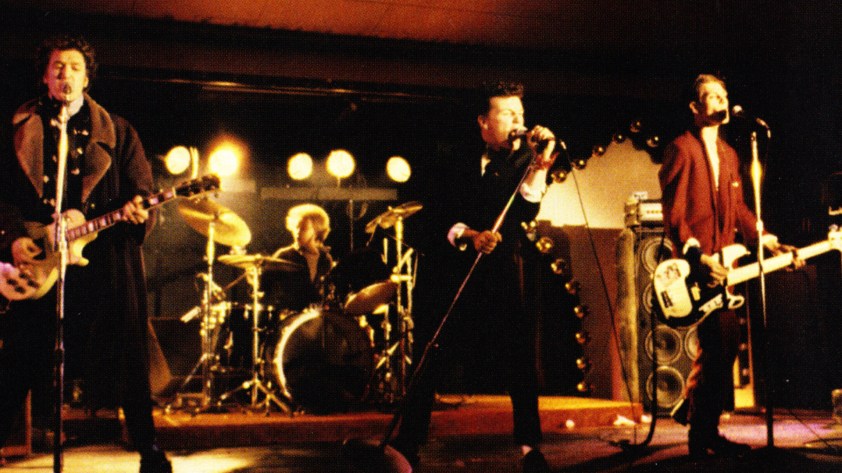
Henry Jenkins writes, “fans [choose certain] media products from the total range of available texts precisely because they seem to hold special potential as vehicles for expressing the fans’ pre-existing social commitments and cultural interests.”[19] As Dowd wrote in the script earlier, and as is pictured on-screen, Corinne’s experience of the punk band, mirrors the struggle that she has been facing internally. Her admission to Billy, “I want to be like you,” doesn’t mean that she wants to be Billy Frate, singer for the Looters, British punk band, it means she wants to be like what he has cast forth onstage. In effect, she has “poached” the image, not the man. Not unlike writers of fan fiction, or participants in on-line communities, what Corinne succeeds in doing is taking what she has seen in Billy’s performance and using it as a vehicle to express her own “cultural interests.” Part of this entails making the traditionally masculine “punk” image into one that melds Corinne’s own burgeoning sexuality and overt femininity with her demand for personal justice. Billy’s ideologies and calls to be heard correspond with Corinne’s own, just with a very different trajectory: Corinne is ultra aware of her existence as a marginalized figure, both within the rock’n’roll world and society at large, whereas Billy’s concerns lie with the class issues surrounding his British home, as well as his own personal sense of male anger.

Corinne’s ability to take what she needs from the performance and manipulate it, make it her own, is a highly revolutionary act. Yet not as revolutionary as when she actually does lift one of the Looters’ songs. Later on in the film, as the Stains are getting more and more publicity, and their fanbase is growing larger and larger, Corinne actually steals the Looters’ main song. Diegetically, it is supposed to read as retaliation for Billy’s supposed betrayal of Corinne in his attempts to find a different support act. Yet, when we see the Stains play the song, what we are really seeing is a literal representation of Henry Jenkins’ argument regarding textual poaching.

In his discussion about fans as active readers, Jenkins points out that, many times, fans “fragment and reassemble” the texts provided, in order to participate in a form of cultural production that is wholly their own, and tailored to suit their own pleasures. He addresses the fact that, primarily, this is because they are at a disadvantage, not able to fully participate in the hierarchy of cultural production, because they are the consumers, not the producers. He writes, “like the poachers of old, fans operate from a position of cultural marginality and social weakness. Like other popular readers, fans lack direct access to the means of commercial cultural production and have only the most limited resources with which to influence entertainment industry’s decisions.”[20] Truly, Jenkins’ descriptions of television fan groups could just as easily be descriptions of women in rock’n’roll.  Corinne’s reappropriation of Billy’s song, her “fragmentation and reassembling” of the Looters’ text to a Stains text, is quite simply an expression of her own experience as a marginalized person. By “poaching” their song, Corinne is able to create a whole new product, not unlike many other female musicians have by covering male artists’ songs. Sure, she stole their song, but it means something totally different now that it erupts from her mouth. Ideologically, she has basically said that she cares not for the way that she and her band have been positioned in this “Boys’ Club,” and thus she will take their work, and use it for her own ends. It is a way of fighting the forced second-class citizenship that she has been given due to her female status. Like the fan’s experience of not being able to participate fully in the production of their favorite text, Corinne’s experience has been that of a woman in the male-dominated social economy of rock’n’roll, having to take what she is given. Thus, like the fan who creates her own fan fiction to get what she wants out of a given text, Corinne reappropriates the Looters’ song, and takes what she wants, proving to the Looters’ and everyone else how instable their control over her just might be.

       Female Existence Should Not Be a Rush to the Grave…Or the Supermarket

In the book, Please Kill Me: The Uncensored Oral History of Punk, Legs McNeil and Gillian McCain quote punk icon Patti Smith as saying, “Most of my poems are written to women because women are more inspiring. Who are most artists? Men. Who do they get inspired by? Women. The masculinity in me gets inspired by the female. I fall in love with men and they take me over. I ain’t no women’s lib chick. So I can’t write about a man, because I’m under his thumb, but a woman I can be male with. I can use her as my muse. I use women.”[21]

Patti Smith, the Punk Rock Godmother

While it is important to recognize Smith’s own admission of her oppression, as well as her over-extension of heterosexist fantasies as to who is being inspired by whom (what happens to the gay/lesbian artist, in Smith’s world?) it is also significant to note Smith’s ideas regarding fluid gender identification. Smith, as a performer, has always been visually coded as more than slightly androgynous, and here, she recognizes her mental processes as being just as flexible. This refusal to stick to the strictly defined categories of masculinity and femininity is a living, breathing function of the punk rock existence for a female.

The Stains’ adoption of hyper-feminine aesthetics alongside an aggressively sexual and “tough” demeanor seems to reflect the desire to stay away from strict gender categorization, and yet maintain a female identity. This was not unusual for women in the punk world, and presumably, as a result of Caroline Coon’s role as creative consultant, it is the reason why the physical appearance, attitude and conduct of The Stains brings to mind such influential female bands from the punk-rock era, such as the X-Ray Spex, the Slits, the Au Pairs, and the Raincoats, amongst others. This band of young women seems to act almost as a kind of quoting gesture on the part of Coon and Dowd, of the bands that paved the way for these filmic “girls who created themselves.”

The Stains’ rebellion against gender stereotypes in the film reflects the same rebellion that had in a way created them.  The album cover of The Slits’ 1979 release, Cut, for example, showcased the women in the band, topless, wearing loincloths, their bodies mud-soaked. Contrasting their nudity with a clear affiliation to primal elements (loincloths) yet completely covered in mud, this album cover obscured any kind of “sexy” element that might have been drawn from the photo. This is the same band that Lucy O’Brien notes, “wore knickers [underwear] outside their trousers, wound reggae rhythms around a speed feminine sound and ridiculed ‘Typical Girls.’”[22]

The Slits, "Cut"

Lauraine LeBlanc’s work with punk women seems to corroborate these same ideas of gender transgressions that the Slits took part in. She states,

As I interviewed girls…I found that they navigated through conflicts between the gender norms of punk and femininity by constructing strategies of resistance to traditional gender norms…my research shows that punk girls, by positioning themselves outside of the mainstream culture, engage in active resistance to the prescriptions and proscriptions that overpower…adolescent girls. In negotiating between the norms of femininity and the masculinity of punk, these girls construct forms of resistance to gender norms in ways that permit them to retain a strong sense of self.[23]

The Stains seem to walk that fine line, and occupy that liminal space throughout the film. Their sartorial declarations seemed to parallel those of the Slits, in that their clothing, often sexually provocative, was worn in such a way as to announce their femininity while at the same time ridicule it. By strongly claiming femininity and yet actively denying conventional standards of beauty, attitude, and demeanor, the Stains, like the Slits, turned gender norms on their head. Locating themselves in the netherworld that LeBlanc discusses, between masculinity and femininity, the Stains had a kind of access to both worlds, and were able to present that and share that with their fans, like what the Slits and Patti Smith were able to do.

I’m Perfect, But Nobody Gets Me Because I Don’t Put Out

The space that Nancy Dowd opened up with her script, All Washed Up is one that has yet to close. Toby Vail, a member of the influential band Bikini Kill, and one of the original members of the Riot Grrl movement, is quoted as saying that Ladies and Gentlemen, The Fabulous Stains is “the most realistic and profound film I have ever seen.”[24] While Vail’s compliment is at least slightly hyperbolic, there is no reason to disbelieve her sentiment. The Riot Grrl movement followed very similar lines as the Stains and the Punk Godmothers, and is, to this day, recognized as one of the most powerful, pro-female rock movements of all time.

The re-ignition of interest in this film within the last few years is reflective both of the problematic location that women still occupy within rock’n’roll and of the still-burning fire to resist that oppression and not “put out.” The strength that was detailed in this film about young women resisting gender conventions and actively engaging in revolt against traditional social expectations by being rock musicians is a strength that few films of today carry. Although there have been a few notable exceptions, such as Prey For Rock’n’Roll, and even, to a certain extent, Josie and the Pussycats, there is still the eminent notion that women cannot be part of the rock world and stand on their own two feet. We have had plenty of films about men participating in rock’n’roll (Rock Star, Almost Famous, Sid & Nancy, Purple Rain, This is Spinal Tap, School of Rock, etc), but where are the Rebel Girls?

Before Kathleen Hanna of Bikini Kill ever sung “Rebel Girl,” a film was made about those “rebel girls” and the unfortunate misogynistic practices of a record industry set out to keep the Boys’ Club from ever breaking up.

Part of the "tacked on" final scene...

Dowd’s writing and message are just as strong today as they were years ago. Looking back on the whole thing, it’s really a small miracle that Ladies and Gentlemen, the Fabulous Stains could have made it as intactly feminist as it did, considering the production circumstances, and Dowd’s own disgust and abandoning of the project. Yet, it seems that this is the spirit of Punk Rock. Making it, even though no one thinks you will. Doing it, even though no one thinks you can. Reworking the situation, so that you can make it, and you can do it, no matter how unorthodox. Dowd and Coon’s battles against Adler and his Boys’ Club continue to pay off with each and every viewing of this film. Regardless of the issues that were had, or the somewhat ridiculous tacked-on ending (each Stain has “miraculously” aged a few years, and grown remarkably taller), the spirit of “not putting out” still shines through.

Now, whether that is just my subjective “textual poaching” or not might be debatable, but what holds through all, without debate, is that this film presents an extremely provocative and powerful example of punk rock women in all media, fiction and non-fiction, and the consequences that come alongside that, within the world of rock’n’roll. Whether it should be a film that is considered in parts, as bell hooks saw Madonna’s latter image betraying her former, or in the whole, by seeing that no matter what, the image of girls rockin’ out to the beat of their own drum matters most, Ladies and Gentlemen, the Fabulous Stains is a film that truly is required viewing. Corinne “Third Degree” Burns said that she believed that every citizen should be given an electric guitar for her sixteenth birthday. Well, the economy is a little tight right now. Maybe folks can’t quite work out a guitar. So…what about the DVD?


[1] Hooks, Bell. Outlaw Culture: Resisting Representations. New York: Routledge, 1994.

[2] Ibid.

[3] Jacobson, Sarah. “Why They Didn’t Put Out…Ladies and Gentlemen, The Fabulous Stains: The Expose of a Cult Phenomenon.” Grand Royal 6. 1997.

[4] Garr, Gillian. She’s a Rebel: The History of Women in Rock & Roll. Seattle: Seal Press, 1992.

[5] Garr, ibid.

[6] Garr, ibid.

[7] Lovich, quoted in Garr, ibid.

[8] Jacobson, ibid.

[9] Echols, Alice. Scars of Sweet Paradise: the Life and Times of Janis Joplin. New York: Henry Holt and Company, 1999.

[10] Jacobson, Sarah and Sam Green.  Ladies and Gentlemen, the Fabulous Stains: Behind the Movie. Documentary. First Aired on “Split Screen” episode #38. May 24th, 1999.

[11] Jacobson, Sarah. “Why They Didn’t Put Out…Ladies and Gentlemen, The Fabulous Stains: The Expose of a Cult Phenomenon.” Grand Royal 6. 1997.

[12] Jacobson, ibid.

[13] Jacobson, ibid.

[14] LeBlanc, Lauraine. Pretty in Punk: Girls’ Gender Resistance in a Boys’ Subculture. New Jersey: Rutgers University Press, 1999.

[15]Jacobson, ibid.

[16] LeBlanc, ibid

[17] Dowd, Nancy. All Washed Up. Original Script- Fourth Draft- revised. Paramount Pictures. January 30, 1980.

[18] Ibid.

[19] Jenkins, Henry. Textual Poachers: Television Fans and Participatory Culture. New York: Routledge, 1992.

[20] Jenkins, ibid.

[21] McNeill, Legs and Gillian McCain. Please Kill Me: The Uncensored Oral History of Punk. New York: Penguin Books, 1996.

[22] O’Brien, Lucy. She Bop: The Definitive History of Women in Rock, Pop & Soul. New York: Penguin Books, 1995.

[23] LeBlanc, Ibid.

[24] Jacobson, ibid.

[25] Jacobson, Ibid.

TCM Classic Film Fest, 2011-Initial Preparations and Looking to the Past

And so it goes. A year passes, things change, and…here we are. About to enter the insanity that is the TCM Classic Film Fest once again.

I experienced it last year, and submitted my review to a local magazine. It ended up going unpublished,  however, that doesn’t mean I can’t post the review here, one year later, right? In short, I would like to share with you my experiences from the TCM Classic Film Fest 2010.

First of all, let me preface this by letting you know that when I wrote this, I was still on my “festival high” and the magazine audience that I was writing it for not nearly as advanced as I feel that this one is. So I apologize if the tenor of the piece feels somewhat…less. In any case, you are a forgiving audience (I feel), so I will give you the writing and hope that you will at least be cheerleaders along with me.
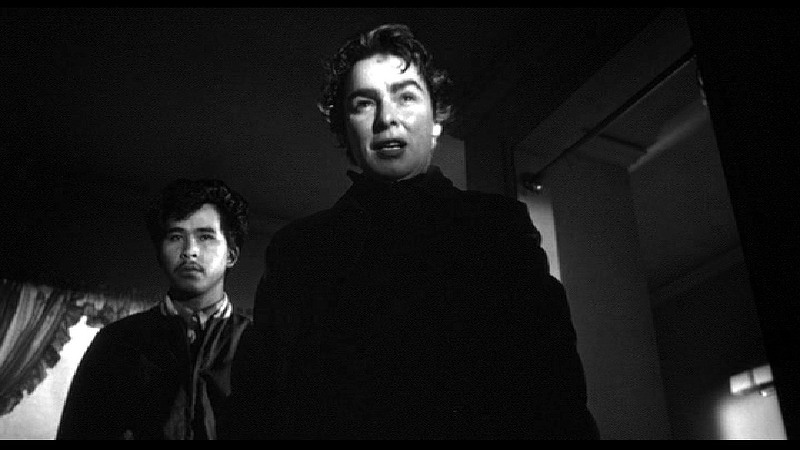
I will tell you this: The TCM Film Festival of 2010 was remarkable in so many ways that I have to publish this piece before I let you know what my plans are going to be this upcoming weekend. So here goes….

Firstly, I must confess: I am not a morning person. It takes me a while to get out of bed. However, the Turner Classic Movies (TCM) Film Festival that took place at Grauman’s Chinese and the Egyptian Theater on Hollywood Blvd, from April 22-25, was a whole different story. In fact, all I needed to know to jump out of bed that first day was: my breakfast is going to be made out of Kirk Douglas, Lana Turner, Dick Powell, and Gloria Grahame and cooked up by Vincent Minnelli in 1952. While most people I know can barely make it to work by 9:00am, I had gotten on my bike, booked it up to the Walk of Fame, bought a ticket, and was in my seat ready to watch one of my favorite films: The Bad and The Beautiful.   

And it was worth every little bit of sleep lost, as there was so much gained! First off, there was a Q&A with Robert Osborne and Cheryl Crane, Lana Turner’s daughter. Most famous for her, um, “run in” at 14 years old with mommy’s gangster boyfriend Johnny Stompanato, (she showed her approval of the relationship by stabbing him to death), Crane was actually most charming and spoke lovingly of Turner. But it had nothing on the film itself. This motion picture can knock any modern day movie trying to “expose” Hollywood’s evils flat on its proverbial ass. Twice. The bad?  Waking up early after being out way too late the night before. The Beautiful? Seeing a gorgeous 35mm print of this, pristine and larger than life…the way it was meant to be seen!

After this, I blasted through hell incarnate (read: tourists and people dressed like SpongeBob Squarepants) to get much needed sustenance and garner a spot for one of THE best and THE most cynical and downright nasty films ever placed on celluloid: Sweet Smell of Success(Alexander Mackendrick, 1957). It was in the Grauman’s Chinese, large and in charge, with a Q&A with one of the stars, Tony Curtis.
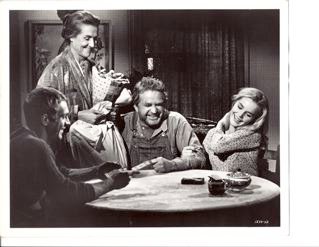
The man, the myth, the legend. See Sweet Smell of Success. Just do it.

I shouldn’t say much about this except that it was a disappointment and it was not Tony’s fault. The guy is 84 years old, and he’s more than welcome to ramble. But if you are the Q&A guy, your JOB is to keep him on track. Oh, and…try and make sure he keeps the microphone up to his mouth. It was tragic, as I would’ve liked to have had a good Q&A for this film. If you have never seen this film, you must. Mike Patton (Faith No More, Mr. Bungle, etc) really likes it. He’s used several lines from it in Tomahawk songs.

The remainder of the festival was amazing. Later that first day, I saw Mel Brooks present The Producers, and that was phenomenal. He’s sharp as a tack, funny as hell, and had great stories.

Mel Brooks outdoes everyone and probably will...forever. Flanked by Mitch Glazer on the right and Vanity Fair's Sam Kashner (who, thankfully, let Brooks have centerstage as well he should have!)

I did another 9:00am run on Saturday to see Billy Wilder’s Sunset Blvd (but I’d do almost anything for a Billy Wilder screening…you should too), and Nancy Olsen was there, looking barely any older than she did in the film! It was impressive. I visited the Egyptian Saturday night to see Donald Bogle (read his book “Toms, Coons, Mulattoes, Mammies and Bucks: A History of Blacks in Film”- educational and extremely well-written!) present some of the most exquisite 35mm transfers of out-of-circulation cartoons (such as “Coal Black and the Sebben Dwarves”)

The 35mm prints of these cartoons were magnificent and the historical discussion by Donald Bogle was beyond that.

done by folks like Bob Klampett and Tex Avery. That show blew my skull apart and made me simply ecstatic to live in a city where I could bear witness to this on a big screen!

Then there was Three Alarm Sunday. Heard of a three alarm fire? I have 3 alarms to wake me up. I used ‘em for Sunday. One was Good, one was Bad, and one was Ugly. Because that was the film I saw. It was life changing. Out of all the films I have seen in my life (and I have seen a ton), I had never seen this, and I had especially never seen it with 94-year-old Eli Wallach doing the Q&A. What do you want me to say? He was witty, funny, charming. He let loose an “I’ll stop acting when I die!”

"I'll stop acting when I die!"

and brought along a birthday card someone sent him that played the beginning theme from the film. The movie and the music were so beautiful that they made me cry. Not once, not twice, but several times. I felt lucky to have eyes and ears, and thanked Italy and Mr. and Mrs. Leone for having some sexy times to create Sergio. I walked out of Grauman’s a changed woman, and will never forget that morning.  While I saw several more films that day, including The Stunt Man (Richard Rush,1980), Murder, He Says (George Marshall, 1945) and one of my all-time-favorites, In a Lonely Place (Nicholas Ray, 1950), The Good, The Bad and The Ugly is a film that went beyond the pale, and really “tied the room together, man.” Thank you TCM, and thank you Los Angeles for providing me with a nice little film vacation! Can’t wait until next year!

And so we have come full-circle. It is now next year. I have been chatting excitedly with my good friends Karie Bible from Film Radar and Dennis Cozzalio of Sergio Leone and the Infield Fly Rule and we all agreed in our different conversations that this year’s schedule is *just* as difficult to prioritize as last year’s. Realistically, the fact that I even have a pass to go to the thing makes me feel like Charlie Bucket getting a Golden Ticket to Willy Wonka’s factory.  That said, when you put certain things against each other at the same time, it truly is like a filmic Sophie’s Choice. That said, I am going to now present you with what I feel will be my schedule for the TCM Classic Film Festival 2011. Feel free to comment on it at will!

THURSDAY, April 28th

7:15- A Night at the Opera with What’s Opera, Doc? on 35mm, guests: Andy Marx and Robert Bader

-I’m not sure if I have seen a Marx Brothers film on the big screen before. So…I’m gonna make sure that I have.

10:15-The Devil is a Woman on 35mm, guest: Katie Trainor

-totally problematic, TOTALLY Von Sternberg/Dietrich, and to quote the TCM site- “When Spain threatened to ban all Paramount pictures over the film’s depiction of their police guard, the studio pulled it from worldwide distribution and destroyed the master. They also released von Sternberg from his contract prematurely ending a level of artistic freedom that the director would never enjoy again.”  This is the world premiere of a new restoration from MOMA. Can we say excited, boys & girls?

FRIDAY, April 29th

-9:00am, Becket on 35mm, Q&A/Discussion w/Peter O’Toole

-I am getting up SUPER early in order to be able to see this. If I do not get a good seat for this I will be crushed. I am soooooooo looking forward to this it’s kinda silly. As I have commented to friends of mine, this is kinda one of the first “bro” movies. But, as far as I’m concerned, it’s the kind of “bro” I LIKE watching. Peter O’Toole in person. Need I say more???

-12:45pm Bigger Than Life on 35mm, guest: Barbara Rush

-It’s on scope. It’s by Nicholas Ray. It’s got Walter Matthau. 2008 restoration. I’ve never seen it. It’s about drug addiction and the ripping apart of the “picket fence” thing. I’m SO IN.

-3:45pm The 7th Voyage of Sinbad on 35mm, guest: Bruce Crawford

-DUDE. Harryhausen. 35mm. Are you out of your mind?? I may resemble a female in all the ways I am supposed to, but when it comes to things of this nature, I WANT ADVENTURE AND BIG MONSTERS ON THE BIG SCREEN. I will not hide the 14-year-old-boy that resides in my brain. And he gets treated to some rockin’ good times with this. Thanks. I could lie and tell you that it was just because I wanted to write about the Bernard Herrmann music, but why beat around the bush???

-8:00pm Spartacus, digital, guest/Q&A: Kirk Douglas

-So I have dreamed of seeing Kirk Douglas in person since…oh…forever. I love that he is a man that doesn’t let anything keep him down and I love his dedication and his passion. I just want to see him in person. I have also never seen Spartacus on the big screen. There is something somewhat romantic to me about seeing it at the Egyptian. So…I am going to do this. I am *hoping* that it will let me out early enough to make the midnight at the Egyptian, however….

-12:00am The Tingler, 35mm, guest: Bruce Goldstein

-I love William Castle. I love Vincent Price. I make it a point to never miss a chance to see a Castle movie when it is being projected, if i can help it. So…if I can help it, I’m gonna try to make it! If I can’t then, ah well.

SATURDAY, April 30th

-9:30am This is the Night, 35mm, guest: Jennifer Grant

-It’s the film that launched Cary Grant’s career, got Thelma Todd in it (aka “Hot Toddy” who died under very mysterious circumstances), it’s pre-code-era, and it’s a new restoration from the UCLA Film & TV Archive. Sounds good for breakfast!

-12:00pm The Outlaw Josie Wales, digital

-Clint Eastwood. Big Chinese. Need I say more?

-3:45 Went The Day Well?, 35mm, Guest: Kevin Brownlow

-OK, so this is where it gets super painful for *me*…I need to see Outlaw Josie Wales so therefore I cannot go to the “Conversation with Kevin Brownlow” that they are having. This part SUCKS. If you don’t know who Kevin Brownlow is, he’s the guy I wanna be when I grow up. He got an Academy Award for the work he’s done with film preservation, ok? So instead of the “Conversation with…” I’m going to see this film. Don’t get me wrong. This film looks incredible!!! It’s loosely based on a Graham Greene story, it’s a North American premiere of a new restoration, it has all the right stuff. And Brownlow is going to speak on its merits! But…it’s playing at the same time as Carousel, one of my favorite musicals in the entire world, a film I have NEVER gotten to see on a big screen, and a film that never PLAYS on a big screen. Yeah, Sophie? You and your choices can go to hell. I’m still loving my Golden Ticket, though. Oy vey.

***here’s my two options that I haven’t decided on yet:

-6:15 Niagara, 35mm, guest: Foster Hirsch

-Love me some Hathaway, great dark Marilyn film, and Foster Hirsch is a badass mofo when it comes to film noir-y writing and that kinda stuff. I would LOVE to see him talk about this film. To be honest, 50% of the draw of going to Niagara is Hirsch. But…I haven’t decided yet.

OR

-6:30 Pennies From Heaven, 35mm, guest: Ileana Douglas

-Don’t think I’ve seen it on a big screen, wonderful film, Steve Martin…pretty irresistible. This slot is a REALLY HARD CHOICE. I may not know what I’m going to until a little while before I go…

-9:30pm One, Two, Three, 35mm, guest: Michael Schlesinger

-It’s Wilder. We do not miss Wilder. It is a rule. Kinda like breathing. ‘Nuff said.

-12:00am The Mummy, 35mm, guest: Ron Perlman

-I think I would have to be mildly stupid to miss seeing the 1932 film The Mummy at the Egyptian theater. If I can make it there in enough time from the Wilder…I’m there. Plus…uh, RON PERLMAN?????? Yeah.

SUNDAY, May 1st

-9:15am The Sid Saga, 35mm, guest: Ross Lipman

-I’m not going to lie. I’m going to this purely because of the film preservationist/restorationist. Ross Lipman is fantastic and everything he has worked on is so fascinating and to me that I pretty much trust his name at this point. He’s also an incredibly nice guy. I am very much looking forward to watching this piece. Once again, it looks like another really exciting and super cool film preservation achievement.

-12:30pm Bright Boulevards & Broken Dreams: The Story of Black Hollywood, Speaker: Donald Bogle

-I’m a sucker for a film academic who can entertain while also educate. And Donald Bogle fits that bill to a T. Therefore, I think I may go ahead and check him out again. He was awesome last year with the cartoons, so…sure! Let’s go for it!

-3:15pm A Place in the Sun, Guest: Rose McGowan

-Why Rose McGowan is the guest for this film…I have no clue. I know she was on TCM, so I have to conclude she digs this film a whole lot. To be perfectly frank, I’d rather have Alec Baldwin tell me why he likes George Stevens, but hey- not up to me, right? In any case, I’ve never seen the film and I just finished a book that uses it as a fairly central plot point, so I think it might be a good idea to finally see it.

So…there are a lot of TBAs still on Sunday, and I might catch Westside Story  or Manhattan, but I’m not sure. This is where my schedule is at this point. All I know is I’m going to be EXHAUSTED on Monday. This is like Comic Con, just less smelly and crowded and more (dare I say it?) nerdy! In any case it is equally so. And I cannot wait. So there you have it. That is my plan. Perhaps I will see you there?

March Madness at the New Beverly Cinema: The Whole Bloody Affair

Standing in line tonight I had an infuriating conversation.

“Yeah, I only went to Grindhouse and Kill Bill. But I came to Kill Bill yesterday and today, and I’ll be coming some other days too. I’m a huge Quentin Tarantino fan,” the young man said, nodding at me wildly, trying to assure me of his fandom.

My eyes widened. They must’ve gone fiery. “No. You. Are. Not,” I calmly informed him, “if you were a ‘huge’ fan, you would’ve been to at least a few of the other shows that he programmed this month. You would not have just attended the films that he directed.”

The young man fumbled a bit and came up with a few reasons that he couldn’t be at the other shows during the month. Work, life, and so forth. Now, I will readily admit- not everyone is as big of a cinephile as I am. Very few people are. I know most of the ones in Los Angeles, and I treasure them like they are my Holy Grail. However, this specific argument upset me.

I’m not going to blame this particular gentleman. For all I know, he could have been insanely busy, and these occasions very well could have been the only times he was able to come to the New Beverly. However, what he is bringing up is an issue that I take issue with. This month we had a very special calendar. One that was very carefully and lovingly put together by Quentin Tarantino himself, as it was his birthday month.

Now, whether or not you are a fan of Tarantino, there is one thing that you cannot deny no matter how hard you try: the man LOVES film. When someone loves film as much as he does, there is a better than average chance that in a month of programming movies, there are going to be at least a couple of great choices. In addition to this possibility, even if you dislike every film on the roster, the chances of you getting to see some of them again, in actual print format, on a big screen…? Well, I don’t think I have to tell you the likelihood of that. So, if you’re into rarities, you got that going for you too. And, for those out there who are fans (and this is what really gets my goat), this month of movies is essentially serving as a microscope onto HIS films. Each film shown this month had something in it that was directly related to his own work (aside from the pieces of his own work that he showed). For me, that was the true gift. All the kids out there complaining about the fact that Quentin hasn’t done any commentaries or doesn’t take pictures with fans or assorted other excruciatingly shallow comments missed the point of the festival: this was his commentary track, guys.

I saw a plethora of great films this month. I saw a double feature of Blume in Love and Bob and Carol and Ted and Alice, with a Q&A with Quentin and Paul Mazursky himself. Not only did these films floor me, but they were perfectly programmed.

Paul Mazursky, 1969

While Bob and Carol will fill your heart with joy and hope for relationships and teach you that marriage CAN work and that human beings CAN properly communicate with one another if they wish to, Blume in Love will disturb the hell out of you, and teach you how one person’s ego can completely ruin a relationship to the point of disaster. Blume is fascinating in its dark horrific complexity where Bob and Carol is equally fascinating in its comedic intricacies.

Paul Mazursky, 1973

I got to put another notch on my Clint Eastwood belt and see Escape From Alcatraz (I have a goal which is to see every film either starring or directed by Clint Eastwood on a big screen- silly, I know, but whatever. It’s my dream, lemme have it!!) alongside this INSANE film called I Escaped From Devil’s Island. What can I really say about Devil’s Island except that any movie that has alternative male sexuality, native nymphomaniac women wielding coconuts as weapons (and no tops), a prison camp narrative, and random bits of stock footage shark sequences pretty much automatically has my heart. That movie don’t fool around, no way, no how.  And will I ever get to see such a beautiful print of that again? Nope, I seriously doubt it.

William Witney, 1973

And then, of course, there was Rod Taylor night…the night that so many of my friends were looking forward to and I was so very interested in. To be frank, I had only a peripheral knowledge of Taylor. I knew him slightly, but so many people whose opinions I valued so very highly were so very very excited about this event that I knew I had to attend. Once again, my lovely cineaste-cohorts were not mistaken. While I felt a bit embarrassed about not knowing more about the actor and yet being excited about the night, I was more excited about learning what I had been missing. See, I’m not one of those people who will fake it if I don’t know something or haven’t seen something. I will come right out and tell you, here and now, I have never seen Jaws. Go ahead, make fun if you like, but my first time seeing it will be on a big screen dammit, and I. Will. Have. A. Blast. In any case, I figured that this could only be another case of me getting to know a new person in my life! So, I strapped on my Rod Taylor MAN-boots, and went to the double of Dark of the Sun and Hell River. While I greatly preferred Dark of the Sun, Quentin’s intro to the films and his enthusiasm for Taylor was catching. I was an instantaneous fan, and a few days later at stupid o’clock in the morning, I found a Rod Taylor film playing on TCM, and I totally watched it.

Jack Cardiff, 1968

I saw so very many things this month from Tarantino’s programmed calender. I watched Richard Franklin’s Road Games (1981) along with Sydney Lumet’s The Anderson Tapes (1971). I finally got to see Stone (Sandy Harbutt, 1974) and enjoyed the living HELL out of the moonshine double-feature of White Lightning (Joseph Sargent, 1973) and Last American Hero (Lamont Johnson, 1973).

While I didn’t see everything, I saw quite a bit of what was offered. While I didn’t like everything I saw, what I liked, I loved. I think my favorite part of the whole deal was that for a month straight not only did I see my film-friends at the movies (who also seemed giddy at the chance to see rare films on the big screen) but we were all having fun. The main theme in all of these films was a kind of energy that is endemic to the Tarantino product. Each film projected held some kind of spice that Quentin has used to build his own works, and not in some “rip-off” way as I used to believe. I also do not believe it to be simply homage either, but that is due to tonight’s viewing of Kill Bill: The Whole Bloody Affair.

I will readily admit that I was never a huge Tarantino fan. I always adored him for Rolling Thunder Pictures and was forever grateful for his help in making Wong Kar-Wai a “film household” name. I always respected his film knowledge and I always admired his passion for cinema as it seemed as gargantuan and as intense as my own. While I have often gotten made fun of over the years for my obsessive devotion and outspokenness in regards to the Seventh Art, so, too, have I heard people knock him for the very same thing. But in my world there is absolutely nothing wrong with getting seriously excited about something that you love dearly and that gives you so much joy .

In any case, suffice to say that I certainly liked his films a lot but didn’t love them. Except maybe Jackie Brown. For some reason, I really loved that one. But that’s a whole other blog entry for another time. My fandom was basically predicated primarily on his self-achieved academic success and only partially on cinematic product. Things have since changed a bit. And this is where his March programming at the New Beverly fits in.

As I moved through the month with my friends and we cheered and clapped and laughed our way through the films, I noticed other things besides the fact that there were certain running themes of moonshine, racing cars/motorcycles, Dyan Cannon, and prison escape. There was cinematic tension to be sure, but I also started recognizing elements that Tarantino had taken from these particular types of films (and sometimes exact films) and used for his own- the “spice” I mentioned earlier. Many people have seen this as a kind of “lifting” or “borrowing,” which would ultimately mean that a Quentin Tarantino film is nothing but a collage. People accuse him of being nothing but a rip-off artist. Years previous to now, I might have agreed. But after having seen many of the films being paid homage to and worked with, I see that that is not at all what Tarantino ends up creating in his own pieces. Even by placing actual set-pieces that are almost identical mirror-replicas from the original source (ie the fight scene in Kill Bill between Lucy Liu and Uma Thurman in the snow is shockingly similar to one in a film called Lady Snowblood) it does not mean that the film itself is a “rip-off.” In fact, to me, it is the exact opposite. While that scene may end up becoming part of the history of that piece, certainly, it does not cause the initial piece of cinema any harm nor does it mean that the new cinematic creation is carrying all the little bits and pieces of meaning from the “first draft.” After all, no one got angry at George Lucas for “ripping off” Joseph Campbell’s Hero with a Thousand Faces with Star Wars, did they?

What Tarantino manages to do is something that I have written on many times- he creates a kind of cinematic palimpsest; something that only someone who truly loves the originating work can do with any modicum of success. Now whether you like/love/hate/feel indifferent towards his own films, his meticulous ability to create new and exciting media while reworking older visuals and themes is to be respected. There is indeed much within Tarantino’s film content that may indeed seem familiar. OK, fair enough. But to oversimplify the work and say that his films are mere pastiche is to underestimate the original content and downplay the effect of the newly created feature. I have many compatriots who are not fans. To each their own. My take is that, regardless of personal feelings on the content, one should be able to respect the construction. And as far as that is concerned, Tarantino just keeps getting better every film he makes.

What happened this month for his birthday celebration that was so very fabulous was that he revealed that construction- he told his New Beverly audience what goes into making a Tarantino film. This was quite a bit different to the last festival he did at the New Beverly, which was the Grindhouse Film Festival, back in 2007. That was another one that knocked my socks off. In fact, I went to so many shows, I couldn’t remember the exact number! My ex-boyfriend reminded me that I only missed 2 out of 25. It was another awesome engagement, but that one was focused on celebrating the release of the film Grindhouse (2007), thus they were all GRINDHOUSE features. This month? It was a slow build-up, and you HAD to be there. If you missed it, then you missed out.

As a cinematic architect, Quentin Tarantino built up the entire program this month in accordance with showing the grande finale which was Kill Bill: the Whole Bloody Affair. The last films I saw before I saw Kill Bill were the films contained in the triple martial arts feature: Avenging Eagle (1978), Duel of the Iron Fist (1971), and Fighting Fists of Shanghai Joe (1973). I believe that the first two films were the very first Shaw Brothers films I had ever seen in my life, although I cannot say for certain. Going to college in Santa Cruz, I have to admit that there were several times I found myself hanging out with young men who would light up a joint and toss on a kung-fu movie, while I sat there amused on the couch, drinking a beer. In any case, I was totally consumed by the ones I watched at the New Beverly. Unlike those lazy college afternoons, I was sitting in my favorite movie theater watching an incredibly colorful print and engulfed in some pretty intense storylines regarding honor, friendship and respect. Avenging Eagle was undoubtedly my favorite (and not just because the stars were super hot). This film got me due to the fact that the narrative had a wild amount of humor intermixed with the drama and the physical dynamics that were truly on a different level than anything I had seen (at least recently). It was shot in such a way that the camera work itself seemed balletic alongside the intensely beautiful martial arts.

What I remember noticing as well was that each fight told its own story. Being a noir scholar, I felt that these fight sequences were not dissimilar to the way that noir cinematographer John Alton used to talk about physical darkness in film: he said that there was more contained within and more fullness/usefulness to shadow than there was in light. Thus he used more dark. If you see any of his films, they are some of the BLACKEST films ever committed to celluloid. Now, I’m definitely an action girl. I dig me some Die Hard, some Commando, some Lethal Weapon and many more. But what action films seem to do and martial arts films do not is weave the action directly into the narrative. Martial arts films create a very significant and almost sacred space for the action to take place in. Within the films we are used to, the action simply is part and parcel of the film, just as most films are shot using light as a method of focus. Alton’s theory of using darkness to flip things around was significant. It said: read this film differently- this is not your standard film, with your standard everyday narrative. And, indeed, Alton’s films were most definitely not standard fare. Watching these Shaw Brothers films and seeing these action sequences spoke to me on that same level.

I didn’t think I was going to get a chance to see Kill Bill: The Whole Bloody Affair, to be honest. It sold out in no time flat. I was gut deep in the middle of writing something for the Film Noir blogathon when they went on sale, and totally missed out. To be honest, I wasn’t that upset. I thought, “No big deal, so there’s gonna be s’more gore, in color, it’d be cool…but I missed my chance at a ticket. Oh well!” I got lucky. And I am so very very thankful that I did.

New Beverly Cinema, March 28, 2011

I would like to point you towards two lovely write-ups that have been done on Kill Bill, as they are smart, succinct and perfectly written. They also go into quite different arenas than I will. However, I think they deserve to be read, as they assist me in my argument on why this version of the film is so wonderful. The first, from Mr. Beaks at Ain’t it Cool News, is a beautifully composed piece that essentially posits: “Shorn of commerce-conceding baggage, turns out KILL BILL is a masterpiece after all.” The second, from Todd Gilchrist over at Cinematical, discusses all the things that were done correctly in this updated version and the things that he feels were not necessary. Both pieces say much of what I feel on the subject and are exceptionally written. In addition to those pieces, however, I have a few thoughts that I would like to share.

I like to refer to myself as a feminist film theorist. People bristle when I say that…I could care less. But I’m that chick that has a raging hard-on for horror films, action films, Giallo, pre-code and noir and finds very little that is “anti-women” in any of it. I don’t think violence inflicted upon a female in a film is, in and of itself, misogynistic. You have to really prove to me that there is misogynistic intent. Then again, there are so many films that are furiously angry towards women in such a way that it cannot be immediately understood. To me, those are the most dangerous pieces of media. Then again, it’s a very tricky area with lots of fine lines. That said, I would like to argue that Kill Bill:The Whole Bloody Affair is, by and large, one of the strongest pro-female films I have ever seen. Indeed, I feel that Tarantino himself is an incredibly pro-female director. Unlike many filmmakers who divest their female characters of all their agency (and yes, this does include some female filmmakers sometimes) Tarantino’s modus operandi is to instill as much power in his ladies as possible. Powerful examples of this (aside from basically every female character in Kill Bill) include the characters played by Pam Grier in Jackie Brown (1997),

Pam Grier as Jackie Brown...The New Beverly showed several trailers of her early films during March; films that clearly influenced the way Tarantino chose to portray women in film

Zoe Bell, Tracie Thoms and Mary Elizabeth Winstead in Death Proof (2007), and both Diane Kruger and Melanie Laurent in Inglourious Basterds (2009).

Melanie Laurent as Shosanna/Emanuelle in Inglourious Basterds, the brave and talented projectionist who, essentially, wins the war through her actions in the film

The empowerment that the women in his films receive is, by and large, more effective than the empowerment that I have seen any women receive in “chick flicks.” But then again- perhaps Kill Bill is just my kind of Chick Flick. Tarantino uses the Kung-Fu rhetoric within Kill Bill to establish and discuss the reclaiming of power within one woman, played by Uma Thurman.

Uma Thurman as The Bride/ Beatrix Kiddo

He leads us, through several different time shifts, through her multiple rebirths. He shows her powerful as a well-oiled machine and as helpless as a newborn baby and aligns us with her each time through her direct address. And just at the point in the film when she is the most powerless, when she has been stripped of all possibilities of escape and the world at large thinks she has been, literally, laid to rest…she is reborn yet again through her inner strength that she was trained to translate into outer strength. Now…seriously…how new-age-y does that sound, right? But that’s what happens. And it’s damn BLOODY. Holy CRAP.

The devastation of the Crazy 88 in The Whole Bloody Affair takes on a whole different meaning than it did before. The additional footage and the fact that it was entirely in color made the scene completely seamless. By repairing the color consistency and removing the black and white shots, the whole thing reads more like the gore-filled ballet of beauty it was intended to be.

Just as I noticed that the Duck hood ornament from Deathproof was the same one featured prominently in the trailer for Convoy showing right before Five Minutes to Live (Bill Karn, 1961), I realized that many of the elements that had been featured in the martial arts triple feature were the ones focused upon in Kill Bill. Honor, integrity, physical dexterity/ability, and (most importantly) revenge. However, placing it within western confines and the female spectrum lent it a uniquely new flavor. While Tarantino clearly used the original Kung-fu films as part of the original thematic parchment, the strong female iconography was the other main layer he put on top, in addition to the other, more aesthetic ones (the anime section, the graphic violence, etc). In total, his Kill Bill palimpsest reflected the Shaw Brothers title card that he slated at the very beginning of the picture, but also each of the additional filmic influences, from Lady Snowblood to The Searchers. Through this combinatory tactic, Quentin Tarantino created a new product that we know as Kill Bill and is best seen as Kill Bill: The Whole Bloody Affair.

If one were to look closely at Deathproof or Inglourious Basterds or his other works, you could see the same kind of architecture. They are all cinematic palimpsests: layered parchments that reflect the past but have new stories written upon them. Cinema itself is like that, a kind of self-reflexive medium, so it is no surprise that Tarantino’s work would constant reflect and refract its own history. But his twist is that it is not simply mirroring, it is creating as well. And to me, that is impressive.

I know that what I learned this month was that I really don’t need any damn commentary for a Quentin Tarantino film, because I needed to know about Tarantino films, I learned at the New Beverly Cinema. Thanks again guys for an amazing month. See ya in the front row soon!