Controlled Testimonies: Cinema, the State, and Nationalism

Hey there! Here is my final piece for the Japanese Cinema Blogathon. I hope that you have enjoyed these pieces and perhaps donated a little money along with the your time spent reading them. I appreciate and so do the people of Japan. Thanks again to Japancinema.net and Cinema-Fanatic.com for putting this blogathon together so quickly. Great work, guys!

Once again, if you would like to donate, just click on the Totoro below, and it’ll take you to the donation site. Enjoy!

The historical relationship between cinema, the state, and nationalism is as complicated as it is far reaching. In reality, these things have always been intertwined; although, for reasons that will be made clear, this fact has not always had the greatest outcome. As the state governs the finances of any given country, and many countries’ film industries are at least partially sponsored by those monies, many a country has seen economic state involvement in their filmmaking. Film is essentially a cultural product and, as Benedict Anderson states, the cultural products of a country have always shown immense dedication to a sense of national spirit or pride[1]. Following this logic, whatever involvement the state might have had with film has also been an involvement with a strong sense of nationalism. Amongst the many examples of this, the two most explicit examples of the historical involvement of politics and national identity in cinema can be seen in the cinemas of Italy and Japan.

According to Paolo Cherci Usai, Italian film production began fairly late compared with the rest of Europe. However, after 1905, the “rate of production increased dramatically in Italy, so that for the four years preceding the First World War it took its place as one of the major powers in world cinema.”[2] From this point up until Mussolini came into power and the talkies began, the Italian national cinema was fairly free and successful, barring the periods of hefty competition that it suffered from other nations such as the US and Germany. When Mussolini and fascism got involved, the entire industry and its product altered dramatically.

As sound was being introduced, the national cinema that had previously ranged from historically-based films (such as Alberini’s La Presa di Roma, 20 Settembre 1870/The Capture of Rome, September 20, 1870 or Pastrone’s Cabiria)

Cabiria (Giovanni Pastrone, 1914)

to socially concerned literary adaptations (like Ambrosio’s Cenere/Ash, based on a book by Grazia Deledda) shifted its content as a result of being under complete state control. Although the “official sanctioning” of censorship passed in 1923 and was “honed and perfected” throughout the next few years, the committed involvement of the Fascist regime was, as Morando Morandini notes, late in arrival.[3] However, once they got involved, they effected harsh and quick changes to the entire Italian cinema culture. While previous Italian films had definitely promoted a sense of nationalism, the fascist state sought to gear Italian cinema toward its own concept of national identity, through censorship and other means.

As far as the silver screen was concerned, Mussolini’s slogan, paraphrasing Lenin, and mirroring the sentiment of the German Minister of Propaganda, Joseph Goebbels, was “For us, cinema is the strongest weapon.” He advocated a strong censorship code as well as economically facilitating a complete restructuring of the Italian film industry. In 1935, the Direzione Generale per le Cinematografia was established to “co-ordinate film industry affairs.” As Ephraim Katz relates, by the onset of World War II,

The government had taken firm control of the film industry…an ingenious scheme made it illegal to show foreign films in their original language versions or subtitled: they had to be completely dubbed into Italian, a process that made it easy to substitute whole sections of dialogue, thus purging the films of any “harmful” ingredients.[4]

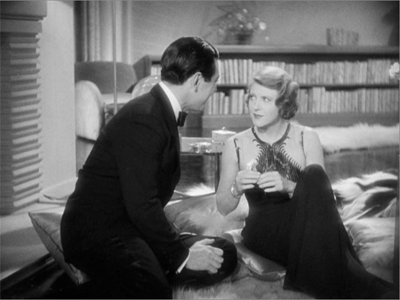
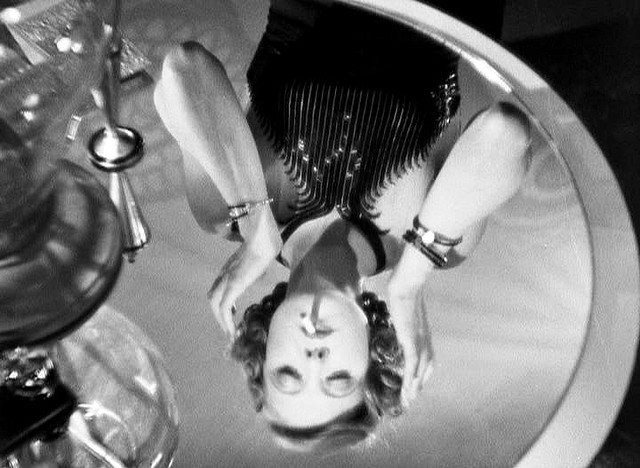
The vast quantity of Italian films during this era belonged to (primarily) one of two categories. The first category was the telefoni bianchi films or “white telephone” films, known as such because of the continual presence of shiny, white telephones.

"White Telephone" movies

These movies were primarily made up of  “glossy” escapist comedies or dramas, emphasizing upper class values and glamour. The second category was the propaganda film, which Morandini divides up into four types: patriotic and/or military films, films about Italy’s “African mission,” costume dramas that were a “parade of precursors of the ‘Duce,’” and anti-Bolshevik/anti-Soviet films.[5] All of the propaganda films concentrated heavily on a nationalistic spirit, proving the “superiority” of Italy and Italian culture through cinematic representation.

Whether a propaganda film or a telefoni bianchi film, it is clear that Mussolini’s influence altered cinematic product. Within these genres that either emphasized complete negation of contemporary realities or centered solely on the government’s definition of national identity, the incestuous relationship that had been forged between government, nationalism, and cultural product was obviously at the forefront. Mussolini’s censorship laws and dubbing laws made it impossible for any outside product to enter the country without being tampered with, not to mention the fact that any and all films with “questionable” content were considered illegal and therefore not allowed to be made. There was even a law that stated that for every three foreign films shown (which were “fixed”, censorship-wise), an Italian film (also “fixed” due to national cinema-creation laws) must be projected, reiterating the nationalism that Mussolini wanted to instill in his subjects. The state maintained complete control over what the Italian public was exposed to. It is not surprising then, that shortly after this period, the Neo-Realist movement came along to try to break free from governmentally imposed ideologies of national identity.

Italy, however, was not alone in being affected by the relations between cinema and state. The Japanese cinema culture had been dealing in national identity since it began, and, at approximately the same time that the Italian Neo-Realists moved in to try to shatter the hold that Fascism had on their cinematically developed national identity, a group of directors in Japan attempted to do the same thing.

Audie Bock identifies the Japanese cinema as having three significant periods: the “first golden age” in the 1930’s, the generation that “emerged from the moral chaos after the war,” and what she calls the “new mood” in the 1960’s, that spawned a “new wave.”[6] Within the first two periods, the three most common genres in the Japanese cinema were jidai-geki (period dramas),
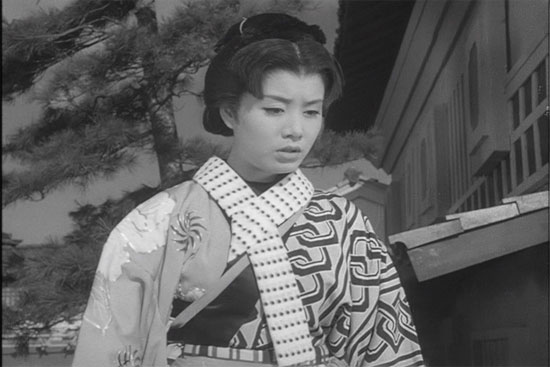
Hibari Misora, famous Japanese Enka singer who starred in many jidai-geki.

gendai-geki (modern dramas), and, the lesser known, shomin-geki (films mainly portraying the daily life of the lower-middle class). After the war, the United States occupied Japan, outlawing any film that seemed to possess nationalistic rhetoric, thus the jidai-geki, seen as supporting the feudal system and celebrating Japanese historical events, were made illegal.

The imperialistic action taken by the US in banning the jidai-geki was not only one of the catalysts towards the creation of the Japanese New Wave, it also serves as an example of how governmental incursions (even from foreign governments) can have a serious effect on a given cultural product and its influence on national identity. The removal of the jidai-geki was a huge blow to Japan’s national image. Censoring or outlawing this genre was one of the ways that the US was able to humiliate Japan, and maintain power. Like Mussolini, by controlling the images, the US was attempting to control national identity, as well.

Not everyone took too kindly to being occupied by the US. In fact, a cadre of filmmakers objected to it and its impact on Japan with fervor, and displayed that in a set of films made in the 1960’s. In his incisive work on Japanese New Wave cinema, David Desser defines the New Wave as a movement “concerned with creating a film content and form capable of revealing the contradictions within Japanese society and with isolating the culture’s increasingly materialist values and its imperialist alliances.”[7]
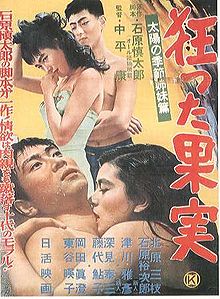
Japanese poster for Ko Nakahira's film, Crazed Fruit (1956). This film is widely considered to be one of the first films in the Japanese New Wave movement.

Annette Michelson historicizes this movement for us in a very insightful manner. She addresses the political events and resultant student protests that sparked the hearts, minds, and cameras of these New Wave filmmakers into action, stating

It was in the struggle of 1959-60, against ratification and implementation of the U.S.-Japan Security Treaty, in both its original and revised versions, that the movement reached its culmination. Ending in defeat, the struggle, which left its mark on the Japanese polity- and upon its artistic practices-must be seen as linked to the more general movement of opposition to the United States’ Cold War policy. [8]

By identifying the movement as being located within the confines of this protest against imperialism and political policy, Michelson catalogues the location of this film movement. In doing so, we are shown the development of a new Japanese national identity, based not on past oppressions, but upon breaking free of those bonds.

Ironically, most of the Japanese New Wave filmmakers were not independent. Like the US, the Japanese film industry had a system that involved not only vertical integration, but contracted directors. Thus, most of the films that are considered “New Wave” were actually studio films! Directors like Shohei Imamura, Seijun Suzuki, and Nagisa Oshima all subverted the system from the inside out, although eventually leaving the big studios like Shochiku, to search of a more autonomous creative environment.
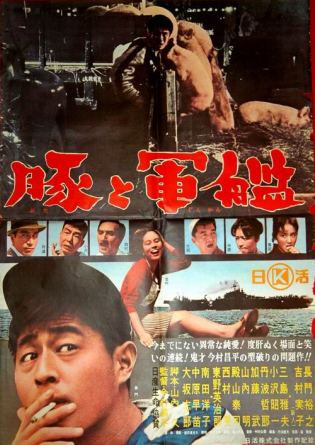
Shohei Imamura's Pigs and Battleships (1961) directly confronted issues having to do with the US military and the Japanese class system.

Out of all the New Wave directors, the one who exemplifies and reveals the most in regards to the movement is Nagisa Oshima. Not unlike Sergei Eisenstein, or many of the young men at Cahiers du Cinema, Oshima was not only a skilled director, but he was a frequent contributor to many film publications. Throughout his career he wrote extensively, not only about his own work and films he enjoyed, but also about the state of Japanese cinema and its relation to politics and history. His film, Night and Fog in Japan (1960), is an exquisite example, not just of a New Wave film, but also of the relationship that Japanese cinema and its “studio system” had to the political situation at the time.

Night and Fog in Japan (Nagisa Oshima, 1960)

David Desser describes Night and Fog in Japan as

One of the paradigmatic films of the Japanese New Wave Cinema…The film is explicitly about the political protests surrounding the renewal of the Security Pact and about the politics that characterized the immediate postwar era. As if to insist on the difference between the generation of the 1960s and its immediate predecessor in the postwar era, Oshima’s film juxtaposes two groups of student radicals- student Communists in 1952 and student protestors in 1960.[9]

Four days after the film was released, Shochiku, the studio Oshima was under contract to at the time, pulled Night and Fog, claiming “poor box office.” Oshima was livid. He knew that it was not the box office that was the problem. After four days? It wasn’t even given a fighting chance! In a highly passionate article in Film Criticism, Oshima addresses Shochiku, directing his protest to their “executive offices.” With “unrelenting anger,” Oshima writes,

This massacre is clearly political oppression. This is demonstrated by the film’s having been withdrawn in spite of the fact that its box-office figures were only slightly lower than usual, and by the sudden way it was withdrawn. If this isn’t political oppression, let even one theater, one independent screening group, give it one opportunity to be shown! Lend it out!…If this isn’t political oppression, what is it?[10]

Oshima continues, stating that Shochiku has “succumbed to political oppression” and that Night and Fog is a crucial film if for no other reason than the Japanese audiences have been given “foolish movies” for too long. Oshima ends the article on a determined note. He grimly states that he is not about to give up, because he believes “in the potential of the audience- that is to say, of the people. I believe they can change…I will continue to make work like this.”[11] The fortitude that Oshima shows, as well as his populist stance, exhibits a sense of strong national identity against the workings of the state. In addition, this article shows Oshima’s immense dedication to the cinema, even within a system of politics that was seeking to undo him, and disassemble the power of a movement designed specifically to stimulate a new kind of nationalism for the Japanese people.

Within the cinematic histories of Japan and Italy we can see two explicit examples of the relationships that are formed between cinema, nationalism and the state. Viewed in a larger perspective, there is a relationship between the two countries based on time period and global history. Italy was not alone in its experience. Many countries previous to and during World War II experienced periods of forced artistic submission, creating feelings of oppression that built up and exploded onto the creative world in the 1960s. Even the United States film industry was a victim of the state, dealing with the Production Code Administration and its censorship techniques. The Japanese New Wave demonstrates the next stage in this process, showing the ultimate effects of a country’s subjugation to an unwanted authoritative power.


[1] Anderson, Benedict. Imagined Communities. New York: Verso, 1983.

[2] Usai, Paolo Cherci. “Italy: Spectacle and Melodrama.” The Oxford History of World Cinema. Ed. Geoffrey Nowell-Smith. Oxford: Oxford University Press, 1996.

[3] Morandini, Morando. “Italy From Fascism to Neo-Realism.” The Oxford History of World Cinema. Ed. Geoffrey Nowell-Smith. Oxford: Oxford University Press, 1996.

[4] Katz, Ephraim. “Italy.” The Film Encyclopedia, 4th ed. New York: HarperCollins Publishers, 2001.

[5] Morandini, ibid.

[6] Bock, Audie. Japanese Film Directors. Tokyo: Kodansha, 1978.

[7] Desser, David. Eros Plus Massacre: An Introduction to the Japanese New Wave Cinema. Bloomington: Indiana University Press, 1988.

[8] Michelson, Annette. “Introduction.” Cinema, Censorship, and the State: The Writings of Nagisa Oshima, 1956-1978. Ed. Annette Michelson. Cambridge: Massachusetts Institute of Technology Press, 1992.

[9] Desser, ibid.

[10] Oshima, Nagisa. Cinema, Censorship, and the State: The Writings of Nagisa Oshima, 1956-1978. Ed. Annette Michelson. Cambridge: Massachusetts Institute of Technology Press, 1992.

[11] Oshima, ibid.

Zombies, Interdimensional Travel and Rock’n’Roll: Pulp Fiction and Japanese Cinema

This is my second piece for the Japanese Cinema Blogathon for Tsunami and Earthquake relief. If you can, I would ask that you donate a little bit of scratch for them. They’ve given us an incredible amount of culture to enjoy. Let’s help them recover from this, ey?

So, if you’re feeling generous…Here’s the link. Just click on Totoro! He will love you forever for it. PROMISE.

***warning: there are some small spoilers within this article, however, considering these films- there is really no such thing as a spoiler. However, I feel it important to say this…just in case.***

What do zombies, vampires, cannibalism, reincarnation, motorcycles and alternative sexuality have in common?

Modern Japanese cinema and pulp fiction.

It may seem strange that a literary tradition that has defined itself as being so very singularly American could have influenced a strain of Japanese cinema that is so singularly Japanese, but it has indeed done just that. While perhaps not as quantitatively traditional as Akira Kurosawa’s samurai pictures or Yasujiru Ozu’s look at Japanese familial and marital daily life, films like Wild Zero (Tetsuro Takeuchi, 2000) and Versus (Ryuhei Kitamura, 2000) reflect the history of Japan and Japanese culture in a manner that has now become part and parcel of Japanese cinematic tradition.

Released in the same year, Wild Zero and Versus not only represent a modern, industrialized Japan, but they are also multi-layered cinematic pieces. They are perfect examples of the axiom “without your past, you cannot know your future, because your future will be a child of your past.” Quite literally, these films display the future while making constant reference to the past. While not a new feat in the world of Japanese cinema, the methodology that these films have chosen to complete this task is quite original, not to mention more than a little strange. By utilizing the tenets of pulp fiction, these films manage to convey a Japanese”ness” that, while present, does not make itself known in shouting declarations. It lets the pulp do all the shouting for them. While most people would not consider either of these films subtle by any stretch of the imagination, I contend that the revelatory facet of these films is how well they manage to deftly slip a defined Japanese national pride within the context of genre pieces. It is an admirable achievement.

The term “pulp” is used to describe a very particular media during a very specific time period. They came up during the very last dying breaths of the 19th century, and faded out in the 1950s.

Named after the paper that they were printed on (these were the cheapie mags, and thus were all printed on wood pulp), the majority of the content was based upon things that later made their way to the American screen in the form of film noir/detective films, monster movies, and science fiction.  Opening up a pulp magazine guaranteed you entrance to an entirely different universe; one where many of the things that we now know as generic conventions were just being birthed.

Aside from the stories, these magazines were all about the covers. While they were generally only on the magazines that were a little pricier than the “pulps,” the visuals were what sold that journal, and the “pulpier” the better. While pulp started out referring to the paper, due to the exploitative components of the entire genre of magazine, inside and out, pulp came to mean something more akin to the fleshy part of an orange- juicy, colorful, and unfettered by a protective skin. One look at most of the cover artistry, and this would be obvious.

The topics covered ranged from romance/love stories, detective fiction and gangster drama to science fiction elements and horror stories. Whatever the most “hot ticket” item of the day was would be the cover of the latest pulp fiction magazine. More often than not, these magazine covers depicted a beautiful girl in some kind of trouble- gangster kidnapping, alien capture, or just your run-of-the-mill terrorizing monster attack. Since with pulp fiction they were actively attempting to shove the “tell a book by its cover” principle at you, the sheer sexiness of the scantily clad, terrified female was definitely supposed to sell the book- and it did. They sold like hotcakes. By combining sex, action, violence and fear on practically every cover, these low-quality magazines became a huge piece of modern day culture. The influence of these books can be seen everywhere from comic books to the exploitation films of the 1950s and all the way to Quentin Tarantino’s film entitled pulp fiction, which had a poster that looked as though it actually were a magazine from back in the day.

Pulp Fiction (1994, Quentin Tarantino)

Pulp magazines were highly representative of America and American politics. Whether they visually expressed the strength of the military, police and/or other authority figures through the covers or told gripping tales of suspense and terror that were lightly veiled allegories to WWII or the burgeoning Cold War, there was something within both the substance and the aesthetics that made it an All-American format. While there was certainly descension and governmental criticism in many of these tales (writers like Ray Bradbury and Philip K. Dick are not well-known for blind patriotic spirit), they are as American as apple pie. Aside from comic books (a very close sibling to the pulps), if you want to signify a kid as an “all-American youngster” in a film, just shove a copy of “The Shadow” or “Amazing Stories” in his grubby paw. That’ll be your signifier, without fail.

Versus: Prisoner KSC2-303 and the Journey Through the Forrest of Resurrection

If there were a pulp cover to Ryuhei Kitamara’s Versus, it would be too cluttered to even see the title. This film is so packed from start to finish with generic elements and caricatures that it almost seems like it is too much. However, that is part of the film’s inherent charm: its utter chaos.

The first time I saw this film, I think I actually understood it better than subsequent times. When I say that this is a piece of cinematic madness that makes Tom Waits’ Renfield look like a normal upstanding guy! The short list for this film would tell you that Versus contains the following: zombies, Yakuza, intergalactic travel, reincarnation, and a cyclic conflict between two warriors that repeats itself every time the individuals involved are back in human form. The longer list would give you cannibalism, vampirism, homosexuality, murder, revenge, and escaped convicts, all interacting within a Forest of Resurrection. According to Versus logic, this forest is in Japan, and is therefore the 444th out of 666 portals that connect this world with the next. And I haven’t even told you what the film is about!

Here’s the plot: prisoner KSC2-303 has escaped and has met up with some yakuza who are supposedly going to get him out of the forest area that he is in that even the gangsters note is “weird feeling.”

Prisoner KSC2-303

But they have to wait for The Man.

The Man- doing what he does best: bloody destruction.

During this, KSC2-303 frees the girl who these men have kidnapped (“here’s the thing- I’m a feminist,” he growls at them before engaging in a nasty battle), and then total chaos ensues. It doesn’t stop for the rest of the picture. Not even a little bit.

They all discover that the dead come back to life in this area, and the prisoner takes off with the girl. The yakuza chase after him only to realize the stakes are totally against them: they’ve been using this area to bury their kills for years. Not a great thing to do in what we find out is the Forest of Resurrection! Long story short, many battles and insane action sequences later, we are informed that KSC2-303 is part of a cycle that happens every time his soul is reincarnated into a different body- he must fight for the girl and prevent The Man (a character who is basically redefining how far evil can go) from his purpose- going through the portal.

KSC2-303 versus The Man

Ramie Tateishi writes of Japanese horror films that “the notion of horror implied in this buried/forgotten past is that the remnants of yesterday may turn vengeful as a consequence of being denied, ignored, or otherwise erased.” (1) Kitamura’s use of zombies and reincarnation only serves as an anchor for this statement. The fact that the yakuza cannot get away from the men that they have murdered and that The Girl and KSC2-303 keep coming back to repeat the same act every hundred or so years, just makes it more relevant. Part of what makes this film unarguably Japanese is its reliance on the past.

Tateishi discusses the state of  what he calls “cultural nostalgia” in Japan. He writes that while there is a certain sense of wanting to reclaim the past, remember it and re-experience it, there is also a certain desire to destroy it. He notes, “this response entails a type of active destruction, insofar as it involves a wiping away of the previous foundation in order to create a new one. What is most interesting about this process is the way in which the elements that characterized the past are (re-) defined as chaotic and/or monstrous, embodying the spirit of primal irrationality that is supposed to have threatened and worked against the new, modern way of thinking.”(2)  Kitamura’s involvement of monsters on every front in addition to the severely chaotic pace of the film tends to support this statement.

It must be noted, however, that Kitamura refuses to just let it stay with Tateishi’s destruction theory. With his involvement of reincarnation, Versus seems to be a film that not only pits two warriors of the ages against each other, but the past and the future. Even the introduction and the coda of the film seem to correlate to this theory, as it begins with images of a samurai warrior and is completed with the aesthetics of a futuristic setting. In a sense, Versus is a film about the conflict that exists within Japanese culture in regards to dealing with the past and moving towards the future. While the film seems to simply give heated and meth-fueled ruminations upon how this is playing out in this “alternate Japan,” the very fact that it is like a gore-addled music video that moves lightning-fast through everything says that perhaps this is part of what is so problematic. This conflict between the two warriors seems to continue, indefinitely, which seems to indicate that until the past is properly dealt with, then this fast-moving, forward-thinking culture will never fully be able to have solid unification.

Kitamura relies on the monstrous and generic iconography to help express his concepts. This tactic is not unfamiliar to the world of pulp fiction. Most science fiction stories and monster stories weren’t really about actual aliens coming from another planet, nor were they about the monster-of-the-week. These characters served as stand-ins for other, more controversial matters. In order to express political distress or in order to profer ideas that criticized the culture at large, the writers of pulp used the “monstrous” as a narrative tool. Subsequently, these stories may be seen as purely horror/sci-fi/adventure, and yet they are active political discourse.

Kitamura’s methodology is largely the same: serious action, lots of blood, guts and monsters, science-fictional environment, all leading to a subtle deconstruction of Japan’s conflicted feelings about how to navigate through the past/present/future.

Remember the Past: Wild Zero and Interpolated Nostalgia

While Versus concentrates on the Fantastic and ideas of conflict and battle, Wild Zero is more of a reflection on pop culture and nostalgia intermingled with zombies, yakuza, flying saucers and alternative sexuality. Using the band Guitar Wolf as a jumping off point, this film takes ideas of the past and modern fears and creates a sort of cartoon out of the entire thing. In a way, where Versus (silly as it gets sometimes) is serious, Wild Zero is almost parodic. Yet, just like every joke has a bit of truth, every “goofy” thing in this film also has a side that compliments it by being romantic or victorious. To be sure, where Versus runs dark, Wild Zero runs exuberantly light.

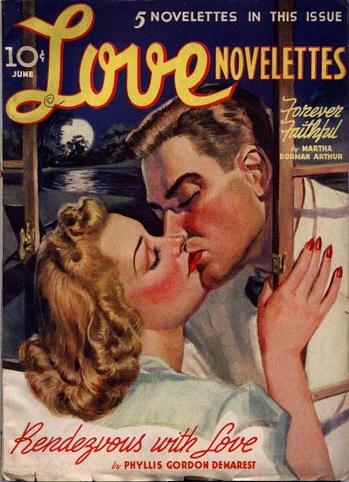
The pulp magazine business had a heady variety of romance magazines-Rangeland Romance, Romance Round-up, Romantic Detective and many, many more. Romance was a huge component of their business.

Within these romance pulps, the theme of being "faithful" was not unusual. It was a practical concept to try to "strongly suggest," due to the fact that many of the reader's boyfriends/husbands were away at war.

Considering that they ran throughout WWII, when all the ladies were at home working for the “good of the country,” there needed to be something for teenage girls and women to read while their men were away! (3) These magazines served a function within the US. Not only did they indulge a kind of romantic world that had been going strong in Hollywood films for a long time, but they also created a kind of Cult of Feminine Desire. The sighing-at-the-drop-of-a-hat kind. However, these books gave lonely women hope for a future in a wartime society that was pretty low in the hope department and also depicted women in some fairly active roles at times (cowgirls or ranchhands, primarily). While I’m not sure if the somewhat powerful roles on the covers of the Westerns were a good trade-off for the consistent depictions of helpless women needing to be saved on the covers of the rest of the pulps, there you have it.  In any case, the romance pulps served a very effective function in keeping hope and positive thinking alive.

Wild Zero has taken the pulp aesthetic, and put an entirely new spin on it. While pulp magazines (and indeed, most cultural objects at the time) were heavily heterosexist, Wild Zero takes romance and love to an entirely different place.

Japanese theater and film history has a very unusual gender history. Kabuki, one of the most famous and highly-regarded forms of theater, has used men to play female parts since practically the beginning. While it started out with both men and women in the plays, women were banned from Kabuki in 1629, due to the suggestiveness of many of the plays being performed in tandem with the fact that most of the actresses were also available for “special services.” On the other hand, when they started to put young men in the roles originally designated for women, that didn’t seem to change the situation much. those young men (Wakashu, as they were known at the time) were also available for prostitution. And their customers? Well, let’s just say that the wakashu were equal-opportunity providers!  While the wakashu were eventually banned as well, both the ban on women and the one on young adolescent men playing women were later rescinded.Women, however,  did not re-enter the theater in an acting context until much, much later.

Men continued to play both the male and female roles in all the major types of theater in Japan: Kabuki, Kyogen, and Noh. This was such a basic part of Japanese culture, that it continued into the cinema for a good amount of  time. Movies began being made in Japan in 1897. The first time that they put a female actress before the camera was in 1911. Considering that the Japanese film industry worked fast and hard, this was a fairly long time to wait to have a female play a female role.

Wild Zero plays on this theme with brutal honesty. Our hero, Ace, finds a young girl at the gas station that he is at. He is on his way to see his favorite band, Guitar Wolf (who he has, incidentally, just become blood brothers with after helping them out of a jam back at the previous show) again, when he stops to fill up on gas. As he steps off his name-emblazoned motorcycle, his eyes meet hers. Her eyes meet his.

It is indeed love at first sight. Tetsuro Takeuchi uses this particular moment to not only emphasize the film’s ultra-sensational pop-culture aesthetic, but also to accentuate the pulpiness of the film’s general narrative. While the nostalgia that Wild Zero seeks to re-create is most definitely a strange amalgamation of 1950s Rebel Without a Cause-ness meets hyperbolic punk-rock superhero of the Repo Man variety, this particular scene is, in effect, created to inspire all the romance and “girly-gushiness” of a romance pulp.

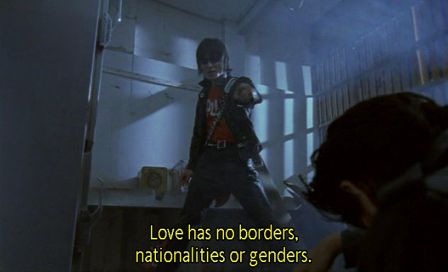
Ace and Tobio’s relationship is a complicated one, however. The main issue? Well, as Ace finds out after saving Tobio from an onslaught of zombie attackers, she is really a highly attractive he. The idea of being in love with a transexual freaks Ace out. He runs and hides from Tobio, just as she has opened herself up to him and told him of her secret. It is at this point that the Spirit of Guitar Wolf appears to Ace, and tells him in a quite disciplinary and reprimanding way, “Love has no borders, nationalities, or genders!”

In a sense, Takeuchi’s film is referencing Japanese theater/film history and making an attempt to recall and rewrite a new one. Tobio’s transexuality not only plays on the existence of the wakashu, but decidedly challenges modern homophobia. This film has a fun and playful front, but it does recognize some extremely powerful and significant topics. In this particular instance, Ace’s adoration for Guitar Wolf makes him realize that his fear was misguided, and he spends the remainder of the film looking for Tobio in order to be reunited with the person that he loves, regardless of their gender.

Wild Zero has many things in common with Versus and I’m not referring simply to the fact that they both deal with yakuza, zombies and space travel. Takeuchi obviously utilizes the same tactics that Kitamura does by creating a hyperbolic, cartoonish and explosive narrative in order to relay issues of Japanese culture. While Versus works mostly with ideas of traditional Japanese-“ness,” Wild Zero confronts modernity and Western influence.

Wild Zero is about rock’n’roll and it is about being attacked by zombies. The band, Guitar Wolf (made up of Guitar Wolf, Bass Wolf and Drum Wolf), serves as a reminder of the past but how one might utilize the past in order to create the future. Their greaser-aesthetic and the pounding soundtrack only serve to support this idea. While songs like Bikini Kill’s “Rebel Girl” are not exactly rockabilly anthems, the rest of the soundtrack is filled with retro-sounding songs that have been renegotiated in order to fit a more punk-rock beat. But, as stated in the beginning of the film by Ace in response to the Captain (the corrupt, drug-dealing club manager), “Rock’n’roll is not over! Rock’n’roll never dies!” And it doesn’t. But as nostalgically rock’n’roll as Guitar Wolf look, they also drive a more modern car, Guitar Wolf’s motorcycle shoots fire out of the back, and they have (essentially) superhero powers. They are past and future, all intermingled within the rockabilly rhetoric of rock’n’roll living forever.

Wild Zero‘s penultimate concentration on science fiction, horror and heroism brings back ideas of pulp magazines. The concentration in many pulp magazines was victory over the invading force, whether that force was a robot, an alien, the opposing military side or an evil monster. Within this film, Ace must conquer his personal demons in addition to the zombies who are trying to kill him and keep him from saving Tobio. While he is engaged in this journey, the film makes continual references to the past in order to show how Ace’s eventual victory is also, in a way, a victory over what is outdated. Even the Captain, when he makes the statement “Remember the past!” to Guitar Wolf receives a very clear message of what the past means at this juncture.

In a sense, Guitar Wolf serves the same role in this movie as The Ramones did in Rock’n’Roll High School . The Ramones were there to be a band but also be a symbol. While Guitar Wolf is a much more active figure within the diegesis than The Ramones were, they serve similar functions. Not only does Guitar Wolf’s look bring up the highly Japanese addiction to the Western rock’n’roll aesthetic, but they are tour guides through the film. One thinks from the several songs that they do, that they would serve a very minor function; that they would simply be there to be the rock stars that Ace sees them as and have a simple performative role. But Takeuchi approaches it differently. Because fan culture is such a large part of Japanese culture, Wild Zero is used to celebrate that aspect of being Japanese but also deconstruct it. While Ace follows the band blindly at first, he learns that there is much to be gotten from their existence that is not received from simple hero-worship. As Ace says in his final voiceover, “From that day on, I never saw a Guitar Wolf show again…Courage and rock’n’roll: that’s what he taught me that night. Love has no boundaries, nationalities, or genders. And he was right.”

Confronting zombies, is a way of negotiating pop-cultural influences. And Wild Zero does so, no holds barred. The zombies are displayed like traditional iconic American zombie archetypes, a la George Romero. I would argue that the destruction of the zombies is analogous to the Western hold on Japanese culture. More importantly however, the existence of zombies that are so very Western in aesthetic only goes to show that there is a certain discursive element to their appearance. The characters’ conversation in regards to Night of the Living Dead seems to sustain this theory since none of them have actually seen the movie and yet they argue about it. This particular scene lays bare many features of Japanese fan culture. Add that to the character of Guitar Wolf (the entire band), and you have Takeuchi’s loud and proud declaration of Japanese pop-culture.

Look at Guitar Wolf themselves: they look like a rock’n’roll band, but they play music on their own terms. While I’m at a loss to describe exactly the kind of music that they play, it is certainly an amalgamation of noise, punk, rock and other genres alongside surrealistic lyrics. Takeuchi essentially makes the statement that, while Western pop-culture certainly informs Japanese pop-culture, it does not create it. While it may seem like a superficial thing to just take the aesthetic of one country’s media and apply it to your own, it is, in fact, more nationalistic and entirely Japanese.

As films, both Versus and Wild Zero may initially seem like wild, action-packed, fluff with acid-hallucination-like versions of plotlines (mostly in the case of Versus, but Wild Zero‘s wacky and comic-book-like story definitely counts). But, much like the science-fiction and horror pulps with their attacks on government and culture, these films have managed to sublimate ideas of Japanese culture within otherwise generic conventions. Part of this is not sublimated- I have yet to see a Western-culture film that is so densely packed with horror/scifi/romance iconography as these, and especially one that flips many of these conventions on their heads. On the whole, however, these films seem to introduce new methods of Japanese film-making that I, for one, enjoy a great deal.

(1) Tateishi, Ramie. “The Japanese Horror Film Series: Ring and Eko Eko Azarak.” Fear Without Frontiers: Horror Cinema Across the Globe. Ed. Steven Jay Schneider. Godalming, UK: FAB Press, 2003.

(2) ibid.

(3) Incidentally, WWII was also when romance comic books became extremely popular, for largely the same reasons. I would contend that one likely spawned the other, since romance pulps (and their famous covers) have a much longer history and go further back than romance comics. Of course, the irony of this is that romance comics continued and pulp magazines fell out of favor.

Eastern Ways in Western Dress: Cultural Hybridity and Subversion in Yojimbo

This post is for the Japanese Cinema Blogathon.  It was started to help assist in the earthquake & tsunami relief. If you like my post/hate my post/are bored to tears by my post, or just enjoy the damn pictures, PLEASE help. Living, as I do, in an earthquake-prone locale (Southern California), earthquakes are quite frightening, and I would like to do my part. Since I am broke as hell, all I can realistically do is what I do best: write. And so I will write for Japan, and hope that someone makes a donation off of what I’ve written or just makes a donation, period. Japan has given us some of the most incredible cinema in the entire world and will continue to do so. Let’s help out a little in appreciation, shall we?

The standard assumption about modern Japanese culture is that because it contains elements familiar in the west, perhaps even born in the west, it has become, in effect, entirely Westernized. Looking closer at Japanese culture, however, we can see that this assumption is about as ridiculous as saying that the United States has become more Chinese because a good many people prefer that cuisine. It is only an example of the kind of binary thinking that revisionist histories and neo-colonial thinking have created within the world that would necessitate this kind of compartmentalization.

Within this essay, I will be looking at an example of Japanese cinema that expresses not only the Japanese-ness noted previously, but also certain aspects of cultural hybridity and significance within Japanese culture. In order to explicate my argument, I will be using a variety of texts varying from discussions of cultural hybridity and Japanese history to Hamid Naficy’s work on accented cinema. What I hope to show in this work is the remarkable ability of one culture (Japan) to reappropriate and “poach” different themes and iconographies from another culture (United States) and feed them through their own, culturally specific machinations in order to create something wholly new and different.

The film I have chosen, Yojimbo (Akira Kurosawa, 1961) illustrates the ways in which cultural identity is asserted through the conscious blurring of boundaries and intentionally fluid interpretations of genre. By re-placing the American Western within historically important samurai contexts, Japanese cinema can be seen to be making its own cinematic space.

Yojimbo (1961), Akira Kurosawa

This claiming of cinematic environment and demand for a location of cultural expression places modern Japanese cinema squarely within the definitions of Third Cinema. As defined, Third Cinema is “an alternative cinema…a cinema of decolonization and for liberation.”[1] By retaining individual signifiers and insisting upon their own generic interpretations, these films reject cultural depreciation and celebrate ethnic identity, and expound the tenets of the Third Cinema in a very localized fashion.

In order to truly understand Japanese cinema, it is crucial to know the history of the country itself. As Teshome Gabriel writes,

Lacking this historical perspective, the film critic or theorist can only reflect on the ways in which this cinema undermines and innovates traditional practices of representation, but he/she will lose sight of the context in which the cinema operates. An equally significant component of the critical perspective that must be adopted is the recognition of the TEXT that pre-exists each new text and that binds the filmmaker to a set of values, mores, traditions and behaviors- in a word, “culture”—which is at all moments the obligatory point of departure.[2]

Thus, in order to not fall into the “trap of auteurist fallacies and ‘aesthetic’ evaluative stances,”[3] I shall give a brief historical and cultural outline of Japan. Although by no means exhaustive, I will cover the primary events that many historians feel to be the most essential and transformative, as well as those occurrences that have singular importance to my argument.

Although there was clearly a great deal that went before, the Heian period, which lasted from 794 a.d. to about 1185 a.d., is where we will begin. During this era, there was a “flowering of classical Japanese culture in new capital of Heian-kyo (Kyoto). Court aristocracy, especially women, produced a great body of literature–poetry, diaries, the novel The Tale of Genji–and made refined aesthetic sensibility their society’s hallmark.”[4]

image from the illustrated scroll, "The Tale of Genji (Genji monogatari)" - a narrative novel authored by Lady Murasaki; painted by Takayoshi in the 12th century

The cultural product that resulted from this period was significant and vital, being reproduced continually even today, within Japanese painting, cinema and television. However, although the creative vitality still existed, the relative peace was not to remain, as the Kamakura Period (1185-1333) ushered in the beginning of military rule. The significance of this was vast, as it replaced noble rulers with the samurai (warrior). Although there is recognition of artistic development during this time, the primary feature for over a century is civil war, and until approximately 1600, Japan is immersed in Sengoku Jidai (Era of the Country at War). There is no unified Japan, only a series of warlords fighting with each other. Intriguingly, this is also the period during which the Portuguese enter the Japanese islands and introduce firearms and attempt missionary work to convert the Japanese to Christianity. The Portuguese fail in their religious mission, however, and are punished severely for attempting to dilute the national culture.

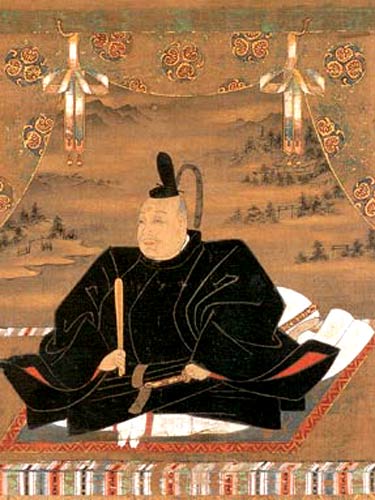
In 1568, a man named Oda Nobunaga starts the process of reunifying Japan. Followed by Toyotomi Hideyoshi, the foundation of modern Japan is laid. However, although these men laid down the base, it was up to another man to change the course of Japanese history forever. After he brutally beat Hideyoshi (and a few years later forced Hideyoshi’s legitimate heir to commit seppuku, ritual suicide), a man named Tokugawa Ieyasu became the Shogun, and ruled with a strict, isolationist sensibility. He cut off exchange with all countries except China and the Netherlands, expelled Portuguese missionaries and essentially shut the doors of the country for 200 years. Michael Cooper, the former editor of Monumenta Nipponica, an interdisciplinary journal on Japanese culture and society, states quite simply that, “Tokugawa wanted to clear the board of all these foreign influences which were just muddying the waters, making life more complicated.”[5] And clear the board he did. Not only was trade extremely limited, but also foreign books were outlawed, travel abroad was forbidden. For 200 years Japan was kept away from the rest of the world, and the rest of the world was kept out of Japan.

Tokugawa Ieyasu

During this period, however, the Japanese had ample time to refine and hone its multitude of cultural assets, without any infiltration or any disturbance from anyone. Literature, ritual customs, art, and theater all prospered in this period. However, this could only last for so long. Finally, around 1867, the Tokogawa shogunate was ended and this started the Meiji Period.

The Meiji Restoration (called this because power was restored to the Emperor Meiji) began the colonization of Japan by the west. It is noted that during this period, the Japanese, “like other subjugated Asian nations…were forced to sign unequal treaties with Western powers. These treaties granted the Westerners one-sided economical and legal advantages in Japan.”[6] Beyond this, significant modernization and Westernization occurred. Compulsory education, now reformed to resemble French and later German systems was implemented, as well as a European-style constitution in 1889.

1686- the Meiji emperor of Japan moves from the old capital, Kyoto, to the new capital, Tokyo

After being closed off from the rest of the world for so long, its seemed to the Japanese that they needed to hurry and “catch up,” so they sent scholars away to different countries to attempt to get what they needed in a more condensed fashion. However, after a certain period of time, and successfully winning two wars, all of this Westernization became repugnant to the Japanese, and there was a significant rise in nationalism again.

Western forms of modernity proved to be like a virus- once they entered the Japanese system they stayed. The symptoms were treatable, but the virus would always be there. On the other hand, the more this virus showed itself, the more nationalistic the country got. The West continued to colonize Japan until the end of World War II, when Japan was physically occupied by the US, and forced to alter everything from cultural specifics (such as what they could and could not put in cinematic or literary texts) to political structures (religion and state were now entirely separated). After two hundred years of relative peace and cultural unity, it took less than half that time for the West to rope Japan in, and force it into what they saw as submission.

While the historical evidence does show the “conquer” of Japan, and its subsequent punishment and demonization within much of Western culture (especially the US), what occurred within the cultural borders of Japan was something very different. With the sudden influx (initially desired, consequently abhorred) of so many different cultures after the Tokugawa period, it is difficult to conceive of Japanese culture not having been influenced in some way. However, the consolidation of nationalistic identity was so strong before the ports opened that even the influences that had become present were now filtered through a Japanese lens.

The three phases that Frantz Fanon discusses in the progression towards cultural decolonization are defined by Teshome Gabriel as

(a) The unqualified assimilation phase where the inspiration comes from without and hence results in an uncritical imitation of the colonialist culture; (b) the return to the source or the remembrance phase, a stage which marks the nostalgic lapse to childhood, to the heroic past, where legends and folklore abound; and (c) the fighting or combative phase, a stage that signifies maturation and where emancipatory self-determinism becomes an act of violence.[7]

If you follow Japanese history from the end of the Tokugawa Period forward, it seems that Fanon’s text is accurate and appropriate. Certainly the Japanese were fascinated by the outside culture that they had not experienced for over 200 years, but when that outside force sought to dominate their carefully nurtured autochthonous culture, the Japanese bristled. In fact, according to Donald Ritchie and Joseph I. Anderson, the Japanese reaction to new innovations in early cinema followed Fanon’s structure as well. In the beginning, the Japanese audiences “embraced the novelty of the moving picture with at least as much enthusiasm as other nations” but they did not, however, embrace the new cinematic methods, and neither did the directors. Now whether this was due to culturally bound aesthetic preference or not is still up for debate, but Ritchie and Anderson do note that in this aesthetic decision, the audience was “following what has become recognized as a peculiarly Japanese pattern of behavior: first the enthusiastic acceptance of a new idea, then a period of reaction against it, and finally the complete assimilation and transformation of the idea to Japanese patterns.”[8] If this is indeed the case, the Japanese have been in the process of decolonialization in the cinema for almost as long as the cinema has been around.

The cinema in Japan, though initially full of foreign product, soon began to create its own, complete with genres that celebrated nationalism and cultural history. Fernando Solanas and Octavio Getino write that “real alternatives differing from those offered by the System are only possible if one of two requirements is fulfilled: making films that the System cannot assimilate and which are foreign to its needs, or making films that are directly and explicitly set out to fight the system.”[9] What if, in the presentation of these highly ethnocentric and history-centric pieces, Japan was able to do both? I maintain that Japan’s early genre cinema was not only a way of recuperating feelings of nationalism and pride in cultural identity, but also a way to fight the virus of colonialism that had already swept through the country.

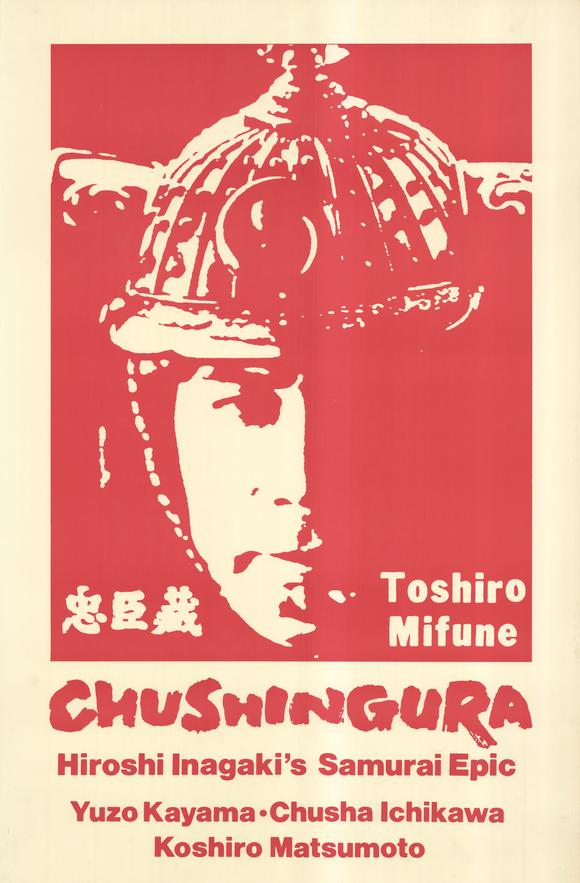
Two of the most popular genres in Japanese cinema (up until they were occupied and forced to change cinematic content) were jidai-geki (historical dramas) and gendai-geki (modern dramas). Stories such as Chushingura (the tale of the forty-seven Ako ronin), which was set in the Tokugawa period and based on historical incidents, were incredibly popular. In fact, that particular story was made into a film over eighty times between the years 1907-1962![10]

Chushingura (1962)

But stories like Chushingura would not have been assimilable to an outside culture, let alone the System that Solanas and Gitano mention. And the jidai-geki made up close to half of the feature films in Japan from 1910 onwards![11] The very structure of Japanese Cinema, from its origination, prohibited its cooptation and cultural dilution. By utilizing their history and cultural signifiers within the cinematic texts, they not only denied the System but also outright thumbed their nose at it.

Donald Ritchie discusses the theory that it was Japanese theater conventions that helped teleologically maintain the cultural identity of the Japanese cinema. It is a distinct possibility that theatrical features like the benshi (a live interpreter for the silent films), or the use of men acting in women’s roles did help in the cultural preservation. However, I feel that Ritchie’s own analysis is far more perceptive. He states that though these theatrical attributes might have “somehow served to preserve the ‘Japaneseness’ of this cinema, protecting it from rapacious Hollywood, [this theory] fails to take into account the fact that…any Hollywood ‘takeover’ was a highly selective and invitational affair. If anything, it was Japanese companies that took over the ways of the California studios. It is probably safe to say that Japan has never assimilated anything that it did not want to.”(italics mine)[12] While it is of utmost consequence to recognize the agency that Ritchie mentions, it is also appropriate here to mention the concept of cultural hybridity. The nature of Japanese cinema is not one of assimilation but of translation. While Japan was a colonized nation, considerably flooded with Western ideology, they managed to hybridize the west with the east, and filter it through their own cinematic language. In their own way, they did what Francisco X. Camplis was suggesting when he connected Raza cinema to Third Cinema, stating that, for decolonization, Chicano cinema needed to “explore and discover our own sense of aesthetics. Our own language.”[13]

Japan, while maintaining sovereignty over their cultural product, also enunciates their voice through the hybridization of colonial product. This technique of cultural hybridity is a highly subversive act of decolonialization, according to Robert Stam. He writes, “these aesthetics share the jujitsu trait of turning strategic weakness into tactical strength. By appropriating an existing discourse for their own ends, they deploy the force of the dominated against the dominant.”[14]Thus, when films such as Akira Kurosawa’s Yojimbo (1961) re-place the Western within a samurai context, it is actually creating a site of resistance.

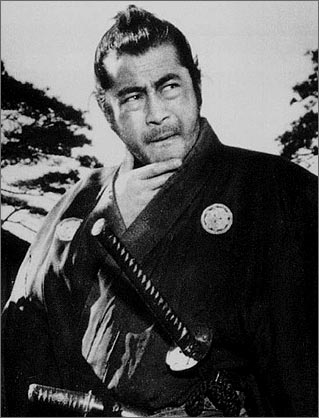
Although Kurosawa has been called the “most Western” of all Japanese filmmakers,[15] he himself stated that he made Western films for “today’s young Japanese.”[16] While these statements might appear to have similar meaning, it is crucially significant that Kurosawa designates who his audience is. While Western critics may be able to see familiar narrative patterns or generic properties, Kurosawa’s work is a multi-layered text that, although seeming familiar to them, is still a foreign film. A.O. Scott writes that “filmed images do not require translation; we know what we see. Narratives, of course, are another story; even when they seem to be transparent, they come encrusted with local meanings, idioms and references, some of which will inevitably be lost as they move from one audience to another.”[17] Although immediately recognizable as an example of the Western genre, Yojimbo is a perfect example one of those films that, as Scott notes, is “encrusted” with its own set of culturally-bound signifiers.Toshiro Mifune as Sanjuro Kuwabatake/ The Samurai

The story of Yojimbo takes place just after the end of the Tokugawa period. A ronin (masterless samurai) who was “once a dedicated warrior in the employ of Royalty, now finds himself with no master to serve other than his own will to survive…and no devices other than his wit and his sword”[18] Traveling in solitude, he comes upon a village and is fascinated to learn that it is in the middle of a turf war between two extremely morally corrupt clans. The ronin, Sanjuro, takes it upon himself to rid the town of these evil clans and their warlike ways by pitting them against each other, and letting them do the damage. In the end, the two clans do destroy each other, but the irony is that when they do, the town is left empty- a literal ghost town.

The two clans do battle

In his book, An Accented Cinema: Exilic and Diasporic Filmmaking, Hamid Naficy writes,

Accented films embody the constructedness of identity by inscribing characters who are partial, double, or split, or who perform their identities by means of the strategies already mentioned. By so engaging in the politics and poetics of identity, they cover up or manipulate their essential incompletion, fragmentation, and instability.[19]

In Yojimbo, Sanjuro’s constant changes in affiliation between the two fighting clans underscore his fractured character. Sanjuro is a wanderer. He is a man with no allegiances and no home. He has arrived in a town that is already split in two, and now, in order to unite the town (and perhaps his own identity), he must fracture himself even further by playing both sides. To go even further, whatever side he is playing is also instable because it’s a lie. David Desser describes Kurosawa as a “dialectical” filmmaker. He describes Kurosawa’s films as cinematically split, noting that Kurosawa “offers enjoyment to the audience seeking escapism and the audience seeking substance; he speaks to the Japanese and to the West. More importantly, through a dialectical combination of the two, he speaks to both about each other.”[20] If this is indeed the case, then Sanjuro’s split identification is standing in for Kurosawa’s, a self-reflexive position that, Naficy notes, is also not unusual for accented film.

Sanjuro (Toshiro Mifune) and director Akira Kurasawa

In accented cinema “neither the home-seeking journey nor the homecoming journey is fully meliorating. The wandering quests, too, are often tempered by their failure to produce self-discovery or salvation.”[21] Kurosawa’s deliberately open-ended yet dark and ironic close to Yojimbo attests to that theory. After all the effort that Sanjuro put into saving the town, the only people who are left alive at the end are the coffin-maker and the tavern keeper. Sanjuro looks at them, says, “Now it’ll be quiet in this town,” turns his back and walks away, clearly continuing on with his journey. It is clear that, although he has saved the town, there was really nothing there to save. Although nihilistic, this scenario further explores Kurosawa’s identity as an accented and hybridic filmmaker and reaffirms Sanjuro’s identity as his cinematic double. With this ending, Kurosawa clearly demonstrates his own border consciousness, which “like exilic liminality, is theoretically against binarism and duality and for a third optique, which is multiperspectival and tolerant of ambiguity, ambivalence, and chaos.”[22]

Yojimbo possessed many of the standard features of the Western genre, yet also ended up revolutionizing it. I contend that Desser’s theory of Kurosawa as a dialectical filmmaker should be widened to include his position as a dialogical filmmaker as well. Yojimbo did not remain contained within Japanese borders. In 1966, director Sergio Leone remade it in Almeria, Spain. The film starred Clint Eastwood, and was released under the title Fistful of Dollars. Jim Miller writes,

Although the storyline remained much the same in Fistful as it did in Yojimbo, a man alone playing both sides against each other, the end result of Clint Eastwood’s role brought about a whole new look at the Western hero as a lone wolf, anti-hero that was totally different from characters John Wayne had played. The anti-hero had been done before and been well received…but…[this] was a Western anti-hero who had not been viewed by American moviegoers, and that made the character and the actor who played him a different kind of Western hero.[23]

While Fistful of Dollars became the first in what would be a series of films starring Clint Eastwood as Sanjuro’s American surrogate, the Man With No Name, it is integral to recognize that the American translation of Kurosawa’s work introduced a new archetype. My position is that Japanese films (even Yojimbo, which David Desser admits is “dependent on Western [genre] structures”[24]) subvert Western colonial narrative structures through their cultural filtration system. This is further proven by Miller’s discussion of the reception of Clint Eastwood’s character.

The three central roles in the Western genre are “the townspeople or agents of civilization, the savages or outlaws who threaten this first group, and the heroes who are above all ‘men in the middle,’ that is, they possess many qualities and skills of the savages, but are fundamentally committed to the townspeople.”[25] Kurosawa’s conflation of archetypes is vital and entirely intentional. By creating a climate in which the townspeople are the savages and the hero is committed to the destruction of the townspeople, he is forcing the spectator to reflect on “a world of uncertainty.”[26] In many ways, this film can be seen as analogous to the confusion brought on by Westernization. The main villain, Unosuke (the son of one of the clans), is in possession of a gun, and waves it around like a cowboy. The rest of the men are armed only with swords. The presence of this weapon, and Unosuke’s ultimate defeat, signifies that even though the Western world might have invaded Japan historically, forcing change and cultural infiltration, the basic structures of Japanese identity are strong enough to withstand that change. Essentially, Sanjuro’s abrupt but confident departure from the town signifies the triumph of the samurai, symbol of loyalty and honor, and Japanese history, over the attempt by the West to conquer the East.

In the introduction to Donald Ritchie’s book on Japanese cinema, he traces the hypothetical life of a 50-year-old man in each period of early Japanese cinematic history. From the man in 1896, who “would have been born into a feudal world where the shogun, daimyo, and samurai ruled” to the man who “would have witnessed the forced adoption of the Gregorian calendar, the emergence of a nationwide public school system, the inauguration of telephone services…and the construction of railways,” Ritchie briefly looks at what a Japanese man might have experienced. But, Ritchie says, “through it all, he…would have been told to somehow hold on to his Japaneseness. [A] slogan indicated the way: ‘Japanese Spirit and Western Culture’ (Wakon Yosai)- in that order…[and] In this manner, it was hoped, Japan might avail itself of the ways of the modern West and, at the same time, retain its ‘national entity.’”[27] Teshome Gabriel says that Third Cinema “must above all be recognized as a cinema of subversion.”[28] By working through the ideas of Wakon Yosai, the Japanese cinema is a proud and active part of Third Cinema. Through the jujitsu model of hybridity and a refusal to dilute their national identity, Japanese cinema has, and is continuing to have, the best of worlds. They truly have subverted the dominant paradigm and are only richer as a result.


[1] Gabriel, Teshome. Third Cinema in the Third World: The Aesthetics of Liberation. Ann Arbor: University of Michigan Research Press, 1982.

[2] Gabriel, ibid.

[3] Gabriel, ibid.

[4]Heinrich, Amy Vladeck.  Ask Asia, a K-12 Resource of the Asia Society, History of Japan, 1994. available at http://www.askasia.org/image/maps/timejape.html, Internet; accessed 16 March 2011.

[5] Michael Cooper, interviewed in “Japan: Memoirs of a Secret Empire.” Empires, narr. Richard Chamberlain, PBS, 26 May. 2004.

[6] Meiji Period (1868-1912), Periods of Japanese History, Japan Guide, 2 June 1996. available at http://www.japan-guide.com/e/e2130.html, Internet; accessed 20 November, 2004.

[7] Gabriel, ibid.

[8] Anderson, Joseph I. and Donald Ritchie. The Japanese Film: Art and Industry. Princeton: Princeton University Press, 1982.

[9] Solanas, Fernando and Octavio Getino. “Towards a Third Cinema: Notes and Experiences for the Development of a Cinema of Liberation in the Third World.”

[10] Barrett, Gregory. Archetypes in Japanese Film: The Sociopolitical and Religious Significance of the Principal Heroes and Heroines. Cranbury: Associated University Presses, Inc, 1989.

[11] Ibid.

[12] Ritchie, Donald. A Hundred Years of Japanese Film. Tokyo: Kodansha International, 2001.

[13] Camplis, Francisco X. “Towards the Development of a Raza Cinema (1975)”. Chicanos and Film: Representation and Resistance. Ed. Chon Noriega. Minneapolis: University of Minnesota Press, 1992.

[14] Stam, Robert. “Beyond Third Cinema: the Aesthetics of Hybridity.” Rethinking Third Cinema. Ed. Anthony Guneratne and Wimal Dissanayake. New York: Routledge, 2003.

[15] Desser, David. The Samurai Films of Akira Kurosawa. Ann Arbor: UMI Research Press, 1981.

[16] Ritchie, Donald. The Films of Kurosawa. Los Angeles: University of California Press, 1965.

[17] Scott, A.O. “Us & Them: What is a Foreign Movie Now?” NewYork Times Magazine, 14 November 2004, 79.

[18] Yojimbo, dir. Akira Kurosawa, perf. Toshiro Mifune, Tatsuya Nakadai, DVD, Criterion Collection, 1999.

[19] Naficy, Hamid. An Accented Cinema: Exilic and Diasporic Filmmaking. Princeton: Princeton University Press, 2001.

[20] Desser, Ibid.

[21] Naficy, Ibid.

[22] Naficy, ibid.

[23] Miller, Jim. “Clint Eastwood: A Different Kind of Hero.” Shooting Stars: Heroes and Heroines of Western Film. Ed. Archie P. McDonald. Bloomington: Indiana University Press, 1987.

[24] Desser, ibid.

[25] Kitses, Jim. “The Western: Ideology and Archetype.” Focus on the Western.Ed. Jack Nachbar. Eaglewood Cliffs: Prentice-Hall, Inc, 1974.

[26] Desser, ibid.

[27]Ritchie, Donald. A Hundred Years of Japanese Film. Tokyo: Kodansha International, 2001.

[28] Gabriel, ibid.

Blogging for Japan!

So for a few posts, I shall be participating in this Blogathon and there will be a link to donate money to Japan and the folks there who are going through all the tsunami/earthquake horrors. PLEASE PLEASE PLEASE either donate a few bucks or repost to someone who will. They give us great fucking movies and have for many years. Let’s give Japan some relief, eh?

Let Your Seoul Glow: My Journey to Korean Cinema

This will be my last and final piece for the Korean Blogathon. It has been a pleasure to participate in it, and I can’t wait to watch a slew of the films that have been written about by everyone else! Thanks to everyone that put this together and to Martin for designing such a lovely page to showcase our writing! It’s been fantastic. So, in conclusion…..

I live in a city where everyone is obsessed with the motion picture industry. If you aren’t pitching a script or don’t have one on the backburner, then you’re on your way to a meeting or to meet with your agent. If not that, then you are location-scouting or bitching about budgets or other production issues. Yes, that’s right folks, I live in the Devil’s Playground- Hollywood, CA. I was born and raised here, and it’s what I know. Is it always what I enjoy? Not by a longshot. But it’s where I’m from, for better or for worse.

In any case, try as I might, I was unable to get away from the cinema. It was like the siren’s call to me, although not in the same way as everyone else. While I fought anything and everything cinematic up until college (I was going to be a social worker, dammit!), I was unable to distance myself from the silver screen any longer, and got several degrees in it- but all in theoretical writing. Not as useful as building construction per se, but I loved it, and still do.

Within my film education, I encountered several kinds of Asian cinemas from my professors- but never Korean cinema. So I became very fond of Japanese cinema, and Hong Kong cinema and different Chinese filmmakers. From there, it was all up to me. So, being a rather exploratory person, I dove in head-first and didn’t come up for air for a very, very, very long time.

The first filmmaker I fell for was Wong Kar-Wai. His films came highly recommended by a friend, and that friend could not have been more correct. They were beautiful, sensual, graceful and smart. Some were action-type films and still contained the afore-mentioned descriptions. Wong Kar-Wai sold me, and got me involved.

About the same time, I developed a keen fascination with the Japanese New Wave and wondered intensely why no one knew more about it or was writing more about it. From there, I found Kenji Mizoguchi and became deeply obsessed with his work as well. To compliment the highly sexualized New Wave and the historical-yet-feminist-tinged-Mizoguchi, I was then introduced to my first slightly Korean figure- Takashi Miike. While born in Japan, he was from an area that was dominated by Korean immigrants. In addition, his father was actually born in Seoul. Miike had multiple Korean connections, a fact I was not aware of until a little while ago. He was still, however, a Japanese filmmaker, more or less, and so I added him to my bundle. However, his style added to the New Wave and Mizoguchi really made the kettle start to boil.

Miike has been described as “controversial and prolific” (both of which he is) and his films have been described as being “perverse and extremely violent” and also “dramatic and family-friendly.” Watching Miike’s work made me interested in seeing what else the Asian world had to offer.

Takashi Miike's film "The Happiness of the Katakuris" (2001) was a remake of the Korean film "The Quiet Family" (1998) by Kim Ji-woon

It was not until much later that I became aware of Korean cinema and what it had to offer, but I have to say that the previous films mentioned were the items that whetted my appetite. J-horror and all of its various offerings was starting to get a little repetitous, tragically, and I was not always a fan of how perverse Miike could get. Or at least not his methodologies. It wasn’t my bag, baby.To quote Huey Lewis and the News, I was in the cinematic mindset of: “I want a new drug.”

And lucky for me, I found one: Korean cinema. While doing my research and writing for this blogathon, I remembered that the first Korean film I ever saw was Tell Me Something (1999). To be honest, I have to congratulate Chang Yoon-hyun. While I may forget things about movies I saw last week or last month, I saw this movie over 10 years ago and it still stuck with me. I have thought about the film over the last few years, not remembering the title, but vaguely sure of the storyline and definitely remembering the imagery, and always thinking: “Damn. I need to find that movie and see it again.” So thanks, Chang Yoon-hyun. I’ll be making that purchase soon.

"Tell Me Something" really told me something about Korean cinema...

Continuing onwards, what I have discovered about this country’s cinema is that it has the unique ability to pull the rug out from under me in every single movie I have seen. Just when I think I know what’s going on, I don’t. I can’t think of another country that does that as well as Korea. Really, sometimes the content itself pulls the rug out from under the viewers feet. Look at Oldboy!

But that is what I like the most about Korean cinema and why I cannot stop watching it. My good friend (and fabulous writer) Dennis Cozzalio just recently pointed me in the way of a Korean cinema in my city. The CGV. It looks great. Some American films with Korean subtitles and recent Korean films with English subtitles. It’s got a little cafe, apparently, and I happen to know that it is surrounded by really great (and inexpensive) local food establishments. I’m sold, hook, line and sinker.

When I saw Mother (2009) and Memories of Murder (2003) on a double bill at the New Beverly Cinema, all I could think was that Good Suspense Films had returned to the silver screen. Alfred Hitchcock would be proud. I could just imagine him, sitting in the back, smirking away. I was astounded at how good they were.

July 6, 2010- New Beverly Cinema, Los Angeles, CA

Every time I see a new piece of Korean filmmaking I am blown away. I’ve seen Kim Ji-woon’s I Saw The Devil twice now, and I finally feel like I may be ready to write something coherent on it. It’s a pretty fascinating piece to me. I think what I am seeing come out of Korea is what Japan has not been able to do for me. There is something unexpected, every time. And living in a land where I have come to call almost everything in every film I see, it is a more than welcome facet to a film.

In addition, the humor makes me happy as a bird in springtime. It is so damn dark. This is a characteristic that I find endearing. Here in the US we find cynicism and sadism enjoyable, especially in our “dark” humor. I find that pathetic and super unfunny. I’m not a fan of Todd Solondz. I think he intentionally tortures his audience. But the Korean sense of humor comes from a pretty nasty history anyway, so why not laugh? If one looks at the random aside comments that are made in certain films, or the things that we are asked to find funny…not everyone I’ve been in the theater with has laughed, but I think that they are being played for fun. Almost all of the films that are serious films have a great deal of humor in them.

I know I’m new. I know I haven’t seen everything. But you know what? I’m really damn lucky.Now I get to go and watch all these other films that all the other folks in the blogathon have written about (and ones I’ve found while I’ve been researching for my writing) for the first time. And to me, watching a film you’re really excited about for the first time is like kissing someone you are really attracted to for the first time: you can only do it once, and it is destined to be amazing, even if it might seem a little sloppy at first.

I’m glad that I started out with my background in the Japanese New Wave and ghost stories, John Woo, Wong Kar-Wai, Miike, and all that. It was great stuff. There are aspects within those cinemas (especially horror-wise) that are shared. However, I am mostly glad to have seen those films/those cinemas so that I can appreciate  the Korean cinema on its own terms.

Mama Loves Her Baby and Daddy Loves You Too: Maternal Instincts and The Host

Welcome to edition #3 of the 2011 Korean Blogathon! Hope you enjoy reading this one as much as I enjoy writing it and possibly as much as I enjoyed watching it. I have a feeling this one is gonna be extra fun to do!

It is probably no accident that Bong Joon-ho’s latest entry into the Korean cinema canon is entitled Mother and centers around a maternal figure. His films seem to contain a great deal of discussion about the female body if not direct reference to the birthing figure, as in the 2009 film. While that may seem like an odd thing to say about a filmmaker who has made crime films, comedies and a monster movie, his oeuvre can actually back him up.This director is able to use subtext as skillfully as a trained circus performer, making it look just as natural and easy, and thumbs his nose at convention when he feels it is unnecessary. Like many of his peers, he involves Korean politics and culture, but unlike them he features them within a context of entertainment, humor and realism. To a certain extent, he is the Marvel Comics to everyone else’s DC. (1)

While we can see Memories of Murder(2003) as a dissection of the feminine form (it was a film about a serial killer, after all), and Mother(2009) as a study of true maternal dedication, what could we say of a monster movie?  How could the The Host(2006) possibly tie in to the themes presented in those other two films?

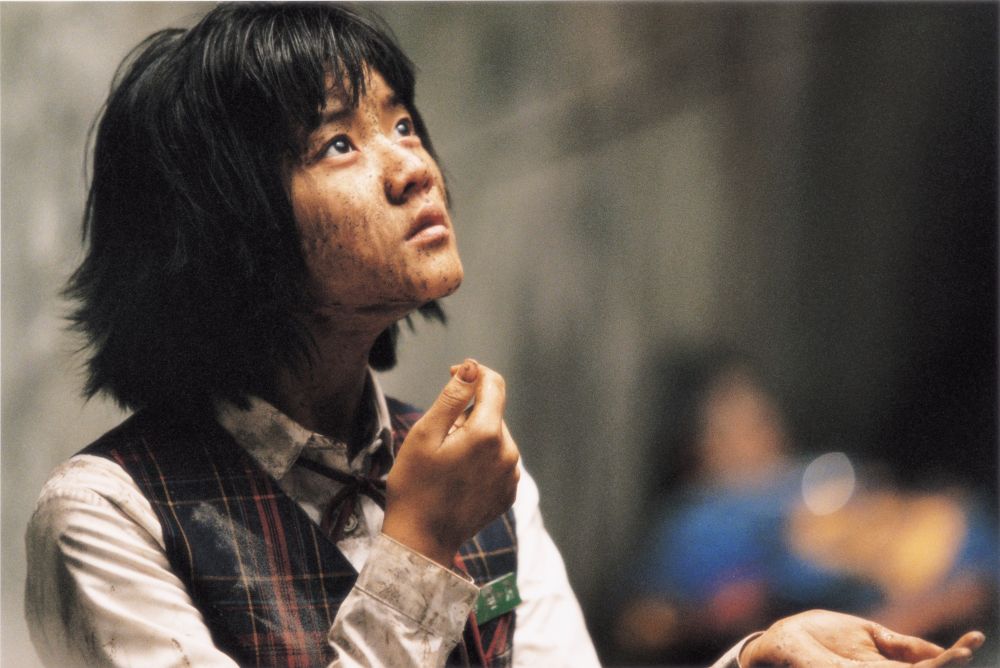
When I sat down to watch this film, I was in a very strange space. I had just gotten home from seeing a midnight showing of Battle: LA (2011) and I had just gone through Every. Single. Facebook post/Twitter and news item about the Japanese earthquake and tsunami. I was wondering what was coming next. Really, in the last few months we’ve had random groups of birds falling from the sky, school of fish washing up on the shore…maybe this was it. Is it time? Is this our last hoorah? I mean, really folks. I saw the footage of those cars and that ocean. Unfathomable. So I figured the hell with it. Perhaps it was time for me to watch my copy of The Host (2006). We seem to be going down anyways. Let’s see how the Koreans think we’re gonna get it. I couldn’t have been more wrong. Bong Joon-ho ended up doing something with this that no other Big Ass Monster Movie That Engages In Serious Politics (although- don’t they all?) has ever done for me before: it soothed me. Now I wasn’t entirely calm, mind you, there were bits and pieces that upset me (in a good way), but my reaction to The Host felt very similar, at times, to my reaction to Frankenstein (1931), one of my all-time favorite films. In a sense, The Host is not only a monster movie, but it is also a tragedy- of maternal proportions.

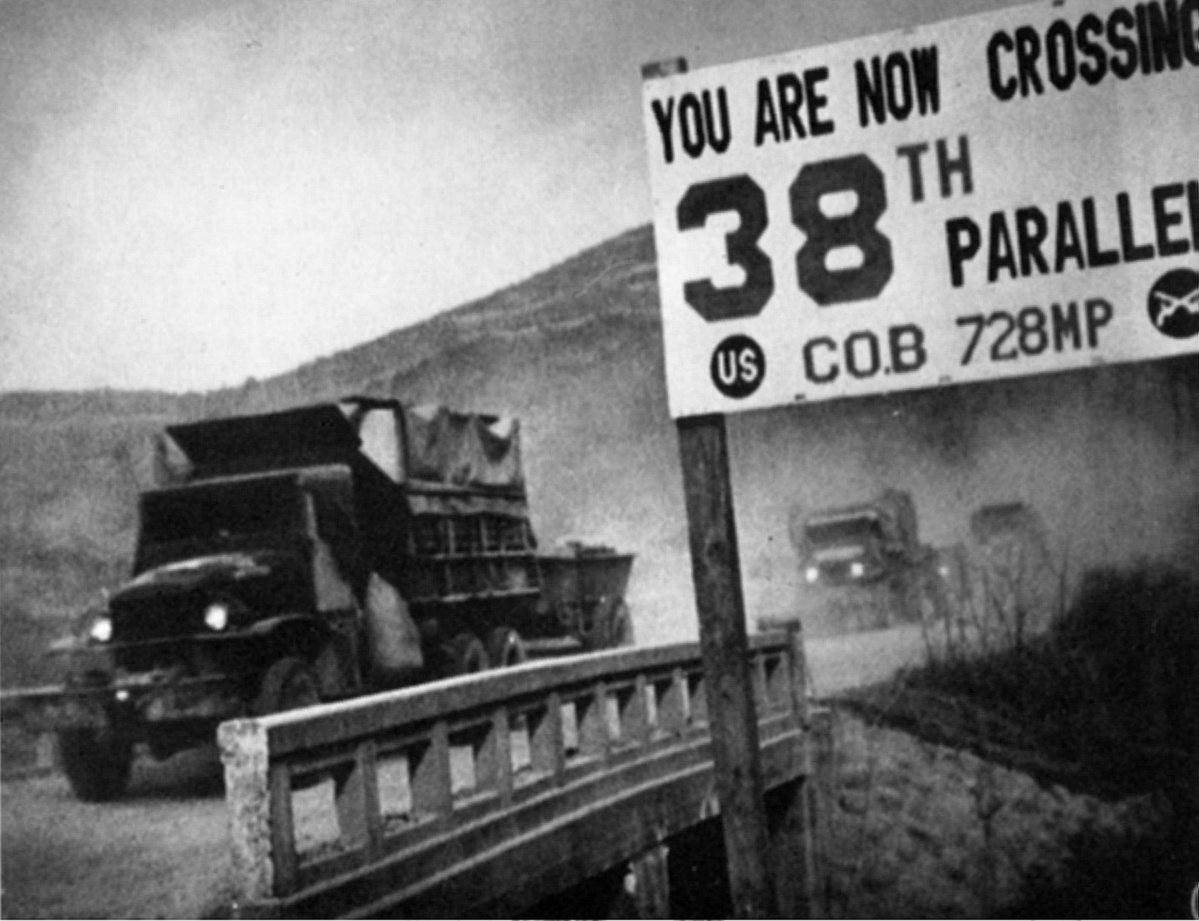
US Foreign Policy hasn’t always been the nicest kid in the world. In fact, I would venture to say that if every country’s Foreign Policy were represented by the kids in Willy Wonka and the Chocolate Factory , the US would probably be Veruca Salt. With this in mind, it is important to look at the relationship that the US and Korea have had for a little over 60 years. This relationship had a great deal of bearing on The Host, and indeed is what helped make it what one Korean critic called “Korea’s first legitimate anti-American film.”(2) While Bong Joon-ho shrugs off the harshness of that title, he in no way denies it. Frankly, looking at history, I might have considered putting that description on the back of the DVD…if it wouldn’t’ve hurt sales. But that’s why I don’t make movies or try to sell them, right?

So let’s talk Korea, 1945. It was a good year, a grand year, a…not really. In fact, realistically, Korea hadn’t been in charge of their own country since before the Japanese took them over a couple decades earlier. Was there hope? Sure. World War II was done. There was hope for many things. But not for Korea. It is said that General John R. Hodge stated, just before arriving with his troops to peaceably “help” Korea post-Japanese annexation, “Korea is an enemy of the United States and any Korean who harms either Japanese or American personnel will be punished by death.” This attitude was not a singular one, nor was it one that dissipated. In fact, it was this general sentiment that led to the development of the 38th Parallel/Division of Korea, the United States Army Military Government in Korea, and the Korean War itself.

One can argue a plethora of motivations as to why the US, in 1945, went into a trusteeship with the Soviet Union for Korea in at the Potsdam Conference; a conference that not a single Korean figure of import was at. However, I would argue that one of the most salient reasons is what I call the Mommy Knows Best Syndrome. Those present- the US, the UK, and the Soviets- decided that since Korea hadn’t been making their own decisions since their diplomatic sovereignty had been removed by the Japanese in 1905, why let them start now? In any case, they didn’t. They moved right in, established themselves against the wishes of every Korean citizen, and divided up the country into North and South. If you hadn’t noticed, the lines ain’t changed much in the last few years.

But that wasn’t enough for the US. Every mommy needs to take care of her baby, right? And in a trusteeship (according to the United Nations, the biggest parent of ’em all), we had to make certain that the decompression from the Japanese annexation went smoothly. While the Soviets had their way with the North, General Hodges came in with the 24th Corps of the US 10th Army and proceeded to set up a military government in South Korea. Just what they needed, right? After all the time of living under Japanese subjugation, it must have been of great assistance to have the United States Army Military Government in Korea (USAMGIK, for short!) come in to a country that they knew little to nothing about (language, culture, people…you name it!) and try to run things. I’m sure that they were sensitive and caring and probably listened to the citizens’ needs, right? Yeah.

It was no secret that the US was interested in staying in South Korea indefinitely. While South Korea had more independence than it had previously had under Japan, that wasn’t saying much. Politically, they still had to get all of their friends approved by Mom. And if she didn’t like them, well…they didn’t get to come over and play. This was a big problem. 1948 came around, and finally a governmental candidate came around who the USAMGIK found acceptable. This one would, essentially, make nice with the US and not cause too much of a fuss. Of course, it didn’t hurt that Syngman Rhee, the first President of  South Korea had lived in the US long enough to have gotten a BA from George Washington University, Harvard University and a PhD from Princeton. He had a gold star from Mama!

The US left the Korean peninsula in 1948, as did the Soviets. However, they just. Couldn’t. Stay. Away. In 1950, the Korean War began, a lovely addition to the Cold War and a proxy war due to the fact that everybody’s parents had come home early to “protect” them- North Korea was being supported by the Soviets and South Korea had US backing…again. Ultimately, after the Korean War, the US never came home. In fact, there is still a military presence there, as part of the Armistice that was agreed upon.

There were other conflicts as well, such as the Korean DMZ Conflict, which was essentially another set of conflicts between North and South Korea…and the US. Additionally, in order to make themselves even more indispensable, the US supplied a hefty amount of economic support needed to rebuild Southern Korea. You might say that Mom paid the bail for the items that she had shoplifted and put in your purse. You’re still left with a record. And South Korea, although it is far better today than it has been in times previous, has scars that simply will not go away thanks to a foreign power that simply will not go away, either.

So what does all of this have to do with The Host? Well, everything really. While it may seem like just another monster movie, at first, this film is based on a true event that Bong Joon-ho states occurred in 2000 when a Korean mortician who was working for the US military poured formaldehyde down the drain. According to Green Korea United,

On February 9th, in the US Eighth Army Mortuary Building 5498, 20 boxes of toxic fluids used for embalming, formaldehyde and methanol, were dumped without any detoxification in a drain.  Mr. Albert L. McFarland GS-11, DAC, after issuing an order to pour these fluids down the drain, was refused by his subordinate on the basis that the drain led to the Han River, and that the chemicals are known to cause cancer and birth defects.  Mr. McFarland swore at the soldier, and ordered him to execute the order. Although Mr. McFarland, the subdirector of the mortuary, was required to send the boxes to the American base in Okinawa, the boxes were covered in dust, and he ordered the chemicals to be poured down the drain. (3)

While American military websites have insisted that this is all environmentalist hogwash, the case was actually brought to the attention of the military by the soldier who got quite sick after dumping the contaminants. While the military still insisted that the formaldehyde-dumping was nothing to be alarmed by, it was reported to Green Korea United, the environmental website, who simply wish formal apologies to the Korean people and for the US Military to be more responsible and prevent things like this from happening in the future.

Bong Joon-ho’s film opens with two men, a Korean and an American- arguing about discarding some chemicals down a drain- in English. When I first put the film on, I thought that my DVD player had misfunctioned, and the subtitles were not showing up. Then I realized the linguistic choice was intentional. The young Korean man protests greatly against pouring the chemicals down the drain, as they would go straight into the Han River, one of the largest rivers in South Korea. The older American man says, condescendingly, “The Han River is very broad. Let’s try to be broad-minded about this, shall we?” The young man’s face falls, and the chemicals get poured down the drain.

"Broadminded foreign policy"

Cut to the Han River. We see a few things happen around the river that seem, well…a little “fishy” (please don’t kill me! It was there!). We meet two friendly fisherman, fishing in the river. One of them finds something in his cup! It escapes! And that is the last we hear of this oddity from them. They continue to fish. We witness a man about to commit suicide from jumping off a bridge. Before he does, he notices something…odd in the water below him. Not that this keeps him from sending himself plummeting to his death, but it’s still there.

These are what I call her little “peek-a-boo”s. Every monster movie has ’em. They are the “Oh, oh, oh, ALMOST saw it!!!” parts of the film before the Big Reveal. In standard Monster Movie Logic, this takes up most of the film. But she’s a different kind of Monster. This is a different kind of Monster Movie.

Next, we meet the Park family. Initially, we meet the seemingly lazy and slovenly Gang-du.

Gang-du, as played by a Bong Joon-ho favorite, Song Kang-ho

As a friend of mine said, “The Host is great because it is the only monster movie that he knows of with a mentally challenged father in the main role.” While I wouldn’t go so far as to say that he’s mentally challenged, Gang-du is definitely different. He works at his father’s food stand right beside the Han River. His Dad, Hee-bong, spends most of his time watching out for his son and the shop as well as for his granddaughter (Gang-du’s child), Hyun-seo. We also find out at this juncture that Gung-du has a sister who is a highly-ranked professional archer (Nam-joo), and a brother who went to college and used to be a student protester but is now on the drunker end of the spectrum (Nam-il).

The folks that we physically meet at this point are Gang-du, Hee-bong, and Hyun-seo, and we see how their life is interacting with customers by the riverfront.  At this point we are about 12 or so minutes into the film. Within the next 2 1/2 minutes, the entire riverfront goes to hell, and we SEE THE MONSTER. Now, if that didn’t get you the first time, Bong Joon-ho’s The Host hasn’t even been running for 15 minutes and we already know what our monster looks like. And not just a “peek-a-boo” anymore, either. She’s out there, running around, in the bright and gorgeous sunlight, gobbling up people like they were Milk-Duds.Run, Gang-du, run!

As this is happening, not only does Bong Joon-ho insert an American who (vacationing or living within Korea- it is unclear) tries his best to “take charge” and “save the day” in a way that only an American Superhero Type would do (he gets brutally devoured- it’s pretty awesome), but Gang-du, while running away from the gigantic monster, finds Hyun-seo, grabs her hand, and then loses her…to the monster. Instead of maintaining his grasp on her hand, he falls while running due to his clumsiness, and his panicked state leads him to grab the next small hand about- another little girl. He looks back as he is running only to see Hyun-seo be snatched up by the monster and carried off across the Han River.

This is now the crux of the film and where everything changes. At this point the Korean authorities move in, and are seeming to quarantines and investigate the area, while Gang-du and his father move off to the site of mourning with everyone else, where they are joined by Nam-joo and Nam-il. However, once there, everyone is then also moved off-site and quarantined for having been within range of the monster and the river. Gang-du volunteers the information that the monster’s blood hit him in the face, making him an extra special candidate for study.

Once the government representatives who are dressed quite smartly in their bio-hazard suits have moved the Park family to the hospital and informed them that Gang-du will be tested on in the morning, the real story begins. Everyone goes to sleep, and Gang-du, against doctor’s order’s, fishes out a can of squid from the pocket of one of his belongings (they informed him not to eat before his tests the next day). As he is eating, his phone rings. It is Hyun-seo. She is alive, and stuck in a dark place but she is not certain where. And then the phone dies.

About this film, Bong Joon-ho says,

It’s easy to lose your sense of humanity making any film, not just monster films… With The Host, what kept this film human was the quality of the characters and the acting. In monster films you typically have a scientific reason for why the monster came to be and what their weaknesses are. Most of the story focuses on the monster. But in this film the monster comes out right at the beginning and then it’s mainly about the family, what each character is about, the details of their stories. I think that’s why the film retains a human aspect. If you want to be really picky about it, I don’t think you can say The Host is a monster movie. It’s more of a kidnapping movie. The kidnapper just happens to be a creature. It’s all about the family coming together and what they overcome. (4)

While I wholeheartedly agree with all those points, it is essential to look at this “kidnapping” feature of the film  as well as the monster-on-immediate-display feature in order to reveal one of the more prominent aspects of the film: the maternal features of the monster, which serve as her “humanity.”  This asset underscores the kind of pathos that many monsters throughout horror history have had (Frankenstein, King Kong, Dr. Jekyll, etc) and also serves as an integral cultural symbol. Multiple times within the film there are references to older Korean customs that are dying out and are being used by/taught to younger generations. There are discussions about the “generations” and the “generation gap.” What the monster and the kidnapping serve to do, in a way, is show that Korean youth is still relevant and important; they are not forgotten about, the way that Hee-bong admits that he forgot about Gang-du, when he was a child.

After the phone call is when we get a chance to see where Hyun-seo has ended up. She is in some kind of chasm, filled with dead bodies. But Hyun-seo does not remain stuck down there. The remainder of the film is spent trying desperately to locate her, by her family. Meanwhile, other (dead) adult bodies are dropped periodically, as the creature comes back. During the “drops,” Hyun-seo lays on the floor, still, pretending to be dead. Each time the bodies drop, Hyun-seo checks for signs of life, to no avail. Until there is another child. It seems that the monster, who drops these bodies, has the capacity for tenderness, whatever her version of that is. Upon dropping off the latest child and his older brother (who doesn’t make it), she was shown to possibly be giving Hyun-seo a gentle lick upon arrival. It is an ambiguous lick, but there, nonetheless. Paired with later actions of the creature, I read it as maternal interest in Hyun-seo.

While Hyun-seo deals with culture on the inside, the Park family deals with politics on the outside (although, really, they are inherently mingled). Gang-du and company have to beg, borrow and steal to get out of the hospital. Not only do they have to bribe Korean officials to look the other way but Hee-bong has to spend his life savings (he is insanely overcharged) to get a car, guns and other items just to escape properly. When asked about this kind of cynical portrayal of Korean society, Bong Joon-ho said simply, “The funny thing is that Korean audiences don’t receive it cynically or seriously but as comedy. Bribery and corruption are both very familiar but also very funny. Audiences don’t feel anger or grief. They accept this as a realistic picture of life. Koreans don’t react defensively, witnessing corruption for them is as natural as breathing.” (5) In addition to this, when the escape does not pan out, and Gang-du is recaptured, it is indeed the American military scientist (in tandem with a young Korean to translate) who pretends to be kind to Gang-du simply in order to capitalize on his misfortune. He reveals to his colleague that there really was no virus, and therefore all of the work that they are doing on Gang-du is for naught. Of course, the American military scientist underestimates Gang-du and his comprehension of English (naw, no throwbacks to history there at all, eh?). Even though Gang-du is unable to stop the totally unnecessary major brain surgery from taking place, he is able to escape and go after his daughter.

Meanwhile, back in the lair, Hyun-seo and the little boy are attempting to plan their getaway. But the creature has returned before they can fully enact it. This is where the creature truly reveals her function as a mothering character. Hyun-seo has strung up a line of clothing as a “rope” but cannot reach it. She must run up on the sleeping creature’s back in order to get to it. She tells the little boy to wait, and she runs up the creatures back, when all of a sudden…she is stopped, caught, and very gently returned to the ground.

Within the commentary for The Host, Bong Joon-ho says that he hates the conventions of the monster movie. Thusly, there was no “big reveal” and the monster never hid in shade of night. The monster’s gentle treatment of Hyun-seo, and even the small licks and cleaning procedures seem to go against everything we “know” of a monster. These things all not only depart from generic models but lead us to a more alternate way of looking at what or who this being is.

Our creature was created out of the US military’s thoughtless tainting of Korean soil. This is not the first time that US foreign intervention has created massive disturbance within this country. However, this is the first time that the country has gotten ample opportunity to fight back. And yet the offensive seems to be to protect its young. The adult figures that the creature meets generally meet a dark fate, and yet the children, the new generation, seem to get saved. While the monster will eventually meet the same end that all monsters in monster movies meet, the maternal instinct that she has must get recognized.

Children have traditionally played an important role in progressing culture. To spend an entire film searching for a child is clearly sending a message. The Host is an incredibly message-laden film that tells us that the future is important, not just within the narrative but perhaps for historic and cultural purposes. Bong Joon-ho’s film is not heavy-handed, even if it is seen as “anti-American” and blatantly political. Every which way you look there is a reference to the way that US foreign policy deconstructed a country that never wanted to be split up in the first place and was always looking to have a voice and never allowed one. Gang-du’s angry cries of “Fuck you, no one ever listens to me,” could simply be Korea’s cries for the last 60 years. However, all of this is deftly contained within the context of a good ol’ monster movie, and really- what else are monster movies for?

(1) DC comics located their heroes/villains in made up locations that were analogous to large cities (ie Metropolis or Gotham City), while Marvel located their heroes/villains in the actual locations.

(2) unidentified Korean critic quoted in Lee, Kevin B. “The Han River Horror Show: An Interview with Bong Joon-ho.” Translated by Ina Park and Mina Park, Cineaste, Vol. 32 No.2 (Spring 2007). Accessed 3/11/2011. http://www.cineaste.com/articles/an-interview-with-bong-joon-ho.htm

(3)  “The Eighth US Army Division Discharged Toxic Fluid (Formaldehyde) into the Han-River.” Green Korea United. Accessed 3/11/2011. http://green-korea.tistory.com/74

(4) “The Han River Horror Show: An Interview with Bong Joon-ho.” Interview with Kevin B. Lee. Trans. Ina Park and Mina Park. Cineaste 32:2 (Spring 2007). http://www.cineaste.com/articles/an-interview-with-bong-joon-ho.htm./. Accessed on 3/12/2011.

(5) ibid.

The Politics of Solitude: Oldboy and Korean Noir

This is my second entry for the Korean Blogathon. Enjoy!

When I asked a friend why he thought Southern Korean cinema seems to offer so many films based upon the theme of revenge, I got a much different answer than the one I was expecting. Most people I know simply chalked it up to the North/South Korea thing, which was fine. I get that. No big deal. Really, as one of my girlfriends stated, you’d want revenge too “when half of your extended family probably died of starvation or were put in a work camp making asbestos-covered paper flowers for French weddings.” But I was personally of the opinion that the revenge thing couldn’t entirely come from the schism. There had to be more. And, as it turned out, I wasn’t altogether wrong.

While I did think that the Northern/Southern Korean explanation was too much of an easy way out of explaining the severe proliferation of violent and vengeful films, I was unprepared for my friend’s other answer. It seems that Southern Korean filmmakers use revenge as a trope in a way that is similar to how US filmmakers have done in the past. He noted that the contemporary South Korean attitude is one of complete and total self-reliance due to massive distrust of authority figures. In essence, if something needs to get taken care of, the individual takes care of it themselves, as almost every professional agency is seen to be corrupt in some regard. Director Bong Joon-Ho corroborated my friend’s statement when interviewed about his film The Host. Bong states, “It would seem that only the little guy and his family have the best interests of Seoul at heart — the government could care less.” (1)

What struck me most about this was that, beyond these directors’ desire to align their main characters with a kind of  “everyman/little guy” mentality, their primary focus still remains in underscoring the fact that Joe Everyman is a very lonely place to be, existing more readily in a location of solitude and self-sufficiency than any kind of communal wealth. In doing so, they inadvertently have made it so that nearly every single one of their Revenge Films feature what is, essentially, the perfect noir protagonist (2). Like the noir guys of yesteryear, the male heroes of Korean cinema tend towards a violent methodology and don’t listen to anyone but their own inner voice. Of course, this may also have a lot to do with the fact that the outside world has seriously messed with their existence and thus their entirety is now dedicated to getting back at those that ruined their lives, but who knows?

Like Glenn Ford in The Big Heat (Fritz Lang, 1953) or Cliff Robertson in Underworld U.S.A (Sam Fuller, 1961), South Korean cinema is populated with characters whose main goal in life is to even the score with the figures who caused them the greatest pain without any help from a higher authority source. In the American and Korean films, the heroes chose to take matters into their own hands…with markedly different results. But they are also markedly different countries. That said, what should be noted is that both of these groups of films (American noir and what we will now call Korean noir) indicate a severe distrust of authority/authority figures. While films like Heat and Underworld were directly correlated to American political contingencies, revenge films within South Korea are a very specified and specialized kind of noir that is reflective of South Korean political culture and climate. In order to clearly see how South Korea looks at its own people and develops its own noir, looking at one film in particular may give us a more conclusive feel.

OLDBOY: Laugh and the world laughs with you. Weep and you weep alone

Noir extends beyond a mood and beyond a time. It is not a genre and it is as complicated as a chess board made from a silken spider’s web…and just as sticky. Park Chan-wook’s film, Oldboy, was released in 2003 as part of his “Vengeance Trilogy.” I would argue that this film fits the category of Korean noir perfectly and that the political discourse being laid out could be seen as somewhat revolutionary and yet not extraordinarily unusual in that respect for the highly volatile country of South Korea. While Oldboy‘s sibling films also work for a discussion of Korean Noir, I feel that the overt visuals and meticulous aural planning make this the primary film of importance within the threesome.

In one of my favorite essays about the environment of film noir,”No Way Out: Existential Motifs in the Film Noir,” the author describes the protagonist as never actually being able to fit the word “hero” due to the shape of his surroundings. He says that “his world is devoid of the moral framework necessary to produce the traditional hero.” (3) If that description doesn’t fit Oh Dae-Su’s world to a T, I don’t know what does. As the film begins, the poor guy is just drunk and in the police station, having been done for being drunk in public. His pal comes to get him, they make a tragic last phone call to Dae-Su’s family, and…the alcohol takes over, leading Dae-Su to take off from the phone booth. The next thing he knows? He is trapped in a hotel room for the next 15 years, and he has no idea who put him there or why.

While the meat of the film may take place outside of the hotel room, post Dae-Su’s “escape,” that 15 year period is not to be ignored. Within his room/cell, he is allowed a very essential piece of information: a television. This media object serves as his sole escort- historically, sexually, and socially. We watch as he communes with soccer games, dance shows, and intensely important world events. Time passes and we are privy to his attempts at escape, all the while the screen is split, and we get to see the political changes taking place or the death of Princess Diana on the right while Dae-Su is trying to dig his way out on the left.

As Henry Sheehan so deftly notes,

Dae-su’s imprisonment begins in 1988, the last year of the rule of Chun Doo-hwan, a brutal and murderous military dictator who ruled South Korea with the help of a secret police force, intimidation, indoctrination, and all the tools of a modern authoritarian state.  Dae-su has a television set in his cell, so he is able to watch political developments more or less as they occur.  But they come at him in the weird, leveling flood typical of TV images.  The return of political dissident (and future president) Kim Dae-jung, for example, is given no more (and no less) emphasis than the wedding and subsequence death of Princess Diana.  Dae-su’s greatest television fixation is reserved for a young singer he seems to regard as his lover, but most of the time he flicks from channel to channel.  Politics and sex, both a factor of imprisonment,  get all mixed up in the gently pulsating beam. (4)

While we recognize what is going on in these initial diegetic circumstances , it is also integral to recognize where Oldboy itself comes from. Not unlike The Postman Always Rings Twice, The Maltese Falcon, or other famous films noirs, Oldboy had literary beginnings. Oldboy was borne out of a comic book written by Nobuaki Minegishi and Garon Tsuchiya. If those names don’t sound Korean, it’s because they’re not. They’re Japanese. Started in 1997, this 8-volume manga was bought in 2005 by Dark Horse to translate and then distribute in English due to the immense popularity of Park Chan-wook’s film. Although widely considered to be a comic with a noir-like storyline, the Japanese version of Oldboy differs from the Korean film greatly. While one might say that this is due to simple translative book-to-film issues, I would argue that with this property, it goes deeper.

Historically, Korea became annexed by Japan in 1910, making it part of the Japanese Empire. It remained so until the end of World War II in 1945, when Korea became what it is today, divided into North and South. Those kinds of scars don’t easily heal. One possibility with Oldboy is that Park Chan-wook saw the manga, saw the capacity it had for expansion, and simply lifted it, just wishing to use the narrative elements in an artistic manner. However, there is far too much political content within his film to argue such a thing. While these political elements are indeed gracefully hidden, they are most certainly there, making them seem just as much part of the storyline as anything else. Park Chan-wook’s ability to mask politics with characterization, music, and plot is nothing if not masterful.

When asked about the politics in Oldboy, the director’s response was coy. He said simply, “That is not what I intended. I can understand why people think that, and I have no intention of blocking that line of thinking!”(5) While this response may seem like a denial of having placed political messages within his work, Park Chan-wook’s relaxed attitude towards other’s people’s interpretations and his unwillingness to “get in the way” may tell another story. The heart of Oldboy does lay in a noir-like narrative, but the politics set the stage.

As Dae-Su’s story continues out of his forced isolation, he meets Mi-do, a woman who accompanies him on his journey to try to find the individual(s) who robbed him of his life. His involvement with Mi-do only leads him to more complications, and in the final face-off with the villain he discovers more about things in his past and Mi-do’s past than he ever wanted to know. Dae-Su sacrifices a great deal in order to make sure that Mi-do’s past never has to effect her in the way that his has caught up with him.

In this final scene, we witness Dae-Su, the man who has massacred people wildly and exacted the most horrific torture and revenge, is shown to be down on his knees in front of Lee Woo-Jin, the man who had imprisoned him for 15 years. Is he begging for his life? Not even a little. Dae-Su has shown that he cares nothing for his own existence. His body has pumped almost nothing but pure revenge since being released from that tower. No. Dae-Su is begging for the existence of Mi-do. Within this exchange, Lee Woo-Jin has said the most essential thing of all. Aside from threatening, Mi-do’s life, he said, flat out, “You’re notorious for not protecting your women.”

When Japan conscripted over 5 million Korean men beginning in 1939 for labor and a couple hundred thousand for the war effort, they also decided that they needed some ladies for “comfort.” They established brothels for their military men, and 51.8% of these “comfort women,” as they were known, were Korean. Due to the fact that Korea was under Japanese control, there was nothing that the men could do to stop this from happening. Thus, this became part and parcel of Korean history.

Dae-Su’s relationship with Mi-do is problematic, to say the least. She wants to make him happy, no matter what the cost to her is, even if it is physical pain during sexual intercourse. However, he knows that the emotional pain is on an entirely different registry. He will prevent this at all costs. It is almost as though through by using a Japanese text, Park Chan-wook is attempting to reinscript a new history for Korean women, one without the Japanese annexation and sexual slavery. Within this Oldboy, a film that is rewriting the comic through filmic means, the story is still relentless and painful, but Mi-do maintains dignity even if Dae-Su does not. In his final interaction with the heavy, he plays it so that she will never know her past. She will only know a future. To an extent, this is also a rewriting of Korea, over what Japan had attempted to do.

Dae-su’s final showdown with the man who organized his capture is of great import. It deals with a multiplicity of issues, but more than anything, it deals with matters in and around speech, image and control. The history of Korea isn’t far off from that storyline. While the details aren’t quite the same, both Dae-Su and Korea spent a decent amount of time being locked away, under someone else’s control. Then, upon release, they had to readjust, which still didn’t guarantee a happy life! In fact, in both storylines, there was a reasonable amount of violence, paranoia, and isolation. And at the end of the day, both Dae-su and Korea end up having to be split up into separate entities, with an indeterminate ending; hoping for a good conclusion, but based upon the previous visuals…it’s not lookin’ so hot for anybody at the moment.

While politics provide a solid foundation for Park Chan-wook’s Oldboy, it is film noir that adds the ambiance and gives it the flavor. Park Chan-wook is a very meticulous filmmaker, from his casting right down to his costuming. The mood that was set for this film and the darkness of the piece, was not entirely due to the fact that much of it took place in what were supposed to be hidden or underground locations. To begin with, the entirety of the soundtrack was designed to play as much of a character in the film as each actor. Almost every track was named after a film noir. Whether it was In a Lonely Place, Out of the Past, Kiss Me Deadly or The Big Sleep, each track played a role in rooting the film in a kind of historical background where the protagonist of the film exists in a universe of alienation, solitude and nihilism. Additionally, many (if not all) of these tracks also had a literary background, similar to Oldboy itself. The soundtrack presents Oldboy as a fully formed and musically textured piece that asks you to look beneath the surface.  

Dae-Su, upon waking up in his confinement, begins to narrate the film via voiceover narrative. Now, if one were to take a survey of all the films noir that have voiceover narration…well, let’s just say it would take a long time to name them all. A voiceover is a very tricky thing. As an audience, you become automatically aligned with whomever is speaking to you and telling you the story. It is a fabulous way to curry favor for your main character, and especially if your main character is not so ethically or morally…favorable?

Oldboy does not begin with a voiceover, nor does it maintain as much of a strong presence throughout the film as it does in the beginning. As the film starts, we are simply watching Oh Dae-Su. But he is quite sympathetic. He’s just a drunk family man. Then we are drawn even closer to him through Park Chan-wook’s use of the voiceover after he has been captured and incarcerated. Indeed, it is at this point that some of the most basic notions of film noir become verbally expressed by Oh Dae-su  as he experiences 15 years of pure, unadulterated isolation.

Karen Hollinger notes that unlike other 1940’s genres, where the voice-over narrative is used primarily to “increase audience identification with the main character,” the narrative that is used in film noir is much less heroic. While there is certainly identification going on, the noir voice-over will “most often contain weak powerless narrators who tell a story of their past failures or of their inability to shape the events of their lives to their own design.” (6) While Dae-Su is able to express himself physically and seek out those who caused him harm, the continual voiceover seems to express how powerless he still seems to feel over the 15 years he lost (amidst other plot points). In truth, by the end of the film, the revenge that he has worked so hard to get falls more than a little flat.

Of the concept of revenge, Park Chan-wook said this:

The act of vengeance is a meaningless one. Killing the villain does not bring back the dead. Even the stupidest person knows that. But despite that, people are still captivated by a desire to avenge. And it’s not easy to walk away when the means are provided to “pay back.” [But on top of that,] vengeance requires a tremendous passion and energy. People have to abandon their other everyday activities in order to cling to that purpose only. Why do people want to devote their whole life to this meaningless, fruitless thing? Is this incomprehensible, dark passion the human characteristic, distinguishing us from other animals? (7)

Oldboy, like many films noir, is investigating what it is to be human while living within some kind of existential panic. Oh Dae-su’s solipsistic identity, caused primarily by the machinations of Woo-jin, the evil “puppetmaster,” created a humanity that was so far collapsed that it could only seek the kind of vengeance that Park Chan-wook is talking about. In the end, he truly does attempt to follow the film noir path. As Robert Porfirio writes, “set down in a violent and incoherent world, the film noir hero tries to deal with it in the best way he can, attempting to make some order out of chaos, to make some sense of the world.” (8)


(1) Interview w/Bong Joon-Ho, Rue Morgue Magazine #64, Jan./Feb. 2007.

(2) Noir scholars might insist that I refer to this as neo-noir based upon Oldboy‘s 2003 release date and noir’s temporal restrictions, but due to the fact that I see this film as referring to noir in its originating capacity and also due to the fact that it is existing within the confines of another culture and country entirely, I will continue to refer to it as “noir.”

(3) Porfirio, Robert G. “No Way Out: Existential Motifs in the Film Noir.” Film Noir Reader. Vol. 1. Edited by Alain Silver & James Ursini. Limelight Editions, 1998. 77-93.

(4) Sheehan, Henry. “Oldboy.” Film Criticism & Commentary. Accessed 3/9/11. http://henrysheehan.com/reviews/mno/oldboy.html

(5) Interview w/Park Chan-Wook by Neil Young for Neil Young’s Film Lounge-Park Life. Conducted during the Edinburgh Film Festival, 8/22/2004. Accessed 3/10/2011. http://www.jigsawlounge.co.uk/film/reviews/neil-youngs-film-lounge-park-life/

(6) Hollinger, Karen. “Film Noir, Voice Over, and the Female Narrative.” Film Noir Reader. Ed. Alain Silver and James Ursini. New York: Limelight, 1998.

(7) Interview w/Park Chan-wook by Carl Davis. “Oldboy Director Disses Vengeance, Looks Toward Upcoming Cyborg-Teen Comedy.” 8/22/2005. Accessed 3/11/2011. http://www.mtv.com/news/articles/1508066/oldboy-director-finds-revenge-meaningless-looks-toward-teen-comedy.jhtml

(8) Porfirio, ibid.

transcscript of an interview with Park Chan-Wook, writer-director of
OLDBOY
conducted at the Sheraton Grand Hotel, Lothian Rd, Edinburgh
during the Edinburgh International Film Festival
on Sunday, the 22nd of August, 2004
between 10.00-10.30am

by Neil Young

Wonderwall: The Red Chapel and the Principals of Cultural Exchange

The Red Chapel is not what you would call a typically Korean film. I am using it for my first entry in the Korean Blogathon because I feel like it is far too important to go unnoticed, especially amongst people who have more than a passing interest in Korean Cinema.

The identity of Red Chapel has a semi-permeable membrane. Sometimes identifiable as a Danish picture, sometimes Korean, sometimes an amalgamation of both, this film has nationalism floating in and out of it like rubber toys in a kid’s swimming pool, creating a piece that is, above all, complicated as hell.

Directed by Mads Brugger (a caucasian Dane), and starring Simon Jul Jorgensen and Jacob Nossell (two adopted Korean Danes), this documentary tells the story of how the group of them traipsed into the hermetically sealed, totalitarian dictatorship of North Korea to perform a comedy bit/routine.

“Comedy is the soft spot of all dictatorships,” says Mads’ voiceover during the first 10 minutes of the film, and he is not incorrect. It is common knowledge that Hitler himself owned a copy of Charlie Chaplin’s film The Great Dictator, and was said to have loved it, and that was the film that made fun of the man himself! However, as Red Chapel moves forward, it becomes a harder and harder film to watch, and the comedy drains from it.

Reviews called this film a “more intelligent Borat,” and one of my best friends even acknowledged that, essentially, North Korea gets “Punk’d” within these somewhat harrowing 87 minutes. But I have a difficult time with either of these simplifications (even though I realize that my pal’s comment was just an off-hand remark). The reasons for my discomfort have to do with what I feel is a very tenuous situation that evolves within the film between the filmmaker, his actors (friends?), and the North Korean company that they keep/situations that they are in.

Jacob and Simon are young men who have been raised in Denmark virtually all their lives. It seems that they were given up for adoption by South Korean parents when they were extremely young, and have grown up in Denmark. While they are aesthetically Korean, they speak Danish and are, more or less, culturally Danish as well. In addition, Jacob is a self-described “spastic,” making language even more of an issue (even his English is subtitled).  Upon being approached to do this project, one could see how these young men would find it appealing. While North Korea has clearly not been even slightly part of South Korea for 50 years and counting, it is still close enough to these boys’ heritage for them to want to go back and want to investigate, dictatorship or not.

Oh North Korea…what a place! The Red Chapel is an incredibly important film because it goes behind the scenes of North Korea in a way that nothing has in many years. It is also crucially important because it dissects Korean individuals who have been once removed from their home country, and are asked to revisit not only their originating culture but also come to grips with aspects of their history that they didn’t necessarily know that would have to face or want to face.

While Korea was split into North and South in 1945, and the two locations could not be more distinct at this point, the simple fact is that the country used to be one and it is the location that Simon and Jacob both hail from originally. The most fascinating element of the entire film was that, while skewed to “expose the evil of the system” (as Mads’ voiceover states), the most evil was revealed through the smallest and most seemingly insignificant details. While we are told about people starving by the millions and the various tortures and death camps, it was actually Jacob’s total experience and the reappropriation of the comedy show that truly seals the deal.

While discussing all the North Koreans that they have been dealing with throughout the film, Jacob says sadly at one point in the film, “It’s psycho, cuz they’re all really nice to me.” While he’s right, it also made me wonder what his treatment in Denmark was!

The North Korean treatment of Jacob was gut-wrenching. First of all, they wanted to look good in front of the camera. Not only did they want to look good so that they could make their Dear Leader (Kim Jong Il) happy, but they did so in order to make North Korea look less like the totalitarian regime that it is. According to Mads, had he been born in North Korea and not in South Korea, Jacob would’ve been aborted or killed due to his disorders (spastic/cerebral palsy). His “specialized treatment” by their “handler” Mrs. Mak was not only completely unusual but also basically impossible in the Kim Jong Il Reign.

As the film progressed, and we were introduced to the comedy routine that Simon and Jacob were to perform, we were also introduced to what North Korea actually was. It became clear to me that the voiceovers by Brugger that told us of all the Kim Jong Il horrors were almost unnecessary when we saw what became of the show: it was ripped to shreds. The “cultural exchange” that Brugger kept discussing with the North Korean handlers that had been assigned to Simon, Jacob and Brugger became nothing but another form for North Korean propaganda. Big surprise, eh? Not only that, but they managed to marginalize Jacob’s character as well, frustrating the young actor and depressing him even further than he already was.

Mads Brugger commented over some stock footage of North Korean dancers that people in North Korea lost their identity to the totalitarian government of Kim Jong Il, their Dear Leader, and were nothing but pixels. This analogy fit the bill just perfectly. Within the new show, Jacob lost his voice and his agency and Simon became nothing but a robot for political discourse. Pixels, when put together, fit into a picture. This is exactly what the North Koreans were hoping to see happen. There was to be no cultural “exchange” within this particular experience. In a way,  the most disturbing part of the film was that Mads Brugger knew that this would happen and Jacob and Simon did not. Not only were they pixels for the North Koreans, but they were pixels for Brugger’s own political agenda.

At a particularly painful section in the film, Jacob spits out at Mads, “You have no moral scruples, do you Mads?” and, at that point, it is quite clear that he seems not to. There is always the chance that when they get back to Denmark it will be fine and good, all will be explained, and things will be peaceful again, but in a sense the director seems to be as much of a totalitarian as Kim Jong Il, just with Leftist ideals. Jacob spends a good amount of the film in pain, and is the one person who points out that the North Korea situation is not as simple as we think it is.

The beautiful thing about this film is that we are able to view the film through the eyes of two young Korean-Danish boys and one Caucasian Danish adult, and it seems that the outcome is more deftly complicated than when we started. One can argue that a totalitarian government is always wrong, and politically that is 100% correct. But what about the people?

Mads Brugger’s voiceover seems to be intentionally black and white, so as to lay out the “evil vs. good” arguments that many people in the world seem to be obsessed with. What balances it out is Simon and Jacob, the Korean youth, who see that experiences with human beings in a country make any black-and-white argument problematic and place it into a state of grays. North Korea has never been seen in this way due to the political nature of the country, and it is a groundbreaking move.

While it did not take place within the confines of the country itself, there was a cultural exchange that took place within the context of this film and the participants in it. When Jacob and Simon sing Oasis’ Wonderwall with a group of North Korean schoolkids you can see that these two young men have broken free of what they previously were in Denmark and reached a new identity that encapsulated their Korean-“ness” as well as everything that they were before. They regained whatever agency that the North Korean “handlers” had attempted to remove from them and reinstated it within themselves. The two young men that returned to Denmark were not the same men that went to North Korea, and that in and of itself is a big deal.

The Red Chapel is a wonderful film and, while it is alternately disturbing and emotionally wrenching at times, I found it to be highly worthwhile. If you get a chance, please please please put this on your “to see” list.

Korean Blogathon starts today!!!

So, my piece isn’t *quite* ready yet, but this will be our theme for the next week or so….hope you like!!

The Rich Dividends of Sin: Women and Hollywood in the ’30’s

This is my second blog for the Jean Harlow Blogathon. While it does not concentrate solely on our lady of honor, it does concentrate on her era, and the time during which she was making films, in particular the film-making “odds” that she was up against. Enjoy!

Satan is ever seeking to convince people that the wages of sin is not death. Originally, he made that claim to Adam and Eve. Through the movies, he makes it again to our generation. Sin does seem to pay rich dividends in Hollywood.

-Dan Gilbert, Chairman, Christian Newspaper Men’s Committee to Investigate the Motion Picture Industry,

On May 17, 1934, the Chicago Tribune ran a small cartoon, entitled, “The Salacious Film Producing Company Debates Whether or Not to Get Worried.” It depicted five men and one woman crowded around a table, discussing a newspaper that one gentleman, in the chair marked “Salacious Film Producer,” is holding. The headline reads, “Nation Wide War Against Filthy Films.” Four men are drawn like stereotypical Hollywood executives- slightly balding, heavy-set, smoking cigars or a pipe, and wearing glasses. The fifth man seems to be the “Hollywood director type,” hair slicked back, a small moustache and a cigarette, short tight pants to just below the knee, and a short-sleeved shirt, open at the neck. The woman, dressed in a hat and stylish dress, with short hair, is standing just beside the director-type, with a cigarette in a holder. One of the executive-types is saying, “Why you’re one o’ the great educational influences o’ th’ country, Chief! Look what America was when you started educatin’ ‘em and look what it is today!” Another says, “Forget it Chief! Don’t Worry! These moral crusades soon blow over.”  The woman states bluntly, “Wait till you get your ten million, Chief, then you can reform without losing a cent.” But the crucial remark is from the director-type. He asks, rhetorically, “Hain’t you giving the people what they want? Is it our fault they’ve learned to like it rare?”

Like it rare, indeed. This cartoon, published at a quintessential juncture in the history of Hollywood motion pictures, was a salient reflection of the situation in Tinseltown. The “nation-wide war against filthy film” mentioned, had been raging for over 10 years in different forms. It was only in 1934, however, right around the publication of this cartoon, that it had reached epic levels.

The battle had started in 1922, when multiple Hollywood real-life scandals like the “Fatty” Arbuckle sex trial and actor Wallace Reid’s drug addiction, had elicited a public morality outcry. At this point a trade protection organization, the Motion Picture Producers and Distributors Association (MPPDA), was incorporated, and the film industry appointed Will H. Hays as director, because his “conservative affiliations and sterling public image spoke well of the industry’s intentions.”[1] Hays began a program of self-regulation, but, unfortunately for them, that didn’t quite gel. Hollywood continued to be what a Catholic Church group deemed “the pest hole that infects the entire country with its obscene and lascivious moving pictures.”[2] In 1927, concerned as ever with the problem of censorship, Hays met with studio executives from Fox, M-G-M, and Paramount, and they orchestrated the first set of guidelines for the film industry, simply entitled the “Don’ts and Be Carefuls” while Hays organized the Studio Relations Committee (SRC) to implement them. However, suggesting that people “don’t” or “be careful” does not a clean picture make, and the films continued to make American moral groups bristle. Finally, in 1930, the “Code to Govern the Making of Talking, Synchronized and Silent Motion Pictures” was born; authored partially by Irving Thalberg, vice president in charge of production at M-G-M, and Martin Quigley, a Catholic Lay person and publisher of the Motion Picture Herald. As Leonard J. Leff and Jerold L. Simmons wrote, “the Code nonetheless promised some changes in Hollywood. Not only were the proscriptions more comprehensive than the Don’t and Be Carefuls, but Colonel Joy [Hays appointee who read scenarios and scripts] would attempt real enforcement.”[3]

The one thing that the PCA didn’t bank on was the effect that the Depression would have. The earlier Jazz Age of the twenties had people attending the theater in droves. Now, with unemployment at almost eight million Americans, the lush days were over, and the mounting East Coast pressure sent Hollywood a message straight from Darwin: those who produced runaway hits would keep their inflated salaries, swimming pools, and limousines; those who produced fizzles would join the soup lines…as attendance continued to slide, the cooperative spirit behind the initial success of the code dissolved.[4]

A multitude of things have changed in the last years since the Code, but the one thing that has never wavered is what sells. The same things that lure audiences to the movies in 2011, ensnared them to the screen in the early 1930s. Those who made films in 1930 knew about the restrictions. But they had a new code- the aphorism “sex and violence sells” was exactly what they followed, and if one were to look at the films that were produced at that time, they followed that code religiously, much to the distress of Will Hays, and his newly appointed public relations man for the Production Code, Joseph Breen.

Some films of the time include such titles as Two-Faced Woman, Sinners in the Sun, She Had to Say Yes, Night Nurse, Safe in Hell, I’m No Angel, Ladies of Leisure, The Greeks Had a Word For Them, Public Enemy, and Female. Clearly these were not what the PCA had in mind. But Hollywood pushed ‘em through, regardless. Sometimes, the racier the title, the better it was, even if it wasn’t particularly applicable to the plot. And the plots? They weren’t exactly Apple Pie and Mom. To the left of you, ladies and gentlemen, I give you drug addiction and alcoholism. To the right, we are offered rape and prostitution. Dead ahead of us, we can see all sorts of murder and criminal activity. Adultery, pregnancy out-of-wedlock, these were the subject matters dealt with in the films of the early 30’s.

On the other hand, these films are some of the most fascinating ones to come out of Hollywood since its inception, 100 years ago. There are a veritable plethora of reasons why these films are so provocative and interesting. However, the one thing that a multiplicity of films had during this time that they didn’t have again until possibly recently (and even that is arguable) is an exciting and unapologetically powerful location for women. Mick LaSalle, in his luminary work on women in the pre-Code era, writes,

The best era for women’s pictures was the pre-Code era…before the Code, women on screen took lovers, had babies out of wedlock, got rid of cheating husbands, enjoyed their sexuality, held down professional positions without apologizing for their self-sufficiency, and in general acted the way many of us think women only acted after 1968…That’s why the Code came in. Yes, to a large degree, the Code came in to prevent women from having fun. It was designed to put the genie back in the bottle- and the wife back in the kitchen.[5]

While there are many other reasons why the Code became strictly enforced in 1934, LaSalle’s estimation is not entirely faulty. This time period offered a type of role for women to play that, to this day, is still unusual. Cascading from the social changes in the 20’s for women, the right to vote, signature fashion changes, and the prevalence of more women going to college and entering the workforce, these films sought to reflect the emergence of power within “the weaker sex” by providing them with a wider assortment of icons and stories in an industry that soon limited their roles to those of less self-sufficient heroines. Although there is a multitude of instances of powerful female roles in the forties and beyond, they never quite had the same taste and free spirit attached to them as they did during the time before the Code of 1930 became an undeniable reality.

In addition to this, the Pre-Code era, due to its plethora of interesting roles for women, gave many actresses their start. In fact, many women began in Pre-Code films, established a certain “character” and became famous for that, even after the Code was enforced. One of these such women was Jean Harlow. While she was, quite literally, a short-lived actress, the persona that she established during her early films was one that followed her throughout her career. While she wasn’t always fond of it, it was one that she played often and played well.

Her first film, Hell’s Angels (1930), had her playing Helen, a character who as David Stenn notes, is “less a character than a caricature, a one-dimensional vamp who smokes, drinks, wears low-cut dresses, and seduces any man at hand.” (6) While she wasn’t lauded for her performance, it was still a case of a woman who was out there, doing what she wanted to because she wanted to. Her subsequent films took this and ran with it, with much better results. Such great results, in fact, that she became a superstar within the M-G-M stable.

Her next installment within the Pre-Code ranks was Public Enemy (1931), with James Cagney. A thorn in the side of  people like Will Hays and Joseph Breen, this was a gangster film; a genre they were very much not in favor of. Once again, Harlow turned on the sultry charm and plays the gangster’s love interest. Even within the first few scenes that we meet Harlow in this film, we are keyed into the fact that she is very much a sexually charged and interesting figure. Not at all like the milque-toast, mealy-mouthed women that were generally being displayed on the screen at the time.

While she did several other films that reflected her Pre-Code “ness” (Red Headed Woman, Beast of the City, Red Dust), it was actually the film that established her as a cinematic icon that also encoded her as a woman of some kind of independence and strength. In Platinum Blonde (1931), Harlow plays a character that, while seeming to undermine the virility of the male protagonist in the film, is actually quite a significant role as a female. While this film is, undoubtedly, prototypical Capra fare, pitting the poor against the rich, major class dissection, and an eventual outcome in favor of the underdog (the lower/poor class), Harlow’s character is no schlub!

The primary plot point in Platinum Blonde is that the character of Stewart “Stew” Smith (Robert Williams), while having initially fallen in love with and agreed to marry Anne Schuyler (Jean Harlow) does not like what the marriage entails. Multiple references are made within the film to show how “imprisoned”  Stew feels in the situation that he, himself, has gotten himself into (birds in cages, sock garters as symbols of constriction). His principal argument is that Anne is holding him within a set of circumstances under which he has no agency.

While this film seems to run as typical Capra-fare, it also seems to run as a kind of unintentionally subversive Pre-Code parable. The scandalous idea of being “kept” was generally reserved for out-of-wedlock, and almost solely relegated to “kept women.” But what if this concept extended itself to marital relations? And even better yet, what if the one doing the keeping were a woman? While the structure of the film still favors the character of Stew (most Capra films were male-centered, the women were well-fleshed out), it is quite fair to say that Anne’s character, and the power that she possesses within Platinum Blonde was not regulation or code of the day.

Within marriage during that time, agency was not something that belonged to the wife. Platinum Blonde seeks to turn the tables, if just a little. While it is not the main point of the film (class struggle being the center), looking at the character of Anne is important. Stew went into the marriage willingly. He was in love and wanted to marry her. Sure, she had money. But he knew that going in. There was, most certainly, a power switch that took place within the diegesis. Anne became the central “pants-wearing” figure of the household. Stew wanted to get out, as he wanted his independence. The great irony of the film is the gender issue. Once again, we can look to Mick LaSalle’s discussion of women in Pre Code films having Great Positions of Power. Looking at later films, we see women trying to break free of loveless marriages or ones in which they are being kept inside a “gilded cage.” Capra’s Platinum Blonde is one in which the woman is the figure who holds the key. Is Anne Schulyer an evil character? No, not even close. Is she close to the characters that Jean Harlow played in other films of the time? In fact, no. She is actually a great deal richer (pun intended) in character and her dominating presence gave her a stardom that went beyond the huge publicity campaign that Howard Hughes had organized around the film. Jean Harlow became best known as the Platinum Blonde, due to an aesthetic feature that was started in this film, however the character in this film helped launch a career that soared (albeit briefly) to heights that she never dreamed she would reach. By playing the rich Anne Schulyer, she “kept” her power in Hollywood, even if at the end of the film she “lost” Stew.

What Anne lost with Stew, Harlow gained in stardom, Platinum Blonde (1931)

On July 1, 1934, the amended Production Code went into effect. As a combined result of the formation of the Catholic Legion of Decency, who threatened a nation-wide Catholic boycott of the movies and accused the industry of “faking observance to the Code,”[6] and Joseph Breen’s new more stringent leadership, what was once just a set of guidelines to be ignored, became a fact that could not be denied. Ten days later, the Production Code Administration (PCA) officially opened for business, and it was at this point that Mr. Joseph Breen had ultimate authority on the output of the Hollywood studios. This authority was secured in three ways: first of all, no picture could be made without script approval from Breen and the PCA. Second of all, it could not be released if it was not endowed with Breen’s “seal of approval.” Lastly, if any company tried to release a film without a seal, God help them, no MPPDA theater could play it. And so, Hollywood changed. But not without leaving its pre-Code mark forever emblazoned on the annals of the cinema.

One of the more potent examples of a film that exemplified what the Code sought to ban, yet what LaSalle says is one of the crowning points of pre-Code cinema, is a film called Female starring Ruth Chatterton and George Brent.

This film, released on November 11, 1933, was a mixed production package. Initially slated to direct the film was German-born immigrant William Dieterle, later known for such titles as The Devil and Daniel Webster, and The Life of Emile Zola. However, on August 9, 1933, Edwin Schallert of the Los Angeles Times reported, “William Dieterle, who was directing Female, Ruth Chatterton’s picture, has been taken ill, and will be replaced by William Wellman.”[7] Wellman, an extremely prolific director, well-known for his work during the pre-Code era, went uncredited for his work on this picture, as did Dieterle, although, according to some sources, Wellman did direct at least 17 scenes in the picture. Brian Cady accounts that upon Dieterle’s illness, “the film was taken over and completed by William Wellman using cameraman Ernest Haller. At that point Warner Brothers decided the lead “boy toy,” George Blackwood, was not up to the job. They replaced him with Johnny Mack Brown and brought in Michael Curtiz who ended up re-shooting half the movie and gaining the final directorial credit.”[8] Final directorial credit went to Curtiz, but with three very prominent directors working on this film, it is clear that the production was more than a little chaotic.

Pre-production seemed to share the same bed. No less than three different articles of the time name Barbara Stanwyck as the leading lady. The Los Angeles Times, for example, quoted in their report of up-coming Warner Brothers productions that “Female, starring Barbara Stanwyck, from the sensational novel by Donald Henderson Clarke”[9] was set to start production soon. However, the next thing you know, Miss Stanwyck has changed her mind. Edwin Schallert writes, “What’s one woman’s poison is another’s meat. And that’s curious in this instance. Barbara Stanwyck didn’t care for the picture Female, which looks as if it will be Ruth Chatterton’s next. Miss Stanwyck was at one time scheduled for the film, but is understood to have successfully opposed doing it.”[10]

The image of Stanwyck and the image of Chatterton within Hollywood were quite different. To make that shift from one actress to another, must have involved some very interesting negotiations. Judging by past works, the role was definitely more of a Stanwyck vehicle. Chatterton, an older actress, was already well-known for Broadway roles, and stage success. Considered to be a very “classy” actress, a role like this was a slightly odd one, but it seemed to work.

Female, based on a controversial book by Donald Henderson Clarke, tells the story of Alison Drake, a hard-hitting businesswoman who runs her own automobile manufacturing business. The film opens with a shot of a business meeting, and a man speaking. The way it is constructing, it seems obvious to the viewer that the man speaking is a powerful figure, if not the head, of this company. Guess again. As soon as he is done speaking, the camera falls on Chatterton, who, upon opening her mouth, makes it abundantly clear who, figuratively, wears the pants around the business. She is all business, no-nonsense, and strong. She can handle multiple phone calls on multiple phone lines, while discussing important matters with her employees, and giving instructions to her secretary. Alison Drake, however, does have a soft spot: good-looking men. We learn, quite quickly, however, that it is not quite romance that she’s after, when she invites these employees up to her house for dinner to discuss “business.” Miss Drake plies the oblivious gentlemen with vodka, “like Catherine the Great” comments one of her servants, and then proceeds to have her way with them. Later, if at work they express any kind of romantic attraction, she quickly dispatches them to another branch of the company- in Montreal. Then one day, she meets her match- a man who does not cave to her seduction. After a very rocky progression between the two, during which he proposes and she practically laughs at the proposal, Alison finally decides that perhaps love and marriage are in the cards for her. She goes and finds her man, who had left town, and they make up, leaving us to infer the standard happy ending.

Alison’s nightly escapades and general characterization did not go unnoticed by censors. James Wingate, one of the censors at the time, wrote to Warner Brothers, horrified. He states,

It is made very plain that she has been in the habit of sustaining her freedom from marriage, and at the same time satisfying a too-definitely indicated sex-hunger, by frequently inviting any young man who may appeal to her to her home and there bringing about a seduction. After having satisfied her desires with these various males, she pays no further attention to them other than to reward them with bonuses. And in the event that they become importunate, she has them transferred.[11]

Mark Vieira notes that, “Warner Brothers told Wingate that Chatterton’s antics would be adjusted, but made no changes.”[12] Gee, that was a big shock in 1933. Not only were the censors unhappy, but also the very making of this picture went against the “Formula” that Will Hays tried to implement in 1924, which “discouraged the adaptation of disreputable plays and novels.”[13] Donald Henderson Clarke’s novel had already been the subject of an obscenity lawsuit. The New York Times reported that “a hearing on the charges brought against the Vanguard Press, book publishers, of 100 Fifth Avenue, by the Society for the Suppression of Vice was adjourned…the Society alleges that Donald Henderson Clarke’s “Female” which was published by the concern, is obscene.”[14] This film was definitely objectionable to all censoring bodies involved, and just after 1934, became one on a list of films to recall and never show again, care of Joseph Breen, and his post-1934 authority.

In the beginning of the film, a girlfriend asks Alison if she’s ever going to fall in love. Alison laughs. “It’s a career in itself. It takes too much time and energy. To me, a woman in love is a pathetic spectacle. She’s either so miserable she wants to die, or she’s so happy you want to die.” Her friend responds, “Aren’t you ever going to marry?” To which Alison quickly retorts, “No thanks, not me. You know a long time ago I decided to travel the same open road that men traveled. So I treat men the exact way they’ve always treated women.” The surprised friend says, “You definitely don’t have much respect for men.” To which Alison says, “Oh, I know, of course for some women men are a household necessity. Me? I’d rather have a canary.” This speech places Female into that category that Mick LaSalle discusses, about women in the pre-Code films coming into their own. He calls Female “role-reversal stuff, very entertaining” but he also notes that Chatterton’s character “predictably…fall[s] in love with the one guy she couldn’t push around.”[15] The strength and characterization that this film exhibits is probably the reason why almost every review compared Chatterton to Mae West, an extremely prominent and successful star of the pre-Code film era. In fact, West almost invented it, with her witticism and beyond-controversial antics and storylines.

Reviews at the time called the film “a sort of discussion of the dangers of feminism and a defense of woman’s place as homemaker”[16] and complained “one knows, moreover, that Miss Chatterton will eventually capitulate with a loud bang. It will be, oh, such a melting capitulation. It happens per rote”[17] I would argue, however, that the way she orchestrates the romance throughout the film, still places Alison Drake in more of a position of power than anything else. Sure, Jim Thorne would not fall under her spell of seduction- at first. She still devises the entire situation, and she makes it happen. Even at the end of the film, where some reviews note disappointment that she gives up her job, and gives in to the “normal” wife-and-mother-type role, she only says that to Thorne, in the car. At that point, however, they are driving to where she must have a meeting with very important businessmen. To me, this paradoxical situation only proves the power of this character more so, pointing out her ability to manipulate any situation to her advantage.

Alison Drake and Ruth Chatterton were not dissimilar. They were both powerful women, who placed high importance on their careers, sometimes to the disappointment of the men they were involved with. Chatterton was already a highly established stage actress by the time she got to Hollywood. Almost 40 years old, by Hollywood standards, she was even a little bit “past her prime” when she was playing roles like Alison Drake. She was a play-producer and aviatrix, and later became a fairly well-known novelist. It is not unusual, after all, that she was chosen for this part, after Stanwyck bowed out. What can be seen from this is that the role of Alison Drake was made vibrant by the personality and character of Ruth Chatterton.

Pre-Code films have recently become a popular area of research, over the last few years. There have been several books and even some documentaries made about the existence of, and circumstances surrounding them. This “unearthing” of these documents is integral to our appreciation of the rest of film history, but most importantly the image of women in film history. In regards to his work on the subject, and his book, Mick LaSalle said that he believes that “the real audience for this subject is young women… Young women are amazed by these films because it reassures them that they’re not some kind of a modern-day anomaly.”[18] It’s nice to have that reassurance.


[1] Vieira, Mark A. Sin in Soft Focus: Pre-Code Hollywood. New York: Harry N. Abrams, Inc. Publishers, 1999.

[2] The National Catholic Welfare Conference, cited in “The Legion of Decency.” Commonweal 18 May 1934.

[3] Leff, Leonard J. and Jerold L. Simmons. The Dame in the Kimono: Hollywood, Censorship, and the Production Code from the 1920’s to the 1960’s. New York: Grove Weidenfeld, 1990.

[4] Ibid.

[5] LaSalle, Mick. Complicated Women: Sex and Power in Pre-Code Hollywood. New York: St. Martin’s Press, 2000.

(6) Stenn, David. Bombshell: The Life and Death of Jean Harlow. New York: Doubleday, 1993.

[6] Lord, Daniel A., S. J. Played By Ear. Chicago: Loyola University Press, 1956.

[7] Schallert, Edwin. “Old San Francisco Immortalized in New Film; Studio and Theater News and Gossip.” Los Angeles Times, 9 August 1933.

[8] Cady, Brian. “Female.” Turner Classic Movies Archive. 1 December 2003. http://www.turnerclassicmovies.com/ThisMonth/Article/0,,25792%7C25796%7C25803,00.html

[9] “Warner Brothers Plan Full Program for Coming Year.” Los Angeles Times, 28 May 1933.

[10] Schallert, Edwin. “News and Reviews of the Stage, Screen, and Music; Gossip of Studios and

[11] Wingate, Letter to Warner, quoted in Vieira, ibid.

[12] Vieira,ibid.

[13] ibid.

[14] “Sumner Must Face Suit.” New York Times 14 April 1933.

[15] LaSalle, ibid.

[16] Watts, Richard Jr. “On The Screen: Female.” 4 November 1933., Warner Brothers Archives. Clippings File, Female.

[17] Cohen, John S. Jr. “The New Talkie: Female With Ruth Chatterton, a Tale of a ‘Captain of Industry.’” 3 November 1933. Warner Brothers Archives. .Clippings File, Female.

[18] Pickle, Betsy. “Complicated Women Looks at Early Brazen Film Roles.” Scripps Howard News Service 1 May 2003.