Elevated to the Gallows pt 2- Colonialism and North America: Blood Quantum (2019)

After Obsession left such a bad impression on me, I have decided to go a different direction with this series.

Instead of deconstructing why I dislike the term elevated horror (which has been done so many times already by plenty of good people), I have decided to use the term elevated in a different sense: to actually ELEVATE a collection of radically underseen and under-appreciated horror works that deserve discussion, exploration and recognition.

When it comes to horror, the bottom line has traditionally been set at “what is the scariest thing you can think of experiencing?” With very few exceptions, that award has gone to the realm of the fantastic. From undead slashers and invasive serial killers, from deep dives into the supernatural and/or the occult to your standard borderline scifi creature features, horror has provided plenty of good scares. And while there is nothing wrong with these categories and I love all of them, the hill that I will 100% die on is that colonization and its accompanying trauma is the most terrifying and horrific experience that a human being could possibly undergo.

This month I sit firmly on the side of highlighting a certain area of horror cinema that has (thankfully) entered the horror canon unapologetically without taking no for an answer. Using classic genre tropes and rhetoric, these movies explore critically important and highly ignored narratives while intentionally reappropriating horror elements much in the way that the cultures and peoples discussed in these films have had themselves and their own cultures reappropriated. These films fucking rule.

And it makes me so. Grateful. For. Horror. Horror is probably the only genre that allows for the full-blown no-holds-barred graphic nature of this historical experience to be fully explored without compromise. And when it comes to exposing colonialism, its hateful nature, players and behavior, there should be NO COMPROMISE. So that said…I will warn you: if you’re not ready for some pure unadulterated anger and perhaps some of the most horrific rage-driven violence you’ve ever seen, these are not the films for you. But maybe they are. And maybe you need them regardless.

So let’s start.

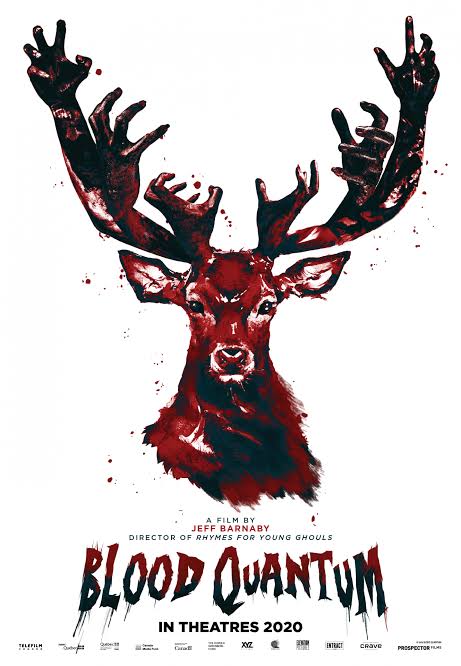
This week was Indigenous Peoples’ Day in the US so I want to discuss a genuinely striking film from 2019 called Blood Quantum. This film was written and directed by Jeff Barnaby, a First Nations/Mi’kmaq filmmaker who was born on a reservation in Listuguj, Quebec. Blood Quantum takes White Colonialism to task for its treatment of Indigenous peoples throughout the years via the classic horror tropes of zombies and their relationship to viral illness/plague. And when I say it takes White Folks to task…IT DOES THE JOB, PROPER.

In all honesty, I wanted to revisit this film before I wrote about it because it is so heavy-duty, layered and, frankly, concurrently violent and beautiful. But I also wanted to publish this as close to Indigenous Peoples’ Day as possible. So choices have been made. If this article doesn’t do Blood Quantum justice, I apologize. I just want people to watch it.

I had heard good things about this film for a long time. I don’t know why it took me…6-7 years to watch it? But when it was released, everyone I know was raving about it. I wish I had seen it then so I could’ve had some interesting conversations.

I genuinely wonder what your Average White Guy Horror Film Fan thought.
I hope he was uncomfortable. I hope he was REALLY uncomfortable. This does a lot of things that a film like Get Out kinda…was just too accessible and nice to do. This film is. Not. Fucking. Nice. It does not play. And that’s a beautiful thing. But at the same time, it made me cry due to its sensitive character portrayals and genuine investigations into human relationships. This is a well-written film and brutal as fuck. It’s 100% my jam.

So let’s start with the title because, well, it plays a huge role in the plot and has historical significance.

According to a piece from the Native Governance Center, blood quantum is

a concept created by white settlers that refers to the amount of so-called “Indian blood” that an individual possesses. Blood quantum appears as a fraction and is “calculated” based on an individual’s family tree. Rooted in eugenics, the concept lacks any scientific basis…Blood quantum is a stand-in device for lineage imposed by the U.S. federal government to disempower Indigenous people and separate them from their lands, resources, culture, identities, languages, and futures…

This may sound familiar to those who are familiar with US Colonialist history. If you’ve heard of the “One Drop” rule for African-Americans (having “one drop” of African-American blood automatically made you Black) it was a similar mythical instrument of racial identification. And, as we can rightly see, both were based on completely whacked out White People “Racial Science” and they were both weaponized as horrific tools of colonialism and White Supremacy, allowing for entire populations of people to endure more pain and suffering than can any white person could possibly imagine.

But blood quantum has become more complex as the years moved on and that certainly comes into play in the film. Many tribes still use this colonial construct to decide who is accepted as part of the tribe and gauge “Indianness” and lineage. But as this interview with Elizabeth Rule has noted, much like Barnaby’s film, many times it’s now used simply as a tool of endurance. Rule states,

The thing that I’ve found to be most interesting about both arguments — in support and against blood quantum requirements — is the language of survival. So, lineal descendant supporters think about high memberships through the lens of existence as a resistance right. And so there’s a desire to build up tribes’ numbers and capacity in order to survive and perpetuate the tribe. On the other side, those who defend blood quantum requirements also evoke this language of survival, and they look upon those blood quantum minimums as a way to preserve an already existing closed community that’s very close and … usually very culturally connected.

So, the film’s title.
It’s already loaded. Without most of the audience knowing exactly how loaded it is.

SPOILERS AHEAD:

The film begins, as horror films usually do, on a perfectly normal day…Until it isn’t. We are introduced to Traylor, a First Nations police chief sheriff on the Red Crow Reservation.
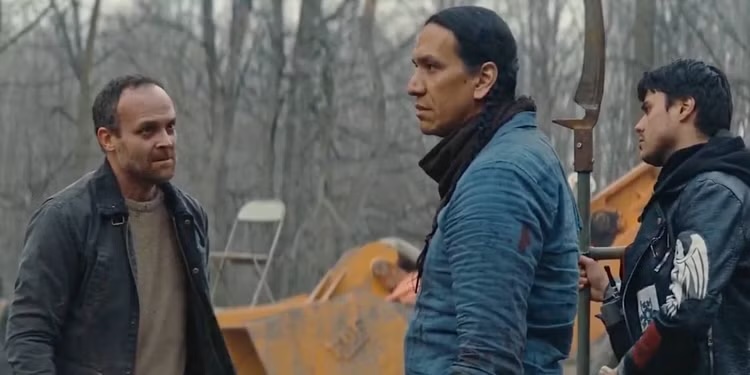
After encountering dead animals coming back to life and some serious chomping action from violent criminals and other random white people, Traylor gives up on passing this whole thing off as a Bad Monday. Naturally, the film escalates but not in a conventional manner. We jump forward to 6 months after this No Good, Very Bad Day and the Red Crow reservation is now an apocalyptic wonderland, looking quite a bit like something out of Mad Max or a George Romero film.
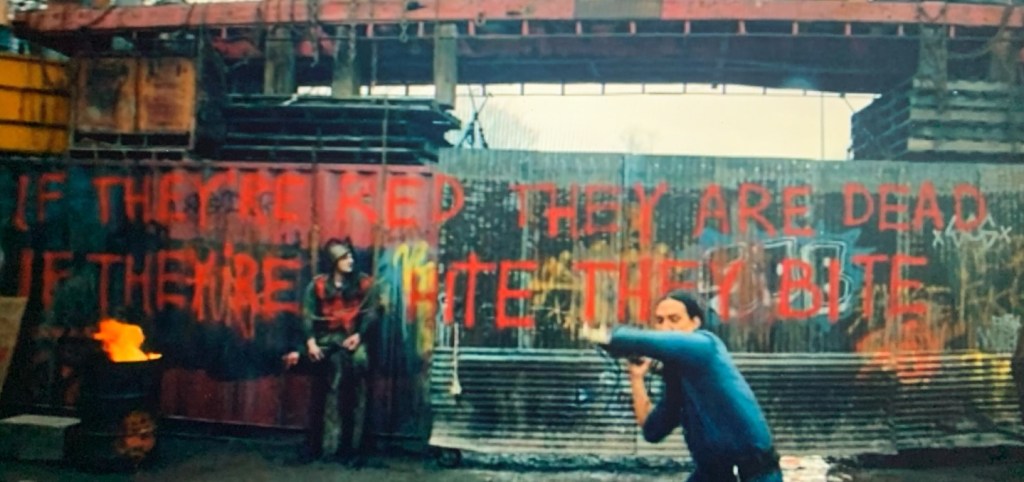
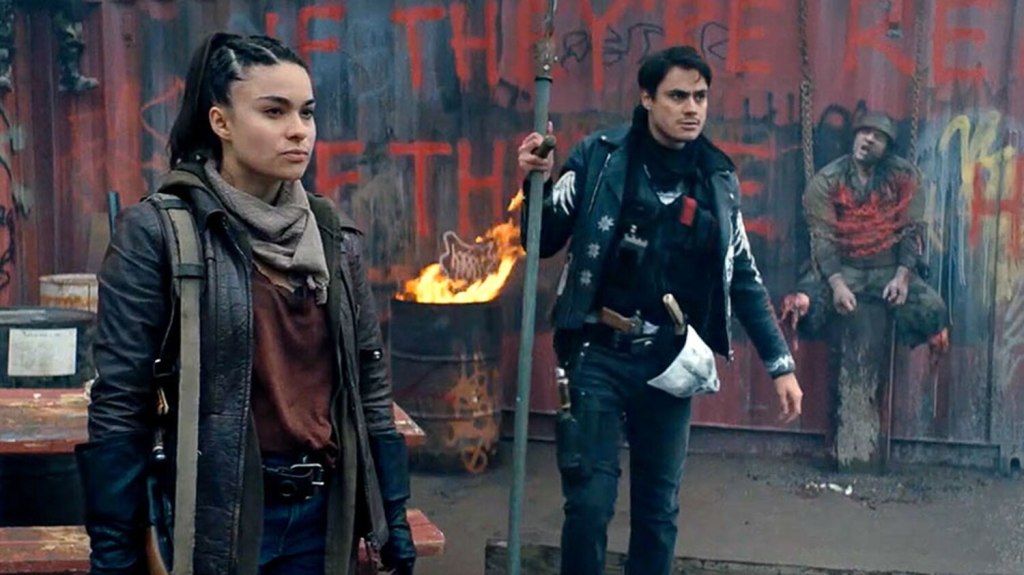
But it gets better. The big reveal comes next.
We discover that there have been no infections within the Red Crow tribe even though people like Traylor were bitten by the infected. As it turns out, the Indigenous genetics of the First Nations people made the Red Crow immune to the bites and the resultant plague that “turned” people. But other people didn’t get so “lucky.”
Most of the population (read: white people) do not have that genetic safety code. And these people periodically come to the compound begging and pleading for safe space and shelter.
What a conundrum.

AND WHAT A FUCKING PREMISE.
And that’s just the tip of the iceberg.
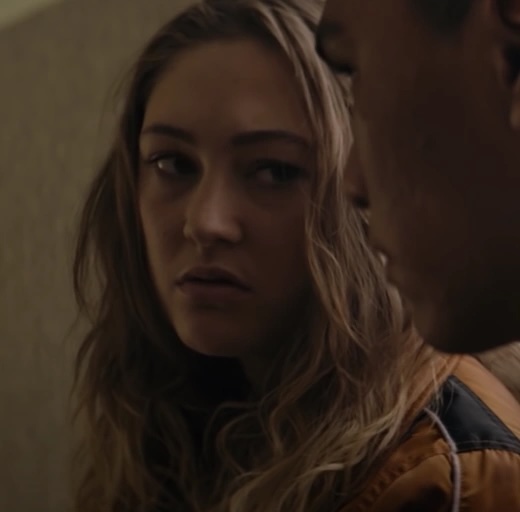
The interracial relationship between Traylor’s son, Joseph, and his white (very pregnant) girlfriend makes life very complicated for, well, everyone. She’s the only white person who lives there and is somewhat (and I do mean somewhat) accepted. I could write an entire blog just on her positionality, white privilege and non-comprehension of the whole situation.
Then there’s Traylor’s other son, Lysol, raised in foster homes and burning with anger at not only white people but the world in general. He’s a genuinely fascinating character and represents colonial damage and trauma in a whole different way (which I will hit on later) but ends up having a massive impact on the narrative and everyone in it.
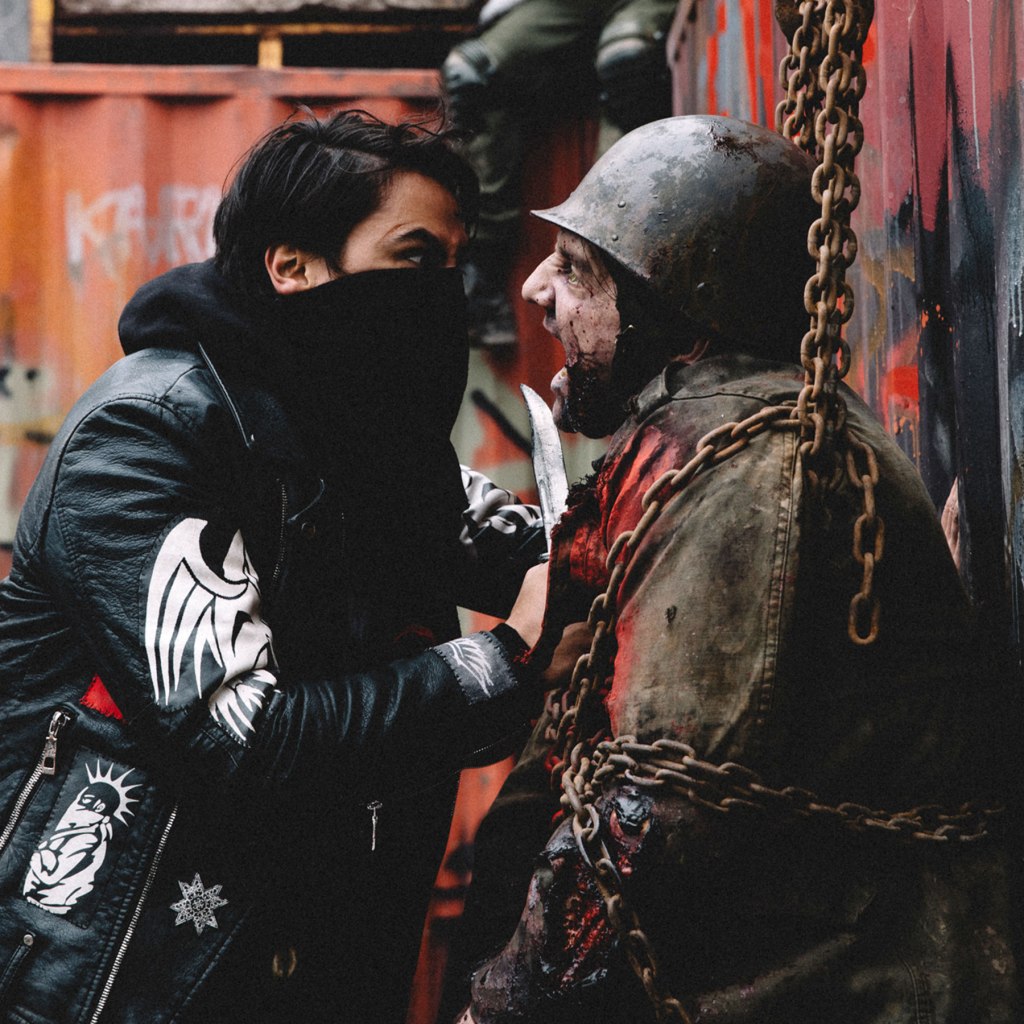

Blood Quantum is an exquisitely layered and complex film bursting at the seams with the full-throttle gore and excitement of a proper zombie film. The FX are no joke and they do not cost the plot anything. While I would certainly be a bit annoyed if people only watched it for that and straight up ignored the immense dexterity with which Barnaby wove a properly intelligent anti-colonial narrative into an electrifying horror film…I guess I would just be glad people are watching it. After all, I don’t see how you could, in all seriousness, call Blood Quantum just a “zombie film.” Most of it is in Mi’kmaq. That linguistic jump alone is a massive shift and just as important as the title.

The majority of viewers will view this as a “foreign language” or see this as qualifying as a “foreign language” title, but I would like to correct this. English is technically the “foreign language” in Blood Quantum. Mi’kmaq is a living language and has been spoken in North America (primarily in Canada’s Atlantic Provinces but going all the way down to Maine) for thousands and thousands of years. Far longer than white settlers have occupied Canadian or US soil. There is a mix of English and Mi’kmaq in the film but Mi’kmaq carries clear dominance. As I watched Barnaby’s film and it became more and more apparent that Mi’kmaq carried more power than English, I cried. I love horror films so much but to have a genre film actively rip apart the horrors of colonialism in a language that has actively survived the terrorism of white supremacy was a very emotional experience. This wasn’t the only time I cried. It brought out a lot of feelings, even amidst the blood and guts.
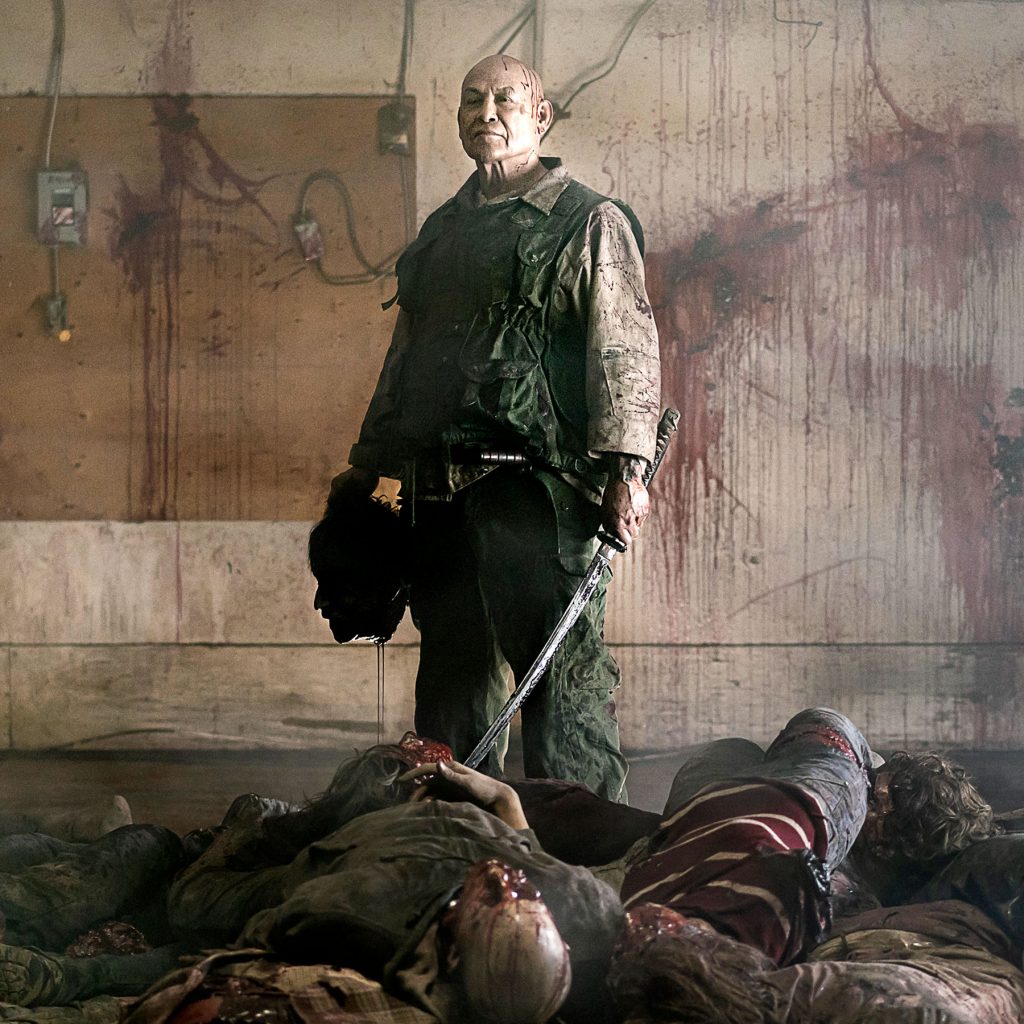
Most zombie media (especially that which directly references plague and sickness) facilitates ruminations on the self, identity and relations to community and future survival. That’s kinda a no-brainer, pun intended. And, of course, Blood Quantum is no different. But meditations on survival and community from the perspective of a colonized population do not hit the same way as a the frightened bleatings of privileged white folks. It’s not that I don’t have sympathy for General Zombie Film People, it’s just that white privilege exists all day every day and when hordes of white zombies are trying to invade a First Nations reservation? It changes everything. Not only does everything go up to 11 in terms of socio-critical relevance, but it becomes a different film. It becomes a re-imagining of past trauma when white people did the exact same thing just…without zombie-ism as an excuse. And bless Barnaby for this.

There is a lot of discussion amongst the Red Crow about whether the compound should allow white people in and whether they should save white people. Watching this conversation happen on film was incredible. But it was also gut-wrenchingly sad. That it should take a zombie invasion to revert proper agency and power to the very people whose land it was to begin with just gutted me (also pun intended, I guess).

And yes, these conversations about human decency and survival were real, especially when they dealt with children. But for me, I kept thinking: this is a First Nations community that has worked like hell to make themselves safe in the middle of an unsafe time and they are able to be safe from white folks for the first time in history. Why should they help white people?? If situations were reversed, what would have happened? Would white people have helped the Red Crow? I doubt it. As many zombie films/tv shows have shown, white folks are very much out for themselves in survival situations. But I guess that was part of the point.

Charlie, Joseph’s pregnant girlfriend, is white and (as such) tries to plead for “everyone” to survive. But it’s hard to watch her do that. Knowing that just outside the walls there are thousands of hungry and detrimental beings who are part of a population that has been trying to kill the people within the walls of the compound since the day they arrived on North American soil. White people in this film are zombies and diseased but…haven’t we always been? Even if we don’t have an actual “plague”? Isn’t colonialism a sickness? And, yes, I do say “we” because I am white and I cannot remove myself from this problem just because I am against the kyriarchy and am a fundamentally anti-colonialist individual.

I’m spending a lot of time on this because it hit me hard. Especially since it discusses land/space/property and safety so explicitly, things that First Nations people have never had the luxury of. The eventual allowance of a few white people in to try to save them was done out of altruism but it ultimately felt suspicious to me and echoed the history of white people taking advantage of Indigenous people and their kindnesses.

Ultimately, however, the story doesn’t go wrong because of the centuries-old obvious hate from white people, it gets undone by someone on the inside. Which is the most frightening aspect of the film. The hatred and rejection that Traylor’s son Lysol (given name Alan) has internalized (from all sides) causes him to act out in the most violent of manners, primarily against his own tribe, destroying everything and everyone in his wake.

I couldn’t help but think that this was also a comment on colonialism as well. Lysol, the product of foster homes, was did not receive the same sort of care and love that Joseph got, turning out bitter and fiercely angry. He was not the same kind of person as the rest of the people on the reservation. A troublemaker, into drugs and drinking, he comes off as a genuinely unhappy and hateful person, becoming more hostile as the film goes on. He vigorously repudiates Charlie for being white and vocally rejects her interest towards saving anyone outside the tribe, defending himself by saying that it was only to keep the Red Crow reservation safe.

Lysol’s past created him and, once again, I think we can turn to colonialism for an explanation. There is a tragically large historical precedent for First Nations children being removed from their families and getting placed in Foster Care. Blood Quantum takes place in 1981, putting Lysol smack dab in what is called the Sixties Scoop. This horrific collection of official policies in Canada forcibly took thousands and thousands of Indigenous children from their families and placed them in non-Indigenous homes, sometimes as far away as the UK, Australia or Germany. Suffice to say, they did not usually get treated well nor were they allowed to explore their culture.

While Blood Quantum takes place in Quebec, the Sixties Scoop affected all provinces and the discourse on Lysol as a foster child is real and so is the trauma he exhibited. Does it make his villain turn right?
No.
Does it make it understandable?
Hell yes.
Can we still look to and blame the horrors of colonialism and terrible whiteness for the terrifying conclusion to Blood Quantum?

ABSOLUTELY.

Blood Quantum asks a lot of important questions of the viewer and I believe that, unlike other, more mainstream horror works, postcolonial horror films give answers. Whether people are ready to listen is another story. I believe strongly that horror is the perfect genre to question and investigate difficult subject matter. I am so grateful for Blood Quantum.


two women gossiping under hair dryers, 1950s-era

Hairy Moments: the Deep Roots of Women’s Hair History

This is the beginning of a series of posts originally posted on a wonderful and lovely website called Dangerous Minds which is now a thing of the past. Please enjoy them as I truly enjoyed writing them and didn’t think they should have dwindled away into the ether of the Internet.

This is one of my all-time favorite photographs. I have no idea who took it, where it was taken, dunno who the hell these ladies are. But goddamn. I adore them all.

I’ve seen tons of people look at this photo and mock these women for unconventional hairstyles, awkward facial expressions, and what is likely a highly Texan aesthetic (my geographic guess). Fine, laugh. But there’s something so charming, so uniquely pleasurable about the way these women (probably family) are enjoying each other’s company, standing out in that ratty backyard. That yard of dead grass laid out in front of a patio overhang that seems to be one short storm away from crashing to the ground. And our youngest girl- the one with the flowing hippie hair and glasses- she’s wearing pink slippers! There’s this weird strength reflected here in this cadre of creatively-coiffed chicks. I bet they made great cocktails and killer cookies.

Women’s hair and beauty dynamics are intensely personal. Since the beginning of time women have invested spaces like beauty parlours/salons with the power of the personal in order to have a location to freely access aesthetic self-care practices. Generally, we do this for our own benefit, to impress someone else or both. These spaces have also traditionally served another equally important function: they are community social zones and “safe spaces” for women to gossip, exchange intimacies that they would never do around male friends/family. Beauty parlours have always served a critical function for women.

The cosmetology world made huge advances in the 1920s. Thanks to the invention of the hair salon (and hair salon franchise) by Canadian-American business woman Martha Matilda Harper, women’s beauty centers shifted from “home visits” to the communal environment we are now familiar with. Harper sold many of the franchise models to lower income women and ended up profiting greatly as a result, even though it could have failed. 

With these advances, there are some unfortunate facts. These sacred communal spaces were structured for Straight White Women and they have never quite lost that flavor, even today. What’s most unfortunate (but not surprising) is that there are women of color who helped establish this space and should be far more famous than they are. Women like Sarah Breedlove Walker aka Madame CJ Walker was born to freed slaves and was an extraordinary businessperson. Employing some of the highest numbers of black women in the United States, Walker developed her own line of beauty products and became one of the first self-made millionaires in the United States.

Looking through what has been visually documented on this topic, it is very rare to see women of color getting their nails done or sitting under a dryer. One of the most unfortunately things salons have done has been to reinforce the “Whiteness is the ideal beauty standard” concept. 

The photographs of beauty parlours and women sharing moments are great. There are outstanding and surreal bouffants and curls, brilliant beehives and up-dos galore. And who knows what they’re chatting about? They could be sharing recipes or gossip about their horribly abusive husband because it is under that dryer that they feel safe. We’ll never know. 

I do know one thing, however. The privilege in those shots gives me pause. I treasure these photographic connections between women during “hair moments” and that helps me examine intense pictures like this one deeper. It is from a Japanese internment camp in Colorado, and this is a beauty salon that they created because there was a need.

These spaces are precious. 

Teachable Moments: Alamo Drafthouse, Cinefamily & the Future of Repertory Cinema

So I think its time to have a little conversation about value, worth and intersectionality.

Things are pretty weird right now. I was talking with a girlfriend the other day and both of us have been in the film community for a really long time. Long enough to remember when internet-based film writing/promotion and communities didn’t rule the scene. Imagine that! But internet/no Internet, there has always been misogyny. Always been racism. The homophobia has been lesser to an extent, but…that’s entertainment. It’s still there. We all know that transphobia is awful no matter where you go so…end scene.

gender neutral robot


Let’s set the stage. Current events: if you’re a straight white male celebrity who sexually assaults women, you might want to start getting scared. James Woods found this out the hard way when Amber Tamblyn called him out on Twitter last week. She wrote two brilliant pieces on Teen Vogue and the NYT, in response to him calling her a liar after she recounted his ill-fated pick-up attempt when she was just 16. Tig Notaro’s recent season of One Mississippi dedicates 2 episodes to addressing sexual assault, which is a direct shout out to Louis CK. Tig has spoken widely about CK’s refusal to address his problem, as have other female comedians.

Screen Shot 2017-09-17 at 9.45.21 PM

Real talk: this shit has been shoved under the rug in the entertainment world since the casting couch was invented and studio heads invited women in for “lunchtime interviews,” promising them the “role of a lifetime.” But women are finally breaking their silence. Which is great. This should be supported and encouraged, especially by powerful men in the media world. But there’s a big chance it won’t be. Why not? Because making a “bold move” such as that might mean outing their friends or losing their buddies. And that’s scary and uncomfortable.

Dudes, I’m calling you out. It’s time. It’s not brave for you to step forward and join us in talking about what’s actually going on. If anyone tells you you’re “brave” or thanks you, tells you how “amazing” you are for standing up, that’s straight up bullshit. You should have always been doing this. You just finally smelled what The Rock was cooking, ok? No back pats, no OMG YOU’RE SO AWESOME!

Make a decision. Look at what’s going on and be on the right side of history. Because history does not wait and it certainly has no sympathy.

Over the last week, some straight white men in the film community have had a few real HOLY FUCKING SHIT moments. These were all heavily tied into the fact that they have absolutely zero comprehension of what VALUE means or what or who might, in fact, be VALUABLE.

It is important to note that most of the recent conversations being had in the film world have been incredibly white and privileged conversations. We have not stopped for one second to address women/people of color, trans bodies, or any communities that might have felt equally bludgeoned by what has been happening in the repertory theater scene. And by that I mean the recent scandals at the Alamo Drafthouse and the Cinefamily.

Screen Shot 2017-09-17 at 9.51.35 PM

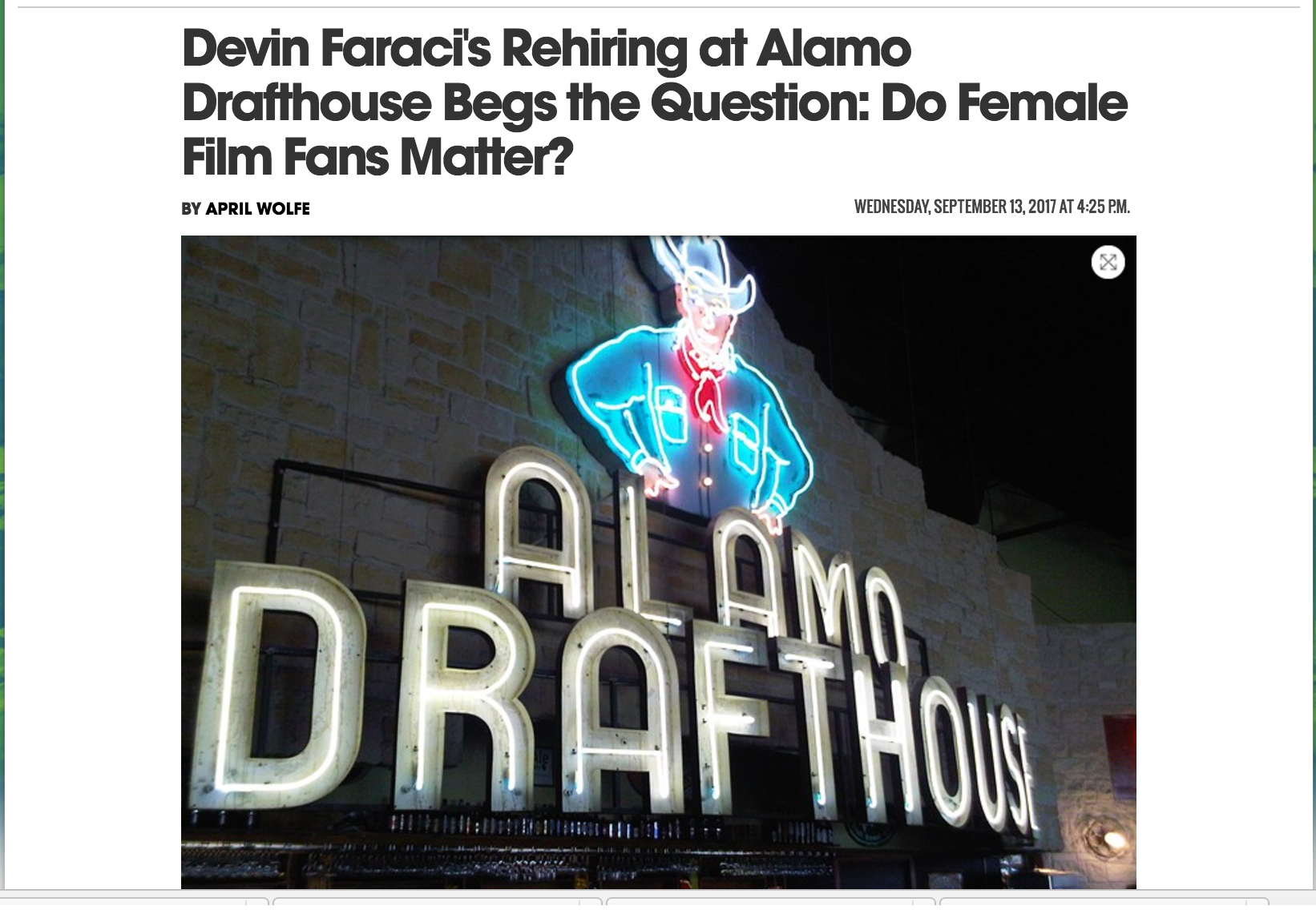
LA Weekly, September 13, 2017

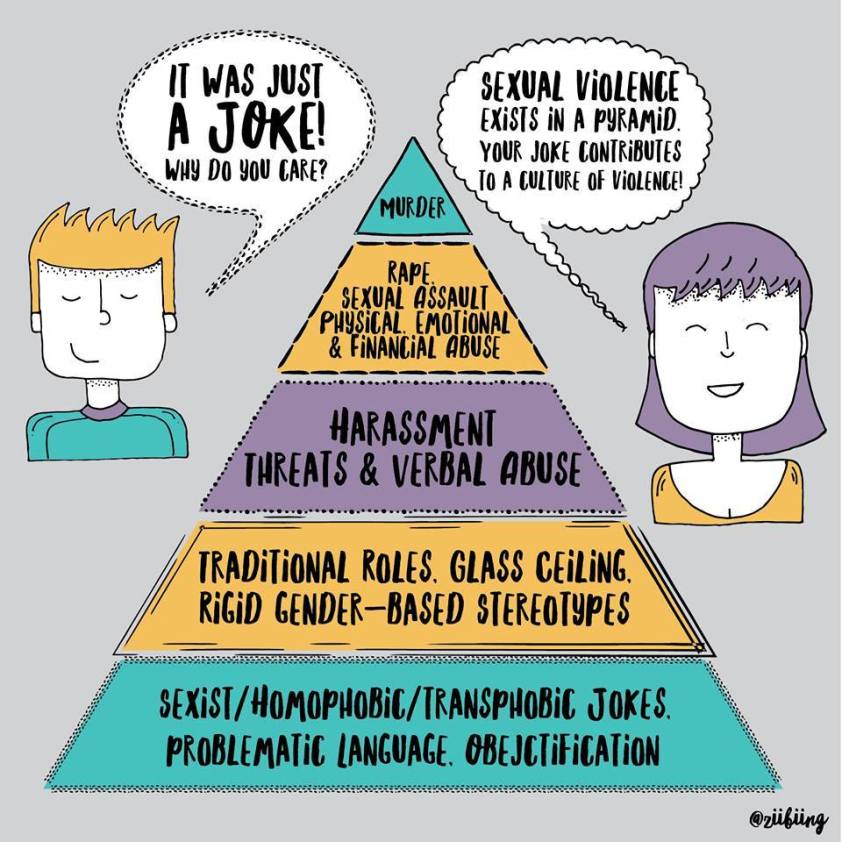
I want to approach this discussion of VALUE on an intersectional level and include every body that has ever felt assaulted by today’s straight white male dominated film culture. It is a structure designed specifically to celebrate all that is white, male, moneyed and heterosexual and oppress all that are not. All marginalized groups-defined as women (women of color especially), people of color, queer folx; trans and non-binary identifying individuals- are considered outsiders from this Primary Group and ostracized. We may try to affiliate ourselves with those in this Clique, but the very nature of its construction denies us entry. We haven’t gotten good seats in the movie theater for quite some time.

AudreLordeSingleIssue.jpg

I have been in the world of cinema and media studies for most of my adult life. The world has changed a lot in the last twenty years, and I’ve changed with it. The one thing that has not changed is the way that marginalized groups have been treated. This is absolutely a question of VALUE. We are simply not considered to have worth.

Structures of value and worth are why women are spoken over on newscasts and televised political arenas. It’s the reason so few brown faces are protagonists in feature films, there are currently no Asian superhero movies and why black bodies have rarely been lit correctly on film and television until work like Insecure (creators: Issa Rae & Larry Wilmore, 2016) or Selma (Ava DuVernay, 2014).

11-insecure-recaps-204.w710.h473

Issa and Molly, Insecure, Photo: HBO

The incidents I will be discussing- the sexual assault troubles at LA repertory movie theater Cinefamily and the sexual assault/employment cover-up/what-have-you at the Austin-based Alamo Drafthouse- are not ones that I plan to give space to here. Please feel free to Google them at your leisure; there are tons of articles available on both subjects. I will be using them and specific details/ experiences in context that I believe to be important to this piece but I don’t believe that I need to link any articles.

Moving forward then- value has been an issue for hundreds of years in marginalized communities. Consider the following: a body’s worth measured in economics (slavery) or a body’s worth measured in marriage and reproduction (a son is good, the family name/legacy continues, a daughter is bad except for marrying off/childbearing). What about a slave body that can reproduce another slave body (a woman of color)? Think on these things. These evaluations are not done by the bodies themselves but by an outside force; an oppressor. Whether it is White Supremacy or Patriarchal Heteronormativity, dominating another body because of your self-created value structures is just fucked up.

One of the primary topics of this article is sexual assault, an act that involves our physical selves. Our bodies. Our bodies are a big part of our worth. Our bodies are physical containers but they are also reflections of our PERSONAL worth. We value ourselves and we value our bodies. So what do we do when our bodies are violated? Worse than that, what do we do when those whom we value enact violence upon our valuable, worthwhile bodies? Who do we turn to when we are viewed as so invaluable that we cannot even be consulted about intimacy? That’s a fucked up feeling.

This was something many women faced at Cinefamily and have faced for years in the film community. Who would believe that so-and-so did THAT? “He’s so coooool Are you sure you remember right? You weren’t just a little drunk?” Because then he’s off the hook. If you’re drunk, the incident didn’t happen. And if he’s got some kind of high-level rep or if he’s famous then it definitely didn’t happen.

Screen Shot 2017-09-17 at 10.09.55 PM

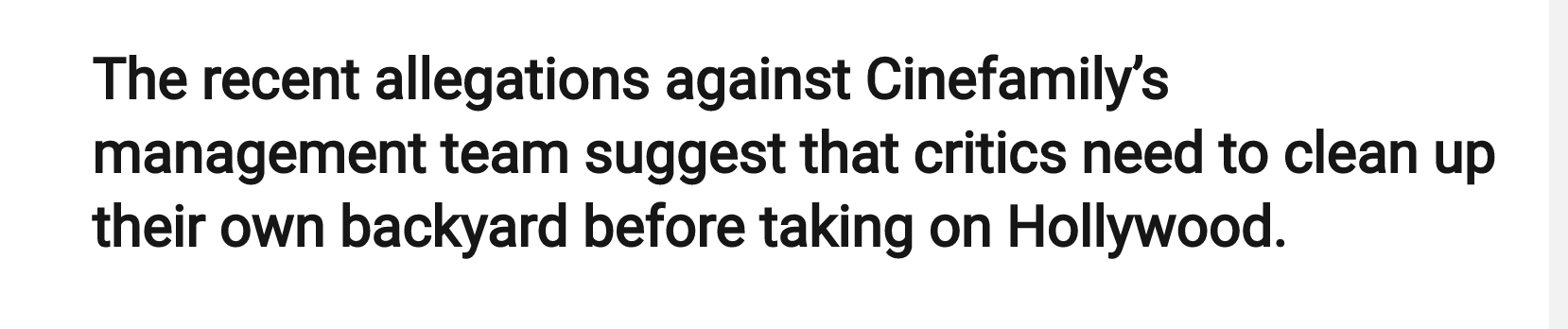
IndieWire Headline, Aug 22, 2017 11:21 pm

Intimate violence is visited upon our bodies and we can do nothing about it. We are not believed because we have women’s voices. Or queer voices. Or black voices. Or trans voices. While white women like Amber Tamblyn can reveal their stories and talk back to James Woods, do you think anyone would’ve believed a black trans woman who wasn’t famous?

Let’s look at social structures of VALUE. White people don’t value POC. If we did, black bodies wouldn’t be strewn lifeless throughout American streets, while the white bodies that violated them are legally allowed to move on without repercussions. Women/women-identifying folx are not valued. If we were, there would be no such term as “mansplaining.” White women are valued more than Women of Color but that in and of itself makes me cringe. And let’s be honest: trans and non-binary identifying individuals get the worst of it. It’s not just that people don’t value them. People pretend they don’t exist. Value and worth. If society, structured exclusively by White Rich Straight Older Men sees no value in you, you play no part and you are worthless.

Having attended the Cinefamily for a long time, I always noticed that there were many female employees and volunteers. Like an overt amount. I knew a few of them. I also saw a huge turnover rate. I stopped going a few years ago except to certain screenings. I saw brilliant and painfully talented people get treated poorly and that left a bad taste in my mouth.

Screen Shot 2017-09-17 at 10.08.24 PM

Film School Rejects, AUGUST 25, 2017

There were a few men employed there, but for the most part, it was women and not in an “empowering women” way. Looking back, the presence of so many women employees had a display case feel. Which I thought was strange. I chalked it up to Cinefamily being an “extreme hipster” theater but that was definitely not it. Sometimes we tend to compartmentalize when we don’t want to see things that are staring us right in the face. This was one of those things.

To Hadrian (Cinefamily founder), cultivating the look and molding the culture around that theater was part of its cachet. He did a masterful job in many ways. On the other hand, other people who never received the credit did much of the work attributed to him. What is critical here is that he created an environment where the only value system at play was his own. In any other work setting, this would have been seen as abusive. In any other work setting there would’ve been a HR person to assist his employees. But his male-dominated upper management structure (which includes the board) was in charge of the entire feel and social landscape of Cinefamily, from screen to popcorn maker.

So the regular floor employees were intimidated as fuck. The value of the women had been as objects, the men as continuing the promoting of the world/culture that had been created. Sounds a little bit culty. Which has been mentioned before. But I really read this as a lot of fear and sadness and a deterioration of personal worth as you continue to be abused by a workplace situation that you used to adore.

Here’s the even shittier part: this is what the world of repertory theaters and film festivals has been like forever. So the fact that Cinefamily exploded when it did made me roll my eyes a little. I couldn’t help but think: OH FUCK. Here we go. So who’s next? And let me stress right now that I have a lot of love for a lot of people working in the film festival and repertory worlds. My archivist/preservationist world is 100% not without its horror stories. In fact, we are probably due for some explosions too. But we’ll deal with those when they happen.


Guerrilla Girls' Pop Quiz 1990 by Guerrilla Girls


As for theaters and festivals and their dreadfully loosey goosey culture…These white, straight and male-dominated events and networks have always had Questionable Incidents. In the past, they were sighed at, and “Oh, that’s just so-and-so”-ed at. It really was like Mad Men. Whispers and secret confrontations swept under the rug. It was expected and built in. But when the ladies talk behind closed doors, we’re not fucking happy about it. And we haven’t been happy about it for years.

Did you know that, guys? Or did you think things were ok? Because a lot of you had to know about a lot of the heinous shit that has happened over the last 20 years. Whether I am in academia, the film festival world, entertainment journalism or my current archiving/preservation community, I want some answers. If my girlfriends and I know, if we’ve been frustrated and angry because we couldn’t call someone out because they were Too Big Time, then you guys must know the stories too. You probably know worse stories and have laughed or just rolled your eyes about it. Every time you didn’t warn us or stop those guys or call them out or do something, you let the women in your life and in the film community know that they were not valued.

Friends. WE JUST HAD TWO NUCLEAR MOVIE HOUSE EXPLOSIONS IN LESS THAN TWO MONTHS. Think there’s something rotten in the state of theatrical? Cuz I fuckin’ do.

So let’s update. It’s 2017. Less rep houses, mostly due to the analog/digital changeover. So we’re down a lotta movie houses and up a hellovalot more film festivals. What did that do? Well, it gave us the white, straight male-dominated film culture that focuses on the White Male Film Geek as Lord King God. It is literally White Geek-Bro Supremacy. This is something that has been planted, cultivated and grown over the years, carefully and intentionally. Fed with social media and entertainment journalism, it is so large that it IS VALUE and considered something OF WORTH. Basically, these geeks bring in the bucks. But at what cost?

I’m here to tell you fuck White Geek-Bro Supremacy. There is nothing valuable that can be created by this system. It does not create communities of worth. It gives NOTHING back.  The Cinefamily, Alamo Drafthouse, Fantastic Fest are examples of this dynamic in action and each one of these has either imploded completely or fractured under the weight of its toxic masculinity.

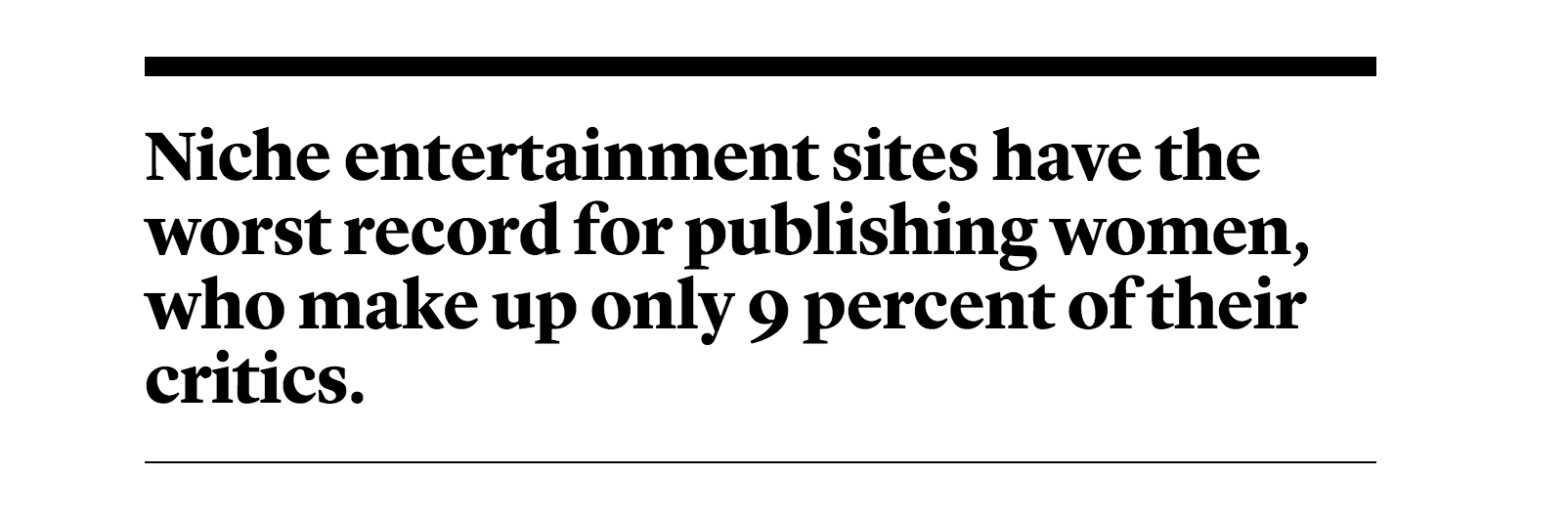
Communities established under this structure do not value women of color who love to read comic books or cosplay because it is joyful. In fact, the communities developed by White Geek-Bro Supremacy do not center joy at all. White Geek-Bro Supremacy centers competition, bullying, and one-upsmanship instead of goodwill, respect and an infectious love for cinema. The cradle of this system is binary viewpoints (best/worst) and list-dependency (top ten most ___). It was heavily nurtured with the idea that some media was indubitably to be valued and some not to be valued, based upon a knowledgeable hierarchy that rose to the top of the message board/chat group communities and eventually published blogs and articles. Incidentally, this is how men ended up dominating authorship of Internet movie sites.

Screen Shot 2017-09-17 at 10.38.24 PM

from Katie Kilkenny’s article, “Why Are So Few Film Critics Female?” in The Atlantic, Dec 27, 2015

White Geek-Bro Supremacy is what was working overtime during the Alamo Drafthouse turmoil this week.

Many thought the mess was about a sexual assault(s) committed by a former writer for an Alamo Drafthouse publication. It was about more than that. It was about a severe lack of transparency, the preferential treatment for a pal and the willingness to risk an entire company’s reputation and national operations on an individual relationship. This speaks of a special kind of blindness: Privilege Blindness. As my friend John Wildman eloquently wrote, a large problem in the Alamo Drafthouse founder Tim League’s “crisis management” was that he never stopped to listen to those who should have been listened to.

This is a recurring theme with privilege. Those with White Privilege, Male Privilege, and Heterosexual Privilege have the idea that their privilege affords them earplugs & blinders. The definition of Privilege Blindness is “I will not make the space to listen to you because of xxxx reasons.” Guess what, honey? Not one of those xxxx reasons is valid. Grab a beer. Pop the top. Just get uncomfortable with this.

privilege.png

When you do not take the time to listen to another person, you are telling them, “You are not valuable. You are not worth anything. You have nothing to tell me of any value. I do not see you as someone who could add value to my life. Your experiences/thoughts/feelings mean nothing to me.” When you do that to someone in a marginalized group, it can be both achingly familiar (we’ve lived our whole lives not being listened to) and possibly life threatening. While the aforementioned former writer for Drafthouse certainly did lousy things, he wrote one good thing on his now-deleted Medium post: “Believe women. Especially when they are talking about you.”

What is it going to take to destroy these systems of oppression? What is it going to take to break down years of abuse? The men and women who have spoken out against the ongoing practices at the Drafthouse are mirror images of those at Cinefamily. They feel ignored, stepped on, devalued and left in the cold. They were not hip enough. Not in the cool kids club. Stories of floor staff at the Drafthouse being treated as “lesser than” because they were not within the upper echelon of the Who’s Who. And I get it: it’s largely impossible in a company that size to have some utopian vision where people are all partying together. But it is possible to have people feel appreciated and like they are part of an institution that is doing something amazing for the cinema community, which is the image that the Drafthouse outwardly projects. Bottom line: the party should never end up being more important than the people who decorated the room for the celebration.

As for Fantastic Fest… Tim League’s gotta be a little sad about that right now. His actions have put him in that funky little zone where moral values have impacted his Financial Value. Fox Searchlight pulled their film from Fantastic Fest. That’s kind of a big deal. While FF usually goes for more unusual fare, it could always use a big studio film for a bump, especially after recently launching new distribution shingle, Neon. Get rid of the testosterone-fueled boxing-matches, limit the VIP-only bashes that create such clear hierarchies and go back to what made the festival unique- its content.

ff pic

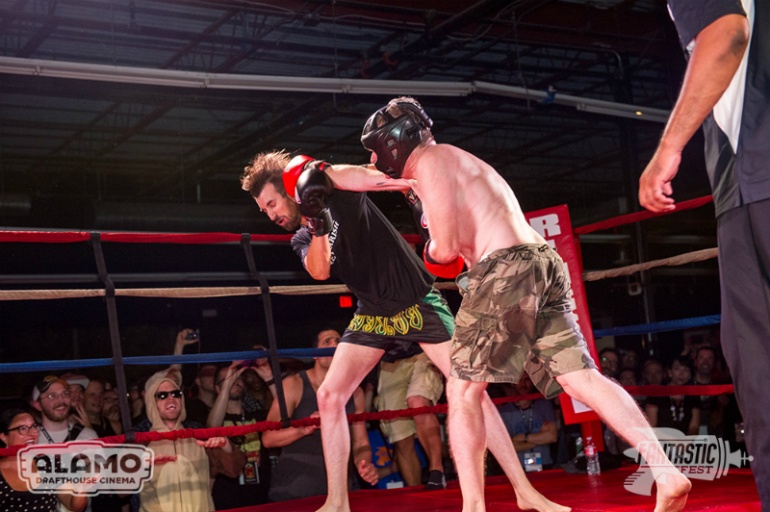
Boxing match from Fantastic Fest 2014, Photo: Alamo Drafthouse, September 21, 2014


So this may have been a lot to get through for many of you. And it may not have made sense or connected to the Cinefamily and Drafthouse situations for some. But please trust me- it all does. Obviously right now I don’t give a shit about TL;DR. Some will read this, others won’t. I’m really pissed off. I hate that it’s taken the devastation of two cinematic institutions and one film festival in order to knock some sense into dudes’ heads and make them remember that women are people too, with feelings and needs and all kinds of INSANE THINGS.

And please know- I never wanted Cinefamily to die. However, in the form that it was in, with that board of directors (some of whom are still very active in the LA rep theater scene), it was impossible. There were amazing people at Cinefamily and amazing people are suffering unemployment now due to its closure. I also do not advocate skipping Fantastic Fest (unless you feel you need to). I think that taking the discussion to the source and holding people accountable is key. But don’t just talk the talk, walk the walk.

rapeculture2

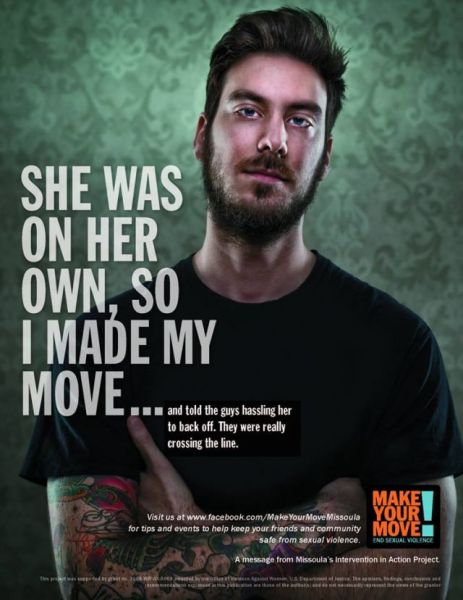
An interesting ad from an anti-rape campaign in Missoula, MT.

I don’t want to see Drafthouse go down in flames but I would like to see its encouragement of White Geek Bro Supremacy stop. This will take more than a few professional sessions with a “crisis management” team. This will mean letting real people – women, POC, queer folx, trans/non-binary film lovers- talk to you, Tim League. And you need to shut up and listen.

Turn a new page. It’s possible, but it’s going to take work. It’s going to take a lot of listening and a lot of people are going to have to get really uncomfortable. A lot of people are going to have to do some major self-reflection. But as Amber Tamblyn wrote to James Woods, “What you are experiencing is called a teachable moment. It is called a gift.”

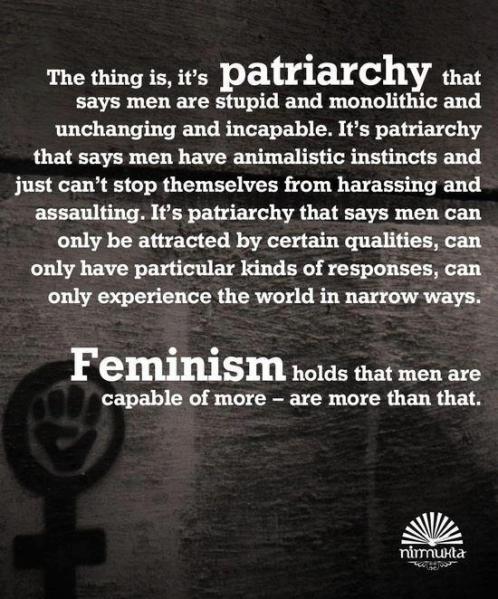
patriarchyfeminism

Women and other marginalized groups are done being quiet. We know our value and our worth, even if rich straight white dudes don’t. For many of us, discovering intersectionalism has helped. Working together we can be more powerful than by focusing on just our own separate issues. Many of us have discovered new definitions of value and worth in community organizing. But that also means that structures of white supremacy and patriarchy are in serious danger. We’re only going to get louder and more powerful.

So White Male Geek Squad? Y’all should get your shit together and clean up your act. We’re coming for you. And that’s a promise.