Seeing Double: The Big Combo and Visual Kinetics

***PREFACE: THIS ENTRY DOES CONTAIN SPOILERS. IF YOU HAVE NOT SEEN THIS FILM, PLEASE BE AWARE THAT THERE ARE SPOILERS WITHIN. BUT, AS AN ADDITIONAL NOTE, KNOWING THE INFORMATION WILL NOT RUIN THE FILM. IT’S ABSOLUTELY INCREDIBLY.***

The Image is more than an idea. It is a vortex or cluster of fused ideas and is endowed with energy.

Ezra Pound

Richard Sattin called it an “economy of style.”[1] Louis Black wrote that “the visual aspects of the film are much richer and more complex than the narrative they are wrapped around.”[2] In an interview with Peter Bogdonovich, director Joseph H. Lewis simply stated, “What interested me most was telling the story through the eyes of a camera. I didn’t like words- wherever I could, I cut words out, and told it silently through the camera…I think that’s what the camera is for and I think that’s what our medium is for.”[3] From these statements, it is safe to assume that, while many filmmakers concentrate on the integrity of plot points or the caliber of an individual actor’s performance, this was not as crucial to the filmmaking of Joseph Lewis. A man who had climbed up through the ranks of the studio system, and had done everything from sweeping the studio floors to directing his own feature films, Lewis understood what he wanted out of a story, and he used the camera and the narrative in tandem to generate the desired results.

While having already made quite a few films by this point, Joseph H. Lewis’ The Big Combo came right at the latter end of the “Noir years.” Released in 1955, the film was labeled by Motion Picture Daily as “strictly adult trade,”[4] with Variety taking pause to note that it was “grim…and hard-hitting… The moronic fringe of sadists will enjoy this, and all the little kiddies will be sick to their stomachs.”[5] Clearly an example of the trend in post-war cinema, James Naremore states, “the postwar thrillers…seemed more downbeat and perverse, perhaps because the war and its aftermath created a vision of ontological evil and a growing appetite for sadism.”[6]

For all of its excessive violence and shockingly explicit sexual displays, the film actually deals more intrinsically with the power of the visual image, both narratively and stylistically. Within this tale that is summarily about a detective who is seeking to bring down a gangster’s syndicate, there is a strategic effort made to discuss the evolution of identity and the recouping of individual agency. Through the use of character doubling, as well as the development of the meaning of visual representation between characters, this film impresses upon the viewer the importance of trying to maintain agency, in an unstable world where it is easy to lose sight of who you are.

Seeing You Seeing Me, Being You Being Me

In her article, “Women in Film Noir,” Janey Place writes that film noir’s visual style conveys a mood of total instability, shifting values, and constantly redefined identities through the “expressive use of darkness: both real, in predominantly underlit and night-time scenes, and psychologically through shadows…Characters (and we in the audience) are given little opportunity to orient themselves…Silhouettes, shadows, mirrors and reflections (generally darker than the reflected person) indicate his lack of both unity and control. They suggest a doppelganger…or distorted side of man’s personality which will emerge…and destroy him.”[7] Within the filmic text of The Big Combo, not only are the characters doubled through the shadowy visual style, but they are also given mirror images through the narrative. Each of the primary characters has a corresponding “doppelganger” that, like Place’s argument, seems to represent a darker, more destructive element that exists within them. As well, exacerbating the cracks in this already-fractured environment is the fact that these characters are doubled not once but twice, each with a different “other half.”

At the hospital, when Detective Diamond (Cornel Wilde) first meets Mr. Brown (Richard Conte), the gangster, and McClure (Brian Donlevy), Mr. Brown’s flunky, we are given visual cues as to the relationships between all three characters. Mr. Brown and McClure are both representatives of different aspects of the otherwise lawful and “righteous” man, Lieutenant Diamond, as well as doppelgangers of each other. Shown in medium close-up, Brown deems Diamond not worthy of speaking to directly, thus he uses McClure as a go-between. He refuses to face Diamond, so he remains seated, back to the policeman. Not only are the shadows starkly present in this shot, but the physical positioning of the gangsters Brown and McClure put them back to back, almost as though they were a strange set of Siamese twins.


Noir is as noir does: Mr. Brown exists in the forefront of McClure's shadow.

McClure is explicitly referred to as Mr. Brown’s double. As Brown states so succinctly in the scene previous to this, while gesturing at McClure, “We breathe the same air, sleep in the same hotel. He used to own it, now it belongs to me. We eat the same steaks, drink the same bourbon. Look-same manicure, same cufflinks.” It is made visually apparent in this shot, however, that McClure’s shadow is hanging over Brown. This might seem strange as he is, in actuality, second string. This shadow, however, speaks to the fact that, besides being Brown’s double, McClure used to be Brown’s boss. However, Brown is now the top dog, and, as he says, hinting at McClure’s own denigrated position, “First is first and second is nobody.” Thus, although McClure’s shadow may be bigger than Brown’s, it is just that- a shadow. McClure’s shadow is bigger than his physical appearance, meaning, essentially, he really is “nobody.”

What brings all these men together is Jean Wallace’s character, Susan. But Susan is quite complicated. Not only is she Brown’s girl, but she has just attempted suicide by chugging down a bottle of pills. If that wasn’t complicated enough, due to hospital and legal issues, not only is Susan the suicidal gangster’s moll, but we have now found out that half the reason that Diamond is obsessed with this case is that he is in love with the girl too.

Narratively, the parallels between Brown and Diamond are clearly drawn. If we couldn’t figure it out from their relationship with Susan, we are given a sequence in which the girl is removed from her hospital room out on a gurney, half-conscious, saying the name “Alicia” (incidentally, one of her doubles). Both Brown and Diamond possess intense gazes as she is wheeled down the corridor. Looking at these men standing next to one another, it is all we can do not to make a joke about them shopping at the same stores. With the exception of Brown’s hat and pocket kerchief, the two men are almost identical visual replicas of one another. Lit similarly, and located right next to each other in an analogous stance, it appears as if Diamond is just a taller version of Brown. Aligning these figures in this fashion only serves to underscore the doppelganger effect between the two men.

As we watch Diamond, he watches Brown watch Susan go down the hall. While we would expect Diamond to be watching Susan as well, seeing that he has spent $18,000 of the taxpayer’s money (as the police captain none-too-gently reminds him earlier) chasing her, he is actually watching Brown. It is almost as though he recognizes his alter ego/mirror image, and sees what Janey Place called the “distorted image…that will destroy him.” It is this kind of recognition that does in fact effect change in the characters within the diegesis. While Diamond is already shown as being obsessed with Susan and the case, this “recognition” leads him to play a significant role in facilitating the other “doppelgangers” and doubles to reveal the clues that help him solve the case.

Brown and Diamond: the yin and yang/dark and light. Even within their names, there is a stark visual connection between the two men.

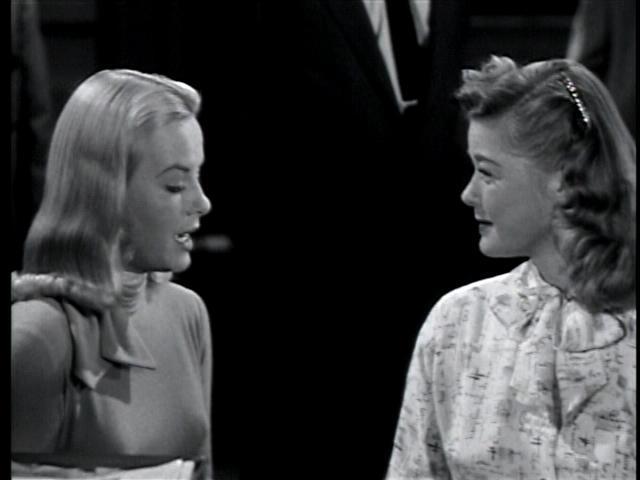
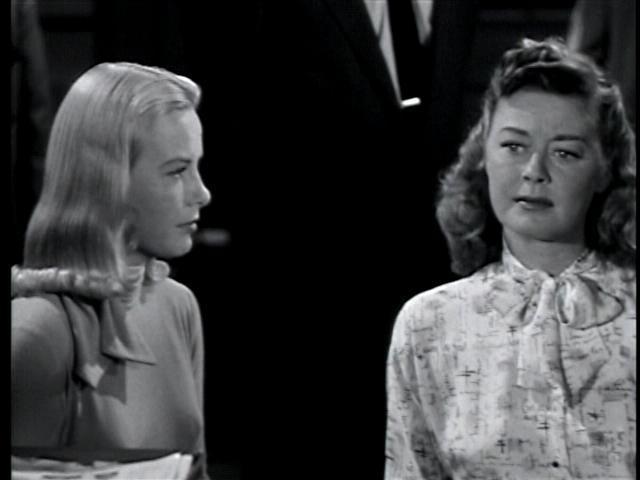
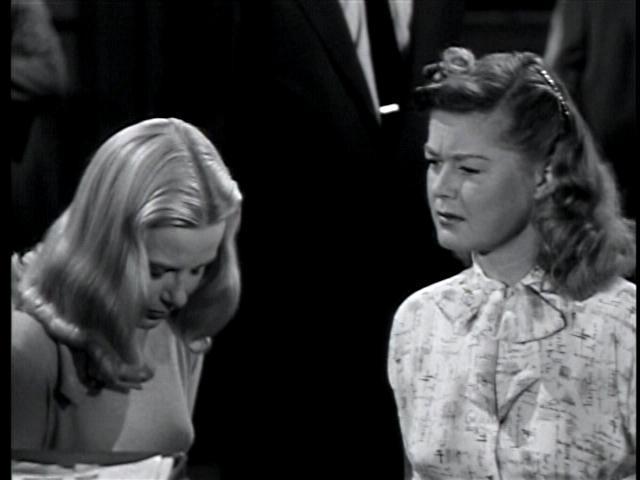
Susan Lowell, the girl in the hospital, is formerly what one might call a “society girl.” Cultured and beautiful, she was interested in classical music and trained in piano- before she met Mr. Brown. At the point where we encounter her, she has been with him for almost 4 years, and is far from that girl that she used to be. As she states to the old friend she encounters in the bar, just before passing out from the overdose of pills, she is now more skilled in “stud poker” than piano. Her alter ego, the name she was murmuring in the hospital, is Alicia, Mr. Brown’s estranged wife, described by one of the characters as a “good girl. Healthy, right off the farm. Brown married her…two years later she was a lush, drink anything.” Susan now not only occupies Alicia’s place by Brown’s side, she has also taken up her position as the “good-girl-gone-bad” resulting from Mr. Brown’s formidable powers of corruption. Later, when Alicia and Susan meet, it is made unequivocally clear that Alicia is simply an older version of Susan. Through their encounter, we are shown the catalytic effect that meeting your “other half” has.

What the audience sees places more insistence on the narrative. Alicia & Susan's "mirror stance" underscores the fact that they are being doubled as characters within the plot.

In that scene, Alicia is sitting in Diamond’s office. Susan enters the room, and Diamond pulls out a chair for her, facing Alicia. Alicia, smiles brightly, asking if Susan is a policewoman. The tone in her voice is the same slightly insane and child-like one that she used when Diamond found her tending her flowers at the sanitarium. Alicia, desiring to be someone else, someone younger and not scarred and tarnished by her past, is attempting to reclaim a child’s identity. Susan then identifies herself, telling Alicia that she is to be a witness against Mr. Brown, and that she has been Brown’s girl for four years. Alicia’s expression changes, “I’m not,” she says, and goes into complete denial, saying, “He met lots of girls, they were crazy about him.”

Susan admits her regret at being with Brown, to which Alicia’s entire attitude changes. “Then why did you stay with him for four years? Why’d you start?” To which Susan reacts with “I don’t know,” and tears. The way Alicia physically responds to Susan is with obvious identification, seeing her own innocence that is now gone.

The effect of the two-shot in which they appear, and the way the camera moves into a closer shot give it a certain degree of intimacy.

As we begin, the camera depicts a shot that is further away, visually involving the rest of the men in the room, Diamond, the police captain, and one other officer. As this scene slowly becomes about recognition of the self in the other, the camera moves in, focusing solely on the two women. The only time this is broken up is when Diamond butts in, making the comment, “Take a good look at her Alicia, take a good look. You can see yourself ten years ago. If you had only spoken up then, how different your life would have been.” As heavy-handed as this comment is, the shot of him, between the women, is fast, while his voice continues and we watch Alicia battle with the reality of “meeting herself” ten years earlier.

The Harsh Truth of the Camera Eye

Beyond the doubling that has been shown, photographic evidence plays a huge role in the progression of the film and its emphasis on the visual image. By utilizing photographs as major catalysts for the revelation of secrets within the film’s narrative, The Big Combo exploits the visual image within the visual image. While the perspective vacillates between the character as privileged spectator and the audience as privileged spectator (or sometimes both), these seemingly innocuous “props” within the film point to the intrinsic value of visible representation. Whether it is through physical doubling or through a piece of photographic paper reflecting a certain likeness, it is that very visual insignia that serves to propel internal conflict within characters and an eventual revelation of truth.

At the point in the film when Susan leaves Mr. Brown, she comes to visit Diamond and brings him a photograph. Having not yet found her, Diamond is under the impression that Alicia is dead, having been murdered by Mr. Brown. The night before, Brown’s men had mistakenly killed Diamond’s on-again/off-again lover, the burlesque dancer, Rita, thinking it was Diamond, so this was not a far jump in logic. Susan hands him the photograph, telling Diamond that not only is Alicia alive, but according to Brown, she is well and living in Sicily. After a brief look at the photograph, Diamond realizes that not only is Alicia not in Sicily, but she may be closer than they think. He takes the photo to a lab to have it analyzed, and the results expose not only Alicia’s location, but also her personal evolution.

The first-person perspective shot of the photograph when given to Diamond, juxtaposed against the darkened room of the laboratory where they are doing a photographic comparison, lays bare the nature of what the photograph means within this context. Where we become aligned with Diamond’s perspective in his office in viewing the photograph, we then are welcomed into the police laboratory and are privy to their commentary on Alicia’s “changes” but through the machinery. We enter the lab, and see a projector, with its image the only light in the room.

This shot of the projector is just another reminder that our film text is about looking at things within a world of doubles and weird mirror vision. Indeed, like the scene in the police station, it is literally a kind of dual projection.

Now aligned with the actual image-making apparatus, the shot follows its line of projection to the two off-kilter and shadowy images of Alicia, in full view upon the wall. One is Alicia from the past, with Brown, and the other, more recent image is the one offered up by Susan. With this carefully constructed spectator view, we are reminded that visual images within the noir film text are volatile and changing, speaking to the very character points that are reinforced by the narrative. Even one of the technicians notes, “She sure changed since the other picture…”

When Diamond finds Alicia, she is at a sanitarium, and happily introduces herself as Anna Lee Jackson, denying any knowledge or affiliation with Mr. Brown.

As Diamond continues to question her, he confronts her with what we are led to assume is the photograph of her with Mr. Brown. However, we do not see the photograph. All we see is her expression change drastically upon taking it from Diamond’s hands, and her extreme emotional response as she tears it to shreds.  As Diamond tells her about Rita’s death at the hands of Brown’s men, Alicia screams in denial, covering her ears, closing her eyes, and repeating “I’m sick, can’t you see? I’m sick?” Diamond responds that she is not sick, just scared. Finally, as the camera closes in tight on her face, she reveals the truth.

As we are now given a more privileged and personal view, we learn why she is really in the sanitarium, information that would not have been revealed had the photograph not prompted a response. Alicia’s eyes still closed, she tells Diamond, “I’d rather be insane and alive, than sane and dead.” It is the threat of Brown that has kept her away, in the sanitarium, feigning insanity.

The photograph acts as a truth serum in this circumstance. The “harsh truth” of the camera eye has lifted the mystery of Alicia’s disappearance, but by her own admission. Just as the uneven and shadowy projected images in the dark police lab led us to see that this is a “visually unstable environment in which… identities that pass in and out of shadow are constantly shifting and must be redefined at every turn,”[8] photographs serve as reminders of past and present identities and the passage between them, rarely in a positive way. Alicia’s revelation to Diamond comes with a steep price: she must reclaim her identity. She can no longer be Anna Lee Jackson, but must revert to the discarded and unwanted identity of “Alicia Brown,” all because of a likeness on a piece of paper.

Within the film text, we are witness to the mistaken homicide of Rita by Brown’s men. Rita, a physical representative of the underworld, is a stripper as well as possibly a prostitute. On the other hand, she is also one of the few genuinely sensitive characters in the film, making her death all the more tragic. However, her significance comes not necessarily from her life, but from her death. Rita’s image, both in underworld iconography and as photographed object helps to facilitate both character development as well as narrative progression.

In the meeting between Alicia and Susan, Diamond shows them the photograph of the dead girl. Diamond shows the women a photograph, growling that Brown had killed her, “Someone he didn’t know, never met, never saw.” Alicia stares at the picture in horror, as Susan begins to cry. “They took eleven bullets out of her body, and Miss Lowell had breakfast with him the next morning,” Diamond continues, shoving the photograph of dead Rita in Alicia’s face. Alicia stares at the photo, closes her eyes, and states, “I’ll tell whatever I know.”

Until this point, Alicia had continued to deny that she had any knowledge whatsoever about any of Brown’s wrongdoings. In the beginning of the scene, she strongly asserts that she is not testifying against Brown. When Diamond brings up Rita, she refutes any previous knowledge of her murder even though Diamond told her all about it at the sanitarium. As Diamond becomes more insistent, Alicia mirrors her previous behavior at the sanitarium, insisting she knows nothing. However, upon seeing the photograph, she calms down, realizing, once again, what she is looking at: another image of herself.

Rita is the double of both women. Both Susan and Alicia are good girls who have fallen, due to the advances of one, Mr. Brown. Thus, their identities are liminal ones: they are “good” yet they have partaken in the underworld, similar to the story of Persephone. Seeing Rita’s dead body is like seeing a reflection of themselves, which serves a dual purpose. This photograph, shown only to them, helps Susan and Alicia realize that this is their “out,” and that by revealing the truth, testifying against Brown, they can be resurrected from their liminal identity as “good-girl-gone-bad.”

Additionally, it propels them into the truth because they quickly realize that the image of the dead burlesque queen could just as easily been their image, 11 bullets in their body, while someone else eats breakfast with Mr. Brown. When Alicia was gone, he got Susan. What happens if Susan is gone? They are expendable. The lifeless double in the photograph reminds these women that in order to recuperate their personal identities, they must tell the truth, and put Brown away.  As the scene ends, the women look at each other as if in the mirror, recognizing each other as the “other,” and knowing that in order to regain personal agency they must keep these secrets no longer.

Taking Back the Light

Janey Place and Lowell Peterson note that, “in the most notable examples of film noir, as the narratives drift headlong into confusion and irrelevance, each character’s precarious relationship to the world, the people who inhabit it, and to himself and his own emotions, becomes a function of visual style.”[9] Strategically, at the end of the film, Lewis and cameraman John Alton make the most of noir visual style by showing what happens when a character decides to “take back the light.”

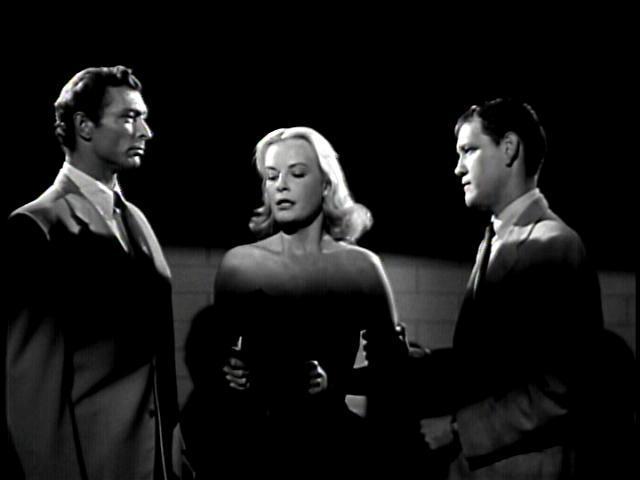
In the beginning of The Big Combo, we see Susan running through extremely dark, almost black, corridors, as though she is being chased. As the scene progresses, we see that she, in fact, is being chased by two men. They catch up with her, and grab her by the arms. The light shines brightly on her head and shoulders, but nowhere else, making her appear practically naked. The intention of this was to show her ultimate vulnerability, and increase the visual strength of the two men imprisoning her, as they are bathed in darkness and shadow. Not only does this set up Susan’s situation within the underworld, but the vulnerability that is an integral part of the character she starts out as.

Susan's capture

Because one of the primary thematic elements of this film is doubling, it is fitting that the film should end the way it began. However, due to the fact that this is film noir, it will not be an exact replica, by a long shot. As Janey Place has argued, and as is made apparent within the film text, a doppelganger is not necessarily an exact duplicate.

Foster Hirsch notes, “the ideal metaphor for the world view that prevails in noir is the maze-like, many mirrored fun house…”[10] In a place where nothing is as it seems, it would make sense that things as integral as power can change during the course of even one scene. Film noir, rife with its unstable personality, whether represented visually or developed narratively, causes the power structure that is ominously present in the beginning of this film to be flipped by the end.

By the finale, Mr. Brown realizes that he’s done for. He has nowhere to run and nowhere to hide. He kidnaps Susan before she has a chance to rat him out, and goes to a private hanger where he waits impatiently for the plane that is supposed to arrive. Susan goes to light a cigarette, and he slaps it out of her hand, and then slaps her face, hard, warning her not to try that again. She looks directly at Mr. Brown and responds, “I want to be seen.” And she does. After meeting Alicia, and looking her own possible future straight in the eyes, she realizes what she has become, and wants to “out” her true self, the one that does not go along with everything that Mr. Brown says or wants.

Brown continues to pace, complaining about the pilot not arriving. “Everything’s falling apart. Can’t trust nobody, nothing,” he says, walking into the fog. As he completes this statement, he looks upward, just as a light hits him.

He looks towards the light, and realizes it’s a police car, and, like Susan’s sprint at the beginning of the film, he runs into the blackness of the hanger, knowing he’s trapped, trying to get away. From the deep fog, where his physical appearance cannot be seen, we hear Diamond’s footsteps coming closer and closer, and his voice telling Brown that it’s done, and to come on out. Brown starts to shoot, but he is shooting at nothing, as he can’t see his target. He can’t see anything, and is looking back and forth, panicked. At the same time, the camera returns to Susan, who is actively watching this exchange between Brown and the police. When Diamond says, “You can’t get away, Brown,” the camera returns to a shot of Susan, who turns around

and grabs a light on the car. Turning towards the camera, she flashes the light directly at the camera, and at the spectator, but is supposed to be at Brown. The scene continues and wherever Brown is, she finds him with the light. In this way, Brown is finally caught and taken away, a man on either side of him, small and vulnerable, a vision analogous to Susan’s in the beginning.

By trapping Brown with the light, Susan succeeds at retrieving personal agency. The main thrust of Brown’s intimidation factor was that Brown could not be caught because no one would speak out against him, for fear of personal injury or death. No one could touch Brown. Within the heavy fog and blackness, it seems that Brown is still untouchable. When the police fire back, they do not hit him. Susan wants them to know how vulnerable he truly is, thus she makes use of the light, and shows him in all his ensnared glory. Through the claustrophobic spotlight, Brown is now shown to be as vulnerable as Susan was, with the solid blacks and whites that cut across her body in the opening sequence.

Brown's capture


It is a mixture of revenge and empowerment. Although Susan is not a femme fatale in the archetypal way, and Brown is certainly no hero, she does use Brown’s trust to undo him, like many other great femme fatales before her. However, through the shining of the light directly at the spectator, we are made aware that she is not doing this out of vindictiveness or with malicious intent, but to look at the situation straight in the eye, as she does the camera, and reclaim the strength of the light for herself.

To See or Not to See…

From its inception, the term “film noir” has taken on a multiplicity of definitions. Ranging from a “series” of films[11] to “subtle qualities of tone and mood,”[12] this term has come to mean a variety of different things to different critics and film historians. Perspective is bounced back and forth like a ping-pong ball, and, for the most part, the end of each film is not necessarily a happy one. These labyrinthine plots involving detectives, policemen, and regular Joes (who have fallen into irregular circumstances), while interesting, never seem to matter as much as the journey itself. In fact, more often than not, the plot is rather forgettable. What is not forgettable, however, is the visual style of each film.

The Big Combo holds special significance in this respect because it is entirely predicated on visual presentation. From character doubling and significance of a photograph to the use of light within a darkened area as an expression of power, visual communication structures the very heart of this film. John Alton, the cinematographer of The Big Combo, wrote that the right visual stimulation “becomes a symphonic construction…with the aid of this visual concert we can actually hypnotize the audience.”[13] In this respect, Joseph Lewis and John Alton worked in collusion to create a film that not only underscored the integrity and the power of the visual image but actualized it in such a way that the spectator could participate in the journey as well.


[1] Sattin, Richard. “Joseph H. Lewis: Assessing an Occasionally Brilliant Career.” American Classic Screen Nov/Dec 1983: 51-55.

[2] Black, Louis. “The Big Combo.” Cinema Texas: Program Notes 14.3 (1978): 75-84.

[3] Bogdonovich, Peter. Interview with Joseph H. Lewis. Who the Devil Made it?: Conversations with Legendary Film Directors. New York: Ballantine Publishing Group, 1997.

[4] “The Big Combo.” Motion Picture Daily 1 Feb 1955. The Big Combo Production Code Administration file. Special Collections, Margaret Herrick Library, 14 March, 2005.

[5] “The Big Combo.” Variety 16 Feb 1955. The Big Combo Production Code Administration file. Special Collections, Margaret Herrick Library, 14 March, 2005.
[6] Naremore, James. More Than Night: Film Noir in its Contexts. Berkeley: University of California Press, 1998.

[7] Place, Janey. “Women in Film Noir.” Women In Film Noir. Ed. E. Ann Kaplan. London: British Film Institute, 1998.

[8] Place, Janey and Lowell Peterson. “Some Visual Motifs of Film Noir.” Film Noir Reader 1. Ed. Alain Silver and James Ursini. New York: Limelight Editions, 1998.

[9] Place and Peterson, ibid.

[10] Hirsch, Foster. Film Noir: The Dark Side of the Screen. New York: Da Capo Press, 1981.

[11] Borde, Raymond and Etienne Chaumeton. “Towards a Definition of Film Noir.” Film Noir Reader 1. Ed. Alain Silver and James Ursini. New York: Limelight Editions, 1998.

[12] Schrader, Paul. “Notes on Film Noir.” Film Noir Reader 1. Ed. Alain Silver and James Ursini. New York: Limelight Editions, 1998.

[13] Alton, John. Painting With Light. Berkeley: University of California Press, 1995.
Deader Than a .357 Magnum: Electra Glide in Blue and the Noir of the Road

When people think of noir and neo-noir, the name Robert Blake does get bandied about periodically. After all, he has either been the star of or a rather central figure of two very interesting films in the genre: In Cold Blood (1967) and Lost Highway (1997). However, I would like to posit that there is a third film in his repertoire that would fit the bill: James William Guercio’s Electra Glide in Blue (1973).
On the 15th of January, I originally had other plans. I waited around for a while, but when those appeared not to be happening, I hopped on my bike and raced down to LACMA for one of the double features that they were having as part of their “True Grit: The Golden Age of Road Movies” series. Although I had missed nearly the whole series, I wasn’t that heartbroken as I had seen many of them on the big screen before. These two films, however, were different. It was Electra Glide in Blue (1973) and Scarecrow (1973).

My ticket for Electra Glide in Blue, the first film in the double feature that night

The first film, Electra Glide in Blue, was a film a friend had told me about ages ago, whilst jamming the cassette into her car stereo and chatting excitedly about how much she loved the film. Ever since then, I had always associated it with her. Looking back now, however, I realize that I had seen images of the film poster and ephemera previous to that, and always imagined it to be a great deal more fetishistic, due to the imagery surrounding it. In truth, I had always associated it with Cruising, and this was due, quite simply, to 2 things: both films being made in the 1970’s and having what seemed to be high leather content in the costumes.

And I am not completely deficient in noting that Electra Glide is a film about fetishes and fetishizing. Looking at the poster one can see the basic authoritarian visuals mixed with a flourish in the font and colors that make it less threatening and more sexually charged:

And the trailer…well, that just speaks for itself.

What I was incorrect about was the subject of the fetish. And how that was to play out. Even upon seeing the trailer the first time, I may not have caught the simple beauty that is this film’s nasty, biting reality. But I think that’s what I love about films in this time period. Biting, nasty things are often the most beautiful. Thus, Electra Glide.

Electra Glide is what I would also call a Weirdo Noir. It’s not Neo Noir, as it doesn’t necessarily play by the rules as set out by all the academics and scholars who have written about that part of the genre. But what I love about film noir is that, from its genesis, it involved politics, nihilism, sexuality, and violence. If Electra Glide in Blue isn’t based on all of those things, I’ll eat my heels.

In the first place, the production and cast is a big part of our Weirdo Noir argument. We have three major figures: Robert Blake, Conrad Hall, and Elisha Cook, Jr. All three of these men were well versed in the film noir world, and are well-known within the noir canon. Who could forget the infamous poisoned glass of water that Elisha Cook Jr drinks in The Big Sleep? Or his other various roles in things like The Maltese Falcon, I Wake Up Screaming, or The Killing? I sure can’t! And Blake’s role as Perry Smith, the cold killer that director Richard Brooks revealed to have at least a somewhat human side in In Cold Blood will forever give me chills.

Then there’s Conrad Hall. Hall and Blake had worked together once before on In Cold Blood, and getting Hall was quite a coup, since the man had just won an academy award for shooting Butch Cassidy and the Sundance Kid. Even more interesting than that, Electra Glide was a labor of love. As Joe Valdez states in his brilliant piece,  not only did the film have a small budget, and a first time director, but the shooting plans were non-union and incredibly bare bones . More importantly, even with all of those restrictions, Valdez notes, “Hall was intrigued enough to offer himself for the job. Guercio forfeited his entire director’s salary so he could afford to pay the renowned cinematographer.”

Electra Glide in Blue was a true noir chemical experiment. By adding each element into the “beaker,” the result was an explosion of epic proportions. One would have to assume that there would have been at least some familiarity with each of these characters past works. They hadn’t been that long ago. Therefore, they each brought with them a certain noir sensibility to a film which defies categorization. According to William “Bill” Blick, writing for Senses of Cinema, Electra Glide is not the conventional 70’s Easy Rider-type film, nor is it a simple cop drama. It almost seems to occupy an ambiguous area in-between. He writes, “Using the structure of a murder mystery, the film reveals more than just conventional mystery plot twists. Blue unpeels layer after layer of its complex characters. While primarily a character study, the film also deals with the struggle for understanding between the tune-in, turn-on, drop-out generation and the older established order represented by the police.”

One of the best things about noir is its elasticity and tendency towards the ambiguous, whether that is in morals, sexuality, or otherwise. People will argue until the cows come home about putting hard dates on when actual film noir starts and stops (“It ends with Touch of Evil, dammit!”), and when neo-noir begins, but what I enjoy is that these arguments exist. What this means is that there is room to discuss. Therefore, a film like Electra Glide, which has been projected in a road movies film fest, shelved in the “cult movies” section of a DVD shop, and otherwise discussed in 70’s film terminologies, can also be seen within the noir lens.

JOHNNY: Did you know that me and Alan Ladd were exactly the same height? Right down to the quarter-inch? Did you know that?…Did you know that he was so short that they used to have to dig a ditch for the girl to stand in to kiss him? You didn’t know that, huh?

Johnny Wintergreen (Robert Blake) is more than slightly obsessed with Alan Ladd. He sees things in him that are the same and things that he would like to be. When we meet him, he is simply a Vietnam vet who is not only the shortest cop on his highway patrol team, but seems to be treated as though he is “small.” But Wintergreen does not see himself as small. He has ambition. Thus his interest in Ladd. To Wintergreen, Ladd is still relevant and sexy, therefore making him relevant and sexy. He approaches some girls at a sandwich bar, and uses his “Ladd lines” to flirt with them, only he takes it even further. He not only makes Ladd’s physicality specific to his own, he also references a particular film which, in a way, also mirrors his own life.

JOHNNY: I remember one time I heard somebody say “Do you know what was Alan Ladd and William Bendix’s first movie?” and just like that, I said The Blue Dahlia.

In Blue Dahlia, Alan Ladd plays a character who is an ex-navy man. The story itself is a peculiar one that also lends itself to Electra Glide and potentially Wintergreen’s own relationship with his partner, Zipper, and his relationship to the public. Although Raymond Chandler’s book was much more explicit about the details and the Breen Office essentially forced the film to be quite neutered (to Chandler’s great displeasure), the film focuses on war’s intense ability to turn human beings into killers past the point of being on the battlefield. In a sense, Blue Dahlia, like many other noirs, was about how the war came home. And this is different from Vietnam in what way, pray tell? There are several instances within the film where Wintergreen’s identity as a Vietnam vet exhibit themselves. And while it is not explicitly stated that Zipper was in Vietnam, it is clear that the way that the war has “come home” to their particular community (corruption-wise, economy-wise, politics-wise) makes him analogous to any of the other figures from Dahlia, even if it is only tangentially.

Wintergreen, however, wants more. He wants to be the heroic figure out of it, and not the one who ends up spiraling downwards. Thus his strong desire to align himself with Alan Ladd, the hero of Dahlia and, indeed, the unblemished symbol of tough-guy perfection. As Foster Hirsch noted about Alan Ladd, he looked “like what a mogul’s idea of what American movie stars should look like.” (Film Noir: The Dark Side of the Screen, 147).

Johnny Wintergreen cannot stand being a highway cop. He wants to be a homicide detective. And he actually makes it…sort of.  But, as in any noir, things go awry. And, like in many noirs, it is actually partially over a woman. Then he is returned to his “small man” status, and must cope with that. However, this is not how it ends. Electra Glide in Blue aligns with the existentialism and nihilism that is so prevalent in film noir as a whole. Just when you think it might be ok, it’s really not. But there are reasons for that which have been meticulously lain out for you within the last few reels. As a kicker, Hall’s cinematography in the last 10 minutes certainly packs a solid one-two punch to the skull.

Robert G. Porfirio wrote,”what keeps the film noir alive for us today is something more than a spurious nostalgia. It is the underlying mood of pessimism which undercuts any attempted happy endings and prevents the films from being the typical Hollywood escapist fare many were intended to be.” (“No Way Out: Existential Motifs in the film noir,” Sight and Sound, Autumn, 1976, vol.45, no.4) While Porfirio was talking about what we generally refer to as “traditional” noir fare, this quote could not be more perfect than for the category of Weirdo Noir, and thus Electra Glide in Blue. beyond all of the connections and the references, the mood of the film is what drives it towards the categorization. You could show this with The Killers, and be set. In fact, that would be a great double.  At the end of the day, when you think about it, you can’t get much more pessimistic than Wintergreen’s line in the middle of the movie, “Did you know that loneliness will kill you deader than a .357 Magnum?” If your mood wasn’t already on its way by then, there was your one-way ticket.

Book ’em, Noir-o!: This Gun for Hire and The Glass Key

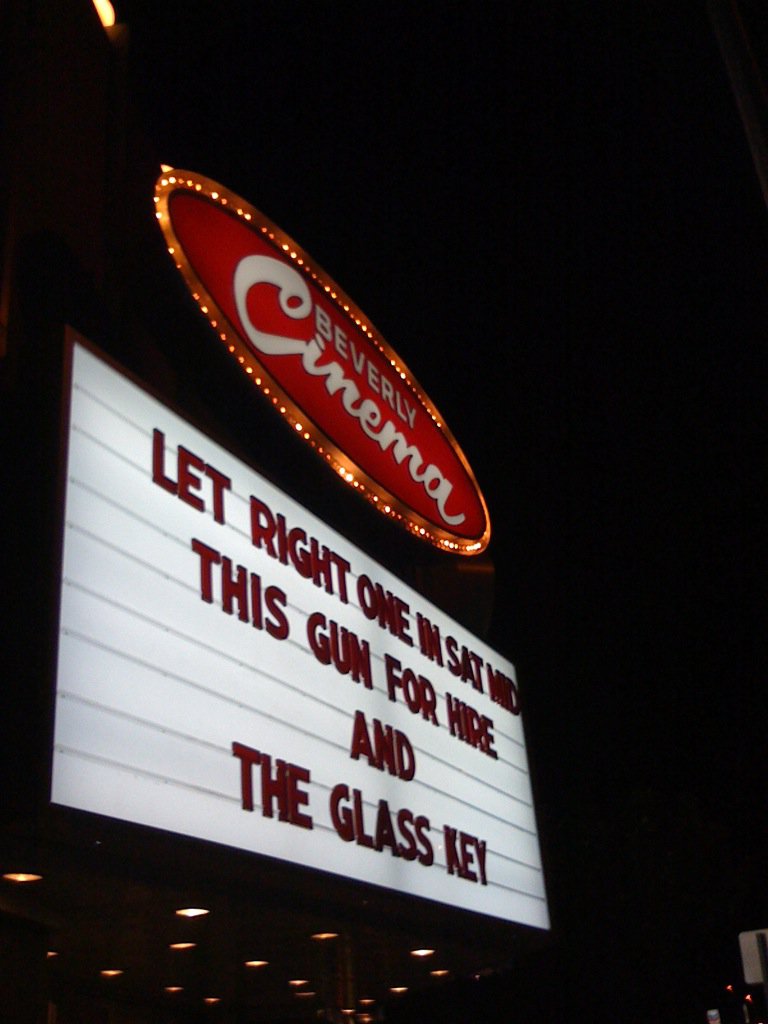
On February 9, I traipsed down to my local movie theater, The New Beverly Cinema, notebook in hand, excitement in heart. There was a double feature of two films that I had never seen in my favorite genre: film noir. At first, I thought I had seen This Gun for Hire, but as the film opened, I realized that I hadn’t. The opening sequence is so very memorable that there is no way I could have forgotten that!

Double your pleasure, double your fun at the New Beverly!

The beginning, in a San Francisco flophouse, made me think it was going to be a San Francisco noir (always fun! Who doesn’t enjoy seeing shots of Fisherman’s Wharf in the ’40’s?). But I was dead wrong. After Alan Ladd has an entertaining and violent run-in with a maid, tender moments with a kitten and a handicapped child, and commits the crime that the narrative of the film is based, the plot, like Ladd’s fate, heads south to Los Angeles.

These geographic locations, while endemic and indeed fundamental to the film noir genre, were my first clues that there might have been some “work done” on the original material. The opening credits are superimposed upon a leather-bound edition of the book with the author’s name prominently featured: Graham Greene. My familiarity with Mr. Greene first came as it did with many other people who I know through the film The Third Man. Although the stars of that film were as American as apple pie, the film is as British as tea and crumpets. Knowing this, having Veronica Lake utter massive pieces of dialogue at Alan Ladd about being an American patriot struck me as more than a little bit odd.

So I did what I normally do in this case: a bit o’ research. What I found was that, indeed, it was just as I thought: the source material had been tampered with, but for quite fascinating reasons. I am someone who loves to look into adaptations. I have written and spoken about them, and think that finding out the “story behind the story” is always fun- it’s the olive in my martini. This film was greenlit, essentially, after two things occurred. Most importantly, crime fiction had become an excellent area for the studios to develop scripts from. They were striking gold left and right in that arena. In addition, Graham Greene’s position within the literary community had achieved some notoriety.  This Gun for Hire, purchased by Paramount in 1936, was only developed as a script in 1942, after Warner’s remake of The Maltese Falcon did quite well. It was clear that This Gun could be risked at this point. And it was a good risk.

The original title of Greene’s work was A Gun for Sale, but published in the US as This Gun for Hire. But the title was not the only thing that they changed. Alan Ladd’s villainous character, Raven, is supposed to be hare-lipped and quite disfigured according to the literature. Up on the big screen, however, it became a bad wrist due to some nasty child abuse, thus bringing up both Freudian issues and incurring more sympathy for Ladd’s anti-hero/villain.

However, none of this is quite as intriguing as the political alterations that were made. The writers of the film, as keenly noted by Rose Capp, “embellished Greene’s left-leaning political thriller with some definitively American elements, not the least of which was the incorporation of prevailing American propagandist sentiments…Tellingly, the American script also transforms Greene’s wealthy industrialist Sir Marcus into a monstrous figure of capitalist corruption.” Not that big of a deal, right? That happened fairly often. It was 1942. It was wartime. Pumping a bit more propaganda in there was no big deal.  What I noticed that was a big deal was the person who put all of this together: Albert Maltz. Maltz was one of the Hollywood Ten.

12 Dec 1947, Los Angeles, California, USA --- Cited for Contempt. Los Angeles: Nine of Ten Hollywood writers, directors, and producers cited for contempt of Congress, await fingerprinting in the U.S. Marshall's Office after they surrendered. They are (left to right), Robert Scott, Edward Dmytryk, Samuel Ornitz, Lester Cole, Herbert Biberman, Albert Maltz, Alvah Bessie, John Lawson, and Ring Lardner, Jr. Dalton Trumbo is scheduled to appear shortly. These are the men who refused to state whether or not they are Communists when questioned by the House Un-American Activities Committee in Washington recently. --- Image by © Bettmann/CORBIS

This Gun for Hire is the first thing on his list of credits, but…there is something unusual about the way that the material was translated. The “gung-ho spirit” was strange and forced. It seemed misplaced, even for a genre and a time that centered upon a certain amount of patriotic “umph.” When Veronica Lake makes her plea to Alan Ladd’s character to “do it for the cause” of America, it still seems that “the lady doth protest too much.” There is also something very significant in the main villain, Brewster. He is, as Capp points out, a figure of Capitalist corruption. Was Maltz still able to keep his (and Greene’s) voice within the material? As many of us know, the Hollywood Ten were not un-Patriotic. But they were critical of certain elements of the system that made it unlivable for the everyday man, much as Greene was. We may never know the answers to these questions, but watching the film, I did find this element fascinating.

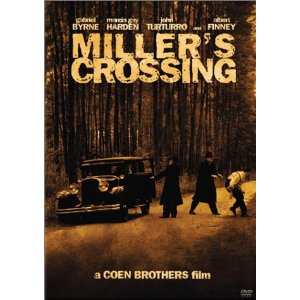
The next film up was The Glass Key. Someone had tweeted on the New Beverly twitter feed that those who were going should look for similarities between this film and Miller’s Crossing. Being a HUGE fan of that film, I was even more excited to see The Glass Key than I had been in the first place. As the credits went up, the first thing I noticed was that, similar to This Gun for Hire, it was ALSO a film based on a book. So I was quite intrigued to see the transition from Dashiell Hammett to Coen Brothers and everything in between! To write that I was stunned is an understatement. There is more than a passing similarity.

When discussing Miller’s Crossing in his book, More Than Night, James Naremore notes that “the Coen brothers mix together ideas from The Glass Key, Red Harvest, and The Maltese Falcon, all the while carefully avoiding direct quotation from the novels. Although their film involves a certain amount of burlesque, it is in one sense deeply true to the imaginative world created by Hammett.” (Naremore, 214) Admittedly, I have not read all the originating source material, but I cannot help but feel that Naremore’s analysis is correct. When you watch Miller’s Crossing, it has elements of Falcon as well as Key but done in such a way that it falls into a category of films that I have dubbed Cinematic Cover Songs. The basic theory behind this holds that what we love about a good cover song is that it maintains the tune (thus we have recognition) but it spins it in an entirely new way so that we can enjoy it as though it were a new piece of media entirely. Thus Miller’s Crossing from the Dashiell Hammett literature as well as, I would argue, the films made from that material.

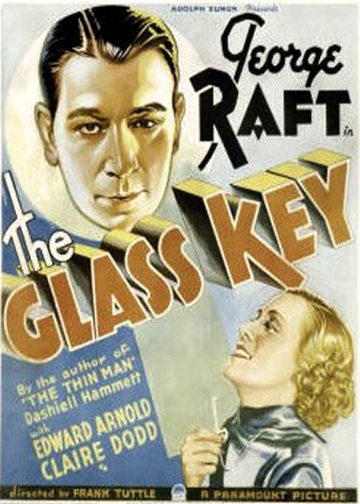
The Glass Key is a bit complicated, material-wise. The Alan Ladd-Veronica Lake film from 1942 was not the first film adaptation. In fact, the first time this Hammett-penned story hit the silver screen was when Paramount filmed it in 1935. It was a property that had been owned since 1931, but due to the now heavily-enforced Production code, it had been going back and forth in order to deal with the more “unsavory” elements within the script; in particular, the corruption within government figures and authority figures.  This version of the film, was directed by Frank Tuttle (who also directed This Gun for Hire, by the way), starred George Raft and Edward Arnold, and didn’t seem to garner as much critical acclaim as its sibling film from 1942. James Naremore noted that it stayed closer to the Warner Gangster cycle of films, but made major alterations to the plot and characters in order to make nice with the Production Code Administration. (Naremore, 57)

The Glass Key, dir. Frank Tuttle, 1935

The Glass Key, dir. Stuart Heisler, 1942

The first Glass Key was left alone and would have probably stayed exactly how it was, a somewhat minor film, remembered only for being a Hammett adaptation and for having PCA issues. However, due to the same film/literature adaptation gold rush that gave This Gun for Hire a shot, Key was given another life. With the success of  1941’s Maltese Falcon (a piece that had two previous versions in its own right- the 1931 film of the same name and 1936’s Satan Met a Lady), Hollywood decided that perhaps Hammett’s writing had finally come of age, and they would try it again. Thus they remade Glass Key. Of course, Alan Ladd had just come off of This Gun for Hire. He had been remarkably successful in that breakout role as Raven, and his chemistry with Veronica Lake was undeniable, so they snatched him up, paired the two of them up again, and the rest, as they say, is history.

All in all, it was a great night at the movies, I would say. Two brilliant films with some fascinating connections. But noir is like that. Misty, murky and secretive. Gotta walk down that alley, talk to the detective, chat up the girl, do the research. Never know what you’ll find…

Silence=Death (to Feminism & Sexuality)

A few years ago, I was lucky enough to share a dinner table in Santa Barbara, California with many amazing women who were, like me, presenting at the Console-ing Passions conference. We had phenomenal discussion, some laughs, and great times. Over the weekend, I was incredibly impressed with many things, but that meal stood out in my mind as it drew me to some incredible panels and introduced me to intensely interesting new scholarship I was previously unaware of.

One of the primary figures at that meal was a woman named Tristan Taormino. Not only was she well-spoken and funny, but she was quick, smart and incredibly incisive when discussing issues in and around feminism and sexuality. I remember sitting across from her and thinking, “This is what a successful woman looks like.” It was a fabulous time, as right beside her sat another woman who I have greatly admired throughout my academic career, Constance Penley. Needless to say, the fact that I didn’t sound like a babbling idiot would have been enough for me, but we ended up having some very intriguing conversations on the projects that Taormino was working on and the state of the adult industry  in general. I learned quite a lot. I would like to think I contributed, but who knows?

Since then, I have followed Taormino’s career in earnest, having seen her presentation at the conference and found it to be like her: bold, intelligent, and necessary. While being a feminist does not mean that you have to be interested in pornographic content or the film work that she does, I feel that her work is incredibly helpful on many levels to many groups of people. She is sex-positive (refreshing in a world that seems to hate the body and sexuality so very much), and has made the attempt to use that in a very productive way to help others, through books, articles, and cinema. This is a very basic and shallow description of her, and I would ask you to inquire further into her career if it seems like something that would be of interest to you. Be warned, it is all adult-themed (not work-safe), but it is all worthwhile, as is she.

So why this article? Well, this morning I awoke to some rather disconcerting news. Taormino, who had been scheduled to be the key-note speaker at Oregon State University’s Modern Sex Conference, was “uninvited” due to her resume and website.

Um, excuse me? So, let me get this straight- you booked her, knowing full well what she does for a living (which extends so far beyond pornography it’s laughable), confirmed the date, agreed to fees, did all the business-y type stuff, then you looked at the resume and website? And, OSU, I hate to split hairs, but I looked at your Modern Sex Conference and…you have some panels there that seem decently risqué. So can you explain to me why you are tossing Tristan Taormino, former editor of On Our Backs, the nation’s longest running lesbian-produced lesbian magazine, a woman who has been on a multitude of television channels discussing sexuality, a woman who lectures at universities from the east to the west coast (ones WAY more highly regarded than you), and (not that this matters, but if a pedigree means something to you) the niece of Thomas Pynchon??

They said something about fearing that they would have the university’s budget cut as it was being used to support pornography. Um, ok. Interesting that Tristan’s response to the entire debacle was:

“I’m extremely disappointed that OSU has decided to cancel my appearance. I’ve been protested before, but never uninvited. I have never misrepresented who I am or what I do. I am proud of all the work I do, including the sex education films and feminist pornography I make. The talk I planned to give at this conference, titled “Claiming Your Sexual Power” has nothing to do with porn, but the porn is such an easy target for anti-sex conservatives and censors. I find it ironic that one of the missions of the conference is to understand diverse perspectives of sexuality. Apparently, my perspective—one of educating and empowering people around their sexuality—isn’t welcome at OSU.”

I have two words for you Oregon State University: not cute. And actually I have one more word: CENSORSHIP.

See, here’s the really sticky part. And this is the part that got in my craw the worst. On Tristan’s twitterfeed today, she wrote:

“Several OSU staff have contacted me w/support but won’t support me publicly for fear of losing their jobs, they say.”

WOW. I don’t know about you, but that got me. As someone who got laid off from a job I liked, in a bad economy, I know how much a job means. So this is no joke. But I’m not going to mince words here: this is some fucked up shit. My gut reaction made me ill. Why? I didn’t know what I would do if I was in the position of one of those staff members. I thought about it for a few minutes. Then I realized that there was no way in the world that if I worked at OSU, I would ever pussyfoot my way around the situation.

What if this weren’t about sexually charged subject matter?

Would we allow censorship to take hold of us that hard that we would not stand up for ourselves and what we believe in? And if so, what will we become? I know that we have families, children, friends, lovers, pets, responsibilities. Hell, times are tough. But do tough times mean that we sell out each other? Some may say I cannot equate what happened today with Tristan Taormino/OSU to historic events like McCarthyism or Germany in WWII. And yes, it seems like hyperbole. Maybe it is. I haven’t eaten a lot today. But when I sit here, and think about the situation, it scares me. This is a mild situation. What if it were something larger?

The concept that fear overrides personal values frightens me. If every one of those staff members publicly came together in support of this women, they would not be afraid of losing their jobs. Yet, losing one’s job in this economy is a fate close to death it seems. Unemployment is an endless void that one does not want to fall into. “Keep that job at all costs,” the voice says, “even if it means sacrificing your own belief system.”

ROUGH.

In truth, the fact that they are not letting Tristan Taormino speak at a MODERN SEX CONFERENCE means that they are not so modern after all. Instead, she will be appearing at a place called She Bop in Portland, a female-friendly adult shop. Preaching to the converted, I guess, but at least still doing it.

If any of this bugs you the way it bugged me, please read this note from Tristan and respond in kind:

Note from Tristan:

Don’t Let the Anti-Sex Conservatives Win!

If you support free speech and my mission of sexual empowerment, please voice your opinion about OSU’s decision to cancel my appearance at the last minute (and not reimburse me for travel expenses) to the following people. I would really appreciate your support —Tristan

Larry Roper
Vice Provost for Student Affairs
632 Kerr Administration Building
Corvallis, OR 97331-2154
541-737-3626 (phone)
541-737-3033 (fax)
email: larry.roper@oregonstate.edu

Dr. Mamta Motwani Accapadi
Dean of Student Life
A200 Kerr Administration Building
Corvallis, OR 97331-2133
541-737-8748 (phone)
541-737-9160 (fax)
email: deanofstudents@oregonstate.edu
twitter: @deanmamta

Dr. Edward J. Ray
President
600 Kerr Administration Building
Corvallis, OR 97331-2128
541-737-4133  (phone)
541-737-3033 (fax)
email: pres.office@oregonstate.edu

Please subscribe to the RSS feed and follow Tristan on Twitter to stay up-to-date on all her upcoming events. Thanks for visiting!

Son of a Gun: An Ode to the Trumbos

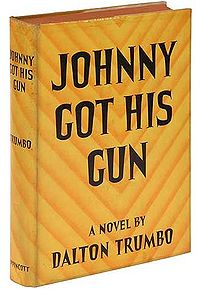
Christopher Trumbo died today. And that saddens me greatly. As I sit here, tap-tap-tapping away at my computer, I have Johnny Got His Gun on in the background. Not only does it remind me of why I am here and why I became interested in the film world in the first place, but it also reminds me of why I became passionate about political issues, and where the two collided.

In the early ’90’s, when people were obsessively concerned about heavy metal music turning kids suicidal or into massive drug-fiends, heavy metal music was very busy turning me into a history buff and a cinephile. See, in 1988 Metallica released an album called …And Justice For All, which included a song called “One.” I didn’t get my grubby little adolescent paws on it until a few years later when I was hip-deep in the penny loafers and uniform skirt of an all-girls Catholic school (needless to say, being a metal fan in that location earned me more than a few detentions-that and the fact that I wore black nail polish on a regular basis). But I purchased …And Justice because I was a big Metallica fan and I had seen the video for “One” on MTV, most likely on Headbanger’s Ball with Riki Rachtman. When I saw that video, my life changed forever.

As many people are in their early teen years, I was a complete jerk to my parents. However, I had some presence of mind and enough brain cell capacity to reach out to my mother (who is exceptionally awesome) and tell her all about this video I had seen. I had also done my research in the academic journals of the time (Metal Edge, Circus, Hit Parader, and especially RIP) to find out more about this phenomenal piece of work. “One” seemed different to me. The sentiment was strange (ie outwardly political, and liberal at that!), the video structure was unusual…the entire assemblage was ground-breaking in my eyes.

The conclusions to my research were good and bad: the film was unavailable to be rented. The book however? My awesome mother got it for me. I ate it up like pie.

Johnny Got His Gun was my gateway drug. I became obsessed. I decided to find out all about the man who wrote the book, and all about the movie, and I quickly did so. I may have been the only underage kid who was spending time (without my parents’ consent or knowledge, of course!) outside Gazzari’s trying to get a date by talking about the blacklist and literary activities of Dalton Trumbo and how that tied into heavy metal. To this day, I am very thankful that approach never worked!

Due to the fact that the internet was not what it is now, it was not until I got to college that this obsession continued in full effect. As I began my film career, I renewed my interest in the subject when I was taking a film history course. To me, the Hollywood Blacklist was one of the most horrifying and awful marks on the industry that we’ve had. I could write for hours and hours simply on that but this is about the Trumbos.

In college, not only did I find that my own family had ties to the Blacklist, but I wrote several pieces exploring the ways that it brutalized people’s souls. At the end of the day, what I found was that Dalton Trumbo, the man who had started this whole journey and catalyzed my interest in this section of American filmic history was a man who, as his son Christopher Trumbo said, “wasn’t able to break the blacklist, to smash it into pieces or obliterate it or crumple it up into a ball and throw it in the trash can — but he was able to cripple it, and when his name appeared on the screen when ‘Spartacus’ and ‘Exodus’ opened within a few months of each other in New York, it became easier for other writers to get their names on what they had written without having to sign statements about what their political beliefs currently were or what they had been in the past or needing to justify themselves to their employers about anything at all.”


Dalton Trumbo's mugshot, prisoner #7551, upon being jailed for "Un-American Activities"


Trumbo’s “crippling” of the Blacklist served a great purpose and essentially opened the employment floodgates so that a great many people who had previously been economically and professionally cowed by this terrible tragedy were no longer handicapped in that regard. Dalton Trumbo, to me, was a hero. He had been a hero to me since I had first read about him as a teen, and he became even more of one as I read further.


The blacklist was a time of evil, and that no one on either side who survived it came through untouched by evil.

I believe that it was with the introduction of the Blacklist to my life that I realized the importance of the writing community to Hollywood, as a good portion of those that were Blacklisted (and almost all of the Hollywood Ten) were, in fact, writers. It was also at this point that I started visually “collecting” blacklisted writers’ and artists works, Trumbo being foremost on that list.

One of the first films Dalton Trumbo's name ever was allowed to be attached to, "breaking" the Blacklist

Kirk Douglas, by insisting that Dalton Trumbo be allowed on the set (and then putting his name on the film), essentially helped catalyze the "breaking" of the Blacklist


Life can never cage a man like this! And it never could...a great film of Trumbo's and very telling.

Tonight I returned home from the movies to the tragic news. Christopher Trumbo, Dalton Trumbo’s son, had passed away at the age of 70. My heart sank. A few weeks ago, I had snuggled myself up with some cross-stitch and blankets, and put on one of the best documentaries I have seen in many years, and (I will stress this) it was not just because of the subject matter.

In 2003, Christopher wrote a play called Trumbo: Red, White and Blacklisted. Directed by Peter Askin, this piece constructed a narrative about the Blacklist and Trumbo’s life based on his correspondence. It played off-Broadway, and had an intense amount of star-power attached to it at different points. In 2007, this became the basis for the documentary, Trumbo.

Trumbo is not only an excellent documentary, but it is a fabulous example of theater put onto film. It not only shows the talent that Dalton Trumbo himself had, but the skill that Christopher possessed in being able to communicate his father through two different mediums (theater and film) that were so thoroughly enmeshed on the screen. Christopher also adds an even deeper layer. Alongside the aforementioned play/film marriage, there are interviews scattered throughout, reminding us that this is not only players recreating correspondence, but real figures recalling real events. The Trumbo family as well as other Hollywood Ten families are contained within the text, relating their own lives with Dalton, while figures like Liam Neeson and Nathan Lane are reading the letters and playing their “parts” so to speak. There are also interesting connections. Kirk Douglas, a very significant figure in Dalton’s life is an interviewee, while his son is a participant in the performance/dramatic readings.

The following clip is one of my favorite sections from the documentary. But there are oh-so-many more!!


Not that Christopher didn’t have his own separate career. He did! Aside from being the assistant director and associate producer on Johnny Got His Gun and assistant director on Exodus, directly out of college, he also had a long and successful career in television (shows such as Falcon Crest, Quincy, Ironside). Christopher Trumbo was widely considered to be, as Peter Askin said, ” a very smart, funny, articulate guy. He was enormously gifted himself, and with the work he did in respect to his father.”

He was indeed his father’s son. He became one of the preeminent scholars on the Blacklist, devoting much of his life to being as learned about the subject as he possibly could. His sister, Nikola, noted that “His passion for the last 20 years or more was to learn as much as he could about the blacklist and then educate others about it, and I think he went about it using each of those attributes.”

Trumbo once wrote that making the film version of Johnny Got His Gun was his father’s response to the insanity of Viet Nam. It is tragic now that we don’t have anyone as poetic or striking as either Dalton or his son to make such bold and original filmic statements about the way of the world. Rewatching JGHG tonight, it reaffirmed my love for Dalton Trumbo, and my feeling that there is some writing talent that, like Haley’s Comet, only comes around every so often. With Christopher’s passing, and my recent viewing of his documentary, my heart breaks even moreso, as there is also one less historian who was Really There, and can talk about what it was Really Like to live through that kind of persecution.

I suppose that all we can do now is all we have ever done: watch, remember, and never forget.


I know that nothing can happen if I remain silent and that everything becomes possible when people find each other and take each other’s hand. I know that when enough of us are able to put aside our fears and find courage in the name and power of our common humanity, that when we do that one by one and then another and another, again and again, every day and day after day that we will become a great and irresistible multitude and that this war will end.

So be it.

Christopher Trumbo


Fascinating Statistics….2010 in review

The stats helper monkeys at WordPress.com mulled over how this blog did in 2010, and here’s a high level summary of its overall blog health:

Healthy blog!

The Blog-Health-o-Meter™ reads Wow.

Crunchy numbers

Featured image

The average container ship can carry about 4,500 containers. This blog was viewed about 24,000 times in 2010. If each view were a shipping container, your blog would have filled about 5 fully loaded ships.


In 2010, there were 3 new posts, growing the total archive of this blog to 32 posts. There were 15 pictures uploaded, taking up a total of 810kb. That’s about a picture per month.

The busiest day of the year was June 25th with 321 views. The most popular post that day was G’night, Sweet King…RIP Michael Jackson, King of Pop, 1958-2009.

Where did they come from?

The top referring sites in 2010 were facebook.com, warcen.proboards.com, mahalo.com, search.aol.com, and mrpeelsardineliqueur.blogspot.com.

Some visitors came searching, mostly for michael jackson, ultimate warrior, wayne’s world, waynes world, and the ultimate warrior.

Attractions in 2010

These are the posts and pages that got the most views in 2010.

1

G’night, Sweet King…RIP Michael Jackson, King of Pop, 1958-2009 June 2009
6 comments

2

Drug Me: The WWE and The Death of Michael Jackson June 2009
2 comments

3

Forged in Fire: Heavy Metal and the Male “Bromance” August 2009
1 comment

4

Are You Mental?: Marty Goes for the Nutso With Shutter Island March 2010
3 comments

5

Thank You For Bea-ing a Friend…:RIP Bea Arthur,1922-2009 April 2009
1 comment

When I Think Back On All The Crap I Learned in High School: Ode To Kodachrome, 1935-2010

I started having pictures taken of me as soon as I was born. My godmother was a photographer/art teacher at UCLA, and I spent the very early bits of my life in weird artsy places and dark rooms at UCLA smelling chemicals, as well as her incense and (very likely) pot-smelling apartment in Santa Monica.

She had crazy amounts of cameras. Underwater cameras. Regular cameras. By the time I was 6, going to Samy’s was like going to the park or the grocery store or something. I dunno. It was just something we did. I knew names of film (Fuji, Kodak) and I kept hearing about this strange thing called an ISO…?

She took pictures. And my mother took pictures. There was a shutter flashing every two seconds. *click*  **zzzz** I still happen to think that the sound of a manual camera is one of the sexiest sounds on the planet. Put that and perhaps an Irish or Scottish accent next to my ear, and I might just automatically have no bones in my body and a huge shit-eating grin on my face.

We have fairly decent collections of family albums due to the fact that before digital cameras came in and caused us to simply look at something and delete its existence forever due to someone closing their eyes or a misjudged hand in the “incorrect place” we got them developed. And not only did we get them developed, but we had this strange exhibit called a “slide show.”

I know, I know, some of you may not remember this or know what this is. For those of you who do not know what a slide is, I will give you a picture:

All kidding put aside, these were very important and essential parts of my life. I doubt my parents (or my excruciatingly stoned godmother and her partner my sorta other godparent-ish guy) ever knew how much these little pieces of my very early childhood this meant to me, but all I can say is that I probably would not be a cinephile if I hadn’t had slide shows all the time as a kid. I remember laughter, my mom having a drink and the ice clinking, and the crack in the wall (our house was built in 1919, or something ridiculous like that), and great photos. Whether they were artsy photos, family shots, or a mix of the two, we had a good time.

The main thing was that it was not unlike 16mm film. The 16mm format, introduced in 1923, was utilized as a way to create “real” movies but at home. It may not have been 35mm, but hey- it was still film, right? And you could project ’em yourself, too? Not only that, it created a sense of community and brought the family together in a way that other things could not. It was one way that, historically, media absolutely built bridges instead of tearing them down. The process of creating a film together, and then watching it together was a bonding experience. Look at the opening of the TV show, The Wonder Years.

Within this clip, you see a family that is very clearly having Family Fun Times. Ok, yeah. It’s a television show. But it’s a television show that I grew up with. I also watched this show explore some pretty harsh issues of the time in a fairly sensitive and smart manner, so I would have to say that opening the show with a 16mm family film was a good call. It showed the historical reality that was going to be presented withing the fiction. Not bad for an 8:00pm ABC show, essentially aimed at a mid-range adolescent audience.

So back to slide shows. My slide shows in the ’80’s served a similar purpose to the 16mm home movies. They really brought us together. Seeing as my family had quite a bit of tragedy happen before I was even in Kindergarten, we needed some o’ that. Plus they were all hippies anyway. It was their thing, man. At any rate, I enjoyed the pretty pictures. And now, with the death of Kodachrome, I am starting to realize (perhaps) where the birth of my love for cinema came from.

When I went to summer camp, I took a photography class. It just made sense. I liked the visual image. I like the pictures. I like making pictures with my eyes. I like certain photographers as artists much better than most painters, sculpters, etc. The first camera I ever used was a Pentax K-1000 up at Camp Swig, in Saratoga, CA. It was awesome. If I remember correctly (and I believe pretty heavily in the Dorothy Parker quote “Women and elephants never forget”) I believe I ended up being the assistant to the camera teacher. Her name was Emily, she had dyed black hair, and she really liked this band I’d never heard of called Pavement and wore khakis. She was really really really cool. I think about her sometimes and wonder whatever happened to her. I have a feeling we’d be friends now. not just because I have a very good sense of who the hell Pavement is, but just because I think we would. I liked her a lot. She was my entrance into The Camera.

Then came High School…and thus the title for this piece. The darkroom at Fairfax High School in 1995 was no joke…to me, anyways. I learned stuff and had a great teacher. And I met one of my better high school friends who I am still in and out of touch with. My first Punk Rawk Pal that was my own age! Imagine THAT!  Yeah, so upon entering that scarlet chamber, I was given several options: engage in a drug deal (generally pot, but I might’ve been able to go harder. Never asked. Wasn’t interested), lounge around and talk about the exciting and engaging world of high school sexuality and politics (Oooo! Sounds thrilling when I have a chance to have 2-3 hours of darkroom time) or use some decent equipment to print pictures with. I chose the latter of the three. Every time. My only issue was negotiating the other idiots who were inside that space with me and the people who actually wanted to work. Regardless, it got done. And I got lovely work out of it.

My next darkroom, at Los Angeles County High School for the Arts? So. Much. Better. I had my work in our shows, it inspired me to go to Venice Beach on busses and get into photography as a True Love For Life. I think at Fairfax it might have been just a crush that I was considering moving in with. But I committed, hook, line and sinker at LACHSA. My only regret? I missed the day that we did pinhole cameras. I think I might’ve been getting my braces off or it was the dentist or something stupid like that. Someday…I want to do a pinhole camera.

The question now, however, is…will I get to? Perhaps some of you have seen the articles floating around people’s Facebook pages about the Death of Kodachrome. And almost all of you have heard the Paul Simon song “Kodachrome.”

Yesterday, after 75 years of glorious color, Kodachrome came to a screeching halt. Dwayne’s Photo, the building in Parsons, Kansas, and the last Kodachrome developing processor in the world, is being sold for scrap. People sent their rolls and reels in from all over the world to get them in by the deadline, spent retirement funds, traveled internationally, just so they could get those “greens of summer.”

I know what you must be thinking. Is it really that good? Can’t they get those colors digitally at this point? They can do anything with computers now! Can’t they reproduce Kodachrome? The easy answer is yes. You can get that color. The problem is you will never get the tone or, more importantly, the feel. Because I have had close relationships with Real Live Film Projectionists for years, I have been lucky enough to experience the warmth of Kodachrome, and it is simply a film look that is like no other (save perhaps Fuji, but that *still* doesn’t have the same thing that Paul Simon sang of- the dude wasn’t stupid!!).

The thing about Kodachrome is that it keeps its color. It was highly regarded for that reason. It started getting beat out by cheaper processes, but there were studies done and according to professionals, archivists, and the scientists-in-between like Wilhelm Imaging Research, Kodachrome “clearly is the most stable transparency film in dark storage; the film is especially outstanding in terms of its total freedom from yellow stain, even after extended aging.”  Unlike other films, even a roll that is undeveloped can keep its color. Look at these two photographs after 20 years lying in the Canadian rainforest, partially buried:

Picture of the best film roll, no white balance

Picture of the best film roll, white balance applied


So if that didn’t hit you, why don’t we try something a little harder. Here is a piece of film work where they seem to be testing out early incarnations of Kodachrome. No, this is not made today. This is actual honest-to-goodness, back-in-the-day, 1922 footage. I swear. If this doesn’t hit you on the glory of Kodachrome, I’m not sure what (if anything) will.

So, when I heard about Dwayne’s closing, and Kodachrome leaving us for good…my heart was broken. The amount of home movies and relationships that were created upon a format whose very emulsion had properties that outlasted the ones of other color film elements? Countless. The history that was made on Kodachrome photography? Beyond measure. National Geographic, for just one example. Familiar with this?

That’s Kodachrome. An iconic image. Documentaries were done about this photograph and the girl in it. Hey, Kodachrome, how ya doing? Naw, you’re not essential to American media culture. Not at all. We’ll just use the quicker, cheaper, ways. ‘S ok. We can fix all that with computers anyway. Digital! It’s the future!

What you can’t fix with computers is the warmth from the screen, the pure vibrancy of the colors of a printed photograph, the laughter amongst an audience, the bond between families making a home movie. These things take on lives of their own. It is no mistake that most artists consider their works to be “parts of themselves’ or their “children.”  In either situation, they are sentient beings or at least possessing blood, musculature and some possibility of animation.

The big joke was that Kodachrome was made by God and Man, as it was created by two musicians named Leopold Godowsky, Jr. and Leopold Mannes. Kodachrome was almost like a combination of the human and the divine. It could do what other color films could not do and for longer, and conduct great miracles (of the Canadian forest variety!). But it also shared a magic on-screen/paper/slide that others have not been able to match. It has touched people in a way that no other film has. Whether it was through a movie camera or the eye of a photojournalist, Kodachrome made an impact on American culture that was clearly almost religious. We have Kodachrome Basin State Park in Utah named after it! Last time I checked, I wasn’t going and picnicking at Ilford or Agfa State Park!

And then there’s Paul. Oh, Paul.

So yes. This is a eulogy. But perhaps it is only a temporary one.  I feel that with the onset of the technological age, unless something changes fast, it will be permanent. The funny thing is that in Paul’s song he says “everything looks worse in black and white” and now that is the only way that Kodachrome can be processed, by a company called Film Rescue International. Oh, irony. According to the New York Times, some folks’re still holding on to their rolls of film because they are hoping that Kodak might “see their lack of wisdom” in killing Kodachrome. And to me that is how it should be. We should always hold out a little hope for the future. After all, it is Kodachrome. It is, has been, and always will be, as Todd Gustavson of the Eastman House says, “more than a film, it’s a pop culture icon.”

The Cult of Hate: Godfather III

To start with, I really liked seeing Sicily. I spent some time there in 2001, and dammit- that place is gorgeous.

When Michael says to Kay that he wants to show her around Sicily because then maybe she’ll  really “understand the family,” I knew exactly what he meant. You would too, had you been to Sicily. It is unendingly beautiful and full of life. Coppola translated this magnificently to film. I think he even got a fairly decent sense of Real Italian Culture, too (or at least what I experienced in the time I spent in Italy), when he wasn’t dealing with Corleone drama.

While I wouldn’t say this is a great film, I would not say this is a film to be hated. In fact, I found this film to be a quite interesting coda to the series. In fact, what it ended up doing was discussing some features that have been subtextual in many mafia films, but never quite laid out as significantly as this. Perhaps it is because it is clear that this is the finale, and Michael Corleone is on his last legs. Perhaps that is the only way that this can come through. Perhaps it is because Francis wanted to feature his daughter and give her some significance. Either way, The Godfather III is actually more about the women as powerful figures than the men, and I found that fascinating.

I wonder if that is why it is the film that everyone scrunches their nose up upon its mention. The series is highly male-based. Having major actions in this film be based upon female characters is more than slightly counter-intuitive to the series as a whole and thus makes it a bit uneven. However, if one were to look at mafia/gangster films, the female presence and female power structure is alive and well.

Let’s start with Scarface (1932), directed by Howard Hawks and produced by Howard Hughes. There has been a great deal written about the main character, mob boss Tony Camonte (played by Paul Muni), and his unnatural sexual attraction and obsession with his sister. Not only does this underscore the fact that he is driven by what I call Mafia Moll Magnetism, but what occurs in the film just supports the theory. Not unlike a femme fatale, many Mafia Molls undo their men purely by containing their power in their sexuality. In Scarface, Tony is undone by his obsession for his sister. The irony of this circumstance (and what complicates the situation sometimes) is that Cesca (played brilliantly by Ann Dvorak) may be aware of the power she has over Tony but chooses not to manipulate him or use it against him. This is not the usual set of circumstances.

Skip forward a few years, and maaaaany gangster films later and you have another stellar example of Mafia Moll Magnetism, only…she is well aware of her position in the gang. White Heat (1949) was directed by Raoul Walsh and introduced us to Cody Jarrett (James Cagney), an iconic gangster figure the world had never seen the likes of before. Now, Cody not only had a double-dealing wife, Verna (Virginia Mayo), but he has a ruthlessly unscrupulous mother, “Ma” Jarrett (Margaret Wycherly) to whom he is beyond dedicated to.

Another facet of the Mafia Moll Magnetism is that no matter what happens, the “protagonist” (in this case, Cody) will generally select the Maternal Figure over anyone else, no matter what anyone might try to tell him. In the narrative, Verna and Ma…well, I don’t want to spoil it, but suffice to say that they had a bit of a power struggle. This also figures in highly within the women who are vying for their Don. Someone’s gotta be Alpha Female. However, at the end of the day, there will always be only be one Alpha Female to Cody: “Ma.” Therefore, no matter what happens to that character, in a sense, Mama still wins. The most famous line of the film, “Look Ma, top of the world!” is one where Cody is still talking to her, and it is clear that, once again, he has been undermined by his dedication to the Main Woman in his life.

It’s a slightly different story with two women who are simply competing for top position due to sexual positioning, but Mafia Moll Magnetism still functions the same way and it is to remove power and functionality from the main mafia unit and bring some of it back within their own realm. It can be seen in a similar way to the femme fatale in noir, only that the Mafia Moll will coalesce and go along with much of what is going on. However, at certain key moments she will assert herself and make herself known, figuring in as an extremely powerful and significant icon within Mafia Media.

How does this relate to Godfather III? Well, having never seen it before, I went to see it tonight and I found it to be a perfect example of this theory. First of all, in all three Godfather films I discovered that there is only one truly sympathetic character, and that is Tony Corleone. Poor kid just wants to sing opera for his dad who’s trying to take over the world…legitimately? Yeah. Right.

So what about Kay? She’s an innocent! Nah, not really. She stood by for too long. Let stuff happen. And her position in GIII is one of a manipulative mother. She trades one child for another. Mafia Moll Magnetism? You got it. In order for Tony to be able to sing opera, she gives Michael Mary. She had to know what would happen with that decision. Sorry, lady, I don’t buy it. You knew. You said you knew. You repeatedly stated you knew the family, etc. So…a child trade-off. Automatically makes Kay an unsympathetic character.

Then there’s Michael’s sister, Connie (Talia Shire). Wooooah, boy! She practically invented the whole concept behind my theory. In GIII, if it wasn’t for her, nothing would get DONE! It seemed to me that this film was about the waning of Michael Corleone, and the waxing of Connie Corleone. When he was down, she would get up, sharpen her nails, and get in command. She knew exactly about Mafia Moll Magnetism and how blood relations only booster that.

Then there’s poor little Mary Corleone (Sofia Coppola). Hmmm. Yeah, sure. It seems that she did know what she was getting into. And she wanted more. There was something about the way she positioned herself several times within the film that said, “I want in.” Even when Vincent (Andy Garcia) lied to her face, it appeared to me that she understood that perhaps this was just under the list of “things we don’t talk about/mention” which meant that she knew he was lying. The fact that Mary orchestrated the entire relationship with Vincent says that perhaps there is more to her than the innocent girl that she was portrayed as. I feel that, while the acting was lackluster, the character definitely contained the qualities that move towards this same goal: a manipulative figure within the familia.

In summation, I feel that Godfather III contained some properties that were far more complex and interesting than your average film. Additionally, it was beautifully shot which is always appreciated. I feel that there are enough shitty movies out there that deserve everyone’s unrequited hatred that this poor film should be left alone as it has some very interesting aspects to it, and definitely ones that I did not count on finding.

One Way or Another

In regards to the New Year, Benjamin Franklin said, “Be at war with your vices, at peace with your neighbors, and let every new year find you a better man.”

However, good ol’ Ben also tried to tenderize a turkey through electrocution, and ended up electrifying himself, so I can’t say that every one of his plans, suggestions or pieces of wisdom were 100% solid.

I’m more of a fan of the Mark Twain and Oscar Wilde school of thought.  Mark Twain said of New Year’s Day that it was “the accepted time to make your regular annual good resolutions. Next week you can begin paving hell with them as usual.” And Mr. Wilde? Well, he essentially followed in the same vein and stated plainly, “Good resolutions are simply checks that men draw on a bank where they have no account.”

In essence, New Year’s can be looked at in many ways.

I have one way of looking at 2010. It SUCKED. But I have one way of looking at 2011: it’s going to ROCK. HARD.

My personal highlights of 2010, the few that occurred, were all film related. The TCM Film Festival was amazing. The Reel Thing Conference in Hollywood and the AMIA/IASA Conference in Philadephia were unbelievable. In the spirit of that, I will celebrate that with a list of my favorite films of the year. In general, I feel that “top 10/25/etc” lists are slightly on the silly end of things and they almost shout “Look at me! Look what I watch! YOU should watch this stuff too!” And some people’s lists are exactly that. My list is not intended to be so. Maybe you’ll find something you’ll like or want to watch, but if not, no big deal. As I am on the path to trying to become an archivist, this is more for me to remember the films that I enjoyed in a particular year than anything else. So…welcome to my Filmic Forum of 2010.

General Rules:

-There is no order of ones I liked best to least based on numerical value, except for #1-3. Those are self-explanatory. Aside from those, I loved them all equally.

-This list is also based upon the films I’ve seen. I have not yet seen Blue Valentine, Dogtooth, Rabbit Hole, White Material, or I Love You Philip Morris (all films I want very much to see).

-The starred ones at the end are kinda my “special selections.” The ones without stars are the definite ones, without any qualms. The last 2 are quite good films, but not my very favorites.

1) True Grit

2) The Illusionist


3) Kick Ass


Valhalla Rising

The Ghost Writer

Animal Kingdom


Splice

The Fighter


Mother

The Girl With The Dragon Tattoo


Social Network*

Black Swan*

All I can say is that with the new Malick film coming out this year, and a few other things that look promising, let’s hope that 2011 is a better year for American film-making than it has been. We used to be good, but I’m losing my faith. This year’s list has quite a large amount of foreign work on it, and it seems like that is where the bravery, creativity and good film-making is going.

In any case, have a great new year, and hope your holidays were great!