Don’t Cry For Me, Argentina: Cinema and the “Real Man”

A few days ago I was on Facebook, and I noticed that a friend of mine had posted a pictorial with some words accompanying it and it was getting quite a buzz. Due to the fact that I have a tendency to keep my eyes and ears open for issues having to do with gender and identity within the cinema, this one caught my glance in particular.

At first, I was amused. But I realized that I was amused at the comments, not the picture. In fact, the more I thought about this, the more highly problematic I found it to be.

The male body is an injured body.  We have seen this played out time and time again. Internal damage becomes externalized in the form of the action, horror and thriller genres. Really, it happens in any film where extensive physical damage is known to take place to the male character(s).

“Hey, aren’t you a feminist?” you ask. “why be so concerned about this stuff? Is the male body any of your business?”

First of all, I am most unreservedly a feminist. And secondly, one of the things that makes me a feminist is my overarching concern with how the cinema fails both sexes, as feminism is not just about women and it never has been.

If you wanna get down to the nitty gritty differences in how this works, the harsh lens of the camera eye tends to sexualize the bodies of women while men’s bodies are physically attacked. Now I’m not saying that women aren’t injured or torn to ribbons. Look at Aliens (1986). However, Vasquez and Ripley were some tough-ass chicks, so that’s going to have to fall into “exception-not-rule” territory. What I’m saying is, on a general basis, what we find in cinema is that the female body is over-sexualized to our great disadvantage and the male body is damaged and physically traumatized beyond what is reasonable.

The male body does not feel real, does not feel whole until they are committed to the screen and the narrative as unwhole, taken apart, bloodied. We cannot properly swallow masculinity as authentic unless it has been made to withstand something physically and most likely emotionally.

Bruce Willis as John McClane in Die Hard- barefoot, bleeding, and hanging over a building. Oh, and did we mention it's Christmas?

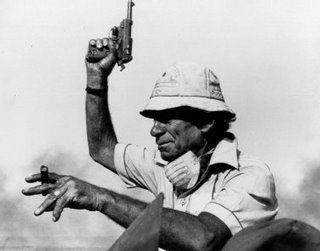
Clint Eastwood as Josey Wales, a man who loses his wife and children to violence and never returns psychologically.

Where does this put our conceptions of the masculine ideal? Not in a very good spot, I’m afraid.

If these things make up our prototype of the real man we are no better off than we were with the over-sexed female icon. In short, we’re in trouble, mister, we’re in trouble good.

We are a gender-damaged culture that scoffs at the “manliness” of Robert Pattinson when compared to Clint Eastwood based upon heroism and tears.  Surely we could find something more intelligent, more reasonable, to criticize the film about other than the manliness of a tough rugged cowboy archetype versus a brooding sparkly vampire!

In addition, I submit that we all need to truly reconsider our notions of what is a “real man” anyways. While I’ll readily admit to being a fan of Charles Bukowski’s literature , love Lee Marvin with every bone in my body and cannot seem to get enough of Sam Peckinpah’s cinematic delights,

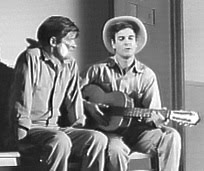
Kris Kristofferson & James Coburn in Pat Garrett & Billy the Kid (1973)

I feel that a certain culture has arisen that has built a shrine to these men (and ones like them), and I’m not sure it’s for the right reasons. These are men who, in celebrating their own masculinity, produced a world of the hyper-masculine. So much so, that at times it would not be beyond reason to step back and ask, “Are you trying to convince me, or are you trying to convince you?” Within these men lies a mixture of pain and sexuality raging so very strong that it can only come out in one way: aggression.

Is this what we would like to consider our “reality”? Pain and darkness?

Here is my question: why don’t we celebrate Jack Lemmon? Is he too much of a “wimp” in the compare/contrast game? Is it just like in The Apartment (1961), where he can only win by a dark default? And is that really winning?

Jack Lemmon & Shirley Maclaine, The Apartment (1961)

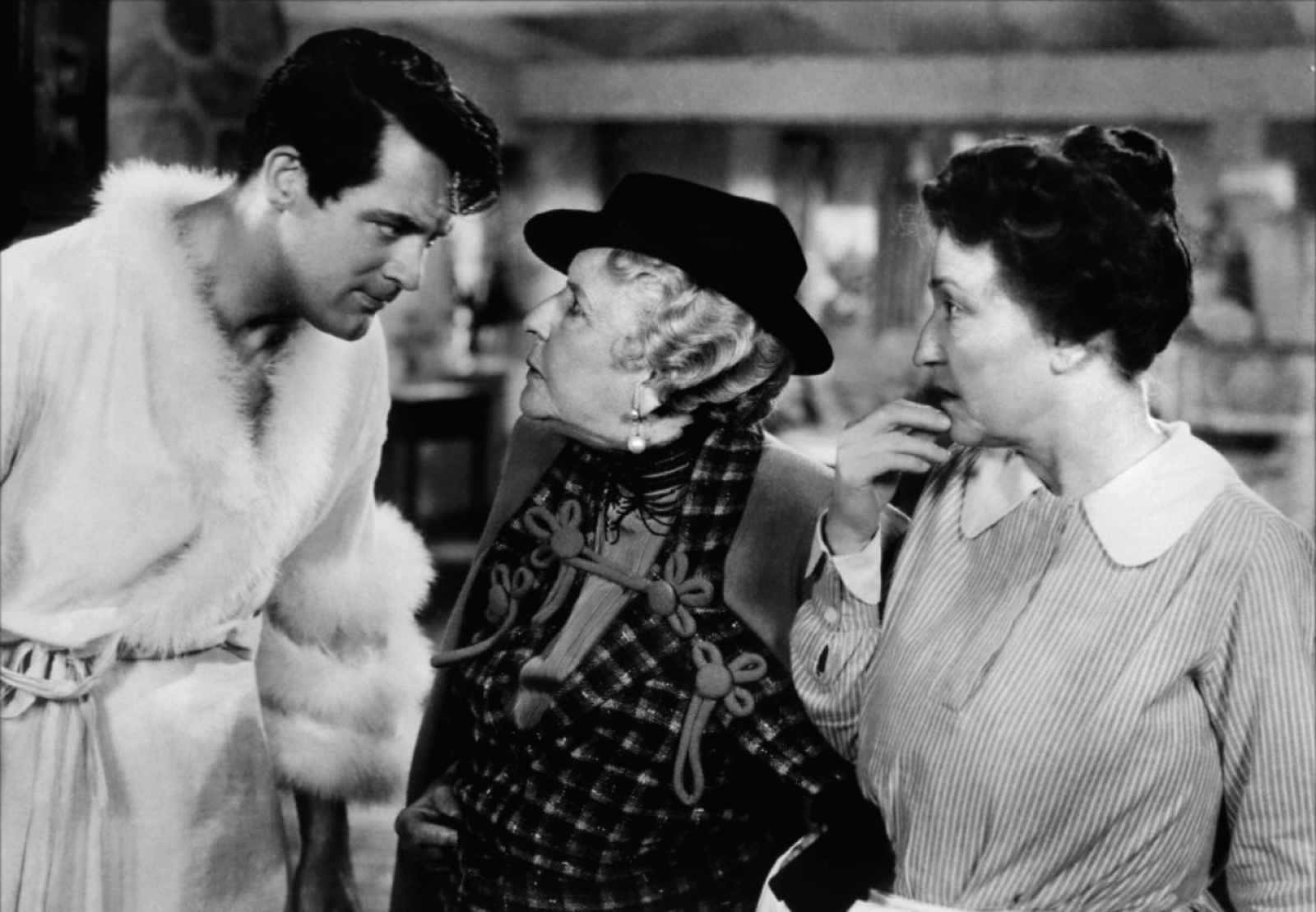
We call Cary Grant “dashing,” but is he a real man? Well, maybe. He did get chased down by a airplane and hang off Mount Rushmore.

Cary Grant, Bringing Up Baby (1938)

And back on the vampire tip, are YOU going to inform Christopher Lee that he doesn’t get to join because he played a bloodsucker for years and years or is Hammer “cool” enough to make it count?

Christopher Lee gets bitey with it...

As we vacillate between the poles of masculinity, looking at what is a real man and what isn’t, it stands to reason that we have some serious decisions to make involving some changes in perspective. I think that it is high time that we make them.

Where does this put our conceptions of the masculine ideal? Not in a very good spot, I’m afraid.

I Miss Talking in the Dark: Cinema, Technological Change and the Personal

Last week I read an article that was being shuffled around my social media circles about the “death of the film camera.”

While I’ll admit I was saddened, I can’t say that I was shocked. I watched as the article made its way, slowly but surely, through all of my friends’ Twitterfeeds and Facebook pages. I considered the fact that a year ago I would have been devastated and that this year I don’t think that this article is the sign of the apocalypse, even if I do prefer cinema that is shot on film.

Today, on Panavision’s Facebook page, they announced that

   As a rental company, Panavision is committed to supporting our customers worldwide by providing them a wide range of camera equipment which includes film cameras. We continue to support our fleet of film cameras, and that includes ongoing major refurbishment, which in many cases means almost a complete rebuild of existing product. There is still significant demand for film equipment in many of our key markets, including studio feature film productions. So, while our ongoing focus is the transition to future products in the digital world, the implication that we’ve quit the film business isn’t accurate.

I guess the idea is to learn and to think critically. It is also to understand that film is changing, even if it not always for (perhaps) the best.

The responses to Panavision’s statement are somewhat more fascinating than the concept that there will never be another brand-new film camera made. Clearly the lack of new cameras will not be problematic. The world is chock-full of them for rent, and, as Panavision stated, they are more than willing to make sure that said-items continue to function at top capacity. So then my question is this- what does the film camera “death” really mean to people? What does it mean to me?

There are no rules in underground cinema, only edges.--Cecil B. Demented (John Waters, 2000)

The people who reacted to Panavision’s facebook “status” were of a few types: the vultures (are you selling any cameras? I’ll buy ’em if you are!), the denial-ists (of course you’ll still support REAL film!) and the realists (this is great news for all sides). My reaction? More on the real. The digital is here and getting bigger but there is no reason to reject our foreparents. In my mind, there is no reason why it cannot all coexist. But that’s another entry.

What this is really about is a kind of nostalgia and fear that most of us cinephiles have. We react to change about as well as a Mogwai does to a midnight snack, which is to say…not very well. We hear the word “digital” associated with the cinema and, many times, it sets off a horrific panic in our system.

Let’s be honest here. How many people do you know who view modern changes to projection, prints, restoration, or filmmaking as somehow a personal attack? Realistically, this is not always the most mature or thoughtful (let alone intelligent) critical approach to a medium that you love above all things. I AM GUILTY OF THIS. But I have started to reconsider my fan-girl-esque issues as they may not come from a place of knowledge, only a place of viscera. I believe that it is when we can connect the knowledge and visceral centers that we can have well-constructed analyses.

While it may seem that I have “sold out” and the The Man “got me” that is wholly untrue. I am just as much of a True Believer as ever, only in a different, more centered way. I cannot let nostalgia and personal engagement take precedence over certain elements of the filmic world due to the fact that I do love it so very much. I am in training to become an archivist, and while I completely disagree with one of my professors that Carolee Schneemann‘s work could be digitized and maintain its integrity and meaning, I have come to understand that the digital does have its place and space.

Do I understand the issues involved with why all the theaters have gone digital with the exception of the wonderful New Beverly Cinema, and 2 or 3 others? Yep. I do. Do I like it? No, I don’t. This is one of the areas that I know has nothing to do with nostalgia: I just like sitting in the dark with other people and watching movies on real film. And I do wish that more studios would be sympathetic to the few theaters that still participate in this semi-arcane practice, at this point. Don’t just suggest that we play a Blu-Ray. I know Blu-Rays look REALLY nice, but…they don’t have the visual warmth. Especially with an audience. Realistically, I am totally willing to take base scratches on a print over the pristine cold of a Blu-Ray if I’ve got film fans around me. Movies are always 50% about what’s on the screen and 50% about who’s looking at the screen for me.

But the film world is this marvelously organic breathing changing thing. It always has been. I expect it always will be. To expect it to stay the same is to desire stagnation. The methods we use to tell our stories change. The ways we communicate our film discussions change. We change. I suppose we cannot realistically get any angrier at the technologies now than when sound came in. It was a rocky beginning, but who knows? Maybe in a few years?

That said, my patience only goes so far. This would have to be where I draw the line: I am exceedingly impatient at anyone in the younger generation (or current generation, for that matter) that uses their phone in a movie theater. To text, to call, to take a picture/screen cap of the screen, any of that. That is the one thing that drives me completely up the wall, and I will NEVER be able to tolerate that change in our world and I find that aspect of technology exceedingly tiresome. I do not have the ability to cope with that and I’m ok with that Area of Crankiness.

I do not believe that the death of the film camera means the death of film itself. I have also started to come to terms with the fact that film is heading in a very different direction than it ever has before and I am looking forward to becoming part of that world and making sure that a strong bridge between the old and the new is maintained. I think what will be key to this maintenance will be the formulation of a mutually beneficial structure amongst all the cinefiles. I’m not entirely sure that is possible, as cinefiles are amongst the most opinionated, obsessive and fan-culture-iffic folks I’ve ever met, but I believe it is worth a try and I certainly plan on doing my part.


God, Men and Monsters: Nicholas Ray’s Bigger Than Life

In 1956, Nicholas Ray made a film that was such a departure from the rest of his work that people still speak of it today.  Just one year after Rebel Without a Cause (a film that did remarkably well, snagging not one, not two, but three Academy Award nominations), Ray had leverage. As a result, he could do a film based on drug addiction and, more or less, get away with it. Sure, films had been done about drug addiction before (in the same year as Rebel, Otto Preminger’s Man with the Golden Arm had been nominated for three awards) but none had utilized drugs and addiction in quite the same way; ripping open the very fabric of the American dream, showing it to be what it really was: an American nightmare.

Did it do well at the box office? Not entirely. Is it interesting anyway? You bet!

Bigger Than Life starred, was produced and co-written by James Mason, and like many other films or television programs of the time, it was “based upon a real incident.” In 1955,  New Yorker magazine had published an article entitled “Ten Feet Tall” which was penned by a medical journalist named Berton Roueche. Shortly thereafter, this particular entry of their “Annals of Medicine” column became translated into Nicholas Ray’s epic, full-color CinemaScope piece, Bigger Than Life (1956). The originating article is a familiar story- a cautionary tale about the horrors of drug addiction and how it can destroy a family from the inside out. Nicholas Ray’s film, on the other hand, was much less polite (if addiction could ever be called polite). It skinned American suburban life like an animal and revealed it to be the diseased and fractured monster that it truly is, underneath all that smooth so-called “perfection.”

I would argue that,  in many ways, Bigger Than Life could be viewed as a horror film. It functions on fear, ideas of masculinity and the monstrous and postulates that true terror is catalyzed by the volcanic eruptions of a figure whose conflicts are drawn out by a severe chemical addiction. The lighting, color use and Joseph MacDonald’s cinematography only serve to enhance this, and the fact that it is a CinemaScope film makes it even more horrifying with every frame. As you watch this film, both the narrative and the visual sensibility will tell you that it lives  up to the title- this film really is Bigger Than Life.

I was lucky enough to see this film at the TCM Film Festival this past year, complete with a Q&A with Robert Osbourne and the leading lady, Barbara Rush (who was simply fantastic and looks like a million bucks!). I have to say- for the first viewing of this film, view it big or as big as possible. I’ve seen many other ‘Scope films that look great but didn’t use the lens as a narrative tool. Nicholas Ray knew what he was working with, knew what he could do, and he did it.

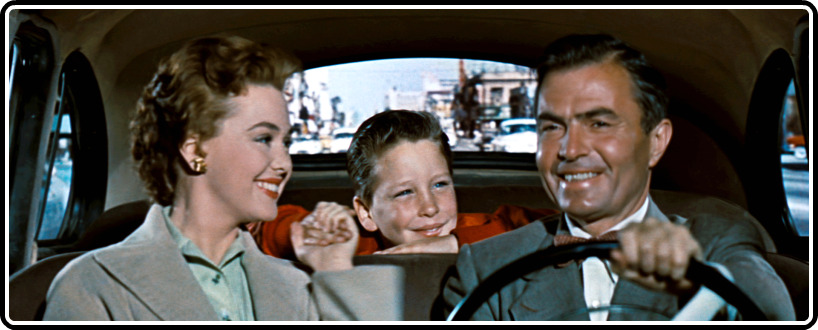
Because of the sheer magnificence of the CinemaScopic vision, a shot that would normally be passed off as simply the "happy car ride" becomes almost oppressively happy due to its epically large and colorful flavor. While the tone of the film at this point is a happy one, it should be noted that the claustrophobic intensity of this shot is not accidental.

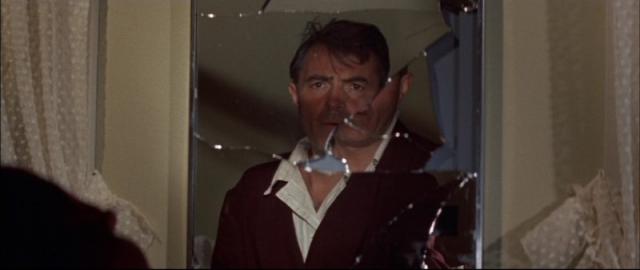
The shattered masculine image plays a huge part in the narrative. This shot emphasizes it even further by showing him staring at his own reflection in a vulnerable physical stance.

Mirrors are powerful objects in this film, and in this scene more than any other. Once more, we have the glory of the sophisticated technologies ('Scope lenses had only been being used for about 3 years when they made this film, so it was still pretty new!) to hammer in the point even more clearly: he knows he has become the monster, and he doesn't like it. But, like every other chemically-involved-monster (Jekyll/Hyde, Invisible Man), he bought a one-way ticket, and there's no going back now.

While this film could have been shot in black and white and an alternative aspect ratio, this shot is a perfect example of the power that Ray had by making the choices that he did. His experience in black and white and noir enhanced the shadowy/terror-like aspects while still wanting to keep the colored/lit bits for a balance. This is one of the most terrifying and visually stunning scenes in the film. This forced perspective shot also underscores the "Mason-as-Monster" theme, seeing as forced perspective shots are not unfamiliar territory within monster films!

Rush said that this film has been shown at various Film Noir festivals. I could see that, however I am still more on the side of the horror genre when it comes to Bigger Than Life. Without spoiling too much of the film, I would like to  bring up a few issues through which I believe that this film can be ultimately defensible as a piece of horror.

Frankenstein (James Whale, 1931), The Invisible Man (James Whale, 1933) and most versions of Dr Jekyll & Mr. Hyde are recognized as parts of the horror film canon. They helped to establish a visual and narrative iconography which, in turn, built the monster world.  I would contend that in certain ways, Bigger Than Life is meant to inspire just as much terror as any of these monsters ever did. Nicholas Ray’s film plays to those monsters and their individual characteristics, features and attributes. The “monster” in Bigger Than Life calls up some of our greatest fears which were revealed in the early 30’s by the great horror masters and places them squarely in front of us, just as Whale or Fleming did. Horror is a device that exposes the ugliest and most devastating issues within society and the humans living within that society. By that definition, I believe that Ray has succeeded in making a horror film.

In Bigger Than Life, James Mason’s character, Ed Avery, becomes less human the greater his addiction. At first, the cortisone appears to be having a positive effect on his life- he’s stronger, has more energy, is filled with enthusiasm for life and everything in it. As the pill-popping increases, Ed Avery seems to disappear and The Monster comes out. The Monster abuses his wife and child, gets into virulent arguments at the workplace and eventually has himself convinced that there is only one way that this series of events that he has put in motion can go- it may not be good, but it’s right because The Monster couldn’t be wrong.

Meanwhile, his suffering wife Lou is playing a dual role- the victim of the nightmarish happenings as well as the “Fritz” or lab assistant in the creation of The Monster. In her own addiction to codependent behavior, she is no better than her husband with the exception that she finally comes to terms with her own “monstrous” behavior and, in doing so, is able to try to effect change on her son’s behalf (as well as her own, I would imagine).

Ed Avery’s flipping between personalities and wild unpredictability gives him somewhat of a Jekyll/Hyde sense. While we are aware that it is dependent upon the pills he is taking, the levels which he reaches throughout the film are so grand that by the climax of the film, it has almost become  Grand Guignol-type behavior, shown by his ludicrous propositions to Lou. I think that this may be one of the main reasons I’ve heard the film referred to as “campy” or “cultish.” By the time the tension has built, the surreal energy in combination with the elaborate colors and shot structure make it seem almost…too much. And yet, I don’t believe that it is too much. From where I sat, the ending seemed like a nightmare bathed in a fever-dream, but one that you may not awaken from.

Terror, pure and simple. And the terror came from the multi-faced monster of addiction itself. Addiction- addiction to substances, addiction to conformity and normalcy against the betterment of one’s family (Lou’s line “We musn’t let Bob think Ed is still sick!” gave me the chills), addiction to abuse, addiction to codependency and, significantly, addiction to power.

In James Whale’s The Invisible Man, the title character (played by Claude Rains), states simply, “The drugs I took seemed to light up my brain. Suddenly I realized the power I held, the power to rule, to make the world grovel at my feet. ” If one were to look at Ed Avery in Bigger Than Life, he seems to be saying precisely the same thing. What is most terrifying in Nicholas Ray’s film (moreso than Whale’s, in my mind) is that there is always a certain level of uncertainty that the chemical supplement is actually the  issue in the long run. Sure, Avery’s an addict. Sure, he’s getting more crazy and abusive due to the drugs. But when he looks at himself in the mirror in the shots shown above, and sees the shattered image, there is something that he recognizes- a fractured Monster Image that he sees with ultimate clarity. Somehow, this made for an even more uneasy scene. What if that Monster was really there behind the man the whole time? That kind of ambiguity is the scariest there is. It means that perhaps it isn’t so much that the drug creates the Monster, but reminds the Monster of what he knows is there all along.


Bigger Than Life‘s goals were to present a picture of the American family and suburban life that wasn’t quite standard for the time. To a certain extent, this trajectory was a little like Billy Wilder’s Ace in The Hole, due to its cynicism and biting social critique. While the film may not have fared well in the box-office back then, it has more than made up for that now in the fact that the horror and nightmarish-ness of each frame remain as singularly beautiful and terrifying as they were in 1956. Thank you, Mr. Ray, for this exquisite vision into the depths!

Born When She Kissed Me: Nicholas Ray Blogathon, 2011

So I didn’t hear about this until the last minute so the first piece I’m posting is a link to my previous piece on In a Lonely Place (1950), but I have much more to say about Nick Ray. He’s one of my favorite directors. I was introduced to his work while still an undergrad, and have only delved deeper over the years. Actually, this year has been quite a good “Nick” year for me, as the film noir festival and the TCM Film Festival here in Los Angeles both provided genuinely amazing Ray treats for me that I hope to write about for this blogathon.

That said, a small caveat on my In a Lonely Place piece- it was one of my very initial attempts at the blog world so it may not be as strong as later articles and it’s fairly dated as it deals with news issues that were happening at that time, but I like it and I’m very proud of it. I will also say that this film is one of my favorites, I have seen it screened theatrically more times than Star Wars and if you ever get a chance, the novel written by  Dorothy B. Hughes is brutal and simply terrific. With that, here is my article on Ray’s film. Keep checking back. I’m hurriedly prepping something else.

Kicking Ass and Taking Names: Violent Women and Comic Book Film Adaptations

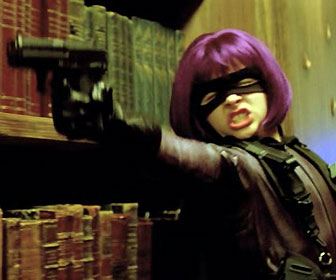
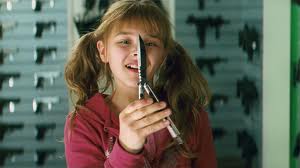
Chloe Moretz as superheroine Hit-Girl in the recent Matthew Vaughn film of Mark Millar's comic book, Kick-Ass

For Roger Ebert, there is something deeply disturbing about watching a young girl engage in a violent action film. His review of the film Kick-Ass says so repeatedly. However, it seems that if she were to be engaged in a highly sexualized role, things might change a bit. It might be a different story. To me, there is something bizarre and almost Laura Mulvey-esque about the fact that he seems critically “okay” with seeing young women put in positions of sexual submission and yet bursts out with fire and brimstone tirades upon seeing a female action hero of the same general age.

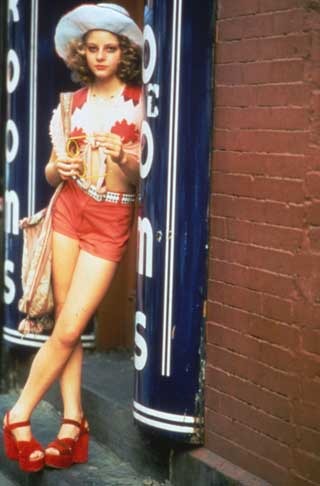
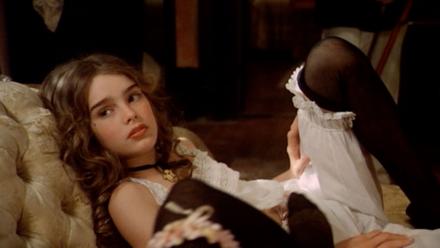
For a man who has championed such highly controversial films as Pretty Baby (Louis Malle, 1978) and Taxi Driver (Martin Scorsese, 1976), two films that center at least partially around extremely young women playing roles that are severely inappropriate for their Real Life ages, it seems raucously hypocritical for Ebert to label a film as “morally reprehensible” based primarily upon the fact that a young girl within the film is involved in countless acts of violence, both visited upon her and acted out by her.

Jodie Foster as street-wise hooker Iris in Martin Scorsese's Taxi Driver (1976)

Brooke Shields as prostitute-in-training Violet in Louis Malle's 1978 film, Pretty Baby

I contend that Ebert’s knee-jerk reaction to Kick-Ass comes primarily from a gender-based locale (although I will concede that age is certainly a factor), and that, while he may have taken the heavy violence in the film to task, he might not have had this kind of untamed response had the most charismatic and powerful figure in the film not been an 11-year-old girl.

To be perfectly honest, I take no issue with his enjoyment of the aforementioned films. They are, indeed, good films. However, based upon his Kick-Ass review that seemed more like an eruption than a piece of cinematic criticism, I have to wonder: what is it exactly about the representation of Chloe Moretz as Hit-Girl that nearly causes an aneurysm while Jodie Foster’s Iris remains safely within the boundaries of acceptability?

At first, I bought Ebert’s “unholy amounts of violence” argument. Kick-Ass is, indeed, insanely graphic. While the comic is moreso, the film is definitely beyond the pale, even if it is done within a very “comic book-like” manner. But then I realized something: Taxi Driver is an incredibly violent film. And it was especially violent for its time! And in 1976, Ebert called this film a “brilliant nightmare” and “compelling.”[1] So, Rog, what’s the deal, dude? What’s up with the double standard?

Using Laura Mulvey’s seminal text, Visual Pleasure and Narrative Cinema, and giving a brief study to ideas of scopophilia and feminist film theory’s discussion of the representation of women in film, we can, perhaps, see why the primary figure in Kick-Ass becomes so problematic for Ebert and several other major critics of the film. Regardless of her age or her uncouth tongue, she is not a figure who can be controlled. I believe that raises some issues for people in a way that no female superhero has ever really done before. These individuals chose to circumvent the more pro-active and narratively positive aspects of the Hit-Girl character in favor of pursuing the negatively charged arenas in which she dwelled. I won’t deny that Hit-Girl is a difficult character to come to terms with. She repudiates every single “sugar and spice and everything nice” argument that you could ever make for what little girls are “made of” and interprets femininity as tough-as-nails-independence. This certainly removes her from “object-to-be-looked-at” territory and places her firmly within the realm of “subject-that-acts-out” territory. And what the hell could be scarier than THAT?

Hit-Girl: Fear of a (Female) Pre-Pubescent Planet

Laura Mulvey writes,

In a world ordered by sexual imbalance, pleasure in looking has been split between active/male and passive/female. The determining male gaze projects its fantasy onto the female figure, which is styled accordingly. In their traditional exhibitionist role women are simultaneously looked at and displayed, with their appearance coded for strong visual and erotic impact so they can be said to connote to-be-looked-at-ness.[2]

Within the world of the superhero film, Mulvey’s discussion is extremely potent. If one were to do a visual archive of all the female figures within all the superhero films, it would be virtually impossible to locate a character who is not working within the spectrum of eroticism, male fantasy and “to-be-looked-at-ness.”

Like Superman can’t hang with the kryptonite and Batman has more psychological issues than a room full of PTSD patients, it is a well-known fact that, within superhero comic book culture, women have been consistently coded for the male gaze. Like the film industry, men have consistently been the main creators of the product so it is not a shocker that they draw and write what they want to see. Who wouldn’t? Additionally, the superhero-comic-reading-population has always been primarily male so the audience simply reflects the creators. We can clearly see the line of logic from production to consumption of women-as-object. While the female characters in these books seemed to be forces to be reckoned with, they were always coded for “erotic impact” first and character integrity second, thus diluting the power and impact of the given character. OK, so the male superheroes and villains are not reasonable representations of the average male either, but they are posited in such a way that they retain all power and are seen as Powerful Figures first and attractive/sexually charged second.

But things change. And sometimes when they change, they change drastically. I believe that in the case of Kick-Ass, this is precisely what happened.

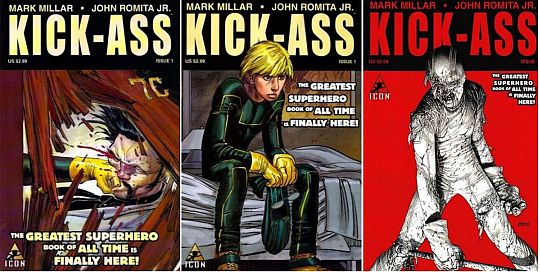
Three covers for the original comic book by Mark Millar and John Romita, Jr.

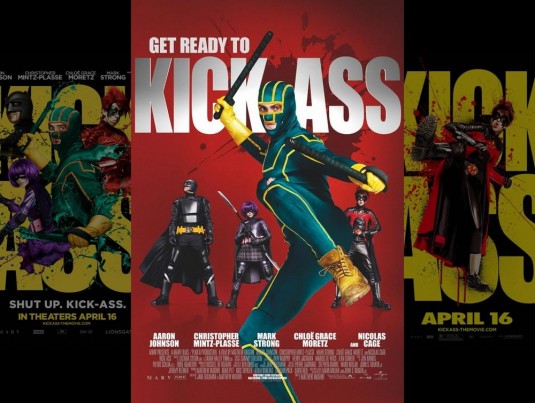
Three different poster designs for the Matthew Vaughn-directed film

Kick-Ass, the comic book is an entirely different monster than Kick-Ass, the motion picture. While I am certain that it would make Mr. Ebert and his supporters cringe at the thought, the comic book is actually a great deal more violent and delves even further into the realms of misanthropy than the film ever does. At the same time, the narrative scope of the comic travels squarely within a space that all of the characters share equally. It is a space that, incidentally, is more about adolescence, growing up and questioning ideas of violence and modern media culture than anything else.

The problem is that Mark Millar and John Romita Jr.’s literary Kick-Ass is not Matthew Vaughn’s Kick-Ass. Just as in any cinematic adaptation from a literary work, there are changes made.  Pieces are added or detracted, transitional elements reworked and most times there are major conciliations made in regards to the character or thrust of the film’s focus in comparison to the originating text. The filmed version of the comic book, while attempting to bring as much of the written/drawn version to the screen as possible, did not do so because of one simple rule: the comic book was the literary version and belonged to Millar/Romita, Jr, et al; the movie was the filmed version and therefore a product of its authors.

Most of the general public operates under the assumption that “the book is better than the movie.” Primarily, the genesis of this comes from the fact that film has always been seen as literature’s poor and trashy cousin; a media form less worthy of cultural esteem. It has been this way since its birth. Thus, when people argue about the book being better, it generally comes mostly out of sociological training and not necessarily from actual personal experience with the literary text. The problem is, we are not instructed on how to appreciate these media forms on their own merits, thus they must be held up against each other. So, when one is adapted from another’s narrative, it is only natural that the “book is better” argument gets raised. While this aphorism is used often, it is also overused, tired, and extremely lazy. Each media is created and consumed through individual means and while they may share a story and even themes, it is much wiser to appreciate each piece upon its own value and not use the parent text as a jumping off place for criticism.

Millar’s Kick-Ass world will not be the bulk of what is discussed here, due to the fact that the things that he involved were of another ilk. From my perspective, even Vaughn’s Kick-Ass was a little bit hijacked by some of his actors. But I believe that once he saw what was happening, he went with it, and decided to amp it up a little, making it the picture we see today. I also believe that while Millar’s work was a total collaboration between himself, John Romita, Jr (artist), Tom Palmer (inker), and Dean White (colorist), Matthew Vaughn’s film was also communally created by him, co-screenwriter Jane Goldman, and the entirety of the cast but primarily Aaron Johnson (Dave Lizewski/Kick-Ass) and Chloe Moretz (Mindy Macready/Hit-Girl). This “hijacking” as it were became more pronounced when it became clear that not only was the film seized from going the direction in which it was “supposed to go,” but through this accident of fate it essentially laid the focus of the film cleanly between the crosshairs of Chloe Moretz’s 11-year-old superheroine, Hit-Girl.

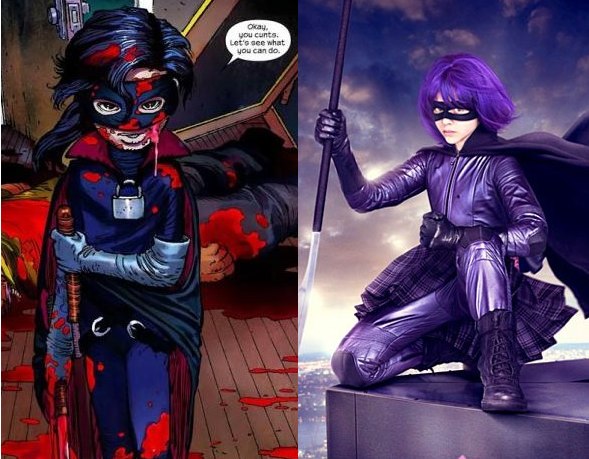
Millar & Company's Hit-Girl versus the cinematic equivalent. Clearly there were some...alterations.

I say “accidental” due to the fact that the story is, for all intents and purposes, supposed to be equally shared between several characters and the central figure (and voice-over narrator), Kick-Ass aka Dave Lizewski (Aaron Johnson). However, it becomes stridently clear at a certain juncture within the film that this is really Hit Girl’s show and Kick-Ass is simply her foil. That said, having this be her film, it takes this piece to a whole different level and what was a simple film about a high-school loser trying to be a superhero and the trials and tribulations that occur in a somewhat Bizarro World-type set-up has now become one of the first films to feature a strong female superhero going about the business in a particularly hardcore manner, without being displayed with any sense of real eroticism.

Hit-Girl is, in fact, a cinematic disruption. She is, pure and simple, the antidote to the scopophilic gaze which Mulvey discusses in her article. While she may be on display, it is for no other reason than to reconfigure a kind of new type of feminine power structure. This interruption in the traditionally pleasured male-gaze is anarchic and insanely potent, causing the more-than-slight discomfort of Roger Ebert and numerous other critics.

Mulvey writes,

[t]he cinema offers a number of possible pleasures. One is scopophilia. There are instances in which looking itself is a source of pleasure, just as, in the reverse formation, there is pleasure at being looked at…the cinema satisfies a primordial wish for pleasurable looking, but it also goes further, developing scopophilia in its narcissistic aspect. The conventions of mainstream film focus attention on the human form.[3]

If the audience finds pleasure in looking at Hit-Girl, one would hope it is not for her “form.” She is not rendered sexually attractive, she is posited in the manner that one would hope an 11-year-old girl would be: generally child-like. When out of costume, she has pigtails, scrunches her face up at things she dislikes, and talks about being rewarded with bowling and ice-cream sundaes for succeeding in tasks well-done.

Does it matter that those tasks involve wearing bulletproof vests and being shot with high-level guns? Maybe, maybe not. The basic idea is still there: she’s a kid.

Out of uniform, Mindy Macready looks average and amiable. However, the mask goes on and...buh-bye bad guys!

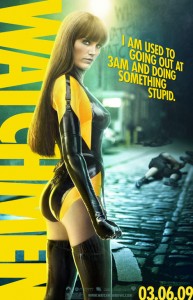
Can we say the same about Iris in Taxi Driver? Not so much. Nor can we dispense with the fact that Violet in Pretty Baby is still in for a life of prostitution, even as we watch her engage in childlike behavior. And as for the countless superheroines in the cinema…well, I believe that the casting of Malin Akerman, an actress in her late 20’s/early 30’s, to play a middle-aged retired superhero in Zack Snyder’s version of Watchmen(2009) tells you all you need to know (if her exceedingly tight and sexy latex outfits didn’t).

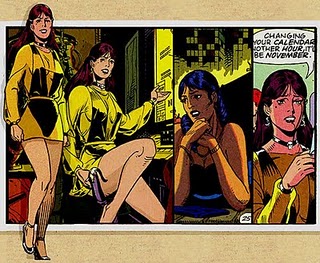
Cinematic interpretation of the Silk Spectre. I believe the line on the poster (clearly cashing in on an out-of-context line) says everything about the way that director Snyder translated this female superhero to screen.

This is the Silk Spectre in the Watchmen comic. Still sexily costumed, but the portrayal gives her exceptional depth and her physicality reflects the physicality of a real woman of that age and experience.

This is the Silk Spectre in the Watchmen comic. Still sexily costumed, but the portrayal gives her exceptional depth and her physicality reflects the physicality of a real woman of that age and experience.

These are displayed female figures, there for the looking at, the pleasure of their characters isn’t about their strength as heroes or their integrity or their interactions with the storylines at all but based on the experience of looking at them and, indeed, visually possessing them to a certain degree. This is due to the eroticism they have been endowed with which is innately tied into a “fetishistic scopophilia [which] builds up the physical beauty of the object, transforming it into something satisfying in itself.”[4]

As a character, Hit-Girl exists almost entirely to frustrate that kind of satisfaction. This character does serve as a source of gratification, but it is in an entirely different manner than your standard young female character or female superhero, primarily because of the removal of the sexual element.

Blogger Kate Harding at Shapely Prose said it best when she was discussing Hit Girl’s presence and the construction of action films. She states that she generally hates action movies where women are the protagonists or “asskickers-in-chief.”

They’ve never appealed to me much, probably because they tend to be sold on the fuckability of the heroine more than the relatability of her; the primary market is still young, straight and male, after all, so a female lead is drawn to evoke fantasies…And because it’s all aimed at the same young, straight, male market, this doesn’t really go both ways. While I certainly don’t mind looking at Matt Damon or Clive Owen or Jason Statham fighting bad guys, I am generally not thinking “God, that was so totally badass, I want to fuck you right now”…If I like the film enough…then I am thinking, much like the young, straight men in the audience, “God, that was so badass, I want to be you right now.”[5]

Harding’s deconstruction of the viewership of the action genre is integral to the manner in which Hit-Girl is satisfying to the audience. She is, like any other superhero or action hero, an audience surrogate. Harding’s discussion in regards to fantasy vs. idolization is of particular value in this instance. Were we treading in Halle Berry/Catwoman waters or even dealing with Anna Paquin/Rogue situations, we would likely be experiencing a large percentage of fanboys/males drooling and female audience members frustrated once again at the over-sexifying of potentially powerful characters. It sounds essentialist, but if you ask most women who like superhero films, you will probably get more positive responses for the male characters than the female, having nothing to do with sexual attraction. I would much prefer to be or hang out with Professor Xavier or Batman than any of the female counterparts. They simply contain more substance. It goes part-and-parcel with Mulvey’s argument and Harding has clearly had her own experiences with the male gaze, as she notes above. Objectification is a nasty bugger. However, this type of reaction is not what occurs with Hit-Girl, with men or with women. And it is due to her lack of erotic exhibition. Because she is not eroticized, she is like a pint-sized icon for all members of the audience to enjoy together (in a somewhat wholesome way, if you disregard the foul language and violence), making this character’s gender-stereotype-destruction fairly radical.

Don’t get me wrong. I’m not trying to infer that this film is bringing people together in some hippie-dippie communal-type way. But it is creating a space in which gender is taking a back seat to character, and in many ways this is a big step. Sure, the excessive violence tends to make Hit-Girl much more problematic due to her youthfulness. But it is her gender that drew the ultimate amounts of attention and if the audience were now gender-blind for their female superhero, it’s no small feat that has been accomplished. As Julia Rhodes of the California Literary Review wrote, “Would critics be as upset if Hit-Girl were Hit-Boy? I doubt it…I can appreciate a girl who knows what she wants and gets it. I still spent parts of the movie chuckling uncomfortably with widened eyes, but I have a love for a girl who outperforms the boys.”[6]

A Superhero of One’s Own: Is Hit-Girl a Feminist Figure?

There has been much talk in and around Hit-Girl and whether or not she is a feminist figure. Many writers have found her to be quite troublesome in this arena, and I cannot help but agree with them. It is far easier to say that she is within the spectrum of feminist iconography due to her character’s basic skeleton structure. Hit Girl has numerous qualities (independence, strong survival skills, high intelligence) that female characters in films are generally lacking and she is presented in such a way that is not predicated upon some kind of sexual promise. But the real issue resides in the fact that we must differentiate between a strong female character and a feminist figure. They do not always mean the same thing.

Reading the reviews of this film from online magazines, newspapers and blogs, one can easily decipher the writers who qualify for the fandom category and those who are clearly part of the critical thinker section. While both groups have sincere and wonderful qualities and are valid sources for types of media scholarship, one is clearly a more problematic zone to operate from, due to personal bias. However, it is entirely possible to be a fanboy/girl and be a critical thinker (I consider myself part of this hybrid group), even if it is an extremely difficult location to exist in. It takes a great deal of training, and is one that I still struggle with on a daily basis. When dealing with a film like Kick-Ass, it is of the utmost importance that one attempts to balance these two sides properly and not just gush all over the page. There are too many dilemmas present for it to be treated in such a simplistic fashion.

In an article in The New York Times, Manohla Dargis and A.O. Scott discuss what they see as the new trend of hyper-violent young women in cinema. Together, they attempt to come to a conclusion in regards to whether or not these images and storylines are in any way, shape, or form forward-thinking. Dargis states, “Part of me thinks the uptick in bloody mama and kinder-killer movies is about as progressive as that old advertising pitch for Virginia Slims cigarettes, meaning not very. You’ve come a long way, baby, only now you’re packing a gun and there’s blood on your hands (or teeth).”[7] And she’s got a solid point. How does putting a weapon in a woman’s hand or placing a young girl in a violent situation transition them into becoming feminist icons? Just because Uma Thurman’s character in Kill Bill survived every single level of hell and then a few more doesn’t make her a feminist figure. She was still a revenge-driven former assassin who enacted hideous violence upon folks she was involved with. The desire to survive and the competence and know-how do not a feminist figure make. Add hyper-violent behavior into the mix and you’ve got some very big issues to contend with.

In many of the articles that I read, several pro-Kick-Ass writers mentioned the fact that if Hit-Girl had, in fact, been Hit-Boy, there would have been no controversy around the fact that she swore like a sailor and took a physical battering like a UFC champ. In this, I agree 100%. However, I would like to turn the tables in a very similar fashion and think about something. Many of these same reviewers saw Hit-Girl as a feminist figure. This was due to her physical dexterity, tenacity, independence, and uncanny ability to kick the shit out of men ten times her size and at least three times her age. Essentially, they based much of it on her physical performance which is narratively linked with intense acts of violence. They saw her survival instinct and intelligent battle tactics as symbols of Female Warrior-ness and not simply what they were: getting out of there alive and getting a job done. I submit to you, much in the “if Hit-Girl had been Hit-Boy” way, that watching a male figure engage in the very same behaviors does not make us consider, for one moment, that he is a symbol (on a larger scale) of Man At His Best and Someone We Should Look Up To.

Feminism is tricky, see. When I think feminist figures, I’m not sure I think a chick with a gun.

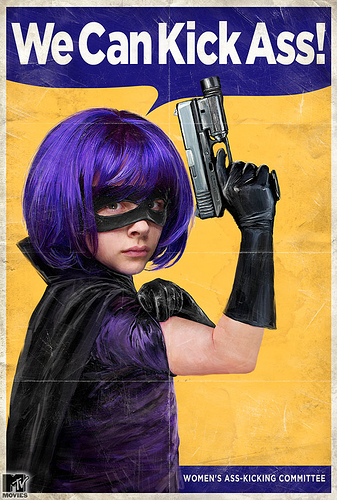
Somehow, I just don't think that this is the kind of riveting Rosie had in mind...

If I did, Ripley from the Alien series would totally be my goddess (even though she’s also tricky as she has feminist thematics running through her character arc, but that’s a whole other discussion!). Realistically, there is no shame in being a strong female character and THEY TOO are direly needed. But it is a huge and largely dangerous step for people to make the jump from kick ass, amazing and strong female character to Feminist Character. The problem these days is that the less boundaries that we have in films, the less of a gauge we seem to have to judge these things. While this sounds like I am advocating censorship or some conservative nonsense, I am not. The less classy our violence and gore gets, the less ability we have to see the difference between…well, anything. If I’m going to sound conservative at all, I’ll say this: in order to renegotiate feminism in the cinema, we are going to have to renegotiate our exploitation films, and Kick-Ass has many attributes that qualify it for exploitation.

In addition to our gauges being screwy due to our films being less classy, we have another major issue that can cause the feminist/strong female mix-up: women get shitty film roles on a regular basis. As Manohla Dargis says, “the American big screen has hasn’t been very interested in women’s stories, violent or not, in recent decades, an occasional Thelma, Louise and Jodie Foster character notwithstanding. There are other exceptions, of course, usually romantic comedies that are so insipid and insulting…”[8] So, essentially, if a woman isn’t being eroticized and sexualized and she’s not in a crappy romantic comedy, then…? Truly, there are precious few roles in any other category. Thus, this new “trend” that Dargis and Scott are discussing is fairly radical in what it is doing for femininity- but not in such a positive way.

Is it the violence? Yeah, partially. I don’t think that there is anything empowering as a woman about the ability to kill, maim or torture another human being. Do I like watching it on-screen? In my films? HELL YES!!! But that’s fantasy. It’s a fictional world. I find that there is a severe delineation between a woman of power who I recognize as a feminist character or simply a really great and strong female character who kicks a whole lotta ass. But I’ll admit: I don’t always want that to be the case. I just know that is the actuality of the situation. My fangirl side wants to claim all sorts of people as feminist figures like Beatrix Kiddo/The Bride from Kill Bill or Hit-Girl from Kick Ass.

The cinephile in me wants to claim The Bride aka Beatrix Kiddo from Quentin Tarantino's Kill Bill as a feminist figure. The critical theorist in me won't let me. It's a big struggle.

But I look at them again and use my better judgment. While they retain qualities of feminism, and perhaps in a different narrative they are feminist figures (post Kill Bill? What’s life like for Beatrix?), in the diegetic slices of pie we are given, they are simply extremely strong and vital female characters. They are just as worthy of respect and admiration, but they are more problematized due to certain aspects given to their respective characters within the storylines.

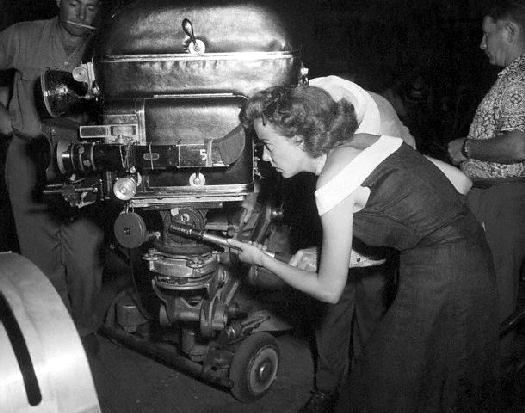
It is slightly disturbing to have Hit-Girl claimed by so many as a feminist figure. It seems to me that we must be really troubled and really out there in the desert dying of thirst when we must claim an 11-year-old child who presumably hasn’t even menstruated as a symbol of women’s strength and endurance for All Time. Call me crazy, but when I think feminist, I think Emma Goldman. I think bell hooks. I think Ida Lupino.

Ida Lupino, actress, filmmaker, feminist figure

I think Annie Sprinkle. Unconventional folks, sure, but still…they are all feminist icons in my book. And Hit Girl is exactly that: a girl. Her name says everything. So tell me- why we are claiming her in the name of feminism again?

Hit-Girl is not acting with any socio-political intent within the film and just because she is not sexualized or placed on erotic display like other superheroines does not make her part of the Feminist Club either. You do not become a feminist character simply because of what you are not it is what you are and Hit-Girl is a character that should not be burdened with the strain of Feminist Character. It places too much stress on what she represents and reveals a blatant refusal to look at the violence within the text and the actual narrative and her role within it which is far more important.

However, Hit-Girl’s aggressive presence in the film may simply be a way of garnering commercial success and playing into a new scheme of films and we might have to come to terms with that, making her even less potentially feminist-y than before. Dargis worriedly states,

It’s tricky whenever a woman holds a gun on screen…I complain about the representations of women, but I’m more offended when in movie after movie there are no representations to eviscerate, when all or most of the big roles are taken by men, and the only women around are those whose sole function is, essentially, to reassure the audience that the hero isn’t gay. The gun-toting women and girls in this new rash of movies may be performing the same function for the presumptive male audience: it’s totally “gay” for a guy to watch a chick flick, but if a babe is packing heat- no worries, man!

If Dargis is right, and she very well could be, Hit-Girl’s character is actually quite damaging, as it is playing right into Hollywood’s grubby hands. With the recent slew of films that have come out that have featured Hit-Girl-like characters (Hanna, Sucker Punch), this worries me. Especially since people are jumping to the Feminist Character title and not looking at the situation critically.

In conclusion, I think I will have to agree with Carrie Nelson of the blog Gender Across Borders. While I don’t think that Hit-Girl is a feminist character, “the idea of superhero and action movies creating space for girls to play aggressive, powerful characters is innovative and refreshing.”[9] As a film, Kick-Ass is action-based and certainly not as meaning-heavy as the comic, but it contains some features that give it credibility. Hit-Girl exemplifies many qualities that adult women (and men, for that matter) should possess: self-reliance, determination, a certain dedication to improving one’s abilities. For many viewers, this was incredibly important, as I read in the comments section of a great many blogs and reviews. Realistically, there is no reason in the world that she cannot serve as a model in this respect. But to confuse her with feminist iconography would be a falsity and not one that an 11-year-old who drinks hot chocolate with lots of marshmallows would want; no matter how well she can handle that set of knives.

The Chocolate Chip Cookie Syndrome: Music and the Cinema

When I was in junior college, I took a class on psychology (specifically, I believe that it might have actually been biopsychology, but I’m not about to dig up those transcripts to find out, no offense!). One of the more interesting things that we learned within that class and the one thing that I have remembered to this day was that of all of your senses (seeing, hearing, tasting, touching, and smelling) only smell was directly linked to the memory processing area of your brain. While other senses can trigger memories and have memories attached to them, none travel quite the same direct route and therefore have a very different relationship.

The olfactory (smell) cortex has an uninterrupted neural connection to the hippocampus. Uh, what? Well, basically, the way your sense of smell works? It’s on a beeline path towards your hippocampus (which I always pictured as a mini-Hippopotamus with a cap and gown on, living inside your skull, but that’s because I’m silly like that) which happens to be the very center of transferring information into memory. Oh and where is this party going down? Inside the limbic system, which is totally a part of the emotion center of your brain.

This is your brain…This is your brain with all your senses pointed out…no graduating hippopotamus, sadly.

So here’s the way I’ve generally explained the chain of events and relationship between your senses and memory and why it makes such a huge difference. I use Chocolate Chip Cookies (if you’re vegan or hate chocolate or have other dietary restrictions…well, know what? Mentally substitute your own nostalgic food!). Due to the fact that we start developing our memories as soon as we ourselves begin developing, we are going to imagine that your grandmother was a hellova baker, and baked the hell out of some chocolate chip cookies. Every time you visited. And you visited on a very regular basis because your family was less dysfunctional than everyone else’s, so you have been smelling these morsels of sugary goodness since you were gumming mom’s nipples. You are now a grown person, and Grams has unfortunately left us, as happens with our elders. One day, you are visiting the family of a friend for *insert holiday here* and all of a sudden you are nearly knocked over by the scent of…what else…chocolate chip cookies baking. However, it is not the recognition that makes your knees practically buckle, it is the fact that it is so much like your grandmother’s house and it all rushes back to you in one intake of breath.

It is a mistaken assumption to make that when you breathe something in, you merely recognize it for what the scent is. Smells are complex relationships. And what may be simply some loudmouth douchebag in front of me in line wearing too much cologne may make the woman behind me start to cry due to the fact that this was the very same scent that her former husband wore. Each person has their own set of smell-relationships that has been created due to memory and their life. Fascinating, no? Fascinating YES!

So what does smelling chocolate chip cookies and getting nostalgic for grandma have to do with cinema? Actually, quite a bit. It’s something that I am calling the Chocolate Chip Cookie Syndrome. While cinema clearly cannot deal with the intricacies of smell (unless you count things like Smell-O-Vision or John Waters’ version, Odorama, neither of which should be included necessarily in today’s argument), that does not mean that it has not attempted to develop a very intense relationship of its own between memory and another sense aside from that which is visual. What I wish to discuss here is sound and not simply sound but musical sound, specifically of the soundtrack variety. 

As film scholars and fans, we are all aware of the highly associative properties of a piece of music that is used in a film. But has it ever been something that you have given much thought to? Have you ever sat down and traced those associations throughout the world-at-large or, indeed, your own life?

Perhaps you have not. I have realized that I have to leave room for people who do not engage in aural stimuli as much or as passionately as I do or as my friends and associates do. Sometimes I need to step away, pull myself back, and realize that some people are just visual. And you know what? That’s totally fine. I probably will never have the same visual conception of certain things that they have. On the other hand, I will probably always feel that they are missing the film in its totality, the way it was intended. At least a little bit. This is something I will try to work on.

I think that people like Martin Scorsese, Quentin Tarantino, and Cameron Crowe have all created films that scream, from the first to the very last reel, Chocolate Chip Cookie Syndrome. Especially the first two directors. The key to Chocolate Chip Cookie Syndrome (or CCCS for short) within a film is the meticulous ability to texture the film with something, in this case music or certain songs, and make those items so damn iconic that you will forever remember the movie every time you re-experience them.

I will never ever be able to hear “Please, Mr. Postman” by The Marvelettes again without thinking of the bar fight scene in Mean Streets (1973). And while that film is arguably one of my favorite films ever made, that song doesn’t give me goosebumps. Does it please me to hear it in a random store while I’m buying detergent? HELL YES. All I can think about is the camerawork and the choreography that goes right along to the song.

Gone to a party or a club recently? OK, well even if you haven’t, there are kids out there who were not even born when Say Anything (1989) was released who are imitating the John-Cusack-with-boombox-posture when Peter Gabriel’s “In Your Eyes” is played. I’ve even seen it for Halloween costumes, and the kids run around playing the song (as though we were unsure which trenchcoat-wearing, boombox-wielding weirdo they might be dressed up as…there were OH SO MANY you know!).

For my money, however, Crowe will always have me from the opening strains of Mother Love Bone’s “Chloe Dancer/Crown of Thorns.” In my world it is the film Singles (1992). While the sequence that it is plays during  and the song itself may not be quite as iconic as “In Your Eyes,” they will remain, for me, embossed upon my brain, images that are always there to be sparked every time I happen to hear the song in whatever context that may occur. I hear Mother Love Bone, and I have my Chocolate Chip Cookie moment, and no one knows that my knees are jelly and my heart is all kinds of achy inside my chest.

And…well…need we mention the numerous films and associated songs that Tarantino has blessed our ears with? Really, he is remarkable in that his musical obsession seems to rival his filmic one. I’m not trying to worship the man, but as far as musical accessorizing is concerned, Quentin Tarantino is almost a special case unto himself. Tarantino’s own CCCS is so multi-generational and multilayered that he draws incredibly rare and eccentric songs from the ether and makes them into communal property. He removes them from a place of musical obscurity and re-places them into a realm that no longer simply exists within the confines of his own memorial space. Not only that, but he has given each song a creative context for which it will now forever be associated.

He uses songs like “Across 110th Street” by Bobby Womack in Jackie Brown (1997), even though that song was the title song of its own film from 1972. OK, OK, so perhaps that song wasn’t as rare as, say, the entire Reservoir Dogs (1992) soundtrack but it did its part to re-member certain aspects of that film genre (blaxploitation) and that era. The song set up the film and within that set-up said to the viewer that there was history here. The casting choice of Pam Grier only reified that statement, as the entire film is about a past/present conflict.

Even more efficiently than Jackie Brown, I highly doubt that there is a single person who can even one song from the Reservoir Dogs soundtrack and not associate it with the matching scene in the film (unless of course they have not seen the film, but that’s a no-brainer). Tarantino was, perhaps, one of the more significant people in the last 30 years to utilize this relationship between aural recognition, visual enjoyment and memory to catalyze his own form of synergy (in the media economics definition- this soundtrack has sold insanely well and continues to do so). He did the exact same thing two years later with Pulp Fiction (1994), and made a killing.

Media economics aside, it is the cultural economics that Tarantino has managed to manipulate through the use of aural stimulation and historical association. We all have personal relationships with these films and the music/songs contained and yet, due to the medium of film itself, we have a communal experience as well. The CCCS that we develop from the musics that we hear within a filmic context CAN sometimes be just as complicated as the olfactory relationships that are imprinted upon us throughout our lives, just in a very different way. They are, most certainly, both stemming from the same memory center/hippocampus/limbic system that has been in development since we were children!

One of the best examples that I could possibly give you of the Chocolate Chip Cookie Syndrome would be a working one, therefore I have chosen a personal example and one that I currently experience on a regular basis. The central component of this is the musical figure: Leonard Cohen. If, while reading this, you get the feeling that it maps out quite like a kind of family tree, you would not be wrong. In a sense, I mapped out my relationship to Leonard Cohen by creating a media family tree that involved all the different branches (of which there are quite a few odd-seeming ones) that poked out when I thought of my relationship to the music of “Leonard Cohen.”

It is almost difficult to diagram my Cohen-lution, due to the fact that I knew his work before I knew his work. While that may seem convoluted, I promise, there is a method to my madness (or so the doctors have told me…). Therefore, instead of starting at the very first time I heard a Cohen song, I will start at the place where hearing a Cohen song connected me with my own version of CCCS.

Watching this clip again, even briefly, I am imagining myself back at 19 years old. I think I was probably blown to bits by this film, even though I didn’t know it. Altman seems to me to be that kind of director. When I saw M*A*S*H (1970) for the first time a short time later, I remember being overwhelmed by how great it was. But also having a delayed sense of its brilliance. Most of the truly good stuff didn’t hit me until waaay later! My experience has always been that a good Altman film, like a proper, well-made cocktail, sneaks up on you. You taste it, you know it’s extremely intoxicating, smooth and enjoyable but what you don’t realize is that a short time later, you get an additional kick. And all of a sudden, you’re thinking, “Oooo! My cheeks are warm, the room feels delightful! Goodness, what was IN THAT THING ANYWAYS???”

That is Altman to me. So what did I get out of McCabe and Mrs. Miller (1971)? A deeply obsessive voice that kept saying, “that damn soundtrack! I gotta have that soundtrack! Who is the guy on the soundtrack??” Mind you, I was living in Santa Cruz at the time, and therefore was pretty much in  Hippietown, USA (there was a designated corner called “Hippie Corner” for kids to spare change and busk on). I had been surrounded by hippies for most of my childhood and yet I didn’t know who Cohen was. While I admit that it’s mildly unfair to associate his entire career with the hippie subculture, this particular singer-songwriter album was very much on that track, so my first impression was that was the genre that he was part of.

The album that I searched all of Santa Cruz for and listened to RELIGIOUSLY for….good grief. I have no idea how many weeks/months. I blame Robert Altman.

After rewatching that opening scene that I posted, I have had to reconsider my notion that all I received from McCabe was the soundtrack. I’m going with the Altman-as-killer-martini concept. There is a very distinct possibility that this film truly changed me for the better and used music as the catalytic agent. I’m not necessarily comfortable discussing the film content in any depth here, as the last time I saw it was the first time I saw it, but based upon that fact and revisiting the opening piece using “The Stranger,” I will have to say that this was a piece of cinema that struck me in a way no other movie ever had. When I posted it here on my blog, I heard the guitar, saw the visuals, and literally felt like I was being transported back to when I had first experienced the film. The feeling that washed over me? Indescribable. Needless to say, when I sat down to write this and planned on including that, I NEVER expected that to happen. The irony of this entertains me quite a bit and the experience itself only underscores my own relationship with this song and, thusly, this film. Clearly, it is something that I cannot escape as it is built into me and my memory just as strongly as Gram’s cookie sweetness might be.


As a more educated Leonard Cohen scholar these days, if you asked me where I first heard Leonard Cohen, I would give you an answer that a good chunk of women my age would give you: The film Pump Up the Volume (1990).Within the film narrative, Allan Moyle uses the original version. I remember being quite taken with it, and being pretty weirded out when a chick began to sing the song. So I fast-forwarded through the song at first, and moved on to the rest of the soundtrack.

That damn soundtrack. DEAR LORD, DID I LOVE THAT SOUNDTRACK.

Bad Brains. Peter Murphy. Rollins. Pixies. Sonic Youth. Concrete Blonde. Mutha-effin’ Soundgarden. Did you NEED more? If you did, I didn’t wanna know you. In fact, I may still hold to that rule…um, same bands too.

First of all, there was The Pixies. THAT was a major discovery in my life. I later learned that there was a different version of The Pixies’ “Wave of Mutilation,” but not having any friends at the time who were into that kind of music really (we were all more or less Hollywood metalheads with braces and Catholic school girl uniforms…danger, Will Robinson!), I just listened to the soundtrack repeatedly. Soon after, I met a friend at summer camp who made me a tape that had The Pixies’ Doolittle on one side and Bauhaus’ Burning From the Inside on the other. I may still have that cassette tape somewhere. I hope I do. I don’t think I took it out of my bright yellow Sony Walkman for the rest of the summer…and then some.

After my initial shock and disappointment at not having the actual song from the movie on my tape, I got incredibly attached to Concrete Blonde’s version of “Everybody Knows.” Lord knows this was not the first time someone had “switched it up” on a soundtrack I had bought before (and it wouldn’t be the last) but I was a bit miffed. However, as I listened to it more, the song became more ingrained upon me than the one in the film. So much so, that I barely remembered that Moyle had even used Cohen’s version in the first place!

I believe that this version became the more powerful one to me for three main reasons. First of all, it’s a brilliant song in general, no matter who is singing it. Secondly, its use in the film is critical and striking, and for a girl who was as attached to both the message and the story of that film, I was, literally hanging on EVERY frame, visually and aurally. Thirdly, as far as cover songs go, this is a really decent one. Johnette Napolitano can belt it out but…she can also emote. Within the strains of this song, she sounds exhausted, worn out and bitter as a $2 whore, but that only serves to give the song the depth it needs.

To switch a singer’s gender can be tricky for the outcome of a given song. It changes the meaning and can give it an unreasonable amount of complications. But here, it works perfectly. In fact, it worked so effortlessly and seamlessly that few people knew that this was, indeed, a cover song. I’ve never been ignorant of things, but at that age I wasn’t exactly paying attention. Here is what I did know:

The song was amazing. It rocked me. I was hooked. I couldn’t say for sure if the other girls I knew/hung out with listened to the soundtrack with as much joy and spirited pleasure as I did, but there was something about that song. It had to do with the film, it had to do with the music, it had to do with the filmmaker making the right choice and hooking me in like the little adolescent goldfish that I was. And I remained hooked for life. The first clue came a precious few months after the August, 1990 release of the film and its soundtrack.

January, 1991. I watch the “One Man and a Baby” episode of Beverly Hills, 90210. There it was. There was the VOICE. Concrete Blonde’s “Joey” was on that episode and I nearly had a heart attack. I was thrilled to pieces. I joined one of those CD clubs and bought the album Bloodletting specifically due to these events. Between Allan Boyle’s Pump Up The Volume and Aaron Spelling’s television, um, “piece,” I became a Concrete Blonde fan.

But nothing ever hit home the same way that “Everybody Knows” had. I didn’t find out until years later why: Leonard Cohen. Due to the fact that his version was only on the film and not on the soundtrack (issues of access!), my familiarity was almost entirely with her version. Thus, “Everybody Knows” has always been, more or less, associated with female vocals rather than Cohen’s own.

When I hear “Everybody Knows,” I have a very complicated response. In essence, it is the Chocolate Chip Cookie Syndrome, as it leads me directly back to the film I associate it with, Pump Up The Volume. However, when I hear Leonard Cohen sing it, I become very mixed up in my synthesis. Do I hear Johnette? Leonard? Do I hear a man weaving the tale? A woman? Does it matter? Is the end result the same? How do gender issues enter into a song so very complex and soaked in social politics? And how to translate the cynicism, especially through the person that I am today, versus the person that I was 21 years ago?


I don’t have an answer for those questions. And I’m very happy to tell you that I do not. If I did, then I would no longer be able to think critically about the relationship I have with these very diverse memories that all seem to share the same base camp, even if they do reside in different tents. I enjoy being able to think about this song and what it means for each person to sing it and also what it meant to me then…and now. Playing the compare/contrast game is part and parcel of my appreciation of the music.  Really, this isn’t far from the experience of finding that it wasn’t simply Leonard Cohen’s “The Stranger” and other songs in Altman’s McCabe and Mrs. Miller that rocked me, but the entire damn film! This is why music in film is important. It inspires memory. Personal and otherwise.

The association of music and film has always been a crucial one for me. From the musicals of yesteryear to the films of today that utilize music in such a way that song could not be torn from image without destroying the whole piece, the match of sound and visual is more powerful than if it were just simply one media or the other.

Film is essentially about transmogrification, anyway. If one leaves a film completely unchanged, even if it is for the worse (I hated Hangover 2, I am sorry that I saw it, but I was still altered in that I will TRY never to see such a terrible movie AGAIN), there is something dearly wrong. One of the most efficient ways in which to permanently conduct change in your audience is to associate certain things with your piece. Music can do that forever. Currently, due to the film Waltzing With Bashir (2008), I am pretty certain that I will never be able to go to any club and hear O.M.D.’s “Enola Gay” without being utterly devastated. That is power. I really loved that song, man. And…I still do. But in an entirely different WAY. If you are able to completely translate someone’s conceptions of a piece of music and forge them around your creative image, I applaud you. And I want to see your film.

It may sound silly but I am proud of having Chocolate Chip Cookie Syndrome. I would be a terrible audience member without it. Right now, I am your ideal audience member, even after far too many classes in film and television theory. I greatly appreciate the filmmakers who work hard to give me those “chips” so that I can TOTALLY GEEK out by myself when I’m out and I hear something like “Down in the Park” by Gary Numan and remember it not from the album Replicas or even Urgh! A Music War! (1982) but from another Allan Moyle movie entitled Times Square (1980).

We all have our own memories. Hell, we all have our own limbic systems! But let’s face it, folks- the fact that you remember that Huey Lewis contributed music to Back to the Future (1985) is no accident and no small feat. Laugh all you want, but it was creatively negotiated to match those tunes up with the film and to make damn sure that this many years later…someone remembers it- and that someone is you. The other memories surrounding Back to the Future? Where you saw it, who you saw it with, what theater or whose house? All of those things are your business, and yours alone, which is a beautiful thing.

And as some great writers once wrote in a great script, that’s the way it crumbles…cookiewise.

Get Into the Groove: Desperately Seeking Susan and Genre Revision

Whatever is funny is subversive, every joke is ultimately a custard pie… a dirty joke is a sort of mental rebellion.

            -George Orwell

When Susan Seidelman received a script entitled “Desperately Seeking Susan,” in 1985, it had already been floating around Hollywood for 4 years. When she saw the title, she knew that it was meant for her, practically sight unseen. The story, a screwball comedy with a feminist streak a mile wide, seemed almost too good to be true, especially considering who sent her the script, and who was already on board to support the film. Not only was the film’s content a powerful commentary on contemporary female identity, definitely unusual, but it was set to involve a female director (Seidelman), a female writer (Leora Barish), female producers (Sarah Pillsbury and Midge Sanford), two (at that point, uncast) female stars, and a female film executive (Barbara Boyle) who really fought for the production. For the time, that many powerful women involved in a single film production was almost unheard of. This was an incredible opportunity, and Seidelman answered their “want ad” with a resounding yes.

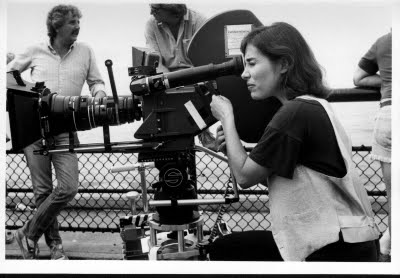
Susan Seidelman on the set of Desperately Seeking Susan

These days, what most people remember about Desperately Seeking Susan is not the multiplicity of ways that it subverts and reworks genres, nor the running commentary it gives on class and sexuality, but the fact that the film stars an extremely youthful and (at the time) barely known Madonna. Although Madonna is a crucial aspect of this production, I would like to present an analysis of the film that lays bare more than a mere “star vehicle” for Ms. Ciccone. I propose that Desperately Seeking Susan’s goal was to look at past film genres with strong female roles, and rework and “mesh” them into an entirely new kind of film; a film that was as much a new kind of  “Woman’s Film” as it was a good old romantic comedy.

In 1972, a little bit over 10 years before this film was made, the Equal Rights Amendment was passed, guaranteeing women equal rights. That same year, sex discrimination was banned in schools and in Eisenstadt vs. Baird, the Supreme Court guaranteed that the right to privacy included the single person’s right to use contraception. The next year, Roe vs. Wade gave women the right to safe and legal abortion, while the year after that saw the ruling of Corning Glass Works vs. Brennan, which ruled that employers cannot justify paying women a lower wage just because that is what they got at the “going market rate.” These years and the next few saw huge leaps for women and the feminist movement. It is no wonder that this film, made in 1985, would choose to make such a bold statement about wanting to break free from the suburban doldrums, a loveless marriage, and a life lived for someone else in favor of a life that is fulfilling, exciting, and personally rewarding.

The appearance of Desperately Seeking Susan after an entire film decade that had been devoted to the exploration and celebration of masculinity could not have been a huge surprise, however. With a few exceptions like Alice Doesn’t Live Here Anymore and a plentitude of underground experimental films, the 70’s film structure tended to focus on a cadre of young talented men, who were each expressing their own personal “vision.” The irony is that the explosion of feminism happened at the same historical moment, and it seemed to fall on deaf ears. Julie Christie notes, “What it seemed like to me was like boys had been let out of school. So it was like, ‘School’s out!’ so the energy was unbelievably high, and I think that is what characterizes North American filmmaking of the 70’s, is the energy. That inimitable American, male energy. And it’s fantastic, but it wasn’t a great time for women.”[1]  So, when an entire decade passed without recognition of the gender politics that were flying as fast at the bullets in Vietnam, women like Susan Seidelman decided that they had to bring their voice to the screen. Thus Desperately Seeking Susan was born.

It's a life so outrageous it takes two women to live it!!

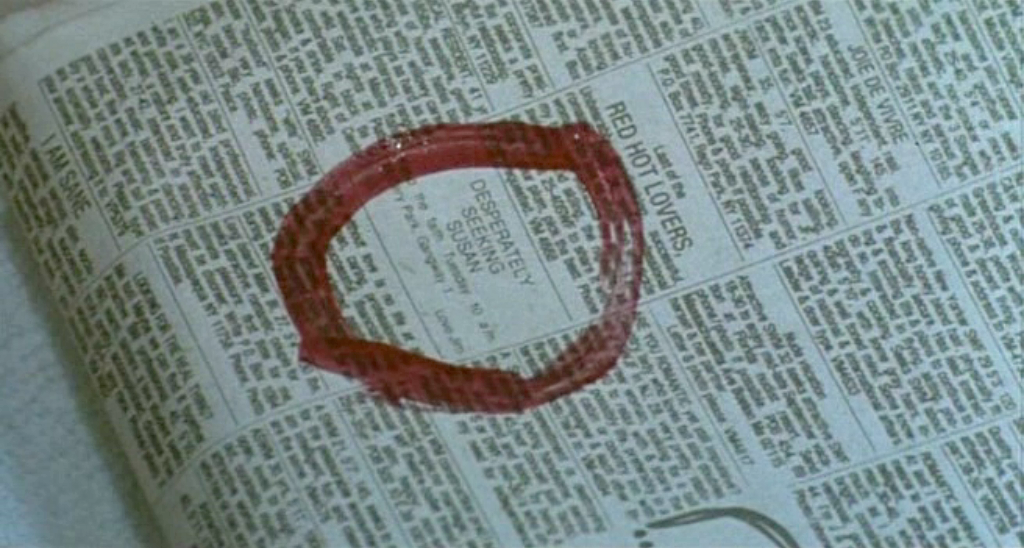
Although Desperately Seeking Susan was criticized at the time for being “sheer nonsense despite the odd, forlorn laugh”[2] and the plot laughed off as “outrageously contrived,”[3] this film, which opened in March of 1985, made a very respectable amount of money on its opening weekend, and ended up as a big hit. The film tells the story of Roberta Glass (played by Rosanna Arquette), a bored and unhappy housewife from Fort Lee, New Jersey, obsessed with the personal ads, and Susan (played by Madonna), a carefree, somewhat promiscuous street-wise party girl, with a penchant for getting in trouble.  After Roberta reads several messages in the paper to Susan from Susan’s lover/boyfriend Jim, Roberta’s curiosity gets the best of her, and she goes looking for Susan, using the personals as her trail. What she doesn’t know is that Susan has gotten mixed up in a criminal scheme that even she isn’t aware of, and Roberta herself becomes enmeshed in the same scheme. After Roberta purchases a jacket that Susan sells to a second-hand shop, and gets a heavy bonk on the head while wearing the jacket, everyone (Roberta included- amnesia works wonders-) thinks that Roberta is Susan. Meanwhile, Susan ends up searching for Roberta, because inside the cast-off jacket is a key, literally, to her whole life which she has left in a locker. The rest of the film tells the tale of their search for each other, a criminal’s search for the stolen goods that “Susan” (really Roberta) possesses, as well as Roberta’s eventual self-discovery (in more than one way), through the very strangest parts of New York City.

Much of the theoretical work that has been done on this film involves ideas of identity, self-discovery, desire and female spectatorship. However, they all seem to hit on one aspect in passing that seems central to the viewing enjoyment of this film: Desperately Seeking Susan is not a “new” film. It is a child of many genres. Be that as it may, it still adds a new element. As Jackie Stacey notes in her essay comparing All About Eve to Desperately Seeking Susan, the central aspect of Susan (like Eve) is that it involves a heroine “whose desires and identifications move the narrative forward.”[4] Karen Hollinger, as well, has noted, “In many ways, Desperately Seeking Susan consciously revises conventions associated with earlier woman’s films.”[5] While other classic genres may have had central female characters, it is not often that an entire film’s progression is dependent upon the woman’s perspective. Due to that factor, we can see that this is where Susan makes liberal use of the genre of the “woman’s film.” Like Mildred Pierce or All About Eve or a multitude of other films in this genre, Desperately Seeking Susan does the precise thing that Mary Ann Doane has suggested is a central aspect of the woman’s film genre: it “obsessively centers and re-centers a female protagonist, placing her in a position of agency…”[6] By looking at the agency that is given to both female leads, we can see that the texture of the film was very much inspired by the desire to create a new film that would (and could) relate to contemporary women. Instead of the melodrama of the early women’s films, the makers of Desperately Seeking Susan replaced it with zany comedy and romance, thus bringing in yet another essential genre: the screwball comedy.

I would argue that the utilization of the female-character-as-driving-force serves as the glue to piece together a film that is essentially derivative of other genres, into a new film that is as self-conscious about its “quotations” as it is about its additive dimensions. However, the genre that is most present within the text of Desperately Seeking Susan is that of the screwball comedy.

Wes D. Gehring defines the screwball comedy of the 30’s and 40’s as possessing “five key characteristics of the comic antihero: abundant leisure time, childlike nature, urban life, apolitical outlook, and basic frustration (especially in relationships with women).”[7] While, for the majority of this discussion, I would ask that Gehring’s definition be opened up to include the term “comic heroine,” his analysis is quite helpful. Comparing Gehring’s definition of the screwball comedy to Desperately Seeking Susan, not only do the creators of the film take pause to recognize the screwball comedy influence[8], but at the time of release, one magazine went so far as to write, “Like the screwball comedies of yore, it [Desperately Seeking Susan] places people in a highly improbable situation and requires that they consult their own sorely tested inner logic to find a way out.”[9] The very fact that Susan came off as a screwball comedy to the naked eye is enough to link it to Gehring’s definition.

Seidelman’s film takes Gehring to an entirely new level, linking it to the strongly feminist discourse that is the backbone of this film. According to the definition, Roberta Glass fits Gehring’s description of the comic anti-heroine in the screwball, to a “T.”  Roberta has an abundance of leisure time (she is a suburban housewife), is portrayed as very childlike (even her husband infantilizes her, patting her on the head, etc), exists within urban confines (the majority of the film takes place not in Fort Lee, New Jersey, but on the crazy city streets of New York), has no overt political perspective (except to remember her real identity, which has a slightly political undercurrent), and is in the thick of an utterly frustrating relationship with Des (played by Aidan Quinn) on one side and Gary (played by Mark Blum), her husband, on the other side.

However, unlike the comic anti-heroes of Preston Sturges’ Sullivan’s Travels or Howard Hawks’ Bringing Up Baby, the idea of a female-centered screwball comedy is somehow revolutionary. All of the assets that we would come to expect out of a male protagonist in one of these pictures come with very different attachments for a woman. Desperately Seeking Susan somehow manages to subvert genre conventions, and flip them on their respective heads. For example, the “leisure time” that Roberta supposedly has, is depicted with a rather ironic twist. From the opening shots of Roberta in the beauty salon to her visit to New York City, she is using her leisure time under the auspices of pleasing someone else: her husband.  It is not her leisure time; it is pointedly his.

Although Roberta clearly enjoys the luxury of the salon, an important section of the conversation there revolves around the fact that, while it is her birthday, she is concerned about how Gary will like her new haircut. Roberta isn’t too certain, as her look reveals. We can see Roberta straining against her confines, even here. The scene, opening up to the strains of a 1950’s girl band singing “It’s In His Kiss (the Shoop Shoop Song),” displays various women in various stages of being “beautified,” from leg-shaving, to nail-polishing, to hair-cutting. Susan Seidelman states,

           Because the film is very much about identity, who somebody is on the outside versus who they want to be on the inside, we decided to open the film in a beauty parlour because that is so much about female identity, and appearance and transformation. I think in the original script the opening was set in a department store…and ultimately, in one of the many rewrites, it was changed to a beauty salon because I think the idea of being remade, which is what beauty salons are about…you go in being one person and you come out hopefully transformed into somebody else, is really the essence of what the whole movie is about.[10]

Thus, amidst the highly feminized world of the salon and amidst reminders of all kinds of superficial beauty, we are introduced to our heroine. It is here that she does two things that solidly state her position in her world (which she reveals is not quite her world after all) and it is here that she begins to, as Seidelman discusses, transform. Initially, she relinquishes control of her haircut, because her sister-in-law, Leslie, and her hairdresser reassure her that, “He’ll love it.” However, it is at this point that she flat-out states her discontentment with her life. Sitting under the hairdryer, we watch as Roberta’s transformation begins.

She sighs, commenting on the love affair that she has been watching develop in the personal ads between two people named Jim and Susan (all the messages begin “Desperately seeking Susan”), “Desperate…I love that word…it’s so romantic…” To which her slightly horrified sister-in-law replies, “Everyone I know is desperate, except you,” and gestures at Roberta. Indignant, Roberta looks out from the hairdryer and says, “I’m desperate!” She is met with peals of laughter from Leslie, to which Roberta responds, “Sort of…” and looks dejectedly back at her newspaper. But the look turns into one that is almost akin to that of a stubborn child being told that they can’t do something: they’ll do it anyways, no matter the consequences. The next shot centers on Roberta’s fingers, holding a blood-red nail polish brush, circling the ad in the personals, with a very steady hand. Thus we have borne witness to the first stage of Roberta’s transformation and the beginning of her attempts to reclaim her own identity, from the people and the situations beneath which she has been living for a long time.

When she goes into the city the next day, Roberta’s husband asks her to pick up the car stereo for him, and remind the clerk that she is his wife, because they get a discount. It is almost as though Gary wants Roberta to remember, as she is leaving the stability of the suburban world for the chaos of New York. It seems that by saying this to her, he reminds her that she is his wife, and his property.  However, this is where the whole situation begins to change. When she reclaims this leisure time as her own, and uses it to pursue Susan, she forgets the car stereo, and, upon arriving back in Fort Lee, timed perfectly to the chicken beginning its twirl around the rotisserie and her housewife-ly duties of synchronized cooking with Julia Childs, her husband inquires about the stereo. This is the point where we realize that Roberta Glass has begun to break free of that ownership. Wearing the jacket that Susan sold to the vintage store and Roberta bought right after, mixing eggs in perfect time to Julia, she reveals to Gary that she has forgotten all about the stereo. She has repossessed that leisure time, both sartorially and actually. It should also be noted that visually, as well, she is the one in control. She is the one the camera follows, and through the different settings there is an evolution. She moves from a location that deprives her of personal power and agency to one where she willfully commands it, based upon personal desire. The personal desire to follow Susan overpowers everything else. That desire is so powerful, that she forgets the car stereo, and with it, forgets Gary’s claim upon her, in order to follow her claim upon herself. We as viewers are drawn into this world, into this location from which Roberta Glass operates, wanting nothing more than for her to escape, and supporting her desires above all else. We are desperate for her to become that “desperate” that she says she is.

Throughout the rest of the film, we are shown a number of ways in which Roberta is breaking free of her stuffy, suburban housewife life. She hits her head while running from the criminal who mistakes her for Susan, after he sees her wearing the jacket that used to belong to Susan. What the amnesia does is serve as a catalyst for the formation of a new and more pleasing personal identity for Roberta. Having to confront the fact that she does not know who she is, Roberta must “find herself.” She thinks she is Susan, being in possession of all of Susan’s personal effects through the locker key she finds in the jacket pocket, not to mention having people consistently mistake her for Susan, as a result of the jacket.

As we have seen, from the very beginning of the film, Susan is Roberta’s polar opposite. She is sexually liberal, streetwise, and self-assured. More importantly, from what we can see, Susan is also a great deal happier than Roberta. Roberta’s amnesia and subsequent quest for her true identity while thinking (and acting) as if she were Susan, becomes our way of seeing that Roberta’s emancipation from her life lived for others can only be achieved through her own self-discovery, even if it is through someone else’s “identity.” How can she escape Julia Childs and a husband who basically ignores her? She must leave it all behind, and become someone else, even if it is not intentionally. As Karen Hollinger succinctly states, “Roberta’s temporary assumption of Susan’s identity as a result of her amnesia allows her to merge with her ideal and experience a psychological rebirth. She finds a new identity by introjecting the positive qualities she finds in Susan into her own personality.”[11]

Frank Capra, a director of many screwball comedies, said that he used comedy to “warm people to my subject…I get them in the spirit of laughter and then, perhaps, they might be softened up to accept some kind of moral precept.”[12] The creators of Desperately Seeking Susan utilized this same method. It is a very funny film, but the message behind it cannot be ignored or denied. The feminism that may not have seen the light of day in the cinema of the 70’s is vibrant and alive with Arquette’s Roberta and Madonna’s Susan. It is a disruption of the traditional view of woman as homemaker, and a forced recognition of woman as full-fledged person, unto herself. This commanded viewpoint was done, a la Capra, through the use of casual humor and relaxed laughter.

Andrew Kopkind noticed that Desperately Seeking Susan was a film that was definitely communicated in “classic Hollywood forms. Leora Barish’s script contains all the ritual elements of farce, even to the obligatory climax where all the significant characters arrive in the same room to sort out the confusion…[but] neither she [Roberta/Arquette] nor Madonna [Susan] is redirected to a conventional existence, which is the way farces usually end…it is unmistakably a woman’s-eye view…”[13] The acknowledgement, then, is that this film, while standing on the shoulders of well-loved and received standards, is creating new standards of its own. Without changing the formula of what makes a screwball comedy pleasurable, Desperately Seeking Susan pulled a “Capra” and inserted some truly important things to think about, in between the laughs and the ridiculous nature of the plotline. And, after a decade of boys celebrating school being out, it was high time the girls hit the playground, and hit the playground they did.


[1] A Decade Under the Influence. Dir. Richard LaGravenese and Ted Demme. 2003. DVD. Independent Film Channel/Docurama/New Video Group, 2003.

[2] Simon, John. “Desperately Seeking Susan.” National Review 37 (1985): 48-50.

[3] Kopkind, Andrew. “Desperately Seeking Susan.” The Nation 240 (1985): 568.

[4] Stacey, Jackie. “Desperately Seeking Difference.” Feminism & Film. Ed. E. Ann Kaplan. New York: Oxford University Press, 2000. 450-464.

[5] Hollinger, Karen. In the Company of Women: Contemporary Female Friendship Films. Minneapolis: University of Minnesota Press, 1998.

[6] Doane, Mary Ann. “The Woman’s Film: Possession and Address.” Home is Where the Heart Is: Studies in Melodrama and the Woman’s Film. Ed. Christine Gledhill. London: British Film Institute, 1987.

[7] Gehring, Wes D. Screwball Comedy: A Genre of Madcap Romance. New York: Greenwood, 1986.

[8] Commentary track. Desperately Seeking Susan. Dir. Susan Seidelman. 1985. DVD. MGM Home Entertainment, 2000.

[9] Author Unknown. “Beautiful Dreamer in a Minefield- Rosanna Arquette.” Time 1 April 1985: 76.

[10] Seidelman, Susan. Commentary track. Desperately Seeking Susan. Dir. Susan Seidelman. 1985. DVD. MGM Home Entertainment, 2000.

[11] Hollinger, ibid.

[12] Frank Capra, quoted in Schiekel, Richard. The Man that Made the Movies. New York: Atheneum, 1975.

[13] Kopkind, ibid.

Sam Fuller: Cinema of Conflict and Contradiction

It is currently June, 2011.  I’m almost to the 10 year mark of when I graduated from UC Santa Cruz.

When I was at UC Santa Cruz, I did the normal school thing, but I also wrote for a film magazine called EyeCandy. It was a fun little journal, just a few of us, and I was really able to introduce folks to cinematic areas that they may not have encountered before.

While we were separated for a spell, I am glad to have “hooked up” again with writing as my primary partner. It’s a good one. While film will always be my boyfriend, writing about film makes a good life partner for me.

One of the things that came up recently around the internet was the screen test that Sam Fuller did for The Godfather part II.  When that came up, I realized that I wanted to go back and reread the article I had written for EyeCandy on Sam Fuller oh-so-many-years-back…see how it held up and IF it held up. All I remembered about that time period of my life was being very passionate about Fuller and having most other film students I knew being extraordinarily passionate about, oh, Kevin Smith or (if I was lucky) some of the more interesting queer film makers like Tod Haynes.

In any case, back in 2001, I was a one-woman-Sam-Fuller-conversion-machine. So…I wrote a silly article to try to educate people and cajole them into joining Team Fuller. Do you know HOW  many arguments I had over the naming of Short Round in Indiana Jones? Yeah, sorry boys at UC Santa Cruz in the late ’90’s/early ’00’s, SOMETIMES girls can be right about films involving your geek heroes. *ahem*

Maybe you’ve read the other stuff on here, maybe not. In any case, here is what my writing looked like back in the Spring of 2000. I have added some pictures (because I can), but otherwise, I’ve left it essentially unchanged. In a sense, I am also using this space to archive my own writing and past work. Hey man, my blog, my rules.

While I edited a little bit for grammatical errors that my own conscious could not abide with the publication of, I would hope that you would be slightly kind…I did write this 10-ish years ago. It’s not terrible, but it’s not something I would hand to Fuller himself. Aside from Billy Wilder, when people ask me who my favorite director is, I think I would have to say it’s this guy right here. When I found him in my late teens/early 20’s,I got obsessed. He uses some of my favorite actors, introduces me to new ones, screws with people’s concepts of what things should/shouldn’t be, and does what he thinks is right. His ethos is strong and, most important of all, entertaining. And as an added bonus, he has some really kick-ass women characters! So here you go. Enjoy the way I tried to introduce Santa Cruz to Sam Fuller.

I wish I could get a larger size of this, but this was the cover for one of the magazines. Not bad, eh?

“You can’t show war as it really is on the screen, with all the blood and gore. Perhaps it would be better if you could fire real shots over the audience’s head every night, you know, and have actual casualties in the theater.”—Sam Fuller

Sam Fuller was a real American. He was a reporter and he fought in the war. He was also, however, a filmmaker. Within his chosen cinematic occupation, he worked towards the portrayal of the country he killed and could have died for. He was extremely patriotic. However, Fuller’s patriotism worked in a very different way than the traditional stars-and-stripes, Fourth-of July barbecue patriotism. Sam Fuller worked to rupture America open, and show what was really inside: the contradictory situations portrayed in his films only exposed the deep-seated issues that lie within American society, but are not polite to discuss. But Fuller was not polite about it either. It has been written about Fuller that he “doesn’t flatter his audiences; he rubs our noses in our own dirt.” One could not mistake a Fuller film. He has an exceptionally unusual style of filmmaking, especially for the time.

One of the most fascinating issues about Sam Fuller is the question that comes up every time when viewing his films: How was he allowed to make that?  For the 50’s and 60’s, Fuller’s films were exceptionally radical, and decisively individual. In a time where almost everyone else was being forced to homogenize their films, Fuller was a complete anomaly. One possible explanation is that his films were primarily “B films”. As a result of that reduced budget and economized shooting schedule, that may explain why he got away with everything he got away with. As well, it must be considered that mainstream Hollywood saw “B” films to be merely secondary cinematic fodder alongside the “A-list films”, opening up opportunity for a great deal more personal expression.

A Sam Fuller film can deal with anything from pedophilia to racism, interracial romance to insanity. His stories were unique in their dealings with women, as he portrayed them as sexual free agents, as well as independent heroines who were not about to “wait around.” He utilized Asian-Americans as real and central characters within his films, instead of portraying them as ethnic stereotypes.

This was still a major revolutionary narrative for the time. CRIMSON KIMONO (1959)

In Crimson Kimono (1959), we can see a perfect example of the ways in which Fuller plays with racism and our own socially constructed stereotypes and expectations. The plot is that of a Japanese-American man and a Caucasian man who fought together during the war, and became inseparable friends as a result of one saving the others life. They return to the US and get an apartment together in LA and become private investigators. The twist in the film comes when they both fall in love with the same Caucasian woman, and she, in turn, falls in love with the Japanese-American man. Pretty weighty stuff for 1959! Not only does this deal with the extremely controversial topic of interracial romance, but it also is a forerunner of the ideology within Sam Fuller’s films that woman should have the same freedom sexually and romantically as men. They should be able to choose, not be chosen.

Fuller’s filmmaking style and plot development are a cinematic war being waged against the things within society that are accepted but are unacceptable. The Fuller landscape is harsh and confusing, placing emphasis upon the aspects of the world that require a more in-depth consideration, such as race, the role of women, and corruption.   It is an offensive action, striking against social mores, and traditional roles.

Fuller’s cinema is one that is overtly contradictory. But he utilizes those contradictions in order to point out the traditional concept of things not always “being as they seem.” However, Fuller’s films are anything but traditional. His characters vary from strippers and prostitutes to journalists and soldiers. The one commonality that most of his films seem to contain is the alternative portrayal of corruption. In his films it is the strippers and thieves that are ethical and good, and the policemen and other “uprights” that are morally bankrupt. This is accurate about every film he has made. In Naked Kiss(1963), it is not the prostitute who is the corrupt, evil force, it is the very paragon of society within the town, and he’s capable of some pretty nasty stuff!

Fuller is the master of irony. In Shock Corridor (1963), a film based primarily within a mental institution, the main character is a journalist who is obsessed with winning the Pulitzer prize. In order to do this, he gets himself committed in order to investigate a murder that occurred within the asylum walls. While inside, he meets the main witnesses of the crime. The first one he meets is Stuart, a young man who, in the outside world, became involved in the Communist party due to his participation in Korea. However, he was placed in the institution because he is no longer involved with Communism, and he was dishonorably discharged due to his affiliation with Communist influences so…he now thinks that he is a general in the Confederate army!

I know why I went over to the commies— ever since I was a kid my folks fed me bigotry for breakfast, and ignorance for supper.

Then he meets Trent, a young man who was one of the first people in his area to be placed into the situation of racial integration in his school.  Tragically, he cracked under the pressure. This young African-American student thinks that he is a leader in the Ku Klux Klan.

In films like Naked Kiss (1963), and China Gate (1957), Fuller gives unusual depictions of strong, independent women, who were allowed to be sexual without being punished for it, and were not ashamed of any of their actions. They took these things in stride, and never required help from a man, because they could do it by themselves. Once again, Fuller called it as he saw it, knowing that this was the “unacceptable” ideology of the time, but knowing that it was the reality of the situation.

Fuller said that camera movement, and actors’ movement was inconsequential, and “what matters is that the emotion of the audience should move…” In the end, it is really up to the viewer to let the film take its effect. His films revolve around making you think about and question realities and truths. He states that this battle is endless. At the end of a few of his films, the closing titles read “the end of this story will be written by you” or “this story has no end.” This intelligent Fuller ambiguity only serves to have the pin pulled out and the grenade thrown to you.

To Hell With You: Blazing a Trail Through Hollywood with John Constantine

Seeing that it is now June and Comic Con is nipping at my writerly fingertips (as it does every year), I figured I would drag one out from the vaults to entertain and/or annoy you all with.

For the last 5 or so years, I have been a participant in the Comic Arts Conference, which is kinda like the Red Headed Stepchild of the Con. We don’t consider it that way, of course, and anyone who is interested in the academic side of the comic book world wouldn’t see it that way either, but anyone who spends the night outside the convention center in hopes of catching a glimpse of a sparkly vampire could really care less that many of us pour a goodly amount of time and energy into these papers. After all- it is an academic conference.

In any case, what I am presenting for you here is the piece that I wrote for the panel I was on in 2007.  I remember liking it. In any case, my opinions haven’t changed much so…here you go- now you too can feel like you were there…minus the crowds, the smelly fankids, and the overzealous everybody. Enjoy!

He’s been compared to James Bond, Phillip Marlowe, Mike Hammer. Critics have described the film as everything from “a clever fantasy/horror noir with a dash of broad comedy,” to one that “lacks the richness of its source material” and is “entirely beyond redemption.” Whichever way you slice it, the 2005 filmic adaptation of John Constantine: Hellblazer seems to be quite a source of discussion and debate, whether or not you were even a fan of the comic. It is common knowledge that all comic to film adaptations go through many stages on their way to becoming their own media object . Whether the parent text is used exactly or whether it is paraphrased, one can usually see the skeleton of the originating document underneath any new additions. Sometimes, however, when a given filmmaker is dead set on extricating him/herself from the previous incarnation of the work, the adaptation can lead to a obscuring of the source material, causing a rift to grow between that which was adapted and the adaptation itself. Director Francis Lawrence’s desire to create his own version of John Constantine and the universe in which he dwelt overshadowed his ability to portray a character that maintained any veracity to the original work. While some amount of this is to be expected, Lawrence’s methodology for addressing John Constantine led to a film that not only removed the character’s cultural trappings but also eradicated his larger theological basis. In doing so, Lawrence erased the things to which every author of Hellblazer had remained loyal to throughout the entire comic book series, thereby creating a character that was decidedly not John Constantine.

I have been working with filmic adaptations of comics for the last several years. Through the careful study of production methodologies, narrative changes, and textual similarities how smooth the transition from comic text was (or was not) became more apparent. The overall success of each film as compared to that of its progenitor is a key ingredient within adaptation analyses. However, the longer I studied Constantine, the more I found myself unable to defend it as a valid interpretation of the comic book. Not only did this movie willfully exchange the narrative complexities and character depth in the comic for easily digestible storylines and generic protagonists, but it also blatantly lifted items from another film in order to fill out the less, shall we say, “full” areas. By leaning heavily upon previously established film iconography and reformatting the substance of the comic book text to match, the writers and director of Constantine created a new media object that cast out all substantial elements of the initial comic and produced what could only be called a ghost-adaptation.

NO TRENCHCOAT, NO ACCENT, NO SERVICE

Locating the film within US confines instead of the UK was a change, but it really wasn’t that much of an issue. After all, it had been done countless times within the comic book with little to no detraction. However, changing John Constantine into an American freelance exorcist, who stockpiles Judeo-Christian weaponry, and doesn’t make a habit out of hustling, witchcraft and trickery as daily routine was more than slightly ridiculous. As far as the comic was concerned, no matter who was writing or drawing him, John Constantine was none of these things. In making these alterations in his career and religious orientations, John Constantine was changed from the protagonist seen in the comic book Hellblazer to a new character, one that was invented specifically for the screen that shared little more than the name.

However, it was something else entirely that created the ultimate disparity.  To add insult to injury, this film committed the cardinal sin against a comic book character: they erased his history. What if Superman had not come from a different planet? What if a spider had not bitten Peter Parker? Either situation is analogous to what the creators of this film did to John Constantine. While it is essential in adaptations to “edit” the parent text for time and cinematic rhythm, it is not essential to completely alter or eradicate it. Sure, Constantine’s history is very involved and can’t really be boiled down to a single incident like a spider bite (unless you count Newcastle!). But just because a character has a complex background doesn’t mean that you throw the baby out with the bathwater!  Changing Constantine’s story to one that damns him to hell because of a suicide attempt as a teenager, changes his entire character, pathology, and situation. While it could be said that this was simply an attempt to save time and “edit” the comic to fit its screen counterpart, I would argue that the erasure of John Constantine’s history reveals a slightly larger problem: the erasure of his identity, period. The character played by Keanu Reeves in the film, is not the character within the pages of the comic. By taking him out of the UK, and making him an American with a whole new background, the wedge between comic book and film is driven deep enough to make it irreconcilable.

Made by the same man who gave you Britney Spears’ “I’m a Slave 4 U” video and Jennifer Lopez’ “Waiting For Tonight,” the film version of Hellblazer was certainly updated quite a bit from the comics. As the director himself stated in one of the documentaries on the DVD, “[Constantine is] based on a comic book, but I didn’t want it to feel like a comic book movie.”[1] Unfortunately, this may have been his biggest downfall. Frankly, it wasn’t about John Constantine’s trench coat and aesthetic, nor was it about his country of origin. Both things could have been worked with, and perhaps forgiven to an extent. However, as it turns out, in this circumstance, playing with those items was like playing with fire. Lawrence’s desire to dissociate himself from the text that he was supposed to be drawing his inspiration from left him empty-handed, causing both the film product and the source material to suffer from this decision.

In the introduction to Garth Ennis and Steve Dillon’s Hellblazer: Fear and Loathing (issues 62-67), Warren Ellis makes a solid point about John Constantine as he is portrayed throughout the entire comic book series, no matter who was writing or drawing him.

Frequently painted as a mystic investigator in some kind of bastardized Chandlerian tradition…John is one of horror fiction’s more complex characters…Since his creation, John Constantine has gone from the young English occult wideboy of Alan Moore’s initial vision to the troubled and aging adrenaline addict of Jamie Delano’s bleakly poetic writing…The strength of the character, that has him remain so clearly the same man even when viewed through two or three different writers’ eyes, is that he is a terrific mouthpiece for anger.[2]

While I believe that Ellis’ simplification of Constantine as a “mouthpiece for anger” tends to be a bit reductive, his underlying analysis is spot-on. John Constantine has been written and rewritten by no less than 10 different authors. While each of these individuals showcase different qualities of John Constantine and his varying desires/pursuits/intentions, at the end of the day, they all remain faithful (more or less) to the basic skeleton built by Mr. Moore back in 1985. Even Brian Azzarello, when he took up the reigns of the comic upon Warren Ellis’ abrupt departure noted that while his own approach to comic book writing wouldn’t change, his portrayal of John Constantine would require extra conscientiousness. “I’m going to have to be sensitive to this guy’s past,” he stated in an interview with Sequential Tart, “Readers have expectations with Constantine; if I don’t deliver they’re going to scream foul. Not that I’m not going to toy with those expectations, but at this point we know who he is, and what he’s capable of.”[3]   Azzarello, an American writer who excels at noir-type fiction, knew that “you can take the boy out of England, but you can’t take England out of the boy.” He knew that a character that was so deeply British would suffer enormously from any dilution of that cultural heritage.

Even with that in mind, John Constantine’s Britishness made it more challenging for anyone who was not British to write the comic. Brian Azzarello’s run tends to be a good example of this, as his portrayal of Constantine did suffer slightly from what seemed to be his own unfamiliarity with British culture. While the storylines were excellent, his attempts at accented dialogue were forced, and his American characters were far more fleshed out and confidently written than his protagonist. Where his American characters were expressive and extroverted, speaking freely and often, Azzarello tended to keep Constantine silent and stoic, qualities that he never really possessed in his previous incarnations by British writers. The discrepancy between Azzarello’s quiet and reserved Constantine and the more aggressive and loud American characters seemed to signify something more than a narrative choice. To a certain extent, it seems that Azzarello might have been slightly uncomfortable with bridging the nationality gap with Constantine’s dialogue and cultural components, causing him to take less chances with the character.

Considering that Azzarello himself is not British, and that, as previously stated, he wished to remain as faithful to the character as he could, Azzarello’s choices made a good amount of sense. However, they were also very revealing in a cultural capacity. Azzarello’s run was indeed a fascinating look at how one might interpret a foreign culture and attempt to negotiate it within the terms that you, yourself, are intimately familiar. Unfortunately, at the end of the day, the portrayal of John Constantine did suffer as a result of his silence and non-participatory stance, whereas the American characters in that run truly triumphed.

Within the comic book’s infancy and adolescence, the reader is reminded, over and over, that the protagonist is an incredibly culturally entrenched persona. John Constantine’s northern accent, working-class persona and addiction to Silk Cut cigarettes speak of a certain “Britishness” that, to be fair, would be almost impossible to translate onto American soil.
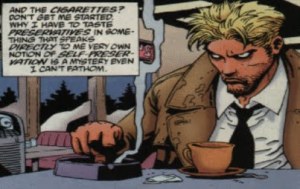
Azzarello attempts to negotiate cultural difference using cigarettes as the tool. Clearly, Constantine is not not a fan of the ones in the US.

Beyond his own affectations, certain famous London pubs and general British landmarks and cities consistently find their way into the visuals, populating the comic with innumerable reminders that John Constantine is unmistakably a Brit. From stories about football hooligans to his travels to see his family in the north, the geography of John Constantine is as much part of his identity as his bad attitude and knack for hustling everyone from his own pals to the devil himself.

By editing this character’s physical attributes, sartorial expressions, and homeland, the film adaptation makes his identity into something different and diluted. It is almost as if the name “John Constantine” has simply been reappropriated to fit a dark, brooding American who smokes too much and can see ghosts. Upon being asked about the aesthetic and nationality changes that were made for his role in the film, Keanu Reeves told Dark Horizons[4] that as far as he was concerned, the only change that was really made about the character was hair color and accent. Unfortunately, it should be noted that this was also a statement made by an actor who told Wizard magazine that he had only “read sections” of the comic books, and “looked more towards the script that I had. Most of what I’ve gotten has come from having a feeling of who Constantine is inside.”[5]

Ideally, seeing who the character is on the inside should be enough to give a fair portrayal on screen, no matter how bad the actor or the acting. On the other hand, not reading the original text is clearly going to buy the character a one-way ticket to Hell, pun intended. On the other hand, if Keanu was simply looking towards the script for inspiration, this means that the fault lies primarily with the writing and not with his apparent disregard for the parent text. The distancing from “comic book movies” that Francis Lawrence had desired made its way into the script, as well, causing an even greater disparity between texts as the actors gauged their performance by what was given to them within the pages of the multi-authored film layout, not with that which existed in the original work.

With additional items that were changed in the script, there was no way to avoid having a film that was barely even shaped by the Hellblazer series. Alongside the cultural amputation in the character, the script itself was an indiscriminate muddle of parts, few of which were from the comic text or original writing. Through the commentary of several actors who readily admitted that they used only the script for reference and had never picked up the comic at all, we can see that the diegesis progressed by the script failed to convey the kind of “spirit” of the comic that Francis Lawrence and the writers talked about wanting to capture. The narrative changes that were made as well as the multitude of alterations to John Constantine himself served to distance the film from the comic book in approximately the same fashion as Lawrence wished to distance his film from the rest of the “comic book films,” which is to say Far Too Much for it to retain the kind of fidelity it desperately needed.

THE EXORCIST REDUX: “THE POWER OF HOLLYWOOD COMPELS YOU!!”

A good portion of my research does involve looking at the natural connective tissues that are formed in comic to film transitions, such as those I have found in films like Hellboy and Sin City. As I studied Constantine and its companion piece, Hellblazer, I was unable to find the same kind of organic growth as I did with the aforementioned comics and films. Instead, what became more and more apparent with each subsequent viewing and reading was that this film interpretation not only struggled to dissociate itself from the comic book, it attempted to align itself with the properties and narratives more befitting the generic restrictions of religious horror films of the 70’s, in particular William Friedkin’s film, The Exorcist. This departure from the comic book made the film version of Hellblazer resemble a remake more than it did a comic book adaptation. As a result, its position within the world of comic-to-film-adaptations is highly questionable, and can be seen as yet another attempt at using a newly popularized genre to try and make a few bucks. Tragically, this comes at a very high cost to the integrity of the actual work, and the trajectories of the comic book series as a whole.

Lawrence’s work may fit into the genre of “comic book movies,” but that identity can only go one of two ways. On one hand, the adaptative identity can be good; it can emulate a type of cinematic hypertext, leading the viewer back to the source material, and perhaps creating new fans or refreshing the memories of old ones. However, on the other hand, this identity can be that which conforms to its own generic restrictions. In this case, as Gerard Genette has written, the piece will, like a genre itself, proceed  “by contagion, [or] imitation, [it has] the desire to exploit or modify a current of success and, as the vulgar phrase goes, ‘jump on the bandwagon.’”[6] Thus, when producer Lauren Shuler-Donner stated that upon receiving the script she saw an opportunity to make a “very classy classic horror film like The Exorcist,”[7] she was basically already mapping out the film’s fate. Donner and the screenwriters wanted to “capture the spirit” of the comic book within the confines of a big-budget horror flick. The director wanted the film to bear a resemblance to the primary text, but not feel like a “comic book movie.”  With that in mind, we can see exactly how this film traveled down the darker path of exploiting both the horror genre as well as the comic book genre.

Director Lawrence pursued the adaptation of this comic through a long standing cinematic horror tradition mixed with a desire for wide public consumption; a methodology that the comic book writers involved with Hellblazer couldn’t have been less concerned about. They stayed true to horror, as it was a horror comic, but they could have cared less about “making it big.” They just wanted to keep telling a great story. Tragically, what the film did was perform a highly publicized castration on the parent text, leaving the most crucially important aspects within the comic and lifting only that which could be digested by the American public within Judeo-Christian terms- ironic for a comic primarily about magic and things of the occult nature. Lawrence’s film simplifies the Constantinian universe to one singular battle between good and evil- heaven and hell- God and Satan. In doing so, the foundation of the original text is transmogrified and refocused. Instead of looking critically at the institution of religion as a whole (like Hellblazer did and still does), the film Constantine only involves Judeo-Christian (in particular, Catholic) theology.

If anyone were to doubt this film’s trajectory, they need only watch the first appearance of John Constantine. Our protagonist’s entrance not only confidently casts him in a role traditionally belonging to Catholic teachings, but also allocates this scene, visually and thematically, to another, widely familiar, cinematic instance. In this scene, we bear witness to a young girl with long stringy hair wearing white or lightly colored nightclothes. Previously seen climbing the ceiling, she is now tied to her bed, writhing and speaking in growls and snarls and a demonic tongue. Constantine enters the girl’s room, and, after a few attempts, finally exorcises a demon from the body, leaving her previously evil and distorted countenance to relax back into that of an innocent; no longer the vessel for a predatory demon.
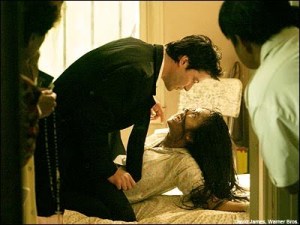
You don’t need to have read Hellblazer to recognize this scene, after all- it’s not in the comic books. Within this dramatic opening, you have the very basic component parts of the beginning exorcism scenes in William Friedkin’s The Exorcist. The significance of this is immense. Not only is John Constantine being posited as a surrogate Father Karras, but he also produces the same result: the casting out of the demon from the young girl’s body, and her return to innocence. While Constantine may perform certain exorcism-type activities within the Hellblazer series, none of them come anywhere close to the way that this one is visually or thematically represented. This scene includes enough familiar horror iconography so as to “jump on the bandwagon” and attempt to include a wider audience who may not be familiar with the comic, but are all-too-familiar with the now cliché Exorcist schema.

In his book, The Satanic Screen, Nikolas Schreck identifies Friedkin’s film as a

“big-budget Bible-thumper,” a title that could easily be applied to Constantine as well. Schreck’s main criticism was that Friedkin positions Woman as “literally the gate to Hell.” (Schreck, 169) While the female body has been used time and time again as the vessel for horror (see practically any Cronenberg film for further reference), Francis Lawrence’s Constantine utilizes the female body in much the same “gateway “ role as Friedkin. Not only is there the opening exorcism scene, but also the remainder of the film centers on a Catholic female, Isabel, who has seemingly taken her own life. In doing so, she has used her body to engage with Hell. Suicide, according to Catholic doctrine, damns Isabel to eternal hell, and means she cannot be buried in sacred ground. The film follows Isabel’s sister Angela (played by Rachel Weisz) as she enlists John Constantine’s help to try to prove that her sister did not in fact commit suicide and therefore deserves a good Catholic burial.

This very narrative substantiates Schreck’s argument, and makes Constantine a definite competitor for the “big budget Bible-thumper” contest. While the opening of the film is meant to establish Constantine’s religious identity, the more thematic and stronger correlative comes at the end, making these two scenes like bookends, sandwiching the film into the familiar Friedkin terms.

As the film gets ready to head into the final confrontation between good and evil, we are confronted with another “situation.”  Through a series of incidents involving the Spear of Destiny and Mexico, Angela has now become possessed. Once again, an exorcism is needed. Constantine begins the exorcism; laying hands on Angela, with his young apprentice Chas looking on. Within the comic book, Chas is a character about 20-30 years older than he is in the film, and he couldn’t care less about anything mystical or magical except for possibly trying to decipher where he might find a good pint. In Lawrence’s interpretation, he is approximately 20 years younger than Constantine, with an eagerness and fan-doration for Constantine that would leave most Harry Potter lovers in the dust. However, the way the two characters are positioned in the film is not unlike the way that Father Karras and Father Merrin are positioned, age difference included, in The Exorcist.

As the exorcism continues, it becomes clear that Constantine needs assistance, as Angela’s belly is looking like it might repeat a scene from Alien. So the young apprentice begins to chant along with his mentor, their voices rising in volume and power. The exorcism continues, an older and a younger exorcist, combining their powers to banish Satan from the body of the innocent Catholic girl.
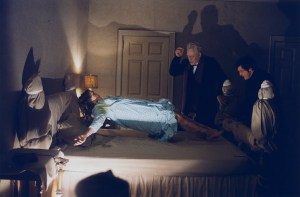
The cadence of their voices practically mirrors that of Father Damien Karras and Father Lankester Merrin in the 1973 film. In those final thrilling scenes of Friedkin’s piece, the possessed young girl is eradicated of her demons by the powers of actors Jason Miller and Max Von Sydow repeating with increasing volume, “The power of Christ compels you! The power of Christ compels you!” and chanting over her body with all their might. Eventually, the spirit is exorcised from little Regan and inhabits Father Karras, who, in a final act of self-sacrifice, throws himself out the window in order to exterminate the demon from the innocent form and the mortal plane. Poor guy… No one told him there would be sequels…

Karras, the younger priest, and Chas, the apprentice, are parallel characters in that they both provide a central act of self-sacrifice in the face of evil. After Constantine and Chas succeed in ridding Angela of her demons, so to speak, Chas looks up at Constantine and smiles broadly. “We did it!!!” he exclaims, with great joy, at which point we are witness to his body being suddenly torn away from Angela and Constantine, and smashed again and again and again into the ceiling with great invisible force, and dropped to the ground like a rag doll. Just before Chas expires, however, he has the opportunity to utter the most unintentionally appropriate line in the whole film. He looks up at Constantine who has run to his bleeding and broken body, and says haltingly, “It’s not like the books, is it John?” To which John replies, “No, Chas, it’s not.” Although this was referring to a previous conversation the two characters had had, what this line really does is give a full disclosure of how this film, with its familial ties to other films and divergent issues of faith and culture really is “not like the books.”

We have cast John Constantine in the bifurcated roll of exorcist as well as Judeo-Christian representative. Through this introduction, and a little boost from a film so well recognized as to become part of common parlance and culture[8], the character of John Constantine is marked within a set of primarily Catholic terms. The problem of this demarcation is that this is not who this character has been defined as, within the pages of the comic. In fact, this definition is about as far from Hellblazer as you can get. Indeed, as one fan of the comic noted in an online forum discussion,

John Constantine has given the Judeo-Christian god the finger, outwitted the devil on his own battlefield, pissed on the king of vampires in a drunken victory, and can con any man into giving him a smoke. That is who John Constantine has always been. True, he may have sought small redemptions. After all, he is human. But the…storyline depends so much on mythos other than that derived from the Judeo-Christian point of view.[9]

BETTER THE DEVILS AND THE ANGELS YOU KNOW

The Hellblazer universe, borne out of Alan Moore’s run of Swamp Thing, was never meant for such reductive measures as were given by the film. Yes, it is a comic text that wheels and deals in religious iconography. In fact, any given run contains more religious issues than an episode of the 700 Club. However, unlike that show, it does not concentrate on religioN, it concentrates on religionS. Where Lawrence went monotheistic for the sake of easy audience digestion, the multiple authors of Hellblazer went pluralistic, indicting and exploring any aspect of the larger concept of capital “R,” Religion that they saw fit to print. Hellblazer was impartial when it came to the treatment of religion and spirituality. Linking Margaret Thatcher and demon yuppies in one story, discussing figures from Chilean folklore like the invunche in another, and following witchcraft-bound killers in yet another, John Constantine had no proclivity towards any particular brand. Thus, by casting him in the role of freelance exorcist/ Father Merrin surrogate/ Catholic superhero, the foundation and real substance of the comic is eradicated, leaving nothing but a phantom of what had previously existed.

So, in the end, what happens when you base your film on a theology and religious narrative that is so disparate from what this character has ever been or done in the originating material?  The answer can be found within the pages of the film reviews. To use one of the oldest and most easily accessible stories within our myth-laden culture, the battle between good and evil, may be easier, but it is also lazy. And the laziness showed. Very few reviews from this film were positive, whether the writer had read the parent text or not. Sure, the establishment of a protagonist that plays to what Max Braden called “Catholic Rules Sinball”[10] creates an easy entrance to the film for a non-comic-reading public. However, in the end, it hurts the cinematic translation as well as the comic book world. Indeed, as Barb Lien-Cooper accurately observed,

    Bad reviews of comic book movies reflect badly on all comic book movies and, by a VERY slight extension, all comic books. When you read the reviews of Constantine, notice if and when the critics talk about the fact it’s a comic book…The easiest way for the comic book boom to go bust is to produce movies that make the public feel that all comics must be as bad as the movie adaptations. We can’t coast on the good will of the Spider-man movies, the two X-Men movies, The Road to Perdition, Ghost World, and American Splendor forever.[11]

And she’s right. Creating a ghost-adaptation like Constantine is not only damaging to the newly-established genre of comic book films, a genre only now able to start exploring its capabilities, but it also endangers the comic book community at large. Indeed, if it has taken us this long to establish ourselves as “real literature,” a film that erases the truly admirable aspects of the comic book is only going to make the struggle for recognition that much harder.


[1] Lawrence, Francis. Special Features “Conjuring Constantine.”Constantine. DVD. Warner Brothers, 2005.

[2] Ellis, Warren. Introduction. “We Never Liked You Anyway.” in Ennis, Garth. John Constantine, Hellblazer: Fear and Loathing. New York: DC Comics, 1997.

[3] Vega-Rasner, Lauren. “Blood Letters and Badmen: Brian Azzarello.” Sequential Tart. Volume 2, Issue 8. August 1999. http://www.sequentialtart.com/archive/aug99/azzarello.shtml

[4] Franklin, Garth. “Constantine: Set Report.” February 20th, 2004. http://www.darkhorizons.com/news04/const2.php

[6] Genette, Gerard. Palimpsests: Literature in the Second Degree. Lincoln: University of Nebraska Press, 1997.

[7] Shuler-Donner, Lauren. Special Features. “Conjuring Constantine.”Constantine. DVD. Warner Brothers, 2005.

[8] Films such as Scary Movie 2 and Repossessed as well as TV shows like “The Simpsons” and “Saturday Night Live” have all make liberal use of the original Friedkin film.

[9] Big_chris, “Constantine” http://www.popcultureshock.com/reviews.php?id=3882, accessed November 11, 2006.