GIRLS JUST WANNA HAVE FUN: Professional Wrestling and the Female Fan

Hello!

So in the mid-2000s I was in graduate school for the first time and I wrote a paper that I REALLY loved on a subject that I REALLY loved (and still do) and made the wonderful choice to submit it to a highly esteemed international conference on feminism and television called CONSOLE-ING PASSIONS and they accepted it. I had just graduated at that point and I was high on academia like a 90s raver on Ecstacy. But, as Frank Sinatra said, I was going to do it MY WAY. That probably cost me the PhD stuff that I was applying for, but looking back on the whole thing, I’m not sure if I have any regrets. I love how my life has gone and I have produced some incredible things & work in my career so far. I’m blessed.

THAT SAID, this piece is my favorite piece that I did in my Critical Studies (now called Cinema and Media Studies) program at UCLA. I got me a nice MA sitting on my desk and I *loved* doing this paper. Every day was bliss. Talking to these women, getting to know them and their stories…I guess I shoulda known then that I would be some kind of oral history & documentation whore at that point, but this paper is still something that I hold with more pride than almost anything that I have ever done & the only thing that I regret is that I never submitted it for actual publication in a journal. Some of the details now are out-of-date so it is no longer a relevant paper (this is the way that wrestling goes…cie la vie!) but I submit to you that my theories- in particular the Discourse of Disgust and Viewing Transvestitism are as fresh and useful today as the time they were written back in 2005ish.

Of note:

1) This is an academic paper and not *technically* published in a journal but if you wish to use or quote ANYTHING AT ALL…ASK ME FIRST!!!!!!! It’s the nice thing to do. Don’t plagiarize. This is my baby. I worked really hard on this.

2) All interviewee names have been changed, with the exception of those who gave me explicit permission to use their real ones.

3) Enjoy the hell outta this. I love it & it fills me with happy feelings to know that I made it. It’s long, but I think it’s good. Ladies love the wrasslin’! It’s a true thing!!! ❤

4) Be somewhat kind…I wrote this a while ago…not sure if my work has gotten better or worse, but if it’s not entirely sound, I was in my 20s. Forgive?

************************************************************************

In the early 1950’s in America, when the Cold War was in full effect, Joe McCarthy and company were running Hollywood, and everyone who was anyone had credit, a brand-new refrigerator, and a ranch-style home, Bess Truman was asked what she would miss the most about the White House, now that her husband was ending his term of office. Without missing a beat, the sharp former first-lady responded, “Wrestling on Thursday nights.”[1] While her response may seem extraordinary to the average, non-wrestling fan, Bess was not alone in her affinity for the events that took place within the “squared circle,”[2] and she is still not. In my experience as a wrestling fan and in my research for this project, I have found that there are (and have always been) female fans of professional wrestling, who are just as vocal and just as dedicated to it as the men. However, to my great disappointment, what I have also discovered is that there is far less coverage or attention paid to female wrestling fans. It is almost as if we don’t exist. As an academic scholar who aligns myself both with feminism and subcultural concerns in general, I found that this invisibility presented me with a perfect chance to give these women a voice, and therefore break the institutionalized silence.

First of all, I would like to define a few of my terms. For the purposes of this project I will be working with information regarding the World Wrestling Entertainment (WWE), and its two primary television shows RAW and Smackdown! As an aside, a small (but important) piece of background information is that the WWE was formerly known as the World Wrestling Federation (WWF). Occasionally, there might be references to Pay-Per-Views, as that is a huge element of the WWE organization (not to mention their revenue). There will be some discussion about live shows, as well as shows watched at home. Primarily, I will be concentrating on the televised text, but the live experience is also well worth noting. Because wrestling has a huge history, complete with its own terminology and main characters, I will be periodically defining terms within the footnotes. Much of the vocabulary used in wrestling has an even longer tradition within the carnival and circus world, and much of it was borne out of that tradition. For the sake of this piece, and aligning myself with the people I interviewed, the time period that will be discussed will be focusing mainly on professional wrestling from the last 20 years. Wrestling has an exceptionally long and involved history, of which many books have been written. However, for the scope of this paper, my concentration will lie with current trends and information as that maintains the most relevance to my area of investigation.

My methodology was quite simple: in order to achieve any information about why women would participate in a fandom organized around what is summarily a hyper-masculine and at times misogynistic display of events, I clearly had to speak to the women themselves. As a fan, I was aware of why I watched it, but why did other women? I knew a few women who liked wrestling personally, and I asked them if they would be willing to participate, and, without hesitation, they agreed. I then turned to a World Wrestling Entertainment online community that I am part of, and placed a small “advertisement.” I identified myself as a female and as a fan, and said that I was working on a project about female fans of professional wrestling, and asked if anyone would be interested in participating. I then left my email address and waited. It was crucial, in my book, to identify myself as a fan, in order to gain trust and access. As Henry Jenkins notes, regarding his own experience in studying fan culture, scholarly work surrounding fan culture has not always been kind, and professional wrestling is no stranger to heavy criticism. In order to demonstrate that the work that he was doing would be sensitive to fan concerns, Jenkins revealed his own personal affiliations with fan communities and identified himself as a fan, to the fans. In doing this, he was able to secure a better line of communication, as he had “reassured” them that he was not going to exploit them or denigrate their position.[3] I concur with Jenkins’ theories about self-identification for entry, thus I made certain that the people who would be participating in my study knew that I was an academic, but was also a fan. I feel that this revelation led to far more fertile results, as the fact that I, too, was a member of the marginalized group, gave the participants greater freedom to speak their minds.

I initially had approximately 25 women enthusiastically respond to my communiqué. Out of those, I was able to secure 13 solid interviews, which I conducted through email. While I recognize the problematic nature of this method, I feel that it was an amazingly successful way of getting information about this particular subject. Besides being an extremely international bunch, wrestling fans are very computer literate. Thus, the capacity that the Internet gives for communication over cities, states, and even oceans is quite positive. I was able to interview women from locations that ranged from California to Canada, Texas to New Jersey, Kansas to Australia. The age range and ethnicities that I came into contact with were just as diverse as the locations. These women placed anywhere from 16 to 32 years of age, and identified themselves as African-American, white, Vietnamese, and of Native American descent, as well as mixed ethnicity/race. Unfortunately, the Internet “problem” is still one to be recognized. Because of the impersonal nature of computer dialogue, I had no way of saying for certain (with the exception of the women I knew personally) whether any of the information that I received was true (i.e. responses could very well have come from men impersonating women, etc), and I also missed out on having the benefit of tangential information that one can acquire through personal inquiry. The questionnaires I received, however, were quite amazing, and the similarities in their responses were so prevalent that for the sake of this project (and in my own subjective opinion) I will defend their veracity.

Women are generally not expected to be fans of wrestling, let alone of sports. As one of my interviewees noted, the stereotypical view of women when it comes to watching sports is that they are usually “sitting around in the kitchen, annoyed at the boys for watching sports.” In an event that unabashedly presents misogynistic discourse and hyperbolic celebration of masculinity, it is no surprise that most people would figure that we would prefer the kitchen. But the simple fact is many of us don’t. Personally, I dig the living room couch. I have a better view. In this study, I will work through various issues in and around women and their experiences in being an otherwise neglected group in wrestling fan culture. Their deviation from the “standard sports fan” (read: male) creates their subcultural status, which gives them as much freedom as it introduces culturally imposed reminders of their supposed limitations.

Within this work, I will present issues in and around the pleasure of the wrestling text for women and why these women truly do find pleasure in it. I will also consider what I term the “Discourse of Disgust” that is present alongside the enjoyment of wrestling; a practice that I feel is singular to this particular subculture made of women. I will then account for their experiences as wrestling fans, and how others react to them, and how they deal with this interaction. Finally, I will conclude with talking about what I call “Viewing Transvestitism,” which I fell is one of the most salient aspects of professional wrestling spectatorship. Together, all these issues combine to form a community that is not only present, but also growing, and as such, deserves to be heard.
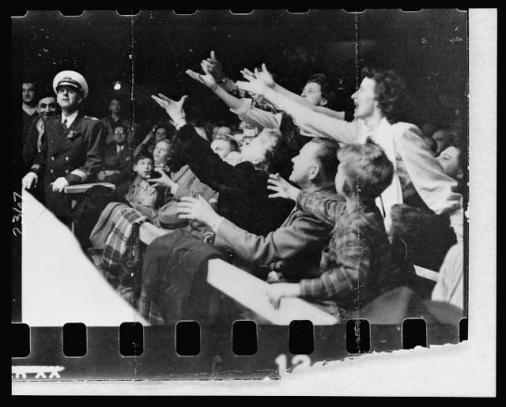
women at ringside, standing and reaching as if to catch something thrown by wrestler Gorgeous George who, though not visible in this image, was standing in the ring

Several women at ringside, standing and reaching as if to catch something thrown by wrestler Gorgeous George who, though not visible in this image, was standing in the ring.                                             Photographer: Stanley Kubrick
Date: 1949
Call Number: LOOK – Job 49-O46, frame 12 [P&P]
Repository: Library of Congress Prints and Photographs Division Washington, D.C. 20540 USA
Image from Look photographic assignment with title: Chicago city of contrasts.
Frame 12 of a contact sheet.
Forms part of: LOOK Magazine Photograph Collection (Library of Congress).

The Whole Package

So why do women get so much joy out of watching guys beat each other up for hours at a time, anyway? In his highly attentive account of sports spectatorship, Allen Guttman notes that “not all spectators…are sports spectators…By this apparently paradoxical remark I mean to refer, for instance, to dandies of both sexes who strut and preen about the venue and never glance at the game…to spouses dragged by spouses to an afternoon of tedium, to parents who come because someone must…and to all others whose motives are extrinsic to sports, per se.”[4] While several of my interviewees noted this fact, the significant point in nearly all of their narratives was that they were not of this ilk and they actually enjoyed watching. The women that I interviewed genuinely love watching professional wrestling, and enjoy being part of the fan culture. One young woman stated that, “I had to get into it by myself. That is to say, I had no older brothers who were into it or anything. I saw RAW one night when I was 9 years old and I was hooked.”[5] In addition to this idea of self-motivated watching, many responses dealt with the evolution of their relationship with wrestling. Some may have started out as the kind of spectator that Guttman describes, but they quickly evolved into an avid fan. “My younger sister, who is 19, actually got me hooked on it,” one viewer related, “I used to catch the tail end of RAW when it was on USA because I used to watch The Highlander, which was on right after it. It would happen that way every week, and eventually I began picking up with whatever storyline was going on at the end of the show. My sister had a habit of taping both RAW and Smackdown! so I watched her tapes to get caught up and eventually started watching them on my own.”[6] What is particularly compelling about this woman’s story is that it was another female that got her “hooked.”  A good number of other viewers spoke of boyfriends or uncles or fathers who they watched wrestling with, and, although not interested at first, they too became “addicted.”

But what is the actual draw? In his highly influential piece on wrestling, Roland Barthes discusses wrestling as the “spectacle of excess,” and likens it to what one might have seen in “ancient theaters.” He deconstructs the absolute pleasure (and expectation) of seeing what he calls “the great spectacle of Suffering, Defeat, and Justice,” and states “wrestling fans certainly experience a kind of intellectual pleasure in seeing the moral mechanism function so perfectly.”[7] While this is inarguably one of the central themes of enjoyment of professional wrestling, the women I spoke with, added more technical aspects to their enjoyment, beyond simply an intellectual satisfaction at seeing the good guy win, and justice served. One woman, Jessica, stated it quite simply as “the whole package…good in the ring, great with the mic[8] and not so bad to look at either.” Upon being asked about who their favorite wrestlers were, and why, most women cited this same “package,” and defined the pleasure that they got from watching these figures based on skill first, dramatic performance second, and aesthetic appeal third, if at all. Yet there was the feeling that Barthes’ concept of the theatrical playing out of good and evil applied. “The best thing about wrestling,” Catherine noted, “is the hero factor. You find a certain wrestler and they embody some hero complex in you…or your inner bad guy. It’s the classic story of bad vs. good.” One woman even referenced silent film iconography as one of the best things about wrestling. “I think [wrestling is] melodrama at its finest. Like those black & whites with the mustached [sic] bad guy that ties up the heroine.”[9]

Beyond the immense pleasure that these women find in the “real athleticism and grace” of wrestling, many of them described the enjoyment that they experience as being part of a kind of “vacation” mentality. Upon being asked if wrestling has impacted their lives, one woman responded, “Wrestling gives me a way to vent…If not I think I would go crazy from the pressure of [work]. There are so many things I have to keep my composure about at work or life. Wrestling (and sports watching in general) gives me “permission” and a forum to be out of control.”[10] Although Heather’s reasoning is slightly different, as she sees wrestling as a relaxing tool, not a cathartic one, the benefit she got from watching wrestling was “having a period of time each week where I sit down and watch TV instead of running around like a crazy person.” While other women noted that it gave them a kind of “stability” in their lives, knowing that they had a place to be on certain nights, and a program that they loved watching, others still maintained that watching it “is an escape. I work hard and I want to forget about work as fast as possible when I get home. Wrestling is perfect for that.”[11]

In David Morley’s work, Television, Audiences & Cultural Studies, he looks at issues of leisure time and families, discussing viewing habits of men versus those of women, and the power plays that occur within that dynamic. Although it is of note that his work represents quite a different population from my own, his discussion of Janice Radway is crucial. Concerning dynamics of power and gender relations within television viewing, Morley writes that

This issue raises the further problem of how difficult it is for most women to construct any leisure-time space for themselves within the home- any space, that is, in which they can feel free of the ongoing demands…[corresponding with this issue] Radway found that many of the women she interviewed connected their reading of romance fiction with their rare moments of privacy from the endless demands of family and work life. In effect, her respondents seemed to feel that romance reading was almost a ‘declaration of independence.’[12]

00901v

Spectators at wrestling match in Chicago.
Photographer: Stanley Kubrick
Year: 1949
Call Number: LOOK – Job 49-O46, frame 6 [P&P]
Repository: Library of Congress Prints and Photographs Division Washington, D.C. 20540 USA
Image from Look photographic assignment with title: Chicago city of contrasts.
Frame 6 of a contact sheet.

Thus, even though the social set-up is different in most cases (in my study, those who had children seemed to be single parents, and those who had significant others had no children), the need for leisure time construction of their own creation was still present, thus giving support to the socially enforced idea of a woman’s work “never being done.”

Not unlike those with marriage and familial responsibilities, these women have a necessity to make their own time, and create their own space. Thus, we can at least partially read these women’s attraction to their wrestling as a catalytic agent, giving them space from the hustle-and-bustle, and serving as the key to unlock the handcuffs they feel constrained by on a daily basis. They are their own liberators.

The bottom line is that women do find exquisite pleasure in wrestling. Whether it is through brilliant physical display or whether it is because it provides a much-needed respite from daily responsibilities, it is clear that there is an attraction to the “whole package” for these women. They love watching the performances of physical skill, and love to participate in viewing what Barthes called the “intelligible representation of moral situations which are usually private.” Wrestling creates in these women a freedom that they do not have in their normal day-to-day lives.  With wrestling, they have “permission” to scream at the television, or to relax with the stability of scheduled time/space for themselves, and a program they get pleasure from. As well, as female sports fans, they are given the ultimate freedom of participating in what is commonly accepted as a male viewing space, thus erasing gender role confines.

Pretty Girls In Spandex

It’s not all love and flowers and positive energy out there in the female fans of wrestling world, however. There’s plenty there that is actively denied, rejected and absolutely hated. Many of the women I interviewed had conflicting opinions about certain wrestlers (some loved Randy Orton, some thought that it was terrible that he was getting pushed [13] as much as he was, etc), and others still differed on which televised show they liked better (RAW or Smackdown!). However, the one thing that they all uniformly agreed on (with rare exception) was the dissatisfaction with the current status of the representation of women in the WWE.

These women seem to be operating with what I have termed the “Discourse of Disgust,” which centers upon three crucial features. The first feature is what I call the “T&A/Catfight Display,” which references the idea that almost all of the female wrestlers in use today are there solely for the purpose of titillating the males in the audience, and not to demonstrate any wrestling skill. The second feature is something that I term the “Humiliation/Degradation Game,” which involves the constant positioning of female wrestlers into positions of powerlessness or subjugation. The final feature of this discourse is the “Paucity of the Protagonist,” which deals with the oft-mentioned complaint about there being a lack of high-caliber female wrestlers available, and the strong desire to have somebody to pick from, instead of just making do with who is offered.

In their perceptive account of the mass media and its representation of female athletes, Mary Jo Kane and Susan L. Greendorfer write about the hyper-feminization and the hyper-sexualization of sportswomen. They discuss that, after struggling for so long just to get into this arena (sports), the images that the media uses of different female athletes

Represent a modernized attempt to reinforce traditional stereotypical images of femininity and female sexuality…these feminized and sexualized portrayals are simply new variations on very old themes: media images as a product or tool of patriarchal oppression of women-and their bodies-through an institutionalized socially constructed system of gender roles and values.[14]

The female imagery that the WWE has used in the last 10 to 15 years ideologically supports this theory. As noted in the book, Sex, Lies and Headlocks, the late ‘90’s was when sex in the WWE (then known as the WWF) became used as a crucial selling point in order to gain viewers away from station TBS who had a competing wrestling show. As the authors note, Vince McMahon (owner and boss of the WWE) has never been much for women’s lib. They cited that “the WWF had a brief flirtation with feminism in the Cyndi Lauper years, but Vince made his feelings toward that side of the business clear when Wendy Richter, Lauper’s confederate, pushed him to expand his ladies’ division. Irritated, he stripped her of her title.”[15] We all know that sex sells. But, in alignment with Kane and Greendorfer’s theories, it is not so much that sex sells, but that sexual representations of women sell especially well, as they reinforce hegemonic notions of male supremacy through the commodification of women’s bodies as sexual objects. Anything that might possibly disrupt the status quo is inherently dangerous, and must go. Thus Wendy Richter was stripped of her title.

Now *that* is a look that should come back into style! Putting some riot into grrl!

Now *that* is a look that should come back into style! Putting some riot into grrl!

As for the sexual objectification of women in wrestling, Patrice Oppliger writes

Sexuality is used to exploit and subvert women…women are presented individually, as objects for consumption. Wrestling shows use many excuses to parade women around in next to nothing. Bikini contests are very popular anytime, but other events are used to get women in sexual outfits such as Halloween or Thanksgiving costume contests. Bra and panty matches were created to strip women within a wrestling competition.[16]

Watching any amount of wrestling, one notices that there is no equivalent of the “bra and panties” or “evening gown” match[17] for the men, nor has there been a significant change in the amount of clothing that the male wrestlers have worn over the years. Style might have changed, but the male uniform has stayed basically the same. Oppliger notes a definite change in the visual portrayal of female wrestlers over the years, stating that “many critics focus on the more recent exploitation phase, skipping over the early days of women in wrestling to a time when females began to wear fewer clothes and started getting breast implants.”[18]

Stripping female wrestlers of their clothing, dressing them in high heels and “strongly advising” (as Vince McMahon is rumored to do) that they get breast implants, are just more ways to disempower these potentially powerful figures, and place the focus on their sexuality and what they can do for the heterosexual male viewer, rather than what they can do in the ring. The hyper-feminization of these wrestlers only serves to uphold the idea that they are there for a “T&A” display, and their wrestling talent is negligible. This is a totally ridiculous practice, for many fans, as Oppliger notes. “Fans get tired of hair-pulling and ‘fake’ falls. In real life, men and women train together in wrestling schools, so they get similar skills.”[19]

tumblr_lio8u7TRk81qc6yqqo1_500

This is a pic from a Tumblr called “Diva Dirt” of wrestler (aka WWE Diva) Torrie Wilson smacking her co-Diva Jackie with a crossbody blow at Wrestlemania 20 in a tag team Playboy Evening Gown match in 2011. One can only assume that the evening gowns were removed earlier due to being an annoyance and catching on bra straps and garter belts?

The women I interviewed felt very strongly on this issue. Due to their adoration of watching a good physical display, and feeling that the WWE was concentrating too much on this “T&A/Catfight Display,” they almost uniformly preferred to watch the men wrestle rather than the women. One viewer, Maggie, expressly stated, “I think the state of the women’s division is…pretty bad. They really have been demoted to just ‘pretty girls in spandex.’…Women [in wrestling] today also wear significantly less clothing than did the women of just 10 years ago. I don’t know how these things would impact younger viewers, but they certainly disgust me, even now.” Joy stated simply, “Not that I don’t like women, but so much of women’s wrestling is just T&A. They lack skill, but can flip their hair or swaggle their hips at the drop of a hat,” while still another took offense to this display, saying that she doesn’t “appreciate that some of the female wrestlers have no skill and are strictly used as eye candy. It’s a waste of time…”[20] One viewer even cited the “bra-and-panties/evening gown” matches as offensive, saying that having these women come up there “mostly to show off their tits and ass” in a match that generally involves them “stripping each other’s clothes off, and whatnot,” actually is direct incentive to watch the men wrestle.

The “Humiliation/Degradation Game” is also offensive to these women. One fan, upon being asked what the worst aspects of wrestling are to her, strongly responded, “some of the God awful storylines involving the girls on occasion. Things like Dawn Marie/Torrie Wilson and Torrie’s dad Vince McMahon making Trish Stratus bark like a dog, etc.” [21].  Yet another complained “these days, the WWE features women like Torrie Wilson and Lita, who cower in the presence of large angry men. It’s insulting…I hope the young fans don’t look up to these weak women, as I looked up to Madusa [older generation female wrestler], and I wish there were stronger female figures in wrestling.”[22]

Former female WWE Champ Madusa aka Madusa Miceli aka Alundra Blayze. Pictured here in her famed feud with Bull Nakano

Former female WWE Champ Madusa aka Madusa Miceli aka Alundra Blayze. Pictured here in her famed feud with Bull Nakano, circa mid-90s

In answer to my question about how watching wrestling impacts the female viewer, Jessica wrote, “I think its bad when they have storylines that degrade women. To me, that’s the biggest insult you can give a female viewer.”[23] These women’s rejection of the subjugation of women is a strong facet of their presence within the female wrestling fan subculture. In order to maintain their fanship, they must be able to watch and experience these segments, yet negotiate their own feelings of offense, in order to continue to participate in wrestling culture. To continue to watch a program that you find alternatively pleasing and insulting is to be placed in a continual location of ambivalence, and takes much dedication and desire to persevere.

Looking at the first two categories of the Discourse of Disgust, it is not a far leap to see the conclusion of this issue, the “Paucity of Protagonists.” While working through the T&A/Catfight Display and the Degradation/Humiliation Game, one can see the development of the third feature. By the WWE’s insistence upon women displaying their bodies over their talent, and performing roles of subordination to male wrestlers through humiliation and degradation, female fans are not left with much in the way of “favorite female wrestlers.” As a result of the first two categories, there is clearly a dearth in strong female iconography for the female consumer to a) identify with, and b) enjoy. The women in my study noticed this, and actively stated that they wanted this situation to change. One woman stated, frankly,

 I prefer watching men wrestle, because there don’t seem to be all that many good female wrestlers around today…Too many of them are fitness-model-gone-wrestler…the women’s division was better [in the past]. Those women could really wrestle and they were entertaining to watch. Today, a woman’s wrestling match has been stripped down to a “Puppies!”[24] comment from Lawler [Jerry “the King” Lawler, wrestling announcer] every thirty seconds…Unfortunately, with     such a small pool of talent, the women can’t consistently put on good matches.[25]

Her dissatisfaction was echoed by another woman’s sentiment. When this fan answered my question about whether or not viewing wrestling/being a wrestling fan can formulate a kind of feminism, she remarked that wrestling has “helped people see that women can get in there and mix it up just like the men, [but] when you have the Stacy Keiblers [female wrestler] getting in there who can’t wrestle, I think it takes it all back a step.”[26]

Her dislike of Stacy Keibler came from the fact that, in her opinion, Keibler was a participant in the T&A/Catfight Display, and had very little wrestling talent, and was there based upon looks alone. As a result of the compromised location that most female wrestlers occupy, there are very few available for women who appreciate the actual physical display of wrestling to choose from. Some fans noted that there are certain female wrestlers who they will watch, as they appreciate their wrestling ability, but unless those wrestlers are on, they choose to watch the men, as the men exhibit a more consistent display of entertainment and high wrestling caliber. As well, the low number of female matches also seems to play a part in this, as one woman criticized the WWE, saying that she would really “prefer if women’s matches got more air time, rather than RAW going to a commercial during the only women’s match of the night!”[27]

In the formulation of a female wrestling fan subculture, you clearly have the features that give them immediate pleasure and satisfaction in viewing, but I would argue that to a certain extent, the participatory nature of negotiating their displeasure, and their identity as players within the Discourse of Disgust, also formulates a large part of their pleasure as fans.

John Fiske writes, “the meanings found in the text shift towards the subject position of the reader more than the reader’s subjectivity is subjected to the ideological power of the text.”[28] Fiske’s conception of an active audience fits the population of female wrestling fans to a tee. These women, through their rejection of the ideologies that the WWE is putting forth, are tailoring the program to fit their own subject positions. Their choice and preference of watching men wrestle over women, is a dynamic location of spectatorship, where they are given the freedom to pursue their own pleasure in the program. The disgust that they show in their consideration of the representation of women wrestlers should not be taken lightly, as their protests are valid. However, they do not let these misogynist ideologies rule their personal viewing pleasure. In his deconstruction of Stuart Hall’s theory of preferred reading, Fiske notes that the “value of the theory lies in its freeing the text from complete ideological closure, and in its shift away from the text and towards the reader as the site of meaning.”[29] These women, therefore, have stripped the text of the offensive elements, freed wrestling from its “ideological closure,” and brought it back to their own site of subjective textual analysis.

Many of these women did re-read the texts given, placing them in an ideological space that was more pleasing and gratifying to their own subject positions. One woman wrote, of the aspects involved in the Degradation/Humiliation Game, “we’ve seen storylines where females are mishandled or emotionally abused by the males and they overcome it and get out of it. And while it may be just a storyline to some, to others it is reality and it gives them the courage to be like the wrestler and get out of that situation.”[30]  Sara explains that her adoration of wrestler Stephanie McMahon has affected her life greatly. “Stephanie McMahon…has done wonders for my personality and self esteem. She’s shown me that, yes, a woman can succeed with men all around her…Everyday when I get up, I can turn over and say to myself, ‘It can’t be as bad as I think, because Stephanie Marie McMahon has been through worse.’” Fiske’s discussion of Turnbull’s work with female spectators of the television program, Prisoner, is exceptionally useful in this capacity. According to Fiske, Turnbull’s results related how he found that

Images of strong, active women fighting the system, gaining minor victories (although eventually succumbing to it) give them pleasure (in the resistance) and a means of articulating a discourse of resistance to the dominant ideology that paralleled the discourse (often called rebelliousness) that they used to make sense of their social existence. The contradictions and struggle between authority and resistance to it existed in both the program and their subjectivities, and the meanings that were activated and the pleasures that were gained were the ones that made social sense to the subordinate and powerless.[31]

These women expressed feelings of marginalization, periodically, whether it was as a result of being one of the very few female fans that they knew, as a result of working in a traditionally male field, or just as a woman in general. However, many of these women were able to combat those feelings through their reappropriation of female figures in wrestling. As Henry Jenkins has written in his seminal text on fan culture, “fans have chosen these media products from the total range of available texts precisely because they seem to hold special potential as vehicles for expressing the fans’ pre-existing social commitments and cultural interests.”[32] Although many of the same people who wrote about how they “now have people to look up to, i.e. Lita, Trish Stratus, rather than actresses,” exhibit all three features of the Discourse of Disgust, they occupy a wonderfully free and paradoxical space where, as an active reader, they can reclaim Trish Stratus as someone they look up to, and see as a strong woman. On the other hand, because of their subject positioning, they can also reject the T&A/Catfight Display, and regret the Paucity of Protagonists.

Surprises and Eyerolls

Another way in which female wrestling fans have formulated an active subculture is in the way that they “react to their reactions.” Although some fans, like Jacky, are “usually shy to mention it anyone, it’s like I am afraid, I don’t know why,” others will go ahead and tell people of their fan status. Upon being asked how other people act in response to the revelation that they are female and a fan of wrestling, many of these women have been met with pronounced derision. Sara states, “what surprises me most about being a ‘female fan’ is when people realize that I am one. Apparently, since I’ve gone away to college and have a good job and a normal social life, there’s no way I can be all of those things and a wrestling fan. Newsflash: I am, and that’s just the way it is.” Kelly stated that the typical response she receives is “’Oh my god! You know it’s fake don’t you?’ followed by hysterical laughter,” while Jennifer reported, “They think I’m crazy and ask if I know that it is fake. They usually are shocked…like I don’t fit the profile of a wrestling fan.” Heather deconstructed the reaction in three ways. She said that when she tells someone that she is a wrestling fan, she gets one of three responses:

a) Getting laughed at/made fun of- to this day, I still get the “hey ask Heather, she watches wrestling” whenever something comes up that might be categorized as “white trash” comes up (nascar, monster truck, etc)

b) I find kindred spirits- there is a fairly large group of people I work with who are wrestling fans- mainly male Hispanic. They are always pleasantly surprised to find I like wrestling because they didn’t expect a girl, and didn’t expect me, in particular, to enjoy it.

c) I get a generic “I used to watch that” with an undertone of  “but I certainly wouldn’t watch that anymore” type of response. Wrestling gets tagged as being something you watch when you’re a kid.

Joy said that her general reaction “varies between surprise and eyerolls,” while Jessica actively marked the response up to gender. She said, “I usually get a ‘Really?’ and I think the reason is because I’m female.” All of these women exhibited similar conditions of reception to their fandom. While many of them accounted for the response as a result of gender deviance (girls aren’t supposed to like wrestling), academic/social status (“you’re too smart to like that!”), or underestimation of their intelligence (“you know it’s fake, right?”) others, like Heather, did report a positivity that they encountered, when they found “kindred spirits.” In fact, more than one of the women I interviewed said that they had met their significant others through their wrestling fanship, as well as many good friends.

These women seemed to encounter criticism from every section of people they told, except for the “in group”- other wrestling fans. Jessica said “some of the guys I know are actually impressed, especially when we start talking about wrestlers or shows. They like to have someone different to talk to about what’s going on in the world of wrestling,” while Maggie stated that her “liking of wrestling is met with a sense of wonder and awe by other wrestling fans [but] meeting other wrestling fans seems hard to do, these days.” Within this section of responses, it seems that women occupy an almost revered position, as unusual fans. Their narratives seem to account for a certain glory that they take in being a subculture within a subculture. As these women are straying from gender convention within the fan culture of wrestling, which is made up primarily of men, these women are given respect and admiration for their fanship. Their own personal gain is that they find other “kindred spirits,” which, as Maggie related, is not a simple task. Within other fans’ responses they are given support and recognition, while in mainstream society, their tastes are infantilized (wrestling is only watched as a child), their intellect devalued (don’t they know it’s not real?), or their academic accomplishments used as weapons (you’re too smart to watch wrestling).

Jenkins maintains, “sports fans (who are mostly male and who attach great significance to “real” events rather than fictions) enjoy very different status than media fans (who are mostly female and who attach great interest in debased forms of fiction).”[33] I would like to address the issue of the problematic nature of being a sports entertainment fan, and discuss the fact that wrestling (which many consider to be a sport) fans do not enjoy the same status as “regular” sports fans. While Jenkins’ point is, on the whole, probably an accurate one, the idea of sports entertainment brings out a whole new way of looking at that statement. While the matches are fixed, and there are writers and fictional storylines, wrestling is a conundrum in its sports identity. Not only do these women experience discrimination because of their pleasure in wrestling, but so do the men. Wrestling fan culture is not a far cry from any other fan culture, where the participants are continually mocked for their affiliation. What makes wrestling particularly fascinating, however, is its conflation of sports (real) and “media”(fiction). Lori brings up a crucial point when she says, “the worst thing about wrestling is mostly the general public’s attitude towards it (ESPN’s 2nd most hated sport, I believe the poll said). Just because there is an element of choreography doesn’t mean that all of it is ‘fake.’ You can’t exactly fake getting thrown through a table, can you?” The fact that ESPN, a major sports channel, classifies wrestling as a sport, yet everyone feels the undying need to remind wrestling fans that what they are watching is fictional, locates this program in a liminal space, haphazardly jumping between elements of reality and fiction, without a fixed identity, causing critics left and right continual frustration. Wrestling’s fiction/non-fiction identity causes its fans unending strife as well, because they must deal with having to defend their fanship, as well as the authenticity of their program. Sara says, about having to stand up for her love of wrestling, that she has learned to “take it with a grain of salt, people just ‘don’t get it,’ and I brush it off as much as I can.”

In Ien Ang’s study of Dallas watchers, she outlines the ideology of mass culture as a process where “some cultural forms- mostly very popular cultural products and practices cast in an American mould- are tout court labeled ‘bad mass culture.’ ‘Mass culture’ is a denigrating term, which arouses definitely negative associations. In opposition to ‘bad mass culture’ implicitly or explicitly something like ‘good culture’ is set up.”[34] Female fans of professional wrestling are subjected to the same tyrannical ideology of mass culture that Ang’s Dallas fans were. In my reading of their narratives (which, like Ang, I tried to do “symptomatically,” to try to find out what the viewing pleasure in wrestling meant to these women), I encountered multiple instances where the fans either maintained a silence about their viewing habits for fear of ridicule, or, more often than not, when they expressed their love for wrestling, they were laughed at or told that what they watched was, in some way, “bad culture.” However, like Ang’s participants, many of these women were able to express to me their own ideology of populism, developed as a result of being attacked for what they liked one too many times.

As Ang defines it, the ideology of populism is “first and foremost an anti-ideology: it supplies a subject position from which any attempt to pass judgment on people’s aesthetic preferences is a priori and by definition rejected, because it is regarded as an unjustified attack on freedom.”[35] I would like to suggest that the participants in my project have a special dualistic relationship to the ideology of populism, as they occupy a very distinct marginal space. First of all, they are already predisposed to this ideology, as they are breaking gender stereotypes by taking pleasure in a hyper-masculine product that is not generally marketed to women, and thus forming a subculture all their own. Hegemonic standards can be likened to the ideology of mass culture in their dominating structure. Thus, by breaking conventional ideas of gender propriety, these women already have a highly developed sense of the ideology of populism, requiring the freedom that conventional standards of femininity refuse to allow.  Secondly, as participants of a subculture (wrestling fan culture, in general) that is consistently assailed as being exemplary of “bad culture” or “low class/bad taste,” they have had to counteract this as well, by formulating a strong sense of freedom of taste. So when I read about “taking things with a grain of salt,” or the ardent statement, “Newsflash: I am [a wrestling fan], and that’s just the way it is” I saw these responses as a strident inflection of the ideology of populism, and the “taste freedom” that it supports.

All The Soap Opera Without Any of the Stupid “I-Love-Yous”

While fan culture can be a difficult location to exist in, women and men who love wrestling are provided an opportunity at what I call “viewing transvestitism.” For men, this means participation in a genre that has historically been rendered “feminine,” while women have the chance to participate in one that has been labeled “masculine.” Through this participation, both sexes have the opportunity to shed the socially decreed gender taste conventions, and, in a sense, “see how the other half lives.”

Wrestling has repeatedly been described as a “male soap opera,” as it contains many, if not all, the essential elements that traditional soaps like Days of Our Lives, General Hospital or One Life to Live contain. First of all, it does involve a family, the McMahons. But wait- it gets better- not only is there a family, but it is the “most dysfunctional family in America,” as many of the WWE advertisements proclaimed, in the late 90’s.[36] While currently the family is not center-stage, it was a huge focus for many years. To this day, divorce, pregnancy, miscarriage, extra-marital affairs, and other “top soap” dramatic elements are still active parts of the storyline. Not only that, but there is never any conclusion. A match may end, Eddie Guerrero might have kept his title because of a disqualification, but that does not mean that the conflict between him and John Bradshaw Layfield is over, by any sense of the word. Professional wrestling works on the same principle that Tania Modleski wrote that soap operas do: “Tune in tomorrow, not in order to find out the answers, but to see what further complications will defer the resolutions and introduce new questions.”[37] Through wrestling’s connotation as a highly masculine form of entertainment, the feminine soap element becomes masked, and acceptable. Yet I find it utterly fascinating that this is the one instance where a male character, totally muscle-bound and alpha-male coded, can get up on stage and shed tears, as wrestler Kurt Angle did a few weeks ago, and the male spectators will not be called “weak” for feeling for the guy. I understand it however- through the diegetic narrative, men are allowed to cross that boundary, enter into the feminized world of the soap opera. In this context, because wrestling is soaked in the hyper-masculine costuming of sports, the soap opera becomes re-named a “male soap opera.”

Female spectators get a chance to break free from the mold as well. As Heather said, one of the great things for her about participating in the wrestling fan culture is, as a woman, you get to “have a ‘boys night’ of sitting around, eating BBQ, and drinking beer, while not being classified as one of the women who are sitting around in the kitchen annoyed at the boys for watching sports.” Lori notes that being a female wrestling fan is “no different than a girl knowing the rules, etc. behind any other sport, like football or basketball. She then becomes more like ‘one of the guys.’” In response to my question of how wrestling impacts the female viewer, Jacky said candidly, “I think it makes them feel like they watch it and it doesn’t matter that it’s a ‘male show.’ I guess it makes them feel like they’re equal and they are not seen as ‘the female watching the show’ but ‘the fan watching the show.’ All these women exhibited strong acknowledgement of the social conventions that gender-type wrestling as “male,” and yet all of them also talked about the pleasure that they get from crossing over into that realm, while still being firmly aware that they are female. The viewing transvestitism that takes place in their engagement with the wrestling text allows them access to what would commonly not be at their beck-and-call. As we saw in the easy acceptance of female wrestling fans by male wrestling fans, this is no surprise, as it is an aspect of the fan culture. However, the ability and freedom that is involved in breaking the strict “boys watch sports/girls don’t watch sports” code is one that gives these women enormous strength, both in their fanship, and in their personal lives.

Newsflash: I Am, and That’s Just the Way It Is

I get enormous pleasure out of watching wrestling. I have my favorite wrestlers, and my favorite storylines, and I have a date every Monday and Thursday night with the television to participate in a program that alternately offends me and gives me suspense, pleasure and excitement. When I turned the questions that I asked these women back upon myself, I found that many of my responses lay along the same lines. There were differences, but overall, I found that the pleasure I received from the wrestling text came from a series of negotiations with my desire to read wrestling according to my own subject position. Just as any of the fans I was in contact with, I am, what Fiske calls, an “active reader.”

I have tried to be as fair and partial about the representation of wrestling and female spectators as I can, but I’ll admit that I can only go so far. I am certain that there is much within these pages that female fans would disagree with me about, but there are just as many people out there who would subscribe to Ang’s ideology of mass culture, and put me down for spending so much “valuable” time on an “invaluable” subject.

On the whole, I think it is crucial to recognize these women’s voices, and their active formation of a subculture within a subculture. It is not easy for a woman to break free of the things that are deemed gender-acceptable or unacceptable. These women’s active participation and intelligent deconstruction of what they watch, and why they watch it, show that not only are they remarkable examples of strength in the face of socially enforced gender restrictions, but they are also engaging in a process by which they are taking the power back, and joyfully transgressing ideas of what a woman “should be watching” or what a woman “should be enjoying.” By joining forces with the rest of the wrestling fan community, they can be seen less as a female, and more as a fan, an experience they might not receive in other areas of their lives. Yet gender is not entirely erased, as shown by these women’s pronounced activity within the discourse of disgust. They are quite aware of the ideological misogyny that the WWE exhibits, yet they make the choice to either re-read it as something that they find positive and meaningful to them, or reject it entirely, concentrating on a different part of the text that does not seem hateful to them. The operative word in this equation, however, is choice. These women know that being part of this liminal group actually affords them choice, and having a choice makes all the difference.


[1] Truman, quoted in Sugar, Burt Randolph. “’Sports Scholar’ Analyzes Wrestling.” Solie’s Vintage Wrestling. 5.553. 18 March 2000. http://members.aol.com/solie3/svwn553.html. 1 June 2004.

[2] “squared circle” is commonly used slang within the wrestling community for the area of the wrestling mat

[3] Jenkins, Henry. Textual Poachers: Television Fans & Participatory Culture. New York: Routledge, 1992.

[4] Guttman, Allan. Sports Spectators. New York: Columbia University Press, 1986.

[5] I will be used pseudonyms for my participants, in order to protect their anonymity

[6] Jessica

[7] Barthes, Roland. Mythologies. New York: The Noonday Press, 1990.

[8] Being “good with the mic” implies the wrestler’s capacity to dramatically perform their “part” well, and display the given role’s personality in a powerful way. This may involve “cutting a good promo” which is a fictional segment designed to advance dramatic storyline.

[9] Theresa

[10] Theresa

[11] Sara

[12] Morley, David. Television, Audiences & Cultural Studies. New York: Routledge, 1992.

[13] Giving a wrestler a “push” means that they are being given a good amount of wrestling time- many times a new wrestler will get a big “push” at the start, and if that doesn’t work out, the wrestler will either be left out until they figure out a new gimmick for them, or he’ll simply be sent packing

[14] Kane, Mary Jo and Susan L. Greendorfer. “The Media’s Role in Accommodating and Resisting Stereotyped Images of Women in Sport.” Women, Media and Sport. Ed. Pamela J. Creedon. Thousand Oaks: Sage Publications, 1994. 28-44.

[15] Assael, Shaun and Mike Mooneyham. Sex, Lies, and Headlocks: the Real Story of Vince McMahon and World Wrestling Entertainment. New York: Three Rivers Press, 2002.

[16] Oppliger, Patrice. Wrestling and Hypermasculinity. Jefferson: McFarland & Company, Inc., Publishers, 2003.

[17] These matches are similar, in the objective is to relieve your opponent of any clothing save the bra and panties. In the Evening Gown match, however, the wrestlers are dressed in evening gowns, whereas in the general Bra-and-Panties match, they might be dressed in other clothing.

[18] Oppliger, ibid.

[19] Oppliger, ibid.

[20] Heather

[21] This storyline involved wrestler Dawn Marie making a romantic play for archrival Torrie Wilson’s father, then blackmailing Torrie into a sexual situation, saying she would call the wedding off. However, Dawn Marie tricked Torrie, and not only “took advantage” of Torrie sexually, but went ahead and “married” Torrie’s dad, anyway. The second storyline featured Vince as a performer in his own program, forcing wrestler Trish Stratus to bark like a dog, as punishment for her participation in a fictional relationship with Vince, when their “relationship” started to “go sour.”

[22] Maggie

[23] Jessica

[24] “Puppies”-a term used by one of the announcers meaning breasts; taken up by a wide population of male fans, who show up in the arena with signs saying things such as “Show us your puppies!”

[25] Maggie

[26] Jessica

[27] Jessica

[28] Fiske, John. Television Culture. 1987.

[29] Fiske, ibid.

[30] Jennifer

[31] Fiske, ibid.

[32] Jenkins, ibid.

[33] Jenkins, ibid.

[34] Ang, Ian. Watching Dallas. 1992.

[35] Ang, ibid.

[36] Assael, ibid.

[37] Modleski, Tania. Loving With a Vengeance. Hamden: The Shoe String Press, Inc., 1982.

Common Careers: Profiles of Women in Media Culture

Funny business, a woman’s career. The things you drop on your way up the ladder so you can move faster. You forget you’ll need them again when you get back to being a woman. That’s one career all females have in common, whether we like it or not, being a woman. Sooner or later, we’ve got to work at it, no matter how many other careers we’ve had or wanted. And in the last analysis, nothing’s any good unless you can look up just before dinner or turn around in bed, and there he is. Without that, you’re not a woman. You’re something with a French provincial office or a book full of clippings, but you’re not a woman. Slow curtain, the end.                                                                                                                                                                                         – Margo Channing,  ALL ABOUT EVE

Margo Channing, the central figure of Joseph L. Mankiewicz’s Academy Award-winning film All About Eve, is undoubtedly one of the greatest female characters in cinema history. But Bette Davis, the woman who made her screen-famous, is the woman behind the woman, so to speak. Bette Davis’ dominance and desired control over her roles and career in real life bled over into the majority of the fictional characters that she played. From the 1930s onwards, Davis sought her independence from the studio contract system. Beginning with a court case that she ultimately lost (WARNER BROS v NELSON, 1936) her desire was to free herself of her current ties and open up more possibilities for her to play parts in whatever films she wished, seeing as the roles she was receiving from Warner were (in her eyes) limiting her career. This small set-back did not stop Davis, however. Although she continued under the aegis of Warner Brothers and became quite successful, she reached out in other ways. To Warner, Davis may have simply been viewed as one of their more financially attractive properties. To Davis, her heightened position in Hollywood gave her power and leverage. And she was quick to take notice of this. In 1941, she became the very first female president of the Academy of Motion Picture Arts and Sciences. However, she relinquished the position a few months later when her Academy cohorts refused to agree with her “radical” idea of supporting the troops and having a performance and nationwide broadcast for the war effort in lieu of the annual Academy Awards.

Bette was a smart woman. While most people are quite familiar with the unyielding and assertive figure she cut on-screen, the lesser-known facts about Davis are just as striking. When her contract with Warner Brothers was renewed in 1944 she made damn sure that she got something in return: she would be allowed to produce 5 films herself, in addition to starring in them. Out of the five, the only one that was ever actually made was A Stolen Life (Curtis Bernhardt, 1946), but she produced the hell outta that picture. Davis freed herself from the bonds of Warner Brothers in August of 1949, calling it her “professional divorce” and becoming a freelance actress for the remainder of her career. For a woman who existed and played within the “studio limits” she definitely pushed them, both within the films she made and through the life she led outside of the sound stage.A Stolen Life2a

But let’s face facts here: the pure unadulterated truth is…there were a great deal more working women than Bette Davis in Hollywood at that time. Not only that, but many of them were women who had more control over their own careers, economic possibilities and personal situations than even Bette Davis. While not all of these women can say that they rocked the very foundations of the film industry by suggesting that they skip the Holy of Holies (the Academy Awards) in exchange for a war fundraiser, many of these women did other things in Hollywood that had a similar effect.

I engaged in a conversation a few weeks ago with a few people online about women’s roles in the film industry today versus what they used to be and when that changed. As a trained film scholar and media archivist who specializes in women in film culture/film history, I realized that we were missing some vital information. As a woman in the film community, I am thrilled that we have established a vital and dynamic interest in getting women the recognition, equality and positioning that we deserve. The heightened enthusiasm for positive female representation in media that certain groups like the Geena Davis Institute on Gender and Media and Amy Poehler’s Smart Girls at The Party have shown is nothing short of brilliant as far as I’m concerned.slider-geena-announcement

But we have a problem. We seem to be reinventing the wheel in certain circumstances. There is a disconnect and it is a big one. That disconnect is called history. Didn’t we have women doing some pretty awesome stuff and being excellent role models a while back? Is our cultural memory that short?

Admittedly, back in the earlier days of cinema, women did not have certain advantages that we have now. For example, pants. In the film noir, Gun Crazy (Joseph H. Lewis, 1950) Peggy Cummins’ character, Annie Laurie Starr, is reprimanded for wearing pants to work. This is probably not a scene we would see in a film today. However, much like this sartorial issue, it is also sadly unlikely that we would see such an exciting and elegantly laid out character like Annie in a film of today.

I believe we have either forgotten where we come from or we did not know in the first place. Either way, it is important to be reminded. What I have noticed is that a certain percentage of the modern film community is just that: modern. And that is an unhealthy thing. If we are sitting around tweeting, blogging and posting about the place of women in film today but forget to mention that women in film have a very distinct timeline of their own, I can only think that there is a problem and it needs adjustment.

I don’t think one can think about the women who helped to create our moving image culture too much. Thus I have decided to write one profile a week about a woman in film culture who has significantly changed the face of moving images as you and I know them. Some of them you will be familiar with (like Bette Davis) and some of them you may have no clue about. But all of them are important. And all of them have had a hand in developing the world that is now woefully lacking in positive female representation and female employment.

I have decided to title this weekly column Common Careers based upon the quote from All About Eve. I am doing this not simply because all of the individuals do, indeed, share that “common career” of being a woman, but they also share the problematic nature that that quote itself possesses. I cannot, by any stretch of the imagination, pretend that Margo Channing’s statement is one of perfection; it is not. But then again, sometimes the best way to explore our hero(ine)s is through their flaws. I find that quote as fascinating for its dependence on heteronormativity as I do for its search for identity.

So join me won’t you? Each week we will look at a different woman and explore the females of the past and their impact on the future.

Welcome to Common Careers. I look forward to your company and hope you enjoy!

Still Here – World AIDS Day, 2013

WADbanner

I’m 35 years old and I’ve been a HIV/AIDS activist since I was old enough to walk the AIDS walk in Los Angeles in the late 1980s. I think my first AIDS walk was around 1986-1987.

We met at Paramount Studios, up the street from my house, and I walked a 10K with my godfather, his friends, my family and thousands of others. I did this every single year. Including the year where I made absolutely sure that I made enough money that I could go to Disneyland with the rest of the people who raised enough money to go to Disneyland. My friend Elana and I, both 9 or 10 years old at the time (if you think that I try to enlist people into my work NOW, you shoulda seen me as a chunky little kid!!) each raised at least $1000 dollars so that we could go to Disneyland. At night. By ourselves. With hundreds of awesome gay men. Buying up all of the princess costumes and fairy wands. And yes, that was REALLY what they were doing. Also? They were the most excellent babysitters you could ever ask for, by the way. We had more fun that night than…who knows. I remember that night so well. It was 25 years ago.

The adult me remembers the laughter. The adult me also wonders how many of those amazing men and women who asked us, “Who are you here with? NO ONE? By yourselves? Wow!” are still alive. HIV/AIDS became a much more serious thing in my life than something you walk for as I got older.

A few years after that fabulous (in every sense of the word) Disneyland night, I became a HIV/AIDS peer educator for Peer Education Program Los Angeles (P.E.P.L.A) and beganpepla spending time speaking at a variety of youth institutions, educating kids my own age about HIV/AIDS. I was about 13 years old. I went to all-girls-private schools where girls were given SUVs for their 16th birthdays. I went to places like Children of the Night where kids were pimped out by their parents from the age of 9. I went to homes for pregnant teens, drug rehab centers in east L.A., elementary schools (yes, we had to completely restructure our discussion for the under-10-years-old-set), and a school where they knew that we were bringing a HIV+ speaker with us, so parents came and sat in a special section, wearing latex gloves and medical masks. Because the disease is AIRBORNE.


My mother let me skip Real School sometimes to go to do P.E.P.L.A events. It was pretty amazing. I met some of the most amazing people there. Some friends that I still maintain today. The structure was an amazing one: a few teens to talk to other teens about how they specifically are at risk. Because, well, teenagers are well-known for that whole “we’re gonna live forever” thing. So condoms, protection, diseases? Yeah, none of that really comes in. And in the 1990s? Fuggetaboutit.

PEP/LA changed my life. Before that, I had one experience with AIDS. I grew up in a highly gay/queer family landscape. My godfather is gay, a HIGH population of our family friends are gay, so on and so forth. I think I had more queer people around me when I was little than straight people, come to think about it.

So while my father died in the early 80s from a car accident, we were still very close with his musical writing parter named Marc Trujillo, and his “friend” named Frank (this was my interpretation. I was so very young). I have two very specific memories of these important men in my life: Marc and Frank passed away, and they were the first men I knew who were taken due to HIV/AIDS. And my mom told me this. My mother never lied to me and she was always very honest with me. I don’t remember who passed first, how it went, it’s fuzzy. But I do remember having this knowledge. And I recall going to the memorial with my mom. Marc’s family owned a flower store on the corner of La Brea and Fountain. And I think that’s where it was. I have no idea how old I was. But I could also  be mixing memories. What I am not mixing up is the fact that they were the first people I remember being close to me and being part of MY HIV/AIDS world.

Years later, I became such a heavy-duty advocate for HIV/AIDS education that I would start arguments with people (me? no, never!) in my all-girls-Catholic school after ACT-UP was handing out condoms outside one day about how great they were and so forth. I made sure that I always attended the PEP/LA events at Children of The Night. children_of_the_night_logo

This was always one of our most difficult events. Many of these kids didn’t stay there and protection on the streets isn’t always an option. Sometimes we would have to talk about how to “fool a trick” into using protection or things like that. WITH YOUNG KIDS. I was 13 and they were my age. And white. And privileged. With a supportive loving family. What right did I have? Except that I cared. Also, some of the kids were already positive. So did it matter at that point? YEAH, it did. We had the information to talk about how the hell to take care of yourself and that there is HOPE. The idea that AIDS is not a death sentence was pretty damn revolutionary in 1994.

I remember the weddings and the funerals. The weddings were amazing. The funerals were fucking crushing. I had more dead friends before I was 16 than any of my other friends in school. But why count? It’s not a competition. I’m just SO MASSIVELY lucky that I got to know them before they left. And for the record, they were not all gay. My first friend who died when I got to PEP/LA was Gary- a gorgeous guy that I had a huge crush on. He had a model-type girlfriend. I used to carry the picture of him & his girlfriend around for a long time. I think that in all my moves it may have gotten lost. But I think I still have the invite to the memorial. The church is in West L.A. He was great.

However, I am deeply grateful to have been a part of my friend John Scott’s life. I was there when he married his beautiful partner, way before legal gay marriage seemed a possibility in anyone’s mind. When he did so, I was a freshman in high school, and all I remember thinking was, “I’m going to an awesome wedding,” and….not even knowing that there were things about getting married THAT WERE ILLEGAL.  My mom drove me all over town when he got sick. I visited him in the towers in Century City, at a few different other places, and at a hospice somewhere too.

But he kept coming out and speaking with us. And he was the “no-bullshit” artist. He would talk about what it was like to end up at the corner near a stoplight and not remember where you needed to go. He would talk about what it was like to always carry an extra pair of underwear with you in case you shit your pants without any warning. He would do this to little spoiled girls at Marlborough school or gangbangers in East L.A. With a smile on his face. Because he would also talk about the fact that these kids had the power not to be in his shoes. tcell1

He spoke with us on a regular basis. I spent so much time with him. I remember his laugh. His smile. These things ring on my ears, my eyes. My John Scott. He was devoted. Until he got really sick. To give you an idea of who my beloved friend was, I need to tell you one more thing. One of the things that I loved the most about John Scott is the fact that he named his T-Cells.  tcell count By the very end, he was going down from 7 to 5 to 4. He would say, “Oh, well!  We’re down to Marlena, Joan, Bette and Judy, now! But they’re tough gals! They can handle it!” I may be a little off on the names, but I am 100% certain on Marlena and the idea that he chose tough film stars to name his T-cells after so they could fight for him. John Scott. I have yet to meet his equal in my lifetime. That was 20 years ago.
I left to go to Israel for high school in the spring of 1994, and that April I got a phone call from the head of my program, Wendy.

“John Scott died this morning, Ariel,” my body went cold. He was supposed to wait until I got back so we could talk about cute Israeli boys. I didn’t know what to do with this. I was a world away with people who I didn’t know and who didn’t know me, even if we had been climbing mountains together and traveling through deserts for months. “Hey Ariel, did you hear me?”

“Yeah, Wendy, I heard you.”

“I was there with him at the end and he wanted me to tell you goodbye. Specifically.”

“?”

“John wanted me to say goodbye to a few people. He said to say goodbye to Erin and to you. So I want you to know that. You were important to him.”

My 15-year-old-self was numb. My now-35-self still doesn’t know how to process that kind of statement. I mumbled thank you, that I would write (there was no email or cell phones…Imagine THAT, y’all!) we both knew how expensive the phone call was, and hung up.

So here we are, and I still feel a responsibility to my dear friend to remind the rest of the world that AIDS still exists. It may be a more manageable condition here in the US and North America, but it isn’t in many places in the world; places where sex education is a privilege not a right; places where protection isn’t even an option. There are many places in the world where masculinity, war landscapes and other ugliness takes precedence over health concerns. In addition, in any country (our own included), anal sex still leaves women “virgins” in many cultures and anal sex is the most at-risk sexual activity when conducted in an unprotected manner. Think on that. So this is most certainly not a gay disease. It is blind to color, race, sexuality and age.

It doesn’t care. But I still do.

AIDS hasn’t gone away. And it’s not like migraines or a bad knee, either. This is still here and it still needs to be attended to. Because I spent most of my young adult life watching my pals die and speaking to kids about it and hoping that someone listened. Because I have friends who still are HIV+ for 20 or 30+ years. Because we want to stay happy and healthy and we don’t want to be the last name on someone’s lips before they are really really really old. Because this is a subject that requires our continual attention- for our health and for the health of those we love. So that next year we will ALL be Still Here.


Measuring Up: Sarah Silverman: 1, Variety Critic: 0

**DISCLAIMER: DUE TO SUBJECT MATTER, THIS ENTRY CONTAINS A FAIR AMOUNT OF UNLADYLIKE LANGUAGE. PLEASE BE AWARE OF THIS IN ADVANCE. THANK YOU AND HAVE A LOVELY DAY!**

Okay.

To be perfectly honest, I don’t have the time to write this piece. I’m in the middle of doing a lot of different things for work right now, but I am taking about 20 minutes out to rant and talk (somewhat intelligently, I hope) about something that I feel strongly about.

Last night a male friend of mine asked me to write about this issue because he felt that he couldn’t. He felt that if he took it on, someone would think he was “mansplaining.” Personally, I think that’s bullshit because he’s a very smart guy and could do an incredible job with this material, but I looked at the article that he was telling me about this morning and….hackles raised.

Apparently some dude at Variety thinks it’s just not ladylike or funny for a female comic to have a dirty mouth. He feels that she is “limiting” herself. And her career.

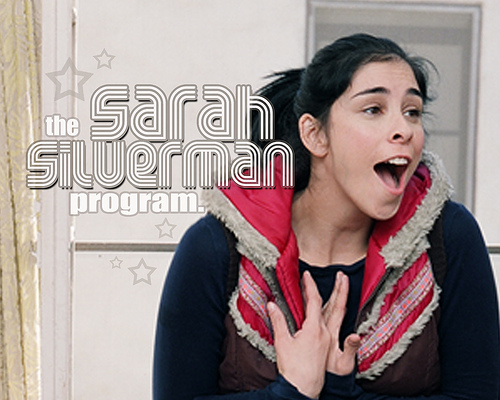
In fact, his TITLE says it all. The article’s title is, “Sarah Silverman’s Bad Career Move: Being as Dirty as the Guys.” Excuse me?? Bad career move? Where have you been for the last few years, Brian Lowry, TV Columnist? Sarah Silverman HAS A CAREER. And a very good one at that! While I am not the biggest fan of all of her work, I really like her a great deal and I know she is excruciatingly and painfully talented, even if some of her comedy sketches don’t fit my tastes. And…she’s been around forever.  That whole “She had her own show” thing. Yeah.sarahsilvermanprog“Being as dirty as the guys.” Are we, as women, still being measured up to male standards of things, Mr. Lowry, instead of simply being appreciated and valued as funny and valuable parts of the comedy community? And, for the record, not all male comics go dirty. I’ve seen amazing sets by Patton Oswalt and Eddie Izzard that were clean as a whistle and I laughed so much I thought I was going to die. So…dirty like those guys? My question to you, Brian Lowry, TV Columnist, is…HOW DID YOU DEVELOP YOUR COMEDY VALUE SYSTEM AND WHY IS IT BASED ON MEN? Bette Midler, Lily Tomlin, Gilda Radner, some funny ladies…certainly not 100% clean. Phyllis Diller and Joan Rivers? Seriously!

Hey Brian Lowry- three words: DO. YOUR. HOMEWORK. Have you EVER heard of Mae West? C’mon, buddy. Up your game.

You state, “This isn’t meant to suggest that female comics can’t work blue. The lament here is that in the wrong hands it can feel gratuitous or become a crutch, whereas unlike many of her contemporaries, Silverman has enough tools that she can and should do more.” This just seems like outright condescension and patriarchal nonsense. Would you have said the same thing about a male HBO special? Substitute “female” with “male” please, insert another present-day young male comedian (Brian Posehn for example) and see how that sounds. Is this something that makes any sense at all? Listen to how this sounds.

Men who criticize strong, powerful, funny women are scared to death of what they bring to the table. Sarah Silverman is one of those strong, powerful and funny women. Whether you like her content or not.

Louis C.K. is one of my favorite comics. And that fear is completely foreign to him. He knows better. This is why he has had Sarah Silverman, Amy Poehler, Parker Posey, Chelsea Peretti, and Maria Bamford on his television show, Louie.louiemaria

Lowry, I think you would do well to take some lessons from Louis. Well, really, most people could.

So after reading your puerile garbage about how Sarah has “limited herself by appearing determined to prove she can be as dirty and distasteful as the boys,” I have to get this straight. Your point is that if she wanted a “real” career, she would start performing in accordance to more “broad values,” of the comedic world? I guess if she did, she would have a better chance to transition past the “39-seat room, the most intimate of standup settings” where this special was shot and towards that “main stage” that you reference. And- that 39-seater- that was surely not the artist’s choice, right? Did you ever once stop to think that maybe, just maybe, Sarah is in charge of her own career? The one that you keep pointing out as needing to have commercial appeal?

Well, as you say, once all this “unladylike” stuff is ironed out, her “overuse” of the word c**t stops, her career will blossom and she will finally get main stage and become a “success” as you see it, right?

Well, sir, you know what I have to say to that, in all of my lady-like approach? Fuck that. Fuck your patriarchal expectations, fuck your inability to just say, “the content isn’t my thing but I appreciate a strong woman working in a male-dominated field that has MADE a career for herself and LOVES what she does on a daily basis.” Fuck your inability to be a good critic, sir. FUCK THAT. Fuck your condescending attitude and your unwillingness to examine a woman’s work according to a media and vocational structure that may run parallel but not identical to that of Standard Commercial Work.

Most especially, FUCK you for connecting her aesthetics to her talent or career or ability in any way, shape or form. This is one of the more insidious ways that sexism creeps through and whether you are aware of it or not, your comment about “Despite all manner of career-friendly gifts – from her looks to solid acting chops –” may seem nice, but has no place in this review. If you were reviewing Ricky Gervais’ latest HBO Special, would you make a comment on his “smashing good looks” or his “manly appearance” before reviewing the work? If I am wrong on this one, and it is, in fact, part of your writing style, to comment on everyone’s physical appearance when you review their work, male or female, I apologize. If it is not, and you were just (again) trying to give Sarah another pat on the head, saying “See how great you could be? If only you didn’t say that “c” word so many times and washed that purty little mouth out a few times….we can take you so far! You’re a real looker!” then…FUCK THAT.

Mr. Lowry. In the end, I would direct you to a fantastic article by comic Rob Delaney. Please read. Women are funny. And, much like any other comic crossing the stage or film hitting the screen or TV show you watch, no one is expecting you to like everything they chat about or do. But I would say this: Go back and look up the rift between Joan Rivers and Johnny Carson and get back to me on how hard it is for women in the comic world. Go back and look up Mae West and pre-code and get back to me. See how many women don’t get spots on stage at open mic nights just because they are women or see how many of them get made fun of/get people who want to sleep with them/are taken advantage of. Then, Mr. Lowry of the Variety TV Columnist world., THEN you can talk to me about how you are going to be Sarah Silverman’s motherfucking career coach.

Until then? BE QUIET AND LET SARAH DO HER THING.

Progress Not Perfection

Spoiler warning: if you have never seen Billy Wilder’s Some Like it Hot, do not play this initial video. It’s a huge spoiler & I wouldn’t want to kill that film for anyone. This clip is only meant to enhance my piece and is not essential  to the comprehension of the rest of the entry.   

I was told recently by someone who I highly respect that we are all works in progress.

While there hasn’t been much to make me feel positive about my situation as of late, to an extent, this statement (and the person it was coming from) did. It came on the heels of having spent an incredible summer day with the women that I went to Catholic-all-girls-school with. Most of them are married, with babies, good jobs, productive lives. Hell, even my punk rock math teacher was there, reminding me that I had been in honors’ math (me?? honors math?? I can’t even figure out a proper tip at dinner with friends anymore! I was good with numbers at one point in my existence???) and quoting the Descendents. Man, she was a great teacher.  I sat there, we laughed, caught up, talked about the things that we got out of our schooling that few others did- why do women these days seem to hate each other so much? And why do they think it’s “cool” to smack each other down and say “Well, I like having guys as friends better”? You need your ladyfriends, yo. Just like guys need their guys! It was a great afternoon talking about how we were inadvertently trained to develop a very strong idea of sisterhood that has lasted us throughout our lives.

We are in our mid-30s. We have known each other since we were 12/13. That’s a fucking long time. Every one of us has made inordinate amounts of mistakes. Pissed our friends and lovers off, learned to fix it. Then learned that each “fixing” method changes for each person. We’ve changed careers, regretted treating our parents or family members in certain ways, learned that maybe certain friends or family members were incredibly toxic and it was our responsibility to play Personal Doctor (we know our own bodies best- mental and physical) and cut out that tumor before it became a larger cancer and destroyed larger portions of our Lifebody.

This is what we call Progress. None of us will EVER EVER be perfect.

I keep thinking of this film by Christine Lahti that I love, called My First Mister. It stars Albert Brooks and Leelee Sobieski.  I cannot count how many times I’ve watched that film. If you haven’t seen it, it will simultaneous make you fall in love with life, laugh and cry. It is one of my all time favorite pieces of film work, and I don’t say that very often. Friends, you can judge me for my excitement and frequent hyperbole when it comes to cinema, but certain films? This is on my list of Films I Would Marry. Come to think of it, I should write up a list like that sometime. But back to My First Mister.  I probably like it because I see bits and pieces of myself in Leelee Sobieski’s character (especially the scene that was shot in Retail Slut on Melrose, RIP). But Albert Brooks character serves as just as much of a mirror. It’s a heartbreaking and heart-fixing story about two broken off-kilter people who walk around limping and frowning through life until they find that other person who makes them laugh and dance. But it is not a love story. The film is a perfect story about how people are simply not and that is a beautiful thing.

My First Mister explores the ways in which we make progress with each other and relationships in ways we never counted on. Did I ever think that 20 years after meeting these women I would be sitting in the sunshine with their babies and realizing that we all basically look the same and are just as sharp-witted, strong, loving and quirky as we were in 7th grade? No way. I would’ve laughed if you had told me that a few years ago. But that’s progress. Progress is also the realization that I need these women in my life. They are so good for me. I hesitate to say it, but I feel like the insecurity that I have now was all received because I was put in an environment that was not as progressive and diverse as that which I spent my early teen years. Not to say that we weren’t all normal jerky teen girls (we totally were, in our own ways), but we also related to each other in a different way. I’m romanticizing it a little, but I think of the way that I entered that school and I remember the way I left and the people I have now. I look up to them. Those relationships were hibernating building blocks. I’m glad that they were awakened.

Internet radio has decided to play “Under Pressure” by Queen right now. It couldn’t be more appropriate.

I graduated from my moving image archive studies program in June. It’s about to be September. In my albeit small graduating class, every single person I have spoken to or heard about already has a full-time job but I do not. The minute that my classes were completed, I applied for unemployment and I was denied. I have appealed the decision, gone to court, and been dealing with this for months now. I have had EDD employees tell me that leaving a full-time job  to complete grad school and do freelance online journalism was a “bad decision” and if I hadn’t done that I wouldn’t be in this situation now. I have had them tell me that freelance work and online journalism/writing wasn’t “real work” so that’s why they didn’t count it. They basically yelled at me and told me that my current state was of my own making, and had I done the smart thing and kept the “real job” and not gone back to school, everything would be fine.

Of course, this woman’s rant just seemed to realize all of the fears and terror-dripped paranoias that I have been pouring out to my boyfriend for the last few weeks, as my job applications kept getting sent into these black holes and no interviews or interest has been shown. He’s a great guy, but it’s frustrating for him. He wants to fix this situation and make me feel better. He just wants to fix everything, just wants me to feel better and see the woman that he sees. But this isn’t a “fixable” situation. And what a terrible thing to lay in the lap of a basically new relationship, right? Poor guy has to listen to me cry about how I wish that I hadn’t gone to grad school and how I feel like I’m no good at what I do. Logically, of course, I know that both of these statements are patently untrue but I feel completely helpless when I cannot do anything for myself economically and when I am not working. The me that I like the least is the unemployed, unassignment-ed, undeadlined me. I am at my most shining when I am powered up and whirlwinding through tons of stuff, 100mph. I glow. Right now, I feel dejected, rejected and like I’m doing nothing.

Another one of my favorite films that I have basically memorized comes to mind at this juncture. Noah Baumbach’s Kicking and Screaming. A brilliant film about the foibles and follies that befall a group of (yup, indeed) college graduates, right after graduation, and coming to term with adult life. If you have not seen this film, SEE IT. But, basically, right now I feel a hellovalot like Max.

Thing is, I’m not Max. I do many things. It’s just all volunteer work. I’m the chair of a committee and have been diligently working on that as things have been moving forward. I volunteered for Outfest, the LGBT film festival, and worked like crazy for that. I recently began involvement in another project for cataloging standardization as well. Pure and simple, applying to jobs is work and, to be frank, new relationships are work. I seem to push all these things to the back of my mind because the only thing that counts in my eyes is getting that “real” job out of school, getting the “real” work that everyone else is getting. This, of course, backfires completely on me because what is “real”? What is that qualifier? Who is to decide? It seems that the qualifier is The Paycheck and that discounts the very real work that I have been doing elsewhere.

I’m working on this, though. Slowly but surely. Because while I am not perfect, the one thing that I have the utmost faith in is my ability to make progress and be productive.

I’m not going to lie. I’m scared.

But I’m scared because I actually care about this. It would say quite a bit if I wasn’t scared. This is my dream and my greatest love. It irritates my guy when I say that, but it’s a different kind of love than I got for humans in my life; I can’t explain it. Film will always be That Thing for me. I am the most fulfilled, the most ME I can be when I am within that realm. I would be disturbed if my unemployed status wasn’t causing a pre-ulcerous condition. I’ve never found any career path that I gelled with like I do this one.

So I have one basic option: keep making progress. And this involves a variety of things.

1) Be realistic: the things that are being done are not nothing. They exist and they contribute to larger bodies of work. My place in the field is important, whether I am actually employed or not. Dropping out is not an option. The healthiest addiction I have ever had is being addicted to film archiving & preservation work and not being able to keep my mouth shut about needing to be active in these pursuits. This isn’t a bad thing.

2) Be grateful: the new people who have entered and re-entered my life are some of the most charming and supportive people I have ever met. And they are adults. Change is good, change is progress. Many times, positive progress comes from the most unlikely of places (see: My First Mister).

3) Listen to Wilder: Billy didn’t write bad dialogue. Always listen to him for advice. Every time my brain is arguing with me on the things that I can recognize are untrue, I will simply revisit Some Like it Hot and get smacked in the face by the reality of me being, as my boy is wont to call me every so often, a silly goose.

I realize that this is a bit more personal than some of my other entries, but sometimes a girl’s gotta do what a girl’s gotta do. Thanks for listening.

Hugo Schwyzer: The Rohypnol Feminist?

feminist

I was going to call this something stronger. Something about my own feminism. But then I realized that today, like many other readers of this piece in The Atlantic, I had been conned. Willingly conned, but conned nonetheless.

Perhaps it seems a little strong to call Schwyzer a Rohypnol Feminist, but from what I have learned this afternoon about his behavior, I think that would be the nicest term for him.

A girlfriend pointed out on a second Facebook post I made today about Ellen Page that she wished that Hugo Schwyzer would shut his mouth. I was incredibly confused. I will readily admit that, as much of a feminist as I am, I am not on the forums or boards of every group on the internet and I am not entirely up-to-date as to what is going on at all times. But…I just graduated a month ago and I’ve been busy job hunting and trying to keep in the film archiving career game. At any rate, I chatted with her a bit and it seems that Señor Schwyzer is not all that he is cracked up to be. In her words he’s an “all around creeper.” Being the research nerd and archivist that I have been trained to be, I went 1,2,3,4 levels deep on this subject and found this to be absolutely the case. Somewhere between Ted Bundy and that dude who took women’s studies classes and went to gay bars just to get laid is this guy. No joke.

First thing’s first, let’s start with his actual article. I liked it. I thought it was pretty good. I’ve been very uncomfortable with the idea of the manic pixie dream girl thing and I enjoyed his resolute command to writers to create better and stronger lead female characters. But here is the primary difficulty with the article: even though he linked to Laurie Penny’s brilliant piece in the New Statesman about the MPDG image and he attempted an exploration based upon some of her points, what he ACTUALLY DID was hijack her work. Basically, move over Penny, hello Schwyzer. Instead of writing a piece in praise of Penny and parsing out the ways in which she had really lain out the basic bits and pieces (as well as subjective experiences) of the manic pixie dream girl image and theorizing how that was salient to the world of women and the feminist movement as it exists in its current state, Schwyzer flipped it. What did he do? He did a “Hey! Lookit me! I know about MPDGs too! I’ve totally experienced it! I know what’s up! Listen to my experience! Read about my subjective exploration of this area and the suffering that I have gone through as a result!”35rt9u

OH REALLY? Hrm. Gosh. Not sure I’m buying this article anymore, Hugo. Think I may still be on Laurie’s side. Sorry about your sucky childhood, but…not really. It kinda seems like a stretch in comparison to Laurie’s rhetoric in and around her growth away from being this patriarchally-created sexual object that has successfully made its way to every cinema and television screen near you.

And that was where the real nastiness started. I could just leave it there and recognize Schwyzer’s authorial egotism and authorial narcissism, things that most writers have at least a small modicum of but, as my girlfriend said, Hugo is not a good guy. And it’s not simply because he wants you to think that he is because he cares about women’s place in the moving image world.

A small preface. As someone who has dated an addict and has many recovering addicts in my friend-family, I am 100% in favor of forgiveness and I support the concept that people change. I know that I have made hundreds and hundreds of mistakes in my life and I am dead certain that I will make hundreds more. Additionally, people grown and changed, developing into better and better people throughout their lives and learn from mistakes. I get it. But they have to learn from them and, most importantly, they must own up to them in the most honest manner possible. This is not an easy task. The first person that you have to be honest with is yourself. Most people can’t do it. It’s easy enough to apology to a friend or colleague, even internet acquaintances that you have aggravated. The intention and the honest value is what is of consequence.

Hugo Schwyzer was an alcoholic and a drug-addict. He slept with the college students he taught. Most notably, he tried to kill his ex-girlfriend and himself. He details his addictions, his apologies and all of these awful actions in a blog post that is still available (as of the moment) here. However, they were also, at one point, available in a far more unexpurgated and complete form on his own blog according to Angus Johnston of StudentActivism.net. In fact, due to the timeliness of Johnston’s post, he was able to capture the original data from Schwyzer’s site and document it before Hugo decided to go into his public archive and change the data himself.  Is this dangerous? You betcha!  As a woman this horrifies me, as a feminist this nauseates me and as an archivist, this terrifies me.

I like to consider myself a competent researcher which is why I am a bit frustrated that I didn’t question today’s article (I don’t trust The Atlantic since they published that article about film restoration that had more holes in it than swiss cheese and some absolutely ludicrous adverts in celebration of Scientology) or its writer, Mr. Schwyzer. But I didn’t. As I have written previously, this is what we get in the viral age: read the headline, agree with the subject, skim the first few lines, get a case of OCD after agreeing with said first lines, repost/retweet article after not having finished. We are all guilty of this but it is not an impossible habit to break.

At any rate, back to Hugo. Johnston makes a point in his blog post that appears to me to return to his having usurped the MPDG discourse in order to make it his own and focus on his own message: he has an undeserved and altogether revolting sense of paternalism which he readily admits to on his own blog!  While I may agree with some of what he says in that post, the context that he puts it into is terrifically condescending. THIS is how he is a rohypnol feminist. He’s that guy who seems so great until you realize he has been emotionally damaging you to the point of needing a good bout of therapy. Emotional abuse and manipulation comes in a great many forms. Schwyzer uses his skills to convince his audience that his activities are genuinely in the scope of feminist activity and yet, upon being asked about his impetus and actions, they all seem to reflect something false. He seems to be using feminism as the drug to corral a following, however controversial the process may be.

In her piece on Schwyzer in xojane.co.uk, Olivia Singer states,

What it comes down to is that I have come to realize, over the past few weeks, that yes men can advocate the equality of women and of course they can call themselves feminists, in the same way I can call out racial discrimination and protest against it, but they cannot teach me what I experience or the way I ought to process that. And I think that’s why it makes my stomach turn. I have grown up accustomed to internalizing male experience, to listening to a patriarchal voice, and I want something a little different with my feminism.

There seems to be a number of different dilemmas that are present here.

How do we deal with a person with a past? His discussion of the almost murder of his ex, no matter how drugged out he was, is disturbing. Indeed, his brutal honesty about his mental illnesses and conditions extend that sense of unease further. It seems that if these events had happened and were part of his general story and they had not gone through what I see as evidence tampering and exploitation from all sides, Hugo would not be this “provocative figure.” On the other hand, would he have the career he does?

As a general rule, I enjoy being a feminist and being part of feminist culture. But I cannot stomach the Andrea Dworkin-types nor the rabid-anti-men types. The first is irrational and the second is misandry. But radicalism in any form drives humans to ridiculous and horrific behavior. I can’t stomach the idea of extremism because it brings out the worst in all of us. I think that many of these women’s publications have been concentrating on the wrong things when they have been poking their sticks at Schwyzer. There is no excuse for domestic violence, rape, abuse or the like. But the continued exploitation of his past behavior is very poor. Even I am participating in this ritual by its discussion. But it cannot go unmentioned in the discussion of today’s article.

I posted that article without knowing anything about him; without knowing that he has a tendency to insert himself into these women’s issues and manipulate them in such a way that he ends up looking great and like Sensitive Ponytail Boy while he’s more on the problematic side.

What is dangerous in someone like Hugo Schwyzer is his belief and insistence that his involvement in the feminist movement gives him the right to behave in a manner that extends and exudes patriarchal structures. This is not immediately obvious in his work, but the continued insertion of his own sexuality and subjective experience imbalances the work and removes its legitimacy. Whether or not he is aware of this posturing (which sometimes comes in the form of a strange kind of anti-male discourse), that is what I find as a woman and feminist.

As I was researching this piece, what I found most sinister about the man was that I had to go to three to four different sources, including the Internet Archive’s Wayback Machine (Thank you Brewster Kahle! You are a rockstar and then some!!) in order to find out what he had originally written about an event that he repeatedly insists that he admits to and has dealt with through his sobriety. Yet all of the data I have found makes me believe differently. When someone goes in and changes evidence on a document, analogue or digital, this sets off a big alarm. The truth seems to be that he wanted to look better. The 2011 version of these blogs added something to the story: a phone call that had never happened on the other two blogs. According to Angus Johnston (who, once again, got much of the actual wording from the Google cache before it disappeared into the digital ether, Schwyzer’s paternal issues towards a “fragile girl” were no longer present, his fetishization of the ex-girfriend’s body was gone (as was his desire to “put her out of her misery”), and he had inserted a bit about placing a call to a neighbor before drifting off to (what he thought would be) death.

Since we have very little actual physical data to prove one way or the other, there is no way we will ever really know what happened. That’s the truth. Schwyzer is quite proficient at keeping those involved in his tales quite anonymous. However, as a trained archivist, in assessing this situation and the other evidence in and around the subject, I cannot find this man to be trustworthy nor reputable in his work for a cause that he says he gives 100% to. He says that he is honest and that the honesty is part of his sobriety. Ok, Hugo, that part is true. Honesty is part of sobriety. But until you stop taking other people’s work and reappropriating it for your own purposes and until you figure out what your relationship to your own digital archive is, I can’t trust you and I cannot accept you as someone who really wants to be an ally. You seem like you are here for your own purposes and you know what? It’s your career. If you want to do that, fine. But don’t call yourself a feminist. In order to do that, you have to want to be part of the community.

Richard Matheson is Legend

I have rabidly consumed the works of Richard Matheson all my life and I am devastated to hear that he has passed away.

Matheson changed the landscape of my mind, introduced me to true horror and tension in moving images and really created my tastes and interests in the more unusual and dark.

In full disclosure, while I have always been a huge reader, I made a huge mistake as a kid. I didn’t read Matheson’s literary works until I was much older and I still haven’t read enough. A part of me feels like I was exposed to him by proxy. My childhood consisted of inhaling Ray Bradbury’s works, and they were in the same writing club. There’s a little bit of closeness there, right?

And really? To my mother’s disappointment after my tantrum over demanding the UNABRIDGED version of Les Miserables in the bookstore, I could NOT get enough of Stephen King. Although to be honest, there are certain similarities to be drawn between French revolutionary youth movements and Carrie…who’s with me?? At any rate, King readily admits to Matheson’s strong influence, and as an adult and more critical thinker, I do see his argument. The first time I was ever exposed to Richard Matheson’s literary work, I Am Legend, it had been adapted by Steve Niles in graphic novel form. The comments people kept leaving in the reviews were “really wordy for a graphic novel” and “I dunno, lots of reading for a comic” which made me think that much of the original text had been kept in. I was definitely in. One of my pet subjects is comic book adaptations and its connection to the archeological concept of the palimpsest (another post for another day), I found this work even more intriguing. The graphic novel was really good, I enjoyed Niles’ art and (no surprise to anyone familiar with Matheson or my tastes) the story is phenomenal. I’ve revisited it many times since.

i-am-legend-000fc

Before that, my main point of reference for Matheson has always been that I have been a life-long Twilight Zone-addict. In fact, I don’t remember a year when I didn’t run to my parents’ room and jump on that big bed that got gradually smaller as I got older to watch the marathon. It was Matheson’s episode “The Living Doll” that gave me my strange adoration for children’s dolls and Telly Savalas and it was most certainly the “Little Girl Lost” episode that scared and excited me every night before I went to bed. And, of course, who can forget perhaps the most parodied TZ-episode ever, “Nightmare at 20,000 Feet”?  Matheson’s skill at flipping domestic situations into ones that would frighten or, at the very least, unsettle the most steely-nerved soul is unreal. If you still don’t believe me, watch the episode “Mute.” I’m a huge Buffy fan, and I enjoy the hell out of the episodes on that show that play with standard forms of verbal communication but…”Mute” will knock you sideways. Why? Because it’s MATHESON.

My name is Talky Tina... (THE LIVING DOLL, S5, Ep6, Orig air date: Nov 1, 1963)

My name is Talky Tina… (THE LIVING DOLL, S5, Ep6, Orig air date: Nov 1, 1963)

Director Edgar Wright had a film festival back in 2011 at the New Beverly. He talked about all the films he’d never seen and how exciting it was to get to explore these titles, these classic and beloved films that people had a strange “OMG, you’ve never seeeeeeen thaaaat???” reaction when he said that he hadn’t had the pleasure. While I deeply, regretfully, heartbreakingly mourn the passing of this genius of a man, I am looking forward to getting gut-deep, ears-deep, pig-tails-deep into his literary works. It is a formidable library and one I know that I will enjoy like the most delicious creme brulee (and OHMAN, do I love creme brulee). To me, it will make this man stay visible, stay alive. In my experience as an archivist and preservation scholar, this seems to be one of the most vital and earnest methods that we can use as admirers of a given artistic work or individual to keep them alive. It’s why I do what I do. Which brings me to my next point: The Incredible Shrinking Man (Jack Arnold, 1957).

Many people do not live long enough to see one of their moving image works become recognized by the Library of Congress and the National Film Registry. In 2009, Richard Matheson’s film, The Incredible Shrinking Man, adapted by him, from his own novel The Incredible Shrinking Man, was chosen as one of the films marked for preservation due to to its “cultural, historical or aesthetic significance.” As the National Film Preservation Board has written about the films that they choose on a yearly basis, “These films are not selected as the ‘best’ American films of all time, but rather as works of enduring importance to American culture. They reflect who we are as a people and as a nation.” From my experience (and if I am wrong, please forgive me) I believe that this is what Matheson does best. His exposure of the darkness and the weirdness of normalcy is what makes him so fucking great. How do you make a cat frightening??

You’re Richard Matheson, that’s how. Not only does Shrinking Man reveal issues of masculinity and the domestic environment of 1957, but it does it way before its time. I generally get irritated when people continually harp on about figures being “so ahead of the game” and doing things so “before their time” and, as a point, I make a valid effort not to do it very much. But with Matheson, “pre-game” seems to have been his middle name.

I had the privilege during my tenure as the curator of the Something Old, Something New film series at the New Beverly Cinema to play Incredible Shrinking Man in tandem with Innerspace on a double-bill that I called “Size Matters.” Joe Dante came for a Q&A, discussed Matheson a bit, and our audience, many of whom were there primarily to revisit Innerspace, was absolutely floored by Shrinking Man. As someone who admittedly gets high off exhibiting films and seeing pleased faces, this was my heroin. Overhearing people talk about “the old movie” actually being “really damn good, dude” made my heart soar. Mr. Matheson, your works still work. And they always WILL.

It is so very rare that figures like this come through the world. Salvador Dali worked in film, animation, sculpture, painting, etc., dead-set on taking any straight-ahead visions of creativity and art and cooking ’em until they were twisted and flexible like spaghetti. Ray Bradbury worked in comic books, film, stage, television and literature (of course), introducing entirely new worlds and atmospheres to our media culture and yet…making them ultimately accessible. Who knew that we could speak the same emotional or intellectual languages as people from other planets? Mr. Matheson, you too worked on revelations and explorations. Fear of the known, fear of the familiar, fear of the self, fear of isolation. How to truly examine horror and what is horror anyway? Many have argued about what the antagonists are in I Am Legend. To me, it simply doesn’t matter. It’s about the story and what lies beneath. What is Matheson actually trying to TELL us?

This is just one woman’s opinion and semi-eulogy on a day I find rather heart-wrenching. I really wanted to meet him. I don’t have too many heroes. He was one.

Dear Richard Matheson, thank you for giving me the ability to appreciate horror, fear and tension in an intelligent and creative way. You taught me how to look at them from the alternative, multi-layered angle. For that, and much more, I will be forever grateful.

Ariel

The Happiness of Failure & Graduate School as Ghost Protocol

Yesterday I passed the exam that said that I am now 100% eligible to take a job in my chosen field of moving image archiving.

Not only is this thrilling and a feat of accomplishment, it is a dream come true. However, I also feel like Ethan Hunt in 2011’s Mission Impossible: Ghost Protocol. At one juncture in the film, injured and beaten to shit, he falls to the floor and growls, “mission accomplished.” Later he expresses surprise that he even said this. Oh, the metamess or metaness of it all.

In a way, there were times when I felt like this second shift in graduate school was my Ghost Protocol.

The independence that Ethan Hunt and his cohort had to work with, the disavowal of the IMF, the continual pursuit of a goal for the betterment of the world…these were all things that I deeply identified with. I don’t think that my cat knew that he was on a moving image archivist rock ‘n’ roll grad team, should he “choose to accept it” but…hey. As my friend Ray would say, I had the ability to make the metal meat mice happen for him. He accepted the mission willingly, if, for no other reason, than he was able to walk across my keyboard at key moments in my digital restoration examinations and planning for film series curations.

Fighting for what you believe in is hard work. Ask Ethan Hunt. Being disowned/disavowed by your organization for the betterment of the Mission is tough. But Hunt moved forward. Not taking no for an answer. Amazingly enough, I did the same thing. I will tell you that I was absolutely not feeling it when I did so. There must be something in my DNA that drives me to do so. But I believe, more than anything, that it is my love for the job and my love for film preservation and restoration itself that drove me to get back up when I got blasted out of the water a few weeks ago.

I failed my grad school exam/portfolio defense the first time.

Holy shit. I was CRUSHED. This was my everything. Watching others in my year be so enthusiastic about passing with distinction and then…I sat there, sobbing. Two years. Working so hard. The worst part was…I knew exactly what I had done wrong. But there was nothing I could do to fix it at that point. Not only that, but I had a show to put on that night! It was the final screenings of a film series that I had spent the entirety of my film archiving education curating. I had to be fresh-faced and enthusiastic, the way that I normally am, not gutted.

By the time we reached the theater, I was composed and the screenings were phenomenal. Perhaps the best events I’ve organized thus far in my career.

This has been an inordinately difficult year for me. As Townes writes in this song,

We all got holes to fill
Them holes are all that’s real.
Some fall on you like a storm,
Sometimes you dig your own.
The choice is yours to make,
Time is yours to take;
Some sail upon/dive into the sea,
Some toil upon the stone.

The one thing that got me through everything was the Moving Image Archiving Studies program at UCLA and what I was working on there as well as the different projects that I was planning for the AMIA Student Chapter. From my previous days as a teen HIV/AIDS educator, I knew that activism was my preferred method of working. But it is not everyone’s. My passion gets my work done and gets things changed and lets me know that I will see results. But it got in the way this time and did not allow me to look at my graduate experience critically. Equally important, it blinded me from being critical of my creative or academic work. This was a major problem.

Failing was one of the better things that has happened to me.

While the above paragraphs do not show as much, it has improved my writing, it has humbled me and it has given me new heroes to follow. One of the films I played that fateful weekend was The Times of Harvey Milk (Rob Epstein, 1984). He failed four separate times before being elected to office. I have recently been doing some research on playwright and author Samuel Beckett, and his work was considered “unpublishable” and rejected from innumerable places before he hit the jackpot. Upon my initial receipt of  the failing grade, one of my mentors, Dennis Doros of Milestone Films responded kindly, saying I should take it in stride. Academy-Award-winning archivist Kevin Brownlow failed many times before he got to the marvelous place he is at today as did he himself.

Depression is a nasty disease and tricky to work with in dark situational moments like this. And I am not one of those people who likes to hide things. Frankly, if I did, it would be unhealthy for me. I have had various health complaints since I was a kid, and they are odd and I have had to tell my employers and friends about them so that it wouldn’t be an issue. My epilepsy is something I have come to terms with now and I have started to try to get comfortable talking about my depression too since I have begun to suspect that, since they are both located in neurologic segments of the brain, they are having some kind of party and making decisions without my control. I am cool with talking about it. What I am not cool with is wanting desperately to deal with failing what I feel is the most important exam of my life and desiring to bounce back right away. It is very frustrating. I hate being frustrated.

Once again this was an area where I felt like it was Mission Impossible:Ghost Protocol. I wanted so badly to reach out to someone, anyone, but…I was on my own.

However, the things that I learned were so amazing that I wouldn’t have done this ANY OTHER WAY.

My writing will now be going through so many drafts if it is going anywhere. What you are reading now is an example of the exercise I discussed a few days ago, “Writing the Don Roos Way.” My speech and presentation work will be less vague and a great deal more professional. My thinking will be more critical and many things about my work will be more concise but equally as powerful. I plan to remove the wishy-washyness that has been present within my work and make real focused statements. After all, I have 2 degrees from a very heady institution that say I am allowed to do so. I believe that I may say these things and to hell with anyone who says the opposite.

It’s about using failure for success and restructuring pessimism for optimism. I believe in the power of words and writing. I also believe that we are the ultimate self-babysitters upon becoming adults, especially for women and the marginalized. If you want to have power or to feel that you have power, write it into your work. Change the pronouns, clarify your sentences, give yourself more credit, have conversations about a) what you really wish to say as a writer or speaker, b) who you want the reader/audience to see you as and c) what actually happened. Are you seeing/interpreting/writing the piece up in a certain manner due to gender/social inequities? I do that. I have been known to have less confidence in my work because as a woman I am socialized to take less credit and to be more “maybe/kinda” than “absolutely/yes.”

The  happiness of failure has led me to passing the exam yesterday, reconsidering how I use pronouns, and never wanting to open a sentence with “however” again.

I am a strong woman with many awkward cracks and hiccups in my interior. But I will be walking the graduation path on Friday in my cap and gown in the name of my mother, grandmother, father, godfather, myself, and the thing that has kept me going this whole time: FILM’S FUTURE.

And when I come off that stage, my first two words will be “Mission Accomplished.”

The Importance of Outfest and Writing the Don Roos Way

My godfather is a writer. Thus, like many of the writers I know, he is full of quotes about writing.

During one of our many conversations about how much I Iove it, how much peace it gives me, how triumphant it makes me feel, how engaging it is to me, as a woman and as an intelligent human being, I remember us debating over the Dorothy Parker quote:

“I hate writing. I love having written.”

I, myself, am not this way in the least. I love the process of putting a piece together. Much like the three witches in Macbeth, I take great pleasure in my cauldron and my word “soup,” I love the way that I am allowed to make things “flowery” if I wish or casual and quirky if that is my intended goal. I love putting my voice in there because writing is my chosen artistic expression.

My little brother is a DJ up in San Francisco (and a very good one, she adds, with devoted sisterly pride). The sweat that pours off the dancers and enthusiastic fans that flock to his booth and to him is inspirational. I can only hope that my writings can inspire that kind of excitement in a reader someday. I say a reader because as a teenage HIV/AIDS educator, I was taught one very important lesson that, 22 years later, I have kept with me and remember daily, if not hourly: if you reach at least ONE person, your work is done.

This is a very difficult thing to remember in a world such as ours where we are dead set on the monetization of artforms and we are in positions where instead of reveling in our positions as writers/creators/film critics, we must choose situations that are exhausting and do not leave us enough time or energy to realize the WHY of our work, only the how  and the when-does-this-need-to-be-in-by.

Last night I accompanied my godfather to the Writers Guild of America, West for an event presented by their Gay & Lesbian Writers Committee. There were many reasons that I wanted to go. For one thing, it was focused on participants from the OUTFEST Film Festival, a film engagement that I passionately believe in and have enjoyed works from consistently over the years.timthumbAdditionally, it was looking at several aspects of Outfest beyond the film festival itself: the writers, participation and development of the Outfest Screenwriting Lab, and indie filmmaking in the queer community. Furthermore, it was moderated by Alonso Duralde, someone who is not only someone I personally think is fantastic, but highly admire in a professional context.

AlonsoDuralde-2

Alonso Duralde, Senior Programmer of Outfest, Senior Film Critic at The Wrap, co-host for Linoleum Knife podcast and regular on What the Flick?! (Young Turks Network)

The program gave me more than what I bargained for and is partially why I am sitting here. But I will get to that later. First, a few issues came up that not only fascinated me but made perfect (if tragic) sense. To lay it out best and relate what I feel are the most critical points of my experience last night, as a writer, as an archivist, and as a woman, I am going to catalog it using sections.

Marginalization Within Marginalization

There was a fascinating discussion about the idea of “whiteness” in the queer moving image community and whether certain writers were working to change that and how. Doug Spearman (Hot Guys with Guns) spoke to this issue, while he mentioned his TV work on Noah’s Arc, what I found particularly important was the mention of breaking boundaries and representations of realities that were not single-ethnicity-ed. Spearman mentioned interracial relationships as part of work he had been involved with and that extending those ideas could only extend diverse concepts of the queer world thusly giving a far more realistic view of the world that we live in.  Listening to this, it was hard. It’s unfortunate to consider that many of our filmic materials, whether queer or straight narratives, seem to stay well within the lines of ethnic and cultural groups “sticking to their own.” It reinforces ideologies and tropes that we should breaking free from.

Adelina Anthony‘s perspective was wonderful in this perspective. She spoke of the usefulness of the theater community and the stage when the moving image world was, to be perfectly frank, trying to pack her wonderfully expansive ideas into their small cages. She spoke of being told to make things “less Latina” or being asked to “tone down the Lesbianism” and other situations requiring her to completely remove her identity from her creative work. Anthony said that the stage and her work with theater has never required her to do so. While she is preparing to move back into moving image/filmic realms, she also mentioned her significant pride in being able to maintain her own identity the whole way through. And the fact that Genevieve Turner (another panelist)’s movie Go Fish was an inspiration to her own coming out story (I have to say- that part was really adorable!).

Outfest as a Writerly Tool and Growing Force

The panel discussed the Outfest Screenwriting Lab, which various people had participated in as mentors (some, as Guinevere Turner quipped, referring to herself, for many years) and others had as “mentees.” The process was laid out clearly and while it was reminiscent to me of the Sundance Screenwriters Lab and it had crucial differences. One of the differences was laid out in the first few minutes of the panel when each filmmaker was talking about their early experiences of queer cinema. Issues such as first viewings of William Friedkin’s Boys in the Band (1970) and panelist Barry Sandler’s pioneering Making Love (1982). What was vital in this instance was not only the experience of seeing queer representation on a screen that had been either underrepresenting or poorly representing the LGBT community for its entire history being able to carry that experience over into future creative endeavors. While the Sundance Screenwriters Lab has a focus on independent cinema, and I have some certainty that the participants may have had life-changing experiences with independent films that also deal with marginalized groups, when I sat there last night…I felt the importance of Outfest itself and this lab.

There is a saying that someone told me when I was a kid and doing all my peer education work. I have no idea how to source the quote – all the information I can find on it seems iffy at best – but someone nice told me it. And it’s a good saying: “Each one reach on, each one teach one.” To me, this seems to be the ethos of Outfest, especially how it was displayed on that panel.

During the question and answer section part of the evening, a young man stood up and asked a question. He was from Outset, the youth filmmaking division of Outfest. It struck me at that point that not only was Outfest a festival where one could find entertainment and access to marginalized images on the big screen, it is, for many film professionals, a centralized agent of personal entry to the larger media world.  For a community that has never had that before, being able to start from the ground (teens), move upwards (young professionals) and possibly make to the silver screen is pretty exciting. Unlike Hollywood on the whole, what I noticed on this panel, when discussing people’s experiences with the Lab or the applause for the young man from Outset or sharing of information about what works/doesn’t work for crowdsourcing a film, was support and positive reinforcement.

It was inspirational to hear June Diane Raphael talk about not completely giving up on her project when it was delayed for two years or when folks in Hollywood told her that horrific thing that I have heard many times before: well, women will follow a male narrative, but men will very rarely follow a female narrative,  and there’s really no market for that so…you may want to rethink things. The men and women on this panel were not only experienced and informative but smart and clearly cared about the work. To me, there is nothing more beautiful. So many people seem to make things that they clearly don’t care about. In a perfect Ariel World, we would all be able to get paid to make these amazing works that are full of the passion and determination that has been with us since we were children. Damn the box office! The box office is not a gauge of film calibre! Then again, I also wish to live in the Shangri-La of Frank Capra’s Lost Horizon most days too, so…ya know…

The queer film community needs Outfest and Outfest is growing. This can only be good. The effect that they have on queer youth and creative people in the LGBT community through their various projects can only help and from what I was able to grasp last night and see in the way people engaged each other on the panel, this structure is one that can only flourish. I believe this will do the entire film festival community a hellovalotta good. Outfest puts out work for everyone and work everyone should be seeing, queer, straight, asexual, pink-polkadotted fetishes, who cares.

Writing the Don Roos Way

One of the many times I went to go see John Waters do his speaking engagements, he described his writing ritual. He gets up every morning, puts on a particular set of comfortable clothes, goes and sits at his computer (might’ve been a typewriter, but I think computer…I think I’m wishing it was a typewriter. More romantic!), and writes for a few hours. Then he shuts it down, and begins his day. EVERY DAY.

I said to myself: WOW. I should totally try to do that. Write at least a little bit every day. A journal entry. Something. Just ritualize it, make it happen, just do it. But make it part of my chores. Because then I’ll have at least accomplished something. Plus…going back to the Dorothy Parker quote, I love the hell outta writing. So, however many months later it is now, and…I have not made this part of my ritual.

SURE, I have had graduate school and I had a regular weekly column where I was writing a ton (which both counted in their own ways) but I was not writing every day. Nor was I reading every day. But that’s another entry. Tomorrow?

Skip forward to the last question of the evening last night, put forth by Kristen Pepe (KP), director of programming at Outfest. She inquired of the panel about their writing processes. The discussion had shifted from filmmaking and screenwriting and begun to focus quite a bit on monetary issues and KP brought up a very salient point: without the talents and writing skills of each of the individuals on the panel, they would not be in a position to go ask for monies for their films or attempt the projects in the first place. How did each of them write?

Everyone had different answers and different methods that worked for them, many of which were small edits on things I had heard before. However, when Don Roos discussed his writing process, something clicked and I liked it. A lot. He stated that as writers, one of the hardest things that we deal with is being able to feel good, feel accomplished, feel 100% on top of the world on a regular basis. He gave the example of a dry-cleaner. As a writer, it’s not like we have anything concrete that we can do/look at/see at the end of the day and say, “man! I finished dry-cleaning all those shirts! I’ve had a great day!” Our successes are far more infrequent, far-between, personal and amorphous.

OH MY GOD. Hello, 80,000 lightbulbs dinging above my head. Don, you are speaking my language!!

He went on to say that in order to combat this, you really DO  have to write every day. [Well, now that you put it that way…]

He said that he puts a timer on and for an hour he has two things up on his computer: whatever project he’s working on and a “journal/blank page.” And he writes. For an hour. No phone, no internet, no interruptions. That blank page could be filled with stuff like “I hate writing, screw today, ugh this is dumb, I don’t want to go grocery shopping, I’m pissed of at so-and-so” or whatever. But eventually, he says, he gets so tired of writing over there that he returns to the project page and gets work done.

The other panelists had some variations on this process, but the one thing that almost all of them agreed on was writing every day. While I don’t want to be a filmmaker or Hollywood successful, I would be happy to be a better writer. I think it would do my head good too. So this is my first day of Writing The Don Roos Way. I have been writing since 11:08am. It is now 2:00pm.

I’d say it works. It also works because I also was able to get my thoughts out about a great experience I had last night and document them properly. As many of you know, I am a soon-to-be-graduated moving image archivist, so documentation is of the utmost importance to me. Listening to Don’s words had significant value to me as far as the documentation of my life or historical events are concerned. In this virtual/weblog world, we now have the capacity to do multimedia documentation. Writing every day also means collecting images and doing research.

It may become a challenge for me to keep it down to an hour. But perhaps that is my challenge. And as anyone who knows me well knows, I’m always up for a challenge!

The Belfast Project: An Archival Study

A note from the author on March 17, 2013, St. Patrick’s Day:

This piece was written for a class in the Fall of 2012. Things have changed slightly since then. Dolours Price has tragically passed on and Boston College moved to vacate the issues pending due to her no longer being alive. The political folks have (bizarrely but not unexpected, I suppose) opposed their motion and the case is still pending. Things are still very difficult in this case and while some people understand the importance of this history, politicos and powerful locals seem to want to play librarian. It’s a very sad state of affairs. I highly suggest that you follow their twitter account ( @bcsubpoenanews) or their blog (http://bostoncollegesubpoena.wordpress.com/) to keep up to date.

–Ariel

400950_409627682427505_579970258_aOne of the most fascinating and significant things about the city of Belfast in Northern Ireland is that it advertises the concept of memory and looks at history as not simply a collection of culture and events, but a lifestyle. Belfast’s walled roads, blockaded pubs and mural-bathed buildings serve as a continual reminder of a past that has only just recently changed course and is only scarcely managing to hold on to their footing. To do Northern Ireland and history, herself, justice, it would be next to impossible to go into the entire story from the very beginning and cover all the important parts. To the inhabitants of Belfast, every story from the Great Hunger in the 1800s and the Easter Uprising in 1916 to Bobby Sands’ hunger strike in 1981 is an important part.

Bobby Sands died after 66 days of hunger striking, at age 27. He is commemorated here. He was a political activist, poet, and was the leader of the 1981 Hunger Strike, where 9 other Irish republican prisoners besides himself died, attempting to fight for Special Category Status (essentially POW-type privileges).

Bobby Sands died after 66 days of hunger striking, at age 27. He is commemorated here. He was a political activist, poet, and was the leader of the 1981 Hunger Strike, where 9 other Irish republican prisoners besides himself died, attempting to fight for Special Category Status (essentially POW-type privileges).

It’s a complex timeline full of conflict, sadness and revolution, beginning all the way back in the 12th century. For a situation of this magnitude with this duration, the idea that the peace agreements were only recently endorsed in the Good Friday Agreement of 1998, with the IRA Decommissioning weapons in 2005 is heartbreaking. In any case, this violence that has only just been halted was begun quite a long time ago, and once started, it never let up. As Landon Hancock writes,
“Like most cultural differences, the roots of the Protestant-Catholic enmity in Northern Ireland are buried in the distant past, with fresh incidents only serving to reopen old wounds and solidify negative stereotypes…The Catholics still feel as if they have an alien culture living amongst them. This feeling has been enhanced through the separation of the two communities and the continued enforcement of the Special Powers Act of 1922. This act, designed to combat IRA resistance to Partition, was left in force until well after the beginning of the Troubles, thus perpetuating a climate of mistrust that has yet to be dispelled.” (Hancock 1996)

It might be reasonable to simply say that the primary issues dealt with land issues and became associated with religious politics, and that the British governmental body, mostly of the Protestant persuasion, decided that their stance was the complete and total control of Ireland, both Northern and Southern. This is how it was legislated, colonized and designed, early on. It’s far more complex than this, involves many more disputes and a great deal more intimate details, but this is the main gist.

Additionally, the population was divided into two different sectors: Protestant and Catholic. While the entire country was made up of both religious groups, the most significant division had taken place when the Protestants colonized Ulster (a collection of counties we now know as Northern Ireland) in the 17th century, and caused endless amounts of fury and mayhem since it was the last location in the entirety of Ireland that had not had some mass settlement by the British Protestant population. Eventually, the residential make-up of the area was left as a bifurcated religious and cultural zone dominated by political unrest. This did not bode well for the future.

Helen-McKendry-has-fought-007

Helen McKendry watched her family get taken from her as a young woman

These past events have led to what most people refer to now as “the Troubles,” a term for the modern slate of events that has built Belfast and created Northern Ireland’s image and identity in the last 50 years. A campaign of bombings, murders, kidnappings and terror that involving the RUC (Royal Ulster Constabulary, the Northern Irish police force), the IRA (Irish Republican Army, the Catholic militant organization) and the UVF (Ulster Volunteer Force, the militant Protestant group) left innumerable people dead or injured, whether or not they had any organizational affiliation. Senior citizens, children, women and teenagers were all affected by the Troubles and hit just as hard by revenge-centered activities of a group like the UVF as they were by the revolution-minded IRA.

One such person who has suffered greatly as a result of the Troubles has been Helen McKendry, daughter of Jean McConville, a woman who was “disappeared” (a nicer term for taken away and killed) during the height of the Troubles, circa 1972. Only 15 at the time, Helen watched her mother get kidnapped by strangers and never returned. Helen has spent her whole life unsure of why it happened and most of it not even knowing where her parent’s body had ended up- Jean wasn’t found until August 2003, when her remains were located on a beach in County Louth. Then something occurred that has made Helen and her family feel that they might get a chance to see justice served. They discovered that the Belfast Project existed and that the participants quite possibly had direct information about Jean McConville’s death: many of those involved in the Project are former IRA members.

The Belfast Project

The Belfast Project was designed by Anthony McIntyre (a former member of the IRA), Professor (now Lord) Paul Bew (of Queen’s College) and Ed Maloney, (journalist and writer). It was never designed for exploitation, financial gain or anyone’s individual career benefit. At the heart of the Belfast Project was an oral history mission borne out of the truth recovery principles as stated in the Good Friday agreements and a very real desire to extend peace and conflict resolution experiences to locales outside of Northern Ireland. As McIntyre stated in a presentation to the Oral History Network of Ireland conference, the entire goal of the Project was
to ultimately enhance public understanding. This was to be achieved through collating and sealing for a time within academia the perspective of those who were combatants or people who had insights that would add to societal knowledge of the conflict… it was envisaged that the material would be of benefit not merely to historians but also to people involved in conflict resolution and policy making right across the board. If the causes of politically violent conflict can be better understood and anticipated in advance then it stands to reason that the potential for averting such conflict increases. (McIntyre 2012)

Anthony McIntyre of the Belfast Project

Anthony McIntyre of the Belfast Project

The Belfast Project, however, stood out in one very significant way: the participants in the oral histories were not whom you would expect. They were indeed deeply connected to the Troubles, but unlike the rest of the extensive work being done in regards to truth recovery shortly after the Good Friday Agreement went into effect, the Belfast Project is not centered on the victims. The focus of this archive is on those who were responsible and/or involved in the incidents that created this population of victims.

As part of the North Ireland Peace Process in the late 1990s, the Good Friday Agreement assisted in bringing about various acts and legal directives when it came to human rights issues and placed a certain level of attention on victims and political prisoners. According to the Ardoyne Commemoration Project, “in the political aftermath of the Good Friday Agreement, the ‘victims agenda’ came to the fore.” (Ardoyne Commemoration Project 2002) At this juncture, if the outside world thought things were complicated before, they were about to get even more intricate. In order to have a go at resolving a conflict that was hundreds of years old, decommissioning weapons was not going to be the only solution. There simply had to be a better method by which the governmental bodies on both the UK and Northern Irish sides could succeed. Their ultimate decision was to legislate primarily for future engagements and simply move forward from what had already occurred. While some steps were taken to immediately change certain situations of those effected by the Troubles, not all were widely palatable (the accelerated amnesty and early release of political prisoners became a matter of some contention).0,,1662953_4,00

The Good Friday Agreement seemed to be attempting to make use of the axiom, “forgive and forget” in a location that is extremely focused on cultural memory. The notion of forgiving is not easy when you have a tradition of not forgetting. While Ryan Gawn writes that this approach is “not abnormal in negotiations in transitional societies” he also shrewdly notices that this same approach that lacks in the study of past abuse “recognizes the distinct nature of the conflict in Northern Ireland where more deaths were committed by paramilitaries, who are unlikely to have information on the murders documented as well as other state-committed murders. This has meant that there has been a failure to engage systematically with the past in Northern Ireland…this lack of action in addressing the past has meant that the issue has become politicized, and now victims’ issues are often fraught with division.” (Gawn 2008)


Almost in response to this, it seems, a cluster of booklets and studies began to be produced on truth recovery and victims on both sides of the sectarian conflict. This literature centered not only on bringing people together, but also on ideas of memory and remembering that authoritarian figures had been just as active in causing the deaths and injuries of friends and family, as had paramilitary groups. Truth recovery became a key issue- in 1999, the Healing Through Remembering Project was created. Their goal was to undertake a consultation process on how Northern Ireland, and those affected both in and out of Northern Ireland could remember and deal with the past, and in doing so, move towards healing. The purpose of the consultation was to produce a document outlining a range of options for dealing with the past and truth recovery, to be submitted to the British and Irish Governments and Office of First and Deputy First Minister, and to the public. (Healing Through Remembering 2002)

Their outline included memorials, memory days, establishments of archives, the forming of groups around shared pasts, and oral history collecting. However, it was all intended for public use due to the nature of the materials. These truth recovery items, while intended to reach across the “Belfast Borders” and break barriers, maintained open access and relied upon a relationship with the average citizen: they advertised in newspapers and other public forums for participation.

From there, digital archives such as The CAIN (Conflict Archive on the INternet) were begun at the University of Ulster in order to house these materials online and it became a solid public source for people to access a variety of links, bibliographies and other academic work about “Conflict and Politics in Northern Ireland,” and it gets updated regularly. (University of Ulster 1996) But there was still something missing. While there was still a sense of moving forward with the peace process, and people could share and learn about the history and work with each other, the history of the Troubles was missing a very important component: the voices of the main actors. Enter the Belfast Project.

Anthony McIntyre spent 18 years in jail as a former Provisional IRA Member. Upon his release, he attended Queens University, Belfast and received his PhD, afterwards becoming a journalist and writer. Shortly after this, he was approached by a professor at Queens College about a project that they were working on that had to do with truth recovery as well- but via the other end of the telescope. This was a very dangerous and tricky road to tread. While anyone can put an advertisement in a newspaper or educational institutional about an oral history project centering on citizenry that has been effected by the Troubles, outreach to former IRA members or folks from the UDA/UFF (Ulster Defense Association/Ulster Freedom Fighters) is far more complex- much like the Mob, if you’re an IRA member, and you “rat,” your life (or your family’s) could be in danger, even now, during a ceasefire/peacetime. While the conflict has been “resolved” for the most part, the history and culture of Northern Ireland has some uncomfortable aspects. This is one of them.

Then there's the UFF murals. Scary, intimidating, also intense. It was a real distinct change to go from one type of mural to the other.

In 2001, just three years after the Good Friday Agreement, The Belfast Project was created with McIntyre as the head researcher and historian and journalist Ed Moloney as Director. The archive was carefully housed in the Burns Library at Boston College in Massachusetts, a University with a well-known and respected Irish Studies program. The fit seemed ideal. They focused solely on getting the oral histories of former IRA and UDA/UFF paramilitary figures; an everything was going to plan. Their goal was to collect the oral histories of this population because they had not had a voice yet and while this population might be quite a bit less popular in the public eye and far more controversial, their historical importance was incalculable. The men and women in these groups would be able to put words and explanations to something that had no explanation and possible assist in other cultures conflict resolution just through discussing their own lives.
However, in order to get these individuals to become part of the project, they had to secure their trust. According to Laura Millar, “Citizens will only offer their trust if they feel it will be respected and safeguarded. An effective society expects those who can exercise their authority to be accountable for their actions; an honorable society then protects those without authority, such as children or the mentally ill, against the danger of abuse.” (Millar 2006)

While these former IRA revolutionaries and UFF soldiers may not have been children, they were in a vulnerable position: if anyone were to know that their stories were being told, it would have been bad news for their families and themselves. Not only had they sworn oaths to their organizations, but it is quite likely that what was to be revealed on the tapes was not only naked and honest oral history, but vivid stories of car bombings, murder and stories that might implicate other people.

In order to gain that trust, the men and women of the Belfast Project signed a donor agreement (standard archival procedure). Within the agreement was a promise that the entirety of each interview would stay completely confidential until the death of the donor or until they gave personal approval for release of contents. This was the contract that the archivists and donors entered into upon starting this project. As Robert O’Neill, director of the Burns Library, stated in regards to the tapes, “Given the sensitive nature of the information revealed by the interviewers, it was important from the start to assure the participants in the oral history project that every effort would be made to keep their participation confidential, and that no transcripts or tapes would be released before the deaths of the interviewees unless they gave formal permission to do so.” (O’Neill 2011)

The Boston College Archive took good care of the Belfast Project for a decent amount of time, and the men worked with their subjects. The oral histories grew and things were going as planned. Until two things happened: two of their interviewees, Brendan Hughes and David Ervine, died, and one of the women they had interviewed, Dolours Price decided to speak out about the Belfast Project and her story outside of the context of the protected archival arrangement. Upon the deaths of his subjects (Hughes was a former IRA member and Ervine was in the UVF), Ed Moloney took the interview tapes, transcribed them, and published a book, entitled Voices From the Grave. This was in no way illegal, unwarranted or going against what the agreement had stated. Hughes had explicitly said in his interviews. But the things that he had revealed in the interviews and thus in the book began to stir up trouble. Dolours Price decision to go public didn’t help matters any.

voicesfromtheGrave

Voices From the Grave was published in 2010. It was the first public “outing” of the Belfast Project and the first access that anyone other than those involved had to the stories being told. The biggest tragedy of this piece of literature was that, while it was the first in what was intended to be a series of volumes documenting a “greater understanding of the dynamics behind conflict from the point of view of those who participated in conflict” (McIntyre, Prime Time looks at the controversy over the Boston College interviews 2012), the publication of this led to what seems to be the demise of the Project. What were revealed in the pages of the book were terrifying stories of IRA and UVF-related murders and destruction. People were killed, ordered to be killed, bombings were planned, carried out, and Brendan Hughes and David Ervine discussed it all.

Beyond detailing organizational structures and the events themselves, the biggest “reveal” in the book was the involvement of current Sinn Fein President, Gerry Adams. While Adams had been a political figure his whole life through, involving himself in various organizations over the years, upon the release of these interviews, Adams has denied having any affiliation with the IRA at all or having ever been a member. While Adams has never refuted the idea that he had a relationship with Hughes, his complete repudiation of IRA ties and involvement seem remarkable to Hughes himself as he stated with absolute insistence that “I never carried out a major operation without the okay or order from Gerry. For him to sit in his plush office in Stormont or wherever and deny it, I mean it’s like Hitler denying there was ever a Holocaust.” (Moloney 2010) tr3_42403sThe implication of Adams in the abundance of violent acts that Hughes discusses, including the murder and “disappearance” of Jean McConville, alarmed Adams to the point of his direct rejection of the book and its contents, intimating that Hughes was likely unwell at the time of the interviews. But, as Lindy McDowell writes, this seems highly unlikely. She says, “[I]t is not a great defense… Not least because those who have heard tapes of Hughes’ testimony (which we’ll all hear in time, via an upcoming television documentary) say he spoke robustly and lucidly. Ed Moloney points out: “When he did these interviews, he (Hughes) was perfectly fit, mentally and physically, and put in quite an impressive performance.” (McDowall 2010)

Aside from the Gerry Adams issue, the disclosure of the information about the McConville case caused Helen McKendry neé McConville to seek out more information about the murder of her mother. Now that the Belfast Project had come into the public eye and direct connections had been made to personal lives (the McConville family) and the political sphere (Gerry Adams), this archive and its contents were about to see their own “troubles” begin. Not only did Helen McKendry express her intentions to seek legal redress as a result of the new information, but shortly after this, a former IRA member, Dolours Price, gave an interview to Allison Morris of the Irish News, disclosing her own involvement in the McConville murder and other Disappeared cases, mentioning also that she had “made taped confessions of her role in the abductions to academics at Boston University.” (Barnes 2010) While Price’s decision to discuss her IRA activities in a public forum made her more at risk for personal attack by McConville or others, it in no way contradicted her agreemeDolours Pricent with the Boston College Archive. Price’s testimonials were still protected under the donor agreement that she had signed. Her choice to work with the Independent Commission for the Location of Victims’ Remains (ICLVR) and discuss her past was a personal one, and, while possibly catalyzed by the publication of Voices From the Grave, was also heavily tied into Price’s own post-traumatic stress disorder and other fragile health conditions that caused her (presumably) to start seeking some kind of personal closure on past events as well. Dolours Price, much like Brendan Hughes, also was not keen on the fact that Gerry Adams was seen as a squeaky clean politician, since he had been the man giving her direct orders as well, according to her statements. However, no matter what her impetus, her own words, as given to the Belfast Project, were under protection.

The Belfast Project Under Attack

Between Price’s actions and Moloney’s book, this issue and archive was no longer going to be let to go about its business. Not only was Helen McKendry passionately determined to get to the bottom of her mother’s disappearance, but other political bodies has started to have an acute interest in seeing what was in these tapes. The British government got in touch with the US District Court of Massachusetts and subpoenaed all materials having to do with Brendan Hughes and Dolours Price, to which the Boston College Archive said, “absolutely not” and quashed the subpoena. In the motion to quash the subpoena, many significant points are discussed, primarily in regards to confidentiality and trust. The subject of protecting the participants in the Project is raised, due to issues in and around the IRA code of silence, in addition to the belief that disturbing the archive and its contents may in fact disturb the very structure of the too-vulnerable peace accords. Boston College noted that the government of the United Kingdom has indicated by its actions a policy not to pursue events that occurred before the GFA peace accords, in order to put the past behind and achieve and maintain reconciliation in Northern Ireland…This effective amnesty, though controversial, was widely understood to mean that the British government was going to close this chapter of history, and not seek to pursue criminal investigations into events that occurred during the course of the Troubles…the belief that prosecutorial action had ended was a significant factor in the willingness of those interviewed as part of the Belfast Project to talk candidly about the conflict. (Swope 2011)

Although this stopped the subpoena temporarily, the ball had started rolling and it was just gaining momentum: in August, 2011 another subpoena was filed that requested any and all of the tapes that held information pertaining to the McConville murder.
It was after the second subpoena that Ed Moloney and Anthony McIntyre got personally involved alongside the Trustees of Boston College, who had been handling the legal affairs up until this point. They wished to be able to participate as plaintiffs and have a voice in the goings-on, so that they might be able to speak on behalf of their own work and argue on behalf of the archive and its much-needed confidentiality. Unfortunately, in December of 2011, a court ruled both against Moloney and McIntyre’s motion to intervene and the motions filed to quash the subpoenas. Then it got worse: the educational facility that had been providing the Belfast Project with safety and housing them in a secure space, Boston College, decided to acquiesce to any and all court requests.imgres Not only that, but they did so (at least partially) out of negligence. While Professor Thomas Hachey, executive director of the university’s Center for Irish Programs had flatly stated in the beginning that Boston College “is firmly and unconditionally committed to respecting the letter and intent of what is a contractual agreement never to release any of the material to anyone unless given permission in writing (notarized) beforehand by the participant, or until the demise of a participant” (Bray 2011), Boston College readily handed over all 176 transcripts of the 24 IRA participants in the Belfast Project. While McIntyre and Moloney were appealing decisions, Boston College moved forward with the legal requests, allowing the once-confidential confessions to be accessed by local American legal bodies. The next stage of this process would very likely be the patriation of these records to those individuals within the British government who are looking to use these records and the information that is contained within them.

As documented by Chris Bray, Boston College not only had a responsibility to the sanctity of the archive and its promises to the oral history participants, but it left the lead researcher and director of the Belfast Project in a terrible position as well, seeing as it did not support them or assist them in fighting this larger battle. Bray summarizes the situation,

“BC got a set of subpoenas, for material in its possession, on August 4. Ordered on December 16 to turn over the materials relevant to the subpoena, BC tried on December 20 to make a first effort to find out what materials in its collection were germane to the August 4 subpoena, with a hearing scheduled on the matter before a federal judge the very next day. August 4 to December 20: 139 days, including December 20…Not having figured out what material in its possession was germane to the second set of subpoenas, BC lost the ability to hand over only those portions of the IRA interviews.” (Bray 2011)

Moloney and McIntyre were able to win a motion for a stay pending the appeal to the first circuit and they also were able to gain the support of high profile individuals like John Kerry and the ACLU, but things are not looking bright. While Boston College did file an appeal on the more general request of the second subpoena, the First Circuit upheld the original judgment from the lower court, but Moloney and McIntyre immediately looked into trying to appeal this. McIntyre also filed for a judicial review in Belfast but was denied on that. But the case is not going to stay there. Both Belfast Project men have decided to take it all the way to the Supreme Court, and they have, seemingly, made some progress there.

According to the Boston Globe, “Supreme Court Justice Stephen Breyer ruled…that the order from the 1st US Circuit Court of Appeals in Boston should be stayed, the researchers said, while the researchers prepare a writ of certiorari, seeking a Supreme Court hearing of their case.” (Finucane 2012) That was just about 2 months ago. The most recent news on the case documents a petition for a writ of certiorari that was submitted to the Supreme Court as of November 16th, 2012. At the stage that the case is at now, Boston College has let a ground-breaking oral history project down and left its donor-participants adrift at sea, but the academic historians and archivists that created the project are going to try their best to make sure that the documents do not have their confidentiality broken any more than they already have been.

Transitioning these files to the UK would likely be the worst thing for the project, endangering not only the personal well-being of many of the people in the Project and the peace status of Northern Ireland, but it would severely compromise the area of oral history in general. If the Belfast Project is not able to protect their participants to whom they promised absolute confidentiality until death or personal release of the tapes, what does this mean for any other project that deals almost entirely with controversial people and subject matter? Not every oral history is rainbows and family trees. Many times it deals in the ugliness of human existence. But if we cannot record this with confidence and assure our subjects that their vital participation will be handled and archived according to the contract that they have signed, then we become useless. Our words are empty and our promises are futile.

Yes, But What Does This All Mean?

The Boston College Archive situation is not an easy one. No one wants Helen McKendry to go the rest of her life not knowing what happened to her mother; it is unfair and painful. But there is a larger picture and the Belfast Project and the decisions that are made within it set precedents- for oral history projects, for university-run and protected archives, and, most importantly, for the status and validity of confidentiality agreements within any kind of oral history or archival collection.

Anthony McIntyre is very firm on this issue. While some may feel that it is his past as an IRA member and his concern for his own personal well-being that has gotten entangled in the process of the Boston College Archive situation, he has said on repeated occasions that not only would he go to jail to protect the confidentiality of the participants, but that it’s not solely about the participants, but about larger questions and if we wish to see these matters attended to with any seriousness, we must treat them with dignity and not do as the university did, which was simply kowtow to legal requests because it’s easier and looks nicer on the front. Sometimes it’s more difficult to stand up for difficult issues and people, but if the people who have made commitments to protect them will not do so, whether or not they agree with their actions, then history itself will become one-sided and we will lose the ability to garner the kinds of oral histories that Moloney and McIntyre were collecting. Trust, once lost, can rarely be regained.

John Lowman and Ted Palys discuss the Boston College Archive case in terms of legal ethics and how the University failed the Belfast Project. As they put it, not only did Boston College exemplify the Law of the Land approach (academic institutions and researchers obeying all legal orders including court orders to break research confidentiality), they have also “provided an example that will be cited for years to come on how not to protect research participants to the extent American law allows. Instead, it has allowed its Law of the Land doctrine to devolve into a form of caveat emptor…As is so often the case with advocates of Law of the Land limitations to research confidentiality, Boston College’s perspective reflects the attitude that law is merely constraining, something to be reacted to rather than something that is enabling, dynamic, and that academics can influence.” (Palys 2012) If this is the case, how are we, as archivists, historians or cultural workers of any kind supposed to trust the institutions that wish to house the elements that they so dearly wish to have? If they cannot provide us with the guarantee that what we will be providing them with protection, then why should we be giving them anything? Boston College was certainly happy to have the Belfast Project associated with their academic institution when they knew that Moloney was going to be publishing Voices From the Grave. Professor Thomas Hachey, of Boston College, the same man who swore up and down that nothing would leave the archive or be given over to legal bodies due to the donor agreements that had been made, wrote the preface to Voices, and oversaw the editing of the volume as well. There is an inconsistency when it comes to academic institutions and what they are willing to do with and for controversial archives and projects such as the Belfast Project.

url-1

Image from a very recent September, 2012 uprising in Belfast, Northern Ireland. Clearly, things are not settled in that area of the world. Is killing this archive REALLY a good idea?

Spokesperson for Boston College, Jack Dunn, has blamed Ed Moloney himself for the entire case, saying that Moloney is at fault because he broke his obligation when he published Voices From the Grave (entirely inaccurate, seeing as the layout of the agreements allowed the histories to be released upon the expiration of said donors). But the men of the Belfast Project are simply concerned with the future of the project as it stands and what it says for the future of oral histories and Northern Ireland itself. Since the main party who has been pushing for the opening of these histories has been the McConville family, Moloney and McIntyre have been sensitive to their case but point out that if they win the day, Northern Ireland and the rest of the families like the McConvilles, on both sides of the sectarian violence fence- IRA or UVF- are the real losers.

As McIntyre says, “If the McConville family were to succeed in this, I think of the vast number of people who will never have truth about what happened to their loved ones. Because the only reason that this has come to the fore about Mrs. McConville is because people were prepared to talk in conditions which would not lead to prosecutions.” (McIntyre, CNN’s World’s Untold Stories: Secrets of the Belfast Project 2012) It is a case of the good of the one versus the good of the many. As Ed Moloney has pointed out in interviews, the Belfast Project is not the only location in which the information regarding the McConville case is located. Dolours Price gave full interviews and information to several publications that seemed to mirror the information that was given to the Boston College Archive. Additionally, the HET (Historical Enquiry Team), established in Northern Ireland in 2005 specifically to look into all of the murders committed during the Troubles, is there for that purpose.

Image from September, 2012 uprising in Belfast, Northern Ireland. Clearly, things are not settled in that area of the world.

Image from recent September, 2012 uprising in Belfast, Northern Ireland. Clearly, things are not settled in that area of the world. Is killing this archive REALLY a good idea?

So why pick on a collection of oral histories that were collected in good faith and not to be utilized for legal means? It stood out in the public eye, but there were other accessible sources that were never pursued- the newspaper interviews, while also under a certain amount of journalism protection, would be more available for the McConvilles to pursue their case and inquiry. There had to be something else. While the McConville family may be the seeming figurehead for tape retrieval, there is a significant possibility that there are political motivations for the British government to want these archival elements. Due to the aforementioned information regarding Gerry Adams already disclosed on the tapes there is the distinct possibility that other tapes contain more information and in larger and more extensive quantities. It seems there very well might be a political drive to this whole case, especially considering that the only individuals whose tapes were requested were those who were former IRA-members. None of the UVF participants’ oral histories were asked for.

At the end of the day, Anthony McIntyre’s stance on the kind of research that the Belfast Project entailed is very clear: if you do not feel that you are capable of entering into the kind of undertaking that involves an “Ethics First” approach (one that may require you to put your own self into the equation in order to protect the work you have done and the individuals you have been working with, i.e. imprisonment or something similar), perhaps you should not engage in that kind of research. However, that does not mean that this kind of research should not be done. In fact, he says, it is essential and when it becomes shut down as in the case of the Boston College Archives it has a big effect on other similar projects, causing others to disengage from possibly controversial or provocative subjects/subject matter due to the chance that they may have to undergo similar legal confrontation and/or not be able to finish their work. To quote McIntyre,

In my own view, no area should be out of bounds to a researcher. In a pluralist society information should be pursued by journalists, researchers and law enforcement alike. But there is no compelling reason for law enforcement to invade bona fide research and attempt to turn it into evidence for the purposes of prosecution…If researchers yield in this crucially important arena it can only lead to a situation whereby certain areas of knowledge will be foreclosed to the researcher and in the fields of criminology, conflict studies, history and political science, there will be tendency towards a law enforcement view of some matters. We know from experience just how skewed that would be. We can also envisage how it would be used to protect law enforcement from some forms of external scrutiny and investigation. (McIntyre, The Belfast Project and the Boston College Subpoena Case 2012)

Oral histories and historians do their best to be as sensitive to everyone’s needs as possible. But it boils down to one thing: when we catalog the stories of history from those who have lived it, we do not have the right to make judgments nor do we have the option to put our personal feelings or emotions in the work we do. What we do when we collect elements is serve as preservationists and organizers so that future researchers may access the “goods” and realized their value. Alongside this, we have a responsibility to the items that we have chosen to work with. They can be filmic elements, audio files, or people’s confidential histories. Whatever the items, the donor agreements and the contracts that have been made should be honored, especially if there are serious legal or cultural repercussions to breaking said agreements. Endangering heritage materials of any kind puts our future at risk and our ability to form new alliances with each other and learn from our past. The Belfast Project was initiated so that we could take the words of the people who were in the IRA and UVF and “pay it forward” in a sense, and use bad for good. If these works are still being used for personal or political gain, we are dogs chasing our own tails and we will never learn from history.

If we start to realize that the larger picture has a greater meaning and pain, as largely felt as it is, may never be resolved simply by knowing who is responsible for a single death, then we may have a way to advance, and the McConville family might see that each story is intertwined to one another and by breaking the seal on one, it breaks the seal on all of them, killing the Project in its totality.

Works Cited

Ardoyne Commemoration Project. “Introduction.” In ARDOYNE: THE UNTOLD TRUTH, by Ardoyne Commemoration Project, 543. Belfast: Beyond the Pale Publications, 2002.
Barnes, Ciaran. “Gerry Adams and the Disappeared.” Sunday Life, February 21, 2010.
Bray, Chris. “Boston College Subpoena News.” http://bostoncollegesubpoena.wordpress.com/. December 28, 2011. http://bostoncollegesubpoena.wordpress.com/2011/12/28/boston-college-time-for-resignations/ (accessed November 30, 2012).
Finucane, Martin. “Researchers win a reprieve from Supreme Court in Boston College Irish Troubles interview case.” Boston Globe, October 17, 2012.
Gawn, Ryan. “Still shackled by the Past: Truth and Recovery in Northern Ireland.” The Peace and Conflict Review (University of Peace) 1, no. 2 (2008): 9.
Hancock, Landon. Northern Ireland: Troubles Brewing. Master’s Thesis, San Francisco State University, San Francisco State University, 1996.
Healing Through Remembering. “The Report of the Healing Through Remembering Project.” Annual Report, Belfast, 2002.
McDowall, Lindy. “Will Voices From the Grave Extract Heavy Price From Adams?” Belfast Telegraph, March 31, 2010.
CNN’s World’s Untold Stories: Secrets of the Belfast Project. Directed by Nic Robertson. Performed by Anthony McIntyre. 2012.
McIntyre, Anthony, interview by Edel McAllister. “Prime Time looks at the controversy over the Boston College interviews.” Prime Time looks at the controversy over the Boston College interviews. RTE One. July 2012, 2012.
—. “The Belfast Project and the Boston College Subpoena Case.” Special Session: Oral History and Conflict Resolution Annual Conference. Ennis: Oral History Network of Ireland, 2012.
Millar, Laura. “An Obligation of Trust: Speculations on Accountability and Description.” American Archivist 69 (Spring/Summer 2006): 60-78.
Moloney, Ed. Voices From the Grave: Two Men’s War in Ireland. New York: Faber and Faber Limited, 2010.
MOTION OF TRUSTEES OF BOSTON COLLEGE TO QUASH SUBPOENAS. 1:11-mc-91078-RGS (UNITED STATES DISTRICT COURT DISTRICT OF MASSACHUSETTS, June 6, 2011).
O’Neill, Robert. “Affidavit of Robert K. O’Neill.” Affidavit of Robert K. O’Neill. Boston, MA, June 06, 2011.
Palys, Ted, Lowman, John. “Defending Research Confidentiality “To the Extent the Law Allows:” Lessons From the Boston College Subpoenas.” Journal of Academic Ethics 10, no. 4 (December 2012): 271-297.
University of Ulster. CAIN Web Service – Conflict and Politics in Northern Ireland. 1996. http://cain.ulst.ac.uk/index.html (accessed Nov 28, 2012).