In regards to the New Year, Benjamin Franklin said, “Be at war with your vices, at peace with your neighbors, and let every new year find you a better man.”
However, good ol’ Ben also tried to tenderize a turkey through electrocution, and ended up electrifying himself, so I can’t say that every one of his plans, suggestions or pieces of wisdom were 100% solid.
I’m more of a fan of the Mark Twain and Oscar Wilde school of thought. Mark Twain said of New Year’s Day that it was “the accepted time to make your regular annual good resolutions. Next week you can begin paving hell with them as usual.” And Mr. Wilde? Well, he essentially followed in the same vein and stated plainly, “Good resolutions are simply checks that men draw on a bank where they have no account.”
In essence, New Year’s can be looked at in many ways.
I have one way of looking at 2010. It SUCKED. But I have one way of looking at 2011: it’s going to ROCK. HARD.
My personal highlights of 2010, the few that occurred, were all film related. The TCM Film Festival was amazing. The Reel Thing Conference in Hollywood and the AMIA/IASA Conference in Philadephia were unbelievable. In the spirit of that, I will celebrate that with a list of my favorite films of the year. In general, I feel that “top 10/25/etc” lists are slightly on the silly end of things and they almost shout “Look at me! Look what I watch! YOU should watch this stuff too!” And some people’s lists are exactly that. My list is not intended to be so. Maybe you’ll find something you’ll like or want to watch, but if not, no big deal. As I am on the path to trying to become an archivist, this is more for me to remember the films that I enjoyed in a particular year than anything else. So…welcome to my Filmic Forum of 2010.
General Rules:
-There is no order of ones I liked best to least based on numerical value, except for #1-3. Those are self-explanatory. Aside from those, I loved them all equally.
-This list is also based upon the films I’ve seen. I have not yet seen Blue Valentine, Dogtooth, Rabbit Hole, White Material, or I Love You Philip Morris (all films I want very much to see).
-The starred ones at the end are kinda my “special selections.” The ones without stars are the definite ones, without any qualms. The last 2 are quite good films, but not my very favorites.
1) True Grit
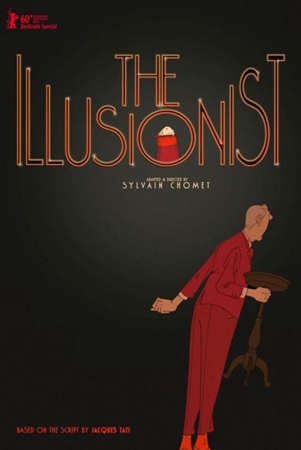
2) The Illusionist
3) Kick Ass
Valhalla Rising
The Ghost Writer
Animal Kingdom
Splice
The Fighter
Mother
The Girl With The Dragon Tattoo
Social Network*
Black Swan*
All I can say is that with the new Malick film coming out this year, and a few other things that look promising, let’s hope that 2011 is a better year for American film-making than it has been. We used to be good, but I’m losing my faith. This year’s list has quite a large amount of foreign work on it, and it seems like that is where the bravery, creativity and good film-making is going.
In any case, have a great new year, and hope your holidays were great!
I’m sitting in a coffee shop. Surrounded by techno-junkies…and I…well, I might as well be one of them.
My “smart” phone is on the left of me, charging through my computer. I have my headphones on, listening to the clips that I’m playing and readying for this piece and my iPod is on the right of me, charger underneath, just in case the battery runs low. It is truly amazing, this. What the hell am I doing? This isn’t me.
I look, for all intents and purposes, either like some weird Star Trek creature, with wires and mechanical technology hanging out all over the place (that is, if you include my tattoos & piercings), or some mad automaton you would call for assistance with your cellphone perhaps. “Hello, this is Verizon, how can I help you?”
The rest of the coffee shop? Not so much. They look happy. Dependent. Smiling. Ready to send off that next resume before hitting that next audition. But first, they’ll hit up Facebook to see what’s up, ya know? And that’s the hilarity. I come to this place with some regularity. It’s near where I live. I can take a pretty good gamble and say that amongst the very filled up shop (yesterday it was almost difficult to find a place to “plug-in”) most of ’em, myself included, are unemployed.
But this is Los Angeles. The LAND of the unemployed. After all, isn’t it still possible to get discovered? No, boys and girls, it’s not. Oh, and just to shatter your dreams even more, That Schwab’s story is an urban myth as well. Lana Turner, if she was discovered *anywhere* was most like discovered somewhere down the street. Schwab’s, on the other hand, much like the place I current am inhabiting, was also a locale for the unemployed to “check in” and “catch up” and perhaps get a break from someone else who may have a lead.
When I lost my job, everyone smiled and laughed and said, “Hey!! Now you’re on FUN-employment!” and I looked at them like they were crazy because, really, it’s an insane way to look at the world. Insane, in every sense of the word. See, you take away someone’s work/worklife/space, and you take away their reason to get up in the morning or their reason to leave the house. Quite literally. Say what you will, but it is true. And I always knew this, which is why I never took my job for granted when I had it. I liked my job. I loved my job. I did anachronistic activities sometimes with anachronistic materials but that made me feel like a million bucks. Now? Well, I’ve totally read a mass of books. I’ve watched a bunch of movies. But I’ve gotten to the point where Law & Order episodes are repeating themselves and that. Is. Not. Good. I miss having a job.
Here is the basic problem: Working give us parameters and schedules and rituals and routines. Human beings need these things. We always have and we always will. Most importantly, work gives us purpose. Just like relationships with other people give us purpose. What happens when we lose one? What happens if we lose both?
See, we have social worlds that are significantly interwoven and related to our working lives. Take away one…well, I don’t think I have to explain what happens to the other. You would be surprised at how much you actually depend on your co-workers. Those people may not be your best friends; in fact, you may not even like them, but you need them. The nauseatingly interesting thing is this: we are learning to supplant all of our social interactions- even those with the most disliked of office co-workers- with those of technology.
So perhaps, then, due to your Iphone 8.5,000 and your awesome new Ipad and whatever the latest and greatest techno-toy is, when you get laid off you won’t be so lonely?
See, I’m not actually sure that this will be the case. Argue what you like, but I have historical back up. When I was in elementary school, I became madly obsessed with the transcendentalists. I thought they were incredible. I should not have been surprised, therefore, when I went straight into an obsession with the Beats. Just made sense. What didn’t was the fact that I was also reading Stephen King and ridiculously thick, poorly written gothic romance novels, searching incessantly for another “Jane Eyre” or “Rebecca”, but hey…who’s counting?
At any rate, there was this guy. Henry David Thoreau. I thought he was a rock star; his ideologies and his whole conception of the world were beyond anything I had ever heard before and it blew my mind. At one point in his career he decided to go and take a cabin in Massachusetts, alone.
By spending a good long time there, he realized he had to leave. But not before having learned something extremely important. In his words, he left the woods:
…for as good a reason as I went there. Perhaps it seemed to me that I had several more lives to live, and could not spare any more time for that one. It is remarkable how easily and insensibly we fall into a particular route, and make a beaten track for ourselves. I had not lived there a week before my feet wore a path from my door to the pond-side; and though it is five or six years since I trod it, it is still quite distinct. It is true, I fear, that others may have fallen into it, and so helped to keep it open. The surface of the earth is soft and impressible by the feet of men; and so with the paths which the mind travels. How worn and dusty, then, must be the highways of the world, how deep the ruts of tradition and conformity! I did not wish to take a cabin passage, but rather to go before the mast and on the deck of the world, for there I could best see the moonlight amid the mountains. I do not wish to go below now. (Thoreau, Walden)
His desire not to “go below” speaks of something a bit more than simply non-conformity. Walden is, by no means a simple piece of literature. It is a gorgeous piece that discusses a litany of topics that, while having some sway on this discussion, would, literally, SWAY us off-course. Thoreau did not wish to “go below” because he recognized that his place was with other human beings, not in seclusion. To paraphrase and oversimplify, people need people in order to move forward through the world in a productive manner. He left for as good a reason as he came: solitude. The recognition that he had lived the “solitary life” and found it to be not as satisfying for the long-haul was a big step for a man as independent as Thoreau. So he left the woods.
The human connection is actually quite strong. Strong enough to leave the woods for, strong enough for people to give up organs for, strong enough for people to do lots of incredible things that make all the people on Oprah cry and go “Aw…” and “Wow!” And that’s great. It’s the wonderful part of the Opposable World. But it seems to be changing a lot as we attempt to turn flesh and muscle into metal and wire, like in the latest Droid commercial…
So here is the problem: we are working very very hard at making very very sure that we do not need people at all. The more we do that, the more jobs are lost and the more unemployment we have. The more unemployment we have, the more relationships and social worlds are lost and broken. See a pattern here? So, with all of this, and especially with the substantive rise of unemployment, don’t you think we should be more ANGRY?
You would, wouldn’t you? Paddy Chayefsky and Sidney Lumet certainly did, back in 1976. But back then, their major technological contender was the luminescent screen of the television, with some politicians and advertising schlumps vying to control people’s minds! What a thing to say…Oh Network, life was so much simpler then…*cue old-timey music and the squeak of a rocking chair*
I am not trying to downplay Network‘s content or the film itself by any stretch of the imagination. Every word, every bit of that narrative, every slice of that piece of cinema remains as true today as it was in 1976. What terrifies me is that in 1976, Paddy Chayefsky was discussing anger, and in 2010, due to a malaise come upon by what I call technojunkie-ism, no one gets angry anymore. Or heartbroken. Or even, dare I say it, really excited or happy. Being attached to these techno-toys, as shown in the Droid commercial, is turning us into robots, really sick robots, dangerously fast. There is even a new anxiety that is being written about called “disconnectivity anxiety” and it is EXACTLY what the words mean. It’s damn scary.
As you saw in the above clip, Peter Finch’s character, Howard Beale, walks into the studio to “make his witness.” What isn’t shown is that he has recently been fired and this is his last appearance on the show. He is, for all intents and purposes, unemployed. And he isn’t just unemployed, he has threatened suicide as a result…while he was on live television. The “last broadcast” in the above clip is supposed to make up for this “poor reaction” to being told he was, as the British say, being made redundant.
What we are shown here is his rage, pure and primal, beautiful and real in all of its intensity. As he asks the audience everywhere to join with him, we watch as he is being co-opted by Faye Dunaway’s character, and the remainder of the film just spirals gloriously from there. However, what is essential to this discussion is the way that Howard Beale expresses himself at this moment in time. He is being removed from and losing everything. He has spent his life working towards his goals, he has the aforementioned social connections (in fact, his best friend/co-worker was the one who had to give Beale the news) and now he has…nothing.
What Beale does, at this juncture, is appeal to the one community that he still has: his audience. He is no longer their television anchor; he is one of them. At the beginning, it seems that every time he says “we”, Beale might as well be saying “I.” However, his only somewhat-subtly disguised subjectivity does not take away from the effect his speech has on his “new peer group” due to the fact that he has now joined their ranks. In fact, if his rawness does anything, it only draws them in closer (thus making it easier for Faye Dunaway to continue to exploit him, and the television audiences, throughout the film).
His next dialogic switch from accusatory direct address to strong demand for everyone to stand up and assert themselves is key. Due to his recent termination, Beale has been left feeling invalid, not even human. He was going to take his own life on broadcast television due to the fact that the station had already done so. Beale gives adamant instructions. He states, “All I know is that first you’ve got to get mad. You’ve got to say, ‘I’m a human being, goddamnit, my life has value!'” Beale, through his anger, has connected with another community (his audience) and gotten back some sort of personal value for himself.
Tragically, that same personal value that Beale regained doesn’t seem to come into play when it has to do with techno-toys. In fact, there doesn’t seem to be anything much “personal” about them, save, perhaps, the painfully bedazzled cell-phone case or an iPod with your name inscribed on the back. Even those aspects seem to speak more about the “value” than the “personal.” Due to our heightened dependence on the largess of the technological empire, whether it be within Network (1976) or reality, our connections to each other are failing deeply. Howard Beale says it perfectly at a different juncture in the film.
Yep, Howard Beale, I couldn’t agree with you more. We ARE in a lot of trouble. These days, it’s not just that one tube we have to contend with. There are chips and boards, and all sorts of wonderful items that create trouble. Oh, Howard, we’ve let you down. 30 years later, have we learned nothing? When you pleaded for us to turn off that set, who actually did? More importantly, was there anyone at that juncture who actually would have? Who didn’t want to see what “happened next”? And ah…therein lies the rub.
We are now a generation of people in need. We need to know, need to have, need to be updated, needneedneed. It is as though we went through two World Wars, Vietnam, Korea and other assorted conflicts, and then, upon getting new technology, decided it was high time to regress to child-like mentality again for everyone so that we can play. The most problematic feature of this (ok, so it’s all problematic, but the very worst one) is that we have no one to parent us or tell us no. Thus, we are losing our way (and each other) as fast as we can develop new toys to play with.
David Wong wrote a brilliant article entitled, “7 Reasons Why The 21st Century Is Making You Miserable” and he hits the nail on the head every single time. He mentions that our social interactions have degenerated to basically less than nothing, making it so that we rarely interact with strangers and we very (if ever) open our friend groups. This alone is heartbreaking. OK, so beyond our retracting our social claws, we also communicate increasingly poorly (almost exclusive through text and online), are almost never criticized (there is a difference between a criticism and an insult…he explains it quite well!), and because most of our friends are online or “virtual,” they are actually a great deal less demanding and therefore the friendship is much less fulfilling and deep. Those are a few of the reasons. I would love you to read the article. It is fantastic and alarmingly accurate.
What Wong hits on is something that I find scariest of all: it is all being taken in stride. Our separation from ourselves and our friends is being shrugged off like a drug charge on Paris Hilton. There is no Howard Beale out there, and if there was, who would listen? These instruments are too much part of our culture now, too convenient…If anyone got upset, all someone would have to do is offer them a free upgrade or a new model and *whoosh*…gone…They would be happy as hell, and gonna find a new app!
As we slip further and further into the abyss of some Cronenberg-ian nightmare, where our Smartphones become part of our hands and our iPods and their holders become permanent bicep attachments from jogging at the gym, it would be nice to think of Howard Beale every so often, and hope that maybe we can figure out a way to put down the techno-toys for a bit before it becomes too late. Unless it is too late. But I would like to think that it isn’t. We need to be responsible about our technologies and each other.
Realistically, I’m not sure I want to know everyone sitting at my coffee shop. But I’m unemployed, I’m lonely, and frankly…I’m game. If we don’t get along, fair enough. But to be perfectly honest, I would rather be out in the world right now trying to have conversations with sentient beings than cooped up in my room continuing a road to ruin and devastation along the lines of what David Wong discusses.
Dear Howard Beale,
Thank you for inspiring the anger in me, and reminding me that I, too, am a human being, goddamnit, and I have value.
I’m mad as hell, and I’m not gonna take it anymore!
Love,
Ariel
Every time he says “we”, Beale might as well be saying “I”
See Shutter Island. No really, see it. Look at it. Physically. And listen. Carefully. To everything that they are saying because as much as this is a fiction film, it kinda isn’t. To all of the folks who called this film Shitter Island? I’m not sure what movie you watched & I’m thinking that maybe you are possibly either a) uneducated about the mental health system’s history in this country (especially on the east coast, especially in the Massachusetts area) or b) are kinda uncomfortable with it or c) both. Now I am willing to admit that the film had many storylines going on at one time, which could seem…jumbled, and mixed some things together a great deal, but I think….that might have been the point. See the film through, and you will know what I mean.
No spoilers here, ladies & gentlemen.
Back to my main point: this is a film in a long line of films about mental illness and institutionalization that serves a purpose- historicizing something that needed it. BADLY. See, Shutter Island, while based upon author Dennis Lehane’s sightings of Long Island (yes, there is one in Boston) as a child, is actually based upon occurrences that took place within the walls of Danvers State Hospital, located in Danvers, MA.
The “real” Shutter Island: Long Island has been a chronic disease hospital, “home for the indigent” and current location of several social service programs since the 1880’s. Up until the 1950’s, when a bridge was built, this island was only accessible by ferry.
Rumored to be the birthplace of the lobotomy, that was simply one of the larger hypes surrounding the locale. The lobotomy procedure was researched and developed in wholly other locations. Danvers itself was built in 1878 and considered to be one of the sites of some of the most horrific psychiatric “treatments” in history, regardless of their “no restraints” policy for the patients. While reporting to house about 600 patients at maximum, the hospital ended up housing 2400 (after only building a few extensions). Danvers was closed in 1992, and reopened again as “Avalon Apartments” in 2006. Yes, you too can pay rent to live on the site of horrible torture!! –Photograph of Danvers c/o http://www.kirkbridebuildings.com
See Danvers wasn’t just a mental institution, it was a mental institution that believed it was truly “groundbreaking” both in its philosophies and in its actions. While I can’t argue that the idea of having no restraints on your patients was a pretty big deal for a mental health industry that was incredibly ass-backwards in the first place, I can say, without any compulsion that torture and abuse would probably go on my list of “um, no, not really groundbreaking.” I dunno. Call me crazy.
See, what happened is actually pretty sad. The original superintendent, Dr. Thomas Story Kirkbride, for whom the main initial buildings were named for, really *did* want to change the world of modern psychiatry. Quick sidenote: if you want to see a great site on the Kirkbride Buildings, please check out the site from whence the above photograph of the Danvers Building site came from! Its truly incredible! Very informative and gorgeous photos! So, back to Dr. Thomas. Serving from 1841-1883, he really believed in providing a beautiful environment where the peaceful setting would pacify the mind, and that the proper care and respect given to patients would help them in their rehabilitation or at least in their everyday survival.
Kirkbride was one of many who were adopting a new system based on ideas of moral treatment, a concept and an approach to the mentally ill that had developed over the years that essentially said: Oh, you know how we used to think that you loony guys were animals and stuff and just lock you up and throw food at ya? Oops! We screwed up…Uh, this lady called Dorothea Dix came and yelled at us last night and we, uh, learned something….
Kirkbride ended up establishing what is known as the Kirkbride Plan, which is a type of architectural plan that has been used in asylums all over the US, and it was created in order to give patients a bit more privacy and a decent amount more dignity as well. This was used in the design of Danvers. However, these nice architecture and moral treatment plans, as wonderful as they were, did not prevent the nightmare that was to come.
The door to the violent wards, at Danvers.
Due to the changes in not only in the mental health system, but economics, and patient density, Danvers State Hospital, once a proud institution of progressive methodologies and compassionate care became a site of terror and human destruction. Michael Ramseur, an expert on the history of Danvers and its lurid details discusses what he has discovered in terms of what Albert Deutsch, a journalist who worked for social reform especially in the case of the mentally ill, wrote as part of his book, “Shame of the States.” Ramseur states that some of the photographs that Deutsch published were very close to what he had seen at Danvers. As Ramseur notes, “In these photographs, I saw the same deteriorated spaces as at Danvers…only as opposed to the abandoned spaces I had been drawing at Danvers, these spaces were full of patients, patients who were haggard and ghostly, often peering blankly into space but sometimes staring penetratingly into the camera. Poorly clothed and sometimes naked, these legions of lost souls were shown pacing aimlessly on the wards, lying on the filthy cement floors or sitting head-in-hand against the pock-marked wall.” (www.ramseursdanversstatehospital.com)
As time moved forward, away from the hippie-dippie “let’s take care of people by making everything look pretty” vibe, mental health professionals discovered psychosurgery. And- wait- the party’s just getting started- they discovered fun little neuroleptics like chlorpromazine aka Thorazine, and for a real jazzy start-’em-up good time, they found Electroconvulsive therapy and Insulin shock therapy. Of course, this all coincided with the fact that more folks were being stuffed in asylums all the time because hey- you’re gay? ASYLUM. You’re politically transgressive? ASYLUM. You’ve been a bad wife aka you’re seriously fucking depressed about your life/being in a submissive/nothing role and the feminist movement is about 25 years away? ASYLUM. So…yes, along with Mary Lee who is a paranoid schizophrenic and talks to several voices on an hourly basis, Joe Schmoe gets socked away because mum and dad caught him with another boy. Oh…and then there was a World War and its aftermath, too, wasn’t there?
WOW. Makes me kinda glad to be where I am today, know what I mean, Vern?
Shutter Island‘s biggest problem is its historical accuracy. If that is a film’s problem, then I’ll watch problematic films for the rest of my life. Everything it deals with: trauma, death, destruction, war, in/sanity, women’s issues, alcoholism…all timely issues for 1954. Scorsese’s skilled collection of one man’s journey through Shutter Island in search of a missing woman and then winding up with so-much-more deserves to be looked at in a very particular and special light.
This is no Mean Streets, this isn’t even Cape Fear. I’m sorry if that is what you thought that you were coming to see…but this film, regardless of all the moments that have no subtlety, is an extremely meticulous film, planned and executed in a way that made me…not sure if I *liked* it as much as I appreciated it and wanted to see it again. The problem with writing about this film is that it IS so meticulous and I refuse to give anything away, so I can only say this: I view this film as a tree, with deep roots and a solid body. I think that Scorsese did something very different with this film and I like that. The music was incredible, the acting/performances were SO strong, the production design beautiful, and it led me in places I didn’t know that I was going. If you felt uncomfortable, GOOD. If you felt weird about things, GOOD. And if you didn’t understand it completely? That’s ok, too. I, myself, look forward to a second viewing. I feel like this is going to turn out to be a great deal like Gangs of New York. I knew that I could appreciate it, but I wasn’t 100% on it because it made me feel…uncomfortable, I think. But I rewatched that a few nights ago and loved it…so?
This is also a Dennis Lehane story. The man behind Mystic River and Gone, Baby, Gone is probably not out to make your day a happy or comfortable one, and I’m really ok with that. Mystic River was probably my favorite movie of 2003 and I still rewatch it (although a laugh-fest it is not!). Lehane’s involvement of his Boston environs with an incredibly dynamic and detail-intensive mystery story is well done, and made me revisit the film throughout the day to see what *I* had missed (although, to be fair, some of that credit should really go to Laeta Kalogridis, the screenwriter, but it was still Lehane’s original piece.
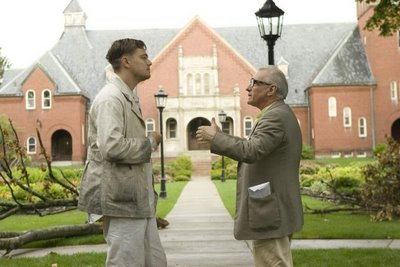
Leo & Marty get “Shuttered” away…
Shutter Island is also a very important piece in Scorsese’s works, as it does bring history to the forefront, and a history that has long been forgotten or, in the case of Danvers, paved over to make room for apartments. Archivist Kirsten Anderberg wrote an interesting piece on her research about the history of American asylums, and I think it’s worth a gander. We have a pretty gnarly history with the mentally ill and mental cruelty.
Filmically, we have shown this before, Shutter Island is not the first go. But it might be important to note that within the films that have been released and/or made, we have also seen it change history as in the case of Frederick Wiseman’s Titicut Follies (1967), a documentary made about the Bridgewater State Hospital for the criminally insane in Bridgewater, MA. The footage that was shown in this film and the abject cruelty that was put on camera may have effected at least some change, as Bridgewater changed its “force-feeding” and torturing ways…albeit not until 20 years later, after 7 patients died, and several 1st Amendment lawsuits regarding the film.
In conclusion, Shutter Island, while not a “Scorsese” film, is one to be taken seriously on a multitude of levels. It is a serious drama, a serious historical work, and a quite intelligent piece of local reflection, due to the hand (as in all of his works) of Bostonian Dennis Lehane. Scorsese should be allowed to take a day off once in a while, guys, to do a different thing. And this was a very complicated film. It should not be shrugged off or tossed aside.
Oh, and while we’re on the subject of not tossing stuff aside, I would advise all of you to check out the pictures that some folks took of the inside of Danvers State Hospital….They’re really amazing….here’s some links:
From the very opening of Grace, I had a feeling that it might be a slightly different kind of film. With its very delicate and feminine visuals and sounds, it opens as a film that is very much in accordance to what ends up being the subject matter: maternalism and child-rearing. However, as it is indeed a horror movie, the light and airy features of these opening shots and the camera drifting languidly over Jordan Ladd’s recumbent naked form seem remarkably eerie when the promos so very clearly advertise death and something “unnatural.”
So the opening, with its almost Downy-commercial-type cleanliness, seems to be underscoring not only the most physically sensual elements of the female but the very natural elements of the female body in general, as the first action we see in the film is the sex act (and what could be more natural than that?).
Throughout the film, what is “natural” seems to be a running theme, which I found to be quite interesting. At first, since there were so many discussions about health food, midwifery and non-traditional health methodologies in general, I initially took the film to be making a critique of all these kinds of hyper-liberal vegetarian/vegan sensibilities. However, I then realized Grace had much deeper-seated and smarter thematics then that. See, ANYONE can take a horror film and chuck in a few “Oh, check out the seitan-eating, soy-milk drinkin’, edamame chompin’ folks!” jokes. That’s simple. Put a few of those in, then have them be the first to suffer and/or die, and *presto*!! Instant laughs from the horror community! Hell, I’d probably laugh…if they were funny! But it takes a pretty special film to take these issues and involve them into a deeper seated narrative that discusses mother issues and what is natural to being a mother. It also was pretty impressive to me, as a female, that there was a male director who was able to hit on as many issues as he did in this film without it feeling in any way, shape or form invasive, exploitative or disgusting.
This was a horror movie. No doubt about it. But it was very sophisticated and brought a great many women’s issues to the forefront, whether intentionally or not. To a woman like me, who digs on women’s issues? I found that pretty exciting.
So let’s get my problems with the film out of the way first: the lesbian shit. There was one character who had a jealousy issue and…the actress wasn’t my fave and the lesbian jealousy weirdness angle is…a bit played out in my opinion. HOWEVER, it was done with a bit more class than normal, and I’m not sure if I could see another route to take if they were gonna have that involved, and it sorta was part of the story, so…I guess it was alright. I really do wish that there could have been a different way that the narrative could have gone without using the age-old (and somewhat tired) old college-relationship between 2 women that comes back as a central figure within the film, but…hey- it didn’t distract me SO much that I didn’t like the movie. It was the ONLY thing that I had ANY problem with and to say that? That’s pretty awesome. It means that this is a pretty damn good film.
On to the good stuff: EVERYTHING ELSE. This movie has tension coming out of every pore of celluloid. When we stayed for the Q&A, the composer discussed some of the aural reasonings why and I thought that those reasons ALONE were incredible. Turns out that Austin Wintory recorded actual baby cries and then mixed them into the music that he composed for the film. The reasoning for this, he said, beyond the actual sound which increased tension in and of itself, is that the pitch of a baby’s cry is the one sound that every human can hear (well, unless you’re deaf, I suppose), no matter what. Scientifically, he reported, the sound is at such a level that your body will respond to that sound in a way that it does not respond to anything else in the world. Indeed, I would say, this does seem to make sense, as somehow we can ALWAYS seem to hear babies crying whether we want to or not. Wintory used the example of being on an airplane and being able to hear a child in the very back of the plane and yet having it sound like the infant was right in your face. Ever been there? Thought so. At any rate, I am a huge sucker for music in film, and THIS FILM had it, and I will say that Wintory’s intermingling of baby sounds with the rest of his lullaby-esque tunes as well as the other scoring was incredible. A good score/good music can make or break a horror movie for me. Would Halloween have been the same without that tune? Psycho? Exactly. So…well done, Mr. Wintory, good addition!
Margaret White *seriously* loved HER daughter!
On to the story now…Within the horror film genre, we have seen some pretty interesting mother figures, have we not?
Norman tried to please you, Mrs. Bates, he really did!
Dude, Mrs. Voorhees, we get it. We would've been pissed if Jason was our kid, too.
The mothers represented within Grace bring forth a whole new kind of mothering to the horror world that I feel has begun within the last few years, and I last saw represented within the astonishingly fantastic French film, Inside. It seems to me that there has always been a certain amount of fascination with the mother figure within the world of horror. Clearly, as shown above, that figure has not always been the figure of protection in, um, the most positive manner, shall we say? Now within films like Grace and Inside I feel like we may have turned a corner. I’m wondering, since men made BOTH of these films, if there hasn’t been a certain change within the way that these directors have come to synthesize the maternal representatives within the slasher genres at large, as well as other horror cinema venues. It seems that, with these films, we are starting to witness a kind of sea change that, frankly, is ALL TOO WELCOME.
Fuckin’ A, do I love a good horror movie. Slashing, hacking, blood, guts. You name it? I love it. I ADORE GORE. But I’m not one of those people who loves without discrimination. I *am* particular. But what I love, I do love very much. And I am extremely fascinated by this new turn in the world of horror. It seems that for years and years we have had a certain set of (for lack of a better term) Horror “Family” Values, many of which have been covered by academics such as Carol J. Clover, Barbara Creed, Harry Benshoff, just to name a precious few (as there are *so* many goodies!). These Horror Family Values have very stringent ideologies in regards to sexuality and motherhood. Essentially, in a horror movie, if you fuck, you’ll die and if you’re a mom, you’re a crazy homicidal bitch with no redeeming qualities whatsoever, emphasis on the crazy, if-you-please. While I think we’re still all waiting for a film where kids can safely orgasm and survive past the post-coital beer (if they even get that far before a knife/axe/murdering-object-of-choice rips through their young nubile flesh), the Mother Issue seems to be making a change.
I hate spoilers, EVEN in reviews, so I’m not going to give anything away. But I will go so far as to say that starting in the film Inside and now continuing on with the film Grace, I’m seeing an evolution in the depiction of motherhood in horror which I quite like. While I could attempt to use some of my Freudian feminist film scholarship stuffs on this, I’m not sure I want to at this juncture. My feelings about this transition probably need more fodder in order for that kind of highly formulated (and quite possibly extensively boring to many) discussion on Sigmund and where he’s at today. I’d probably use the ol’ Virginia Slims adage, “You’ve Come a Long Way, Baby.” I think that the concept that we are no longer treating the mother figure with anger and exposing her to the kind of harsh negativity within the horror film that we have been doing for YEARS is a big step.
It could definitely be argued that both of the mothers seen in Grace have elements of Teh Crazy in them, and Have Issues. However, on the whole, I feel that their portrayals actually have a kind of yin/yang sensibility to them, and do more for exploring female mother issues and issues of loss and attachment. And to say that there are characters in a horror movie that are explored with class and sensitivity is a pretty bold statement, but it must be said. This is a very mature film, and comes with high recommendations from me.
So, here’s to ya, boys. Its fascinating to see that it took a few young men to promote women and motherhood within the horror world. I like it. I like it a lot. I hope to see more people do it. It has actually brought the calibre of the horror film UP, significantly, which, in my eyes is DREADFULLY needed sometimes! End points? If you haven’t seen Inside, holy shit- SEE IT!!! And if you haven’t seen Grace? WELL, what’re you waiting for?
It’s not like it never happens. It happens all the time.
We just never notice.
Well, most of us never notice.
On the other hand, were more of us proficient in other languages, we would be far more indignant about the sheer volume of cases of incorrect subtitling that occur on a film-by-film basis. But, alas, we are not. So they pass us by, and we accept foreign films as having a certain amount of fidelity to their original intentions, linguistically.
To be fair, there are a good number of films that do maintain a pretty faithful translatory nature. However, it is in those few films that stray so desparately from either the exact wording or the feel of the dialogue that are the bad apples that ruin the bunch.
The tragedy comes when it happens to a film as breathtaking and ground-breaking in many ways as Let The Right One In. I was sitting here tonight, and my good friend Gariana from Popcorn Mafia sends me this link that nearly sent me screaming down the street, accusing any young studio exec-type within yelling distance of having *anything* to do with it (even though I knew, full well, that they had no such position in the matter).
So yes. It appears that someone has decided that Americans, on the whole, were ready only for Twilight when it came to Vampire movies. The dumbing down of the subtitles on the DVD is not only ludicrous it’s insulting. Thanks to RobG at Icons Of Fright, I now know that I will not be buying the American release. His treatment of the subtitling and what was “lost in translation” is not only informative, but incisive and well-displayed.
In any case, just a FYI and a heads’ up. If you care about the film (and you really should- its ALL about the “little things” in this film that can ONLY be conveyed through the incredible use of finely attenuated dialogue and storytelling), do yourself a favor and skip the American release- get the Canadian release, get the Korean/Swedish/Swahili…who cares! Just as long as the subtitles are more finely accented to the Real Dialogue.
If they are not, you lose half the film, and it would be like seeing the film without hearing it, or vice versa, a very difficult proposition indeed.
Interesting times right now, I have to say. And the synergy of my film viewing and the world at large is not going unnoticed by this rabid cinephile.
Tonight I went to the Silent Movie Theater to see In a Lonely Place, a film that I fell in love with back in college at UCSC, when my best friend Ray showed it to me. Since then, I have read the book it was based on, wrote a paper about it, and, better still, found an absolutely fucking BRILLIANT song that was based on it (using one of the best lines from the damn film).
This is undoubtedly a troubling film. There is no question in my mind that it is one of Bogart’s best performances, as you see his range of acting through an array of facial expressions that he rarely gets the opportunity to use in most of his more standard roles, however…it makes the film (and his character) that much more, well, disturbing.
See, there’s a murder, right? And it’s a noir, so there seems to be a wrong man thing, right? (And no, I’m NOT going to give anything away, I hate spoilers and ruining films for people with the heat of a thousand burning fires) And of course there’s a love story somewhere inside. All set within the confines of Hollywood and the film industry. Now, the WONDERFUL thing about many of the films in the ’40’s and ’50’s that were made about Hollywood is the way that they treated the landscape. Far from it being the environment where dreams come true and stars are born, it is diseased. Hollywood is sick and rotting, it is a corpse being slowly picked apart by the vultures who live there; beasts who feed upon it (some call those agents, but hey…) trying to gain some substantiation but end up with nothing but more contamination. My point is, that this film is about the sickness.
I am not a stranger to Hollywood, nor am I a stranger to infirmity, especially the kind discussed within the narrative of this film. I wish I could say that it was foreign to me, however, whether it was a personal experience or a friend’s, it is all too familiar. See, no matter how you cut it, Bogart’s character, Dixon Steele, is guilty. I know, I know, I just told you I wasn’t going to spoil anything, but hear me out- I’m not. The main issue in this film has to do with anger issues, and, more crucially, domestic violence. As the cops look at his case, they go through Dix’s files, they come across case after case of fights and brawls and assorted other socially “acceptable” male misbehavior. Then they come to one of his former girlfriends. She retracted the call she made about him, and said that she had broken her nose by “running into a door.”
This is the point where we start to worry and wonder. This is the part where we become disturbed. THIS is the part where the acceptable “guy-ism” of punching the other dude’s lights out doesn’t count. Because you hit a girl. Now I am a full-on feminist, but I don’t think that there aren’t extenuating circumstances to many situations and the term “hitting a girl” does kinda rub me the wrong way at times because it infers that, well, I couldn’t punch the fuck outta someone if I wanted to. However, I also realize that it is a biological FACT that most men are physically stronger than most women in many circumstances (minus weightlifters, bodybuilders, military, and probably a good percentage of the crazy nutjobs that survive Burning Man on a yearly basis, etc), and therefore? YOU DON’T HIT A GIRL.
Which brings me back to my main discussion. Nicholas Ray’s film and Chris Brown and Rihanna. Wh-wh-wh-what??
Yes, I wrote exactly that. Now the interesting thing is, as I was driving to the theater tonight, I was oblivious to the connection between the two (Gee, I dunno, film noir from 1950, R&B teeny-bopper couple from 2009…connection just *didn’t* immediately spring to mind…call me crazy), but as I watched the film unfurl, I was horrified to realize that there was Too Much There. Watching Dixon Steele unravel, watching Gloria Grahame respond, watching their relationship build to the crescendo that it does, the magnificence that is that film…I found more items inside of the diegesis alarming that I had before. Yet, I also found them more heartbreaking and more heartwrenching as well. Because nothing is ever simple, nothing is ever easy, and love, above all, is the most difficult of all things. However, this film shows that love, with certain people, can be a combat zone, and does nothing to hide that fact. As a sidenote, it would seem to me that this at least partially stemmed from the fact that Nicholas Ray and his star, Gloria Grahame, were in the middle of ending their marriage during the making of the film (he slept on the set, actually, claiming the need to “work late”). However, like war, in this film love is hell.
However, it is not that simple. Especially not in real life. And especially not when the media gets involved (also one of the pivotal messages of the film- a critique of fame and the role that the media plays in making/breaking personal lives). This very aspect of media involvement hit me like a jackhammer. Actually, it hit me more like the unending barrage of updates I’ve been seeing everyday at the gym about Chris Brown and Rihanna. And I was fascinated by the parallel issues that I was seeing within fiction and non-fiction, with the more than 50 years in between.
I had been listening to a piece on NPR about teenagers in LA and their responses to the Chris Brown/Rihanna thing right before I pulled up to the theater. See, it’s pretty phenomenal what fandom and fan culture will do to people and their synthesis of actual real life events. The way I see it, there are three main activities that fans regularly engage in that can be seriously and horrifically detrimental in situations like this.
1) Fans will intentionally ignore the negative/unacceptable in order to keep their image of their Perfect Idol “perfect”
2) Fans will actively search for and find “back up” evidence (no matter how outlandish it may seem) that defies the event in question in order to reposition and restore the Perfect Idol back to his/her “rightful” throne
3) Fans will vigorously disseminate their version of events as the absolute truth, as a result of their expert knowledge in that area
Now, please do not misunderstand me. I am a HUGE fan of Fandoms and Fan Culture. I study it, love it, AM it, to a certain extent. Each of the above things in and of itself is not inherently evil. However, when it comes to a situation like Rihanna and Chris Brown…it becomes very dangerous. These three things are, obviously, methods that fans use to intentionally distort the truth. This is not bad when it comes to the discussion of William Shatner’s toupees, but it is damaging beyond words when it comes to something like domestic violence.
Especially when there are, oh, no celebrities with the balls enough to stand up and say “Hey guys- this shit don’t fly. This was not good.” That certainly doesn’t help. So when KCRW has these teenagers discussing their feelings about whether Rihanna hit him first, and then whether she deserved to get hit back because she started it, and others disowning Brown altogether, you end up realizing that there is an entire generation of kids out there right now, struggling to cobble together some kind of reasoning and some kind of meaning from all of this with no guidance. Oh boo hoo, so Brown isn’t getting to do that awards show. Is that going to help these girls who love(d) him? Not really. One of the girls said something to the effect of “Oh, he’s never going to be able to come back from this one. He’s being called Ike Turner, you don’t come back from that.” Tragically, and especially after rewatching the film tonight, I have to play the cynic on this one. He’s already coming back. His PR people are working overtime to make damn sure that happens. Thus I say, welcome to the sickness. Welcome to the disease. Welcome to the virus-ridden place that used to be located in Hollywood, but has now been expanded to a meta-location called, simply, Celebrity.
I was going to post a picture of Rihanna and her face, but do you really need to see that? I mean, that is a physically embodied example of illness and malady, physically imposed and created, but sickness nonethless. But I thought better of it. We’ve all seen it by now, and if you haven’t, google it. NO ONE should EVER get beaten like that. I’m glad that picture got leaked though, even if her 21-year-old ass isn’t. It’s going to make a difference in someone’s life. I hope. But I’m not going to repost the damn thing.
Do we need to see more reiteration on WHY you shouldn’t beat another human being to a bloody pulp? I’m thinking….no. So instead, I’ll end with a brief musing on the foreign poster I found for In a Lonely Place. I thought it was particularly fascinating because, well, the title change. I have a penchant for foreign film posters. BIG time. My favorites currently are the Polish ones. But this one is pretty interesting. The film’s “tagline” literally says “Of hatred? or of death?” And the title? Well, this film is now called “Death in a kiss.”
Quite a different feel from In a Lonely Place, eh? The association of kisses with violence and death with hate and intimacies, all against the backdrop of what seems to be Bogart caressing Grahame’s face in his hands…It’s quite intense. Not unlike the film. Translations and updates can be funny things, not unlike language itself. It can change a film from having a semi-moody, melancholic title to one that connotes vicious violence and explosive passions. That very same language is also used to change one man’s actions of anger and violence into a simple “mistake,” or something that was “taken out of context,” with very similar effects: the entire scene changes.
At the end of the day, media is as sensitive as we are. However, as it seems to be continually proven, not all the people who are producing it these days, are. They are those vultures as mentioned earlier, circling, waiting. At this point it is just up to us really. We have to decide whether we’re going to be down with the sickness, or abscond to greener pastures and leave it for others to deal with, as the celebrities seemed to have done with the Rihanna/Brown case. Alternatively, we can always try and revitalize this bitch, give it some blood, a new title and tagline perhaps. I don’t know about you, but those foreign posters? They always speak volumes to me.
Yeah, so I’m failing right now on the blogging thing. Been reaaaaaaaallly busy….work, school, etc.
So the good stuff- the writing- it will come.
I found this today, though, and had to share.
This morning, at the asscrack of OMG-it-is-way-too-early-o’clock-in-the-morning, the nominations for the 81st Annual Academy Awards were announced. Why they announce it at such a time, I will never know. But it is a time that a very dear friend of mine has made a habit of being up for, each year. “Why do that?” one may ask, “The information is not going to change within a few hours. Why not get that extra few hours of shut-eye?” Perhaps he does it because he wants to be the first to know. His dedication to the cinema is one of the strongest I have ever known, so this would not be unthinkable. Perhaps he does it because he wants to see if his guesses were right. Perhaps he simply wants to see if the movies/actors/film stuffs that he loved so dearly during the year get recognized by the Academy of Motion Picture Arts and Sciences. Frankly, it’s probably all of these things and more. However, there is one thing that prevails above and beyond all these other things-something that speaks to me in a very similar way regarding this particular social institution- and that one thing is ritual.
I’ll tell you something about ritual. Ritual and the cinema go together like…well, popcorn and soda?
We all have our ways of interacting with the screen, but the important thing is that we do it. In a world where Netflix is the rule and not the exception, I wish to argue for the beauty of the cinematic experience and all it entails, and not just for the visual content. It is as much part of the film as the narrative itself. I am not the first to suggest this, of course. In essays written for the seminal film journal Close Up, a quarterly published between 1927 and 1933, there was a particular concentration on the experience within the theater. In no uncertain terms, the writers in this magazine sought to underscore the consequence of the folks sitting next to you just as much as they worked to point out the influence of the actual visual stimulae.
One writer, Dorothy Richardson, even went so far as to describe the cinematic experience in religious terms. She calls the audience an “increasing congregation,” and the employees religious figures like bishops. More importantly, she labels the interaction between said congregation and the movie screen “prayer.” Richardson wrote that the theatrical experience was one of “universal hospitality,” welcoming anyone and everyone to come into the pews. This depiction of cinema as both communal locale and religio-cultural spawning ground only makes the ritualistic aspects of attending an actual theater to see a film even more pronounced.
Thing is, its expensive. I know that. And right now, that’s hard. But when you have places like the New Beverly Cinema, where you can get two movies for $7 most nights, and concessions even cheaper…well, its silly not to go at least every once in a while. If you’re in LA, that is. But I refuse to believe that there isn’t at least ONE theater in most places that most people could afford to go to every once in a while. Because, see, I also believe that we can’t afford not to. The minute that we start fully staying at home, the moment we lose our sense of the “universal hospitality” of a movie theater, the VERY MINUTE we forget what it’s like to be bugged by the laugh of the guy two rows over or the slurping sound of the teenagers making out behind us, or the bawdy drunks who snuck their liquor in………then we lose ourselves and we lose a piece of history. And we are stuck with Netflix. ONLY. Do you really want that?
Pardon my language, but what a boring fucking concept! Not to mention the fact that we will then lose all ability to see the brillilance of a film like the recent Let the Right One In, with its exquisite shot structure and blackest-of-black nights against whitest-of-white snow on a big screen. The experience, while still nice on a small screen, would be just that- “nice.” In a theater, with people, larger than life…its beyond incredible.
I’m not willing to part with that. Are you?
Now what does this have to do with this morning’s announcements? Well, if nothing else, religion has a hellova lot to do with ritual. In fact, since I’m not sure where I am on the actual Higher Being issue, I think that sometimes a good cinematic experience can be just as spiritual to me as a good night in synagogue, since I feel drawn to both in a very deep way. But to a certain extent, that could also be considered cultural. But that’s neither here nor there. Back to Oscar.
Oscar is a holiday for me. And more than that, it’s a ritual. I have preparations. I have guacamole. I spend the day getting ready, watching the red carpet, getting all prepared. Like it was some weird form of Christmas. It’s like my Superbowl. My Personal Day. And I DO like to celebrate it
So many people I know “don’t believe in awards shows, man, they’re such a pile of crap.”
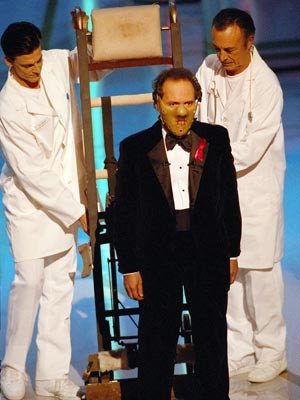
And you know what? Sometimes, um, they’re not the best. Ellen kinda sucked as a host. But remember this?
You can’t tell me that that wasn’t AWESOME. I mean…can you? Honestly?
So while I’m aware (or have been told) that “award shows don’t really mean anything” and that the industry is JUST THAT- an industry, I still love the show and it means something to me. I grew up with my Grandmother voting on the damned things. First time I saw a lot of movies was through screeners that we got. OK, ok, so I saw Naked when I was a little too young, but I got the Footloose and Flashdance soundtracks on vinyl, when they used to send out vinyl!
Ritual. It has to do with history and with precedence. It has to do with importance and belief. It has to do with a process.
All of the above terms would apply to my experience with film, I believe, and what place Oscar has in my life. This will be the first year that I can remember where I have seen practically every film nominated (for most categories, too) on a big screen. That fact alone makes this year extraordinary. Clearly, this is more than slightly due to my amazing housemate Cathie, but even so…good job me!
Throughout my film education, I have had many love affairs with many different directors, writers, cinematographers, genres and time periods. As I have gotten older, I have learned that what my love affair truly consists of is a undying lust for the experience of cinema. Writing about film does that for me, reading about film does that for me, sitting near the front or IN the front row of a movie theater does that for me.
So you don’t have to get up at 5:30 in the morning to find out if Mickey Rourke got nominated for The Wrestler if you don’t want to, and you don’t have to even watch the awards. And, to be perfectly honest, I’m not certain how I feel about the Hugh Jackman-host thing. But I would implore you to do one thing- think about the fact that for the last 81 years we have been celebrating what the industry has considered the Best of the Best of what the Big Time Cinematic Industry has produced.It may not all be good, it may not even be passable at times, but its an interesting reflection of where we are and where we’ve been. And that ritual, in and of itself, is worth at least a few moments of your time.
All right cats & kittens, here we are- end of the year- and I know that AT LEAST one of you would like to know what my top 5 films of 2008 (that I have SEEN) are.
Well, y’know what?
Not only am I going to tell you, but I’m going to SHOW you.
I will post a trailer for each one of my favorite films of this year, with a brief description of why I adore it and think it rocked my socks more than the, well, um, embarrassingly large amount of other films I have seen within the year. Although, that said, truth be told…the large amount of films wasn’t always recent films so I guess that doesn’t really count. BUT THESE DO!!
And these films are EXCELLENT. Seriously. Really really really good. This is the first year I have gone to see new films multiple times in the theater in a VERY long time (many many years…perhaps since Lost Highway or American Beauty) and it is with great passion and cinematic drive that I urge you to partake in these pieces of celluloid. It’s been a shitty shitty year for me in my personal life, but good GOD it’s been a great year for me with movies!
So here’s the way it’s gonna work. I’m gonna post my top 5, but they will NOT, I repeat NOT be in any kind of qualitative order. In other words, there’s just simply no way that I could like one of these over another over another. They are all so different and so amazing in their own ways, and I cannot put one above the other. So, think of ’em on the same scale of Cinema Love, and enjoy.
Lemme know whatcha think, k?
Celluloid kisses and Reel-y big hugs,
Ariel
I don’t play favorites very often, if at all, but if pressed…this was my very favorite film of 2008. The first 45 seconds left me thrilled, stunned, and shocked. This is not your average film. More than anything, this is absolutely nothing at ALL like Waking Life. Don’t even *think* about comparing the two. This film is brutal, gorgeous, and relentless. I think I probably cried through 70% of the film, half because of the sheer magnificence of the art and splendor of the cinematic story before me and half because of content. The animation and the process (of which Folman has several articles/interviews available) are beyond compare.
I can truly truly truly say that I have never seen anything like it.
This film is out now. You will be doing yourself a complete disservice if you do not SEE THIS FILM. The soundtrack, the visuals, the EVERYTHING…perfection. Waltz With Bashir. AMAZING.
If nothing else gets you, the performances ALONE are enough to warrant the ridiculous amount of money theaters are charging for admission these days. However, it’s not just that. This film virtually *drips* with quality. To me, it was like watching the most sensationally intense boxing match I had ever seen in my life. So much so, that at times, it even seemed to be photographed in slightly that manner. Alongside the obviously interesting historical issues and the simply fascinating discussion on the media (including media figures), this film also focuses on the viewer’s own emotional positionality, toying with it a bit, based on the magnificent performances and incredible story in tandem. I dug that part A LOT. Well played, Mr. Howard, one of the best you’ve done!
OK, so aside from my fascination with (read: massive crush on) Robert Downey Jr.for the last 20 years, my absolute adoration for Jeff Bridges and my newfound interest in Terrance Howard (after Hustle & Flow), this movie rocked me. It is a solid and striking film, and I say that not just because I’m a comic book geek, not just because it was fun and exciting, and not just because it was well-written and structured (although it was all of those things and more). What is truly arresting about Iron Man is Favreau’s choice to lay bare the multitude of issues surrounding war as a business and an economic industry, and what that really means, in such an updated, contemporary fashion. Anyone who says that comic book movies are just fluff pieces with no transitive value, needs to experience Iron Man in all its glory. Seriously.
Yeah, I’ve been raving about this left, right & center. FINE. See, I love wrestling. I do. I wouldn’t have written a 35-pg paper about wrestling (that I eventually presented at a international conference) if I didn’t love it. But that’s not the only reason I love this movie. I love this film because it’s accurate as HELL and grips your heart in a choke-hold, refusing to let go. The balls-out emotional intensity is matched only by the wrestling itself, which, I might add, was great. But you DON’T HAVE TO LOVE WRESTLING TO LOVE THE MOVIE. My only criticism was Evan Rachel Wood. She was not good. At all. But the rest of the film was graphic, brutal, and painful in all the right ways. I cried. A lot. Great performances, great characters, and WOW, um, Marisa Tomei? HOT!
On a more personal level, I *finally* feel like a film has been made that will help dispel the myth that wrestling is easy and “fake,” and without any real consequence, something I appreciated beyond measure.
At first, I was just ecstatic about the choice to replace Mrs. Scientologist herself, Katie Holmes, from the first film with…well, anyone. Little did I know it was only going to skyrocket in OMFG HOW AMAZING CAN THIS BE-ness from there. Suffice to say that 2008 was a damn fine year to be a comic book geek who also happens to spend many of her waking hours ‘neath the silvery screen. It’s incredibly difficult to enunciate (at least in a professional or eloquent sense) my feelings about Chris Nolan’s work on The Batman, other than…IT RULES. I kinda turn into a 14-year-old boy. My academic side would like to tell you, however, that this is probably one of the most (if not THE most) faithful comic-to-film adaptations that has been done thus far, both thematically and content-wise. Not only that, but the performances were startlingly good, and the skillful direction and the only-when-needed use of digital effects was gratefully noted and appreciated.















 I was going to post a picture of Rihanna and her face, but do you really need to see that? I mean, that is a physically embodied example of illness and malady, physically imposed and created, but sickness nonethless. But I thought better of it. We’ve all seen it by now, and if you haven’t, google it. NO ONE should EVER get beaten like that. I’m glad that picture got leaked though, even if her 21-year-old ass isn’t. It’s going to make a difference in someone’s life. I hope. But I’m not going to repost the damn thing.
 You can’t tell me that that wasn’t AWESOME. I mean…can you? Honestly?
 Movies Are My Boyfriend