

Last night I watched Damian McCarthy’s 2024 film, Oddity. Needless to say, I absolutely loved it. As a horror film (it gave me a jump scare! SO rare for me!!), as a women-in-horror-film and as what I saw as this violent bridge between toxic masculinity and domesticity in cinema.
Obviously domesticity has played a massive role in film over the years, but with this series I want to examine how there is a preponderance of films that align men’s need for power and their ownership for a home/house. I will take this and weigh it up against women’s safety issues and delve into a variance of thoughts that I have on heteronormativity and domestic lives, class, and what consists of “home,” “safety,” and “power.”
Generally, I hate spoilers and I don’t do them. But since this is more of an academic project (and they don’t care a whit about spoilers) I’ll just give you the upfront right now: There will be spoilers. So if you care about those things, see the film before you read each of these pieces.
On to Oddity and my need to start exploring this topic, especially now.
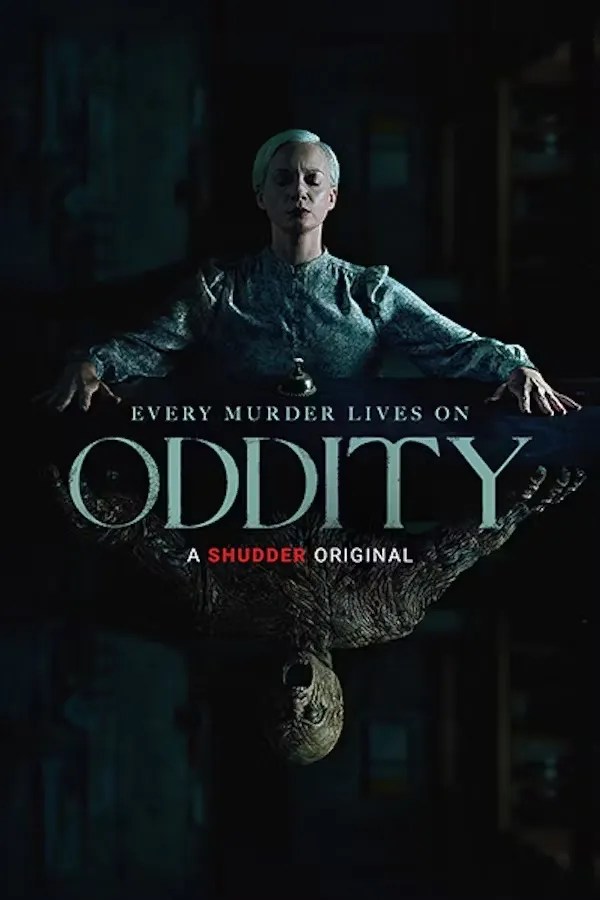
I’ve been trying to watch more films recently and this one was on my list for a while. I have also been thinking about concepts of “home” a lot so it was pretty odd that they ended up integrating these things within one work. But that happens sometimes. Ah, film, you therapeutic bitch! You know exactly what I need sometimes!
Anyway, all that aside, the story isn’t overly preoccupied with the theme that I’m preoccupied with. It’s primarily centered on connections- familial, supernatural, and the toxicity shared between two supposedly “sane” men who work in a clinic for the mentally ill.
Dani and Darcy are twin sisters (both played by the remarkable Carolyn Bracken). Dani, married to psychiatrist Ted Timmis (Gwilym Lee), has just moved out to the countryside to the couple’s new home which (because Horror Movie Rules Say So) has very little cell phone service. This is, however, completely acceptable in the film. It’s that good. We learn from a short exposition by Timmis to his clearly slimy coworker Ivan (Steve Wall), that he’s quite into his new home.
Then Dani dies. But the film does not exactly tell us how. Which is excellent. It hints at it through a thoroughly terrifying scene starring one of Dr. Timmis’ recently-released mental patients, Olin Boole (Tadgh Murphy), but it does what truly great films do- gives breadcrumbs of information, not entire slices.
In a film like this, you really don’t want a sandwich. You just want continual tastes. And that’s what McCarthy does. He builds it like a delicate dollhouse; you’re almost afraid to take a breath with each new scene revelation. It doesn’t unravel, it builds. Even up until the very conclusion. What a film.
Darcy, who is blind, travels to the remote countryside house around the time of Dani’s birthday for various reasons, such as her now former brother-in-law suddenly has a new girlfriend living at the house less than a year after Dani’s murder. So Darcy’s more than a little curious. Unfortunately for Darcy, this doesn’t work out well.
I don’t want to spill the precise details. I want you to see the film.
What I DO want to talk about is ideas of home, domesticity and safety within the context of Oddity.
Concepts of mental balance are of prime significance in the film as are the strength or veracity of relationships.
Dani’s last call to Darcy literally states, “We are connected.” While that is meant to refer to cell phone status, it means far more. Not only are they twins, they are both women. In addition, Darcy is a psychic and medium, maintaining supernatural alliances as well. There are a plethora of connections reflected through this one sentence relayed over voice message. Played multiple times within the film, it is done so in order to emphasize that this is one of the only true and reliable relationships that exists.
*major spoilers start here*
Our poor murder victim is unable to see the reliable relationships in her life. This is a direct result of the primary unreliable one: her husband. As we come to find out later, he is the cause of her death. But she has been warned- again, through someone who she sees as an unreliable source: Olin Boole. Dani does not think Darcy is well, as she confers to her husband in the beginning of the film, asking him to see if she is willing to see a doctor. He agrees. If Dani doesn’t trust her own sister’s state of mind, why would she trust the warning of one of her husband’s former patients?
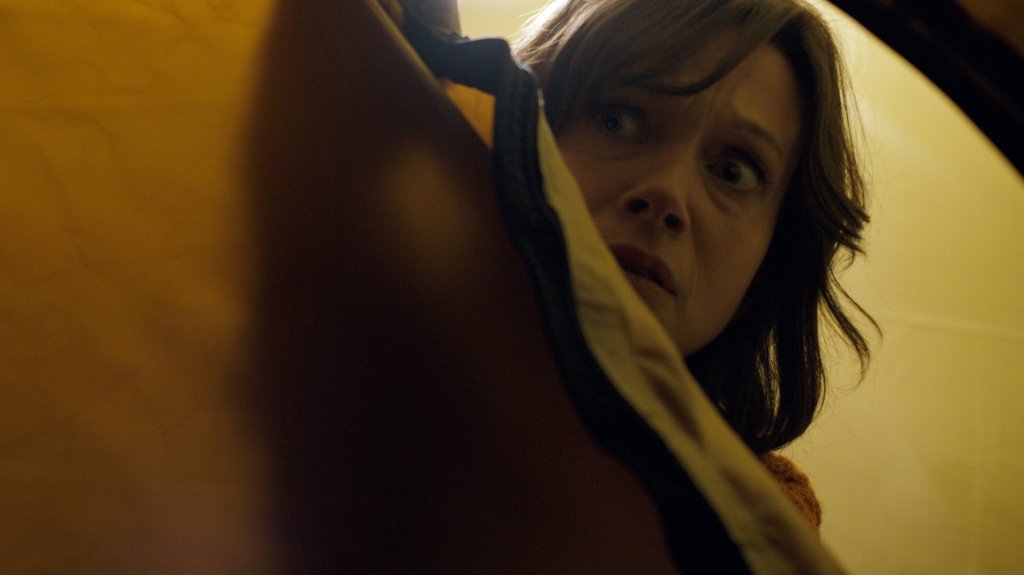
She doesn’t, of course, until it is too late and horror, literally, enters her newly purchased home.
Dr. Timmis is more than a little consumed with this house. He keeps it after Dani’s murder, going so far as to move his “new” girlfriend Yana (Caroline Menton) into it. She complains how uncomfortable it is and tells him she cannot/will not reside there. Begrudgingly, her boyfriend tells her that he will return to her apartment in the city with her, but it is clear that he is dragging his heels more than a little on this statement.
In a conversation he has with his colleague Ivan, he discusses the meaning behind the house, how much he adores it and how it holds a great deal of value for him. To be fair to the doctor, he’s telling the absolute truth. He values the hell out of that house. Enough, apparently, to order multiple women to be murdered in the confines of the structure and wish to continue to reside there.
What is the power and/or the strength of this house? What is the draw for him? While it might be argued otherwise, I propose that Oddity is not a haunted house film. While horror films around homes generally aggregate around ghosts/hauntings, House Fights Back, or some variation of these themes, Damian McCarthy’s work is something else entirely.
This film is a deep gaze into what happens when a man pours the poison of domestic violence and toxic masculinity into a building to live in. Instead of allowing the space “house” to grow into the warm creation of “home,” this hand-built environment has devolved into a supernatural reflection of Dr. Timmis’ own brutality. He is left alone with the trappings of his kills and a cold dark vehicle for existence. But, McCarthy does inquire in that lovely final scene, for how long?
There are a variety of other things to examine within this work- its references to the Jewish Golum, different ghost stories, etc. But I find ideas of reliability, mental stability, domesticity and connectivity most interesting.
The male “sane” characters- Timmis and Ivan- are remarkably unbalanced and figures of white male normalcy. The released “insane” patient, Olin Boole, is terrifying and appears disfigured and monstrous. Yet he is one of the most balanced characters in the narrative. Oddity is truly a film that is about the idea that perhaps not everything is as it seems. Domestic bliss is, perhaps, not as blissful. The charming ideal husband? Perhaps not so charming and ideal after all. But, of course, as in all heteronormative plots, the wife is generally the very last to know.

The bloodshed that transpires due to Timmis’ house obsession is very much about male-domination. While domesticity and concepts of “home and hearth” are attributed regularly to the feminine, ownership and spatial control are traditionally male concepts. Timmis wants the house to be HIS, he rejects the feminine- all the feminine. Dani, Darcy…even Yana in the end. That kind of control is the paradigm of traditional toxic masculinity and it is explored brilliantly within this film. It is also undermined and shown to be dangerous and horrifying by the finale (which I will not spoil for you).
While Dani is clearly preparing a home at the beginning, Timmis doesn’t give a shit. He just likes that he has this new house. It’s just a thing to him, not a larger way of life or an evolving connection with a partner. Obviously, the domestic violence (exacted through someone else’s hands) proves that. He wants to clear the way so he can Have What Belongs to Him
Oddity is a solid film with brilliant performances and really creative work. The women in it are unique, showing a realness that is ultra-rare. But the underlying fear that the men show of losing their manhood is a great touch, especially when underscored (and ultimately outdone) by strong women who are almost all characterized as disabled. Darcy has had cancer and is now blind and it is intimated that Yana was actually a patient in the mental institution. But my question at the end of the film is…what is the real disability?
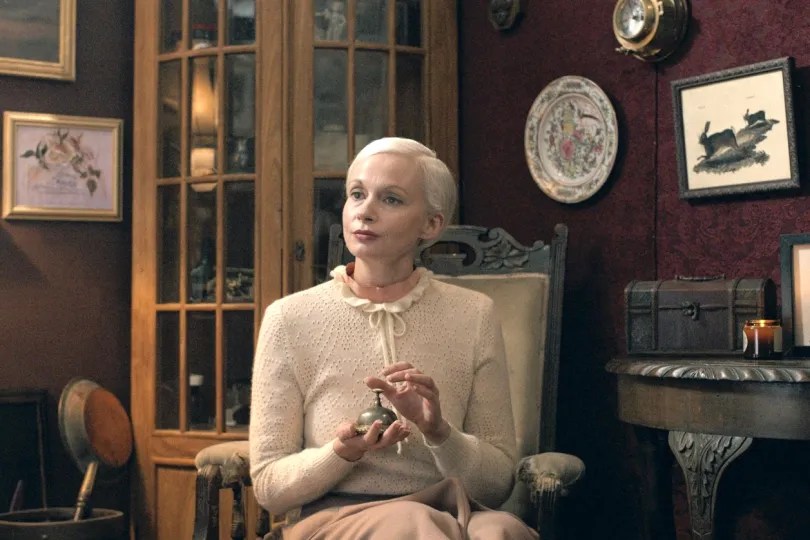
I have named this series after the Elvis Costello song, “Home is Anywhere You Hang Your Head,” so I will leave you with that. Until next time….
 Movies Are My Boyfriend