How I Survived 2018: Films I Became Obsessed With

I don’t generally make lists (I don’t believe in them) but I’m going to half blame Daniel Waters & his excellent cinema-personship for my desire to list the things I saw this year (I read his list today & was like….yeah, there’s some shit I want people to know about) and the fact that I’m getting old & I forget titles of things & such.

Warning: you will definitely see a pattern to much of the content here. I like Korean film and TV. A LOT. Like, not just as a hobby, but like…9/10 things I watch on a daily/weekly/monthly basis are Korean. There’s many many many reasons for this: I love the actors, the political intrigue plots, the corruption angles, the action sequences and the absurd number of serial killers or extremely violent murderous villains with amazing hair and immaculate taste in clothing that are existing in Seoul at any given point in the Korean movie environment.

That said, these are the films I watched this year that blew my mind or just made me super happy to be sitting in a darkened theater with other folks. Or, in some cases, home with my cats.

Please note that this is a mix of new and older films. But all were new-to-me.

성난황소 Unstoppable (English title) / Angry Bull (literal title) – dir. Kim Min-Ho, 2018

Ma Dong-seok is one of my favorite actors ever & the villain in this- Kim Sung-oh is mindblowing. That burgundy suit he wears is 80,000 shades of YESSSSSSS. Also the action in this one was just superb. Flimsy narrative but if you just go: “Cool. Revenge story. Lots of action & badassery” this is great!

꼬방동네 사람들 People in the Slum / People of Kkobang Neighborhood– dir. Bae Chang-ho, 1982

The Korean Film Archive did a hellova job restoring this classic working class drama and it’s worth watching just to see that gorgeous work alone. But the film itself is also great. Mind you, it definitely gets dramatic– like OH GURL THAT MUSIC SWELL dramatic- but I loved this film. And the lead actress Kim Bo-yeon 김보연 is excellent. It’s available to watch here on YouTube for free. thanks to the Korean Film Archive. Also, this article is really great & talks a bit about Bae Chang-ho who was nicknamed the “Steven Spielberg of Korea.”

people of the slum

Amateurs (Amatörer) – dir. Gabriela Pichler, 2018

This very queer, very funny, very touching comedy made my AFIFest sooooo great this year. I’m a huge fan of movies about adolescent girls saying “fuck you, I’m going DIY you stupid adults” and this is that movie. I died of laughter, I cried a looot and I would see it many more times. There are at least 5 languages spoken in this film- Swedish, Tamil, Arabic, German and English. It is about filmmaking, classism, capitalism and tiny backwater towns with a lotta bureaucratic outdated ways. It is loving and punk as fuck.

AMATEURS-by-Gabriela-Pichler

Pig (Khook) – dir. Mani Haghighi, 2018

This movie is so funny my sides hurt from laughing. A serial killer is on the loose picking off film directors in the local Tehrani film scene one by one. It’s all at once a satire, a parody of filmmaking as an industry and creative pursuit and ridiculously self-aware. The main character has some amazing rock t-shirts that he wears throughout and the film is just a blast. Want to rewatch many times.

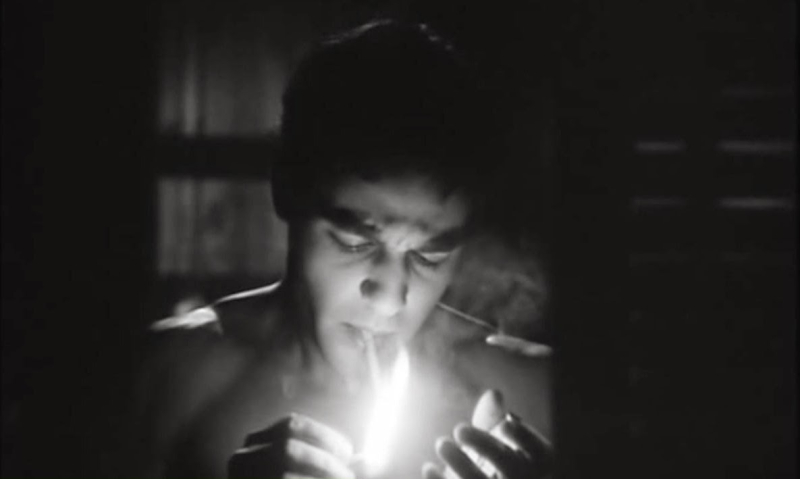
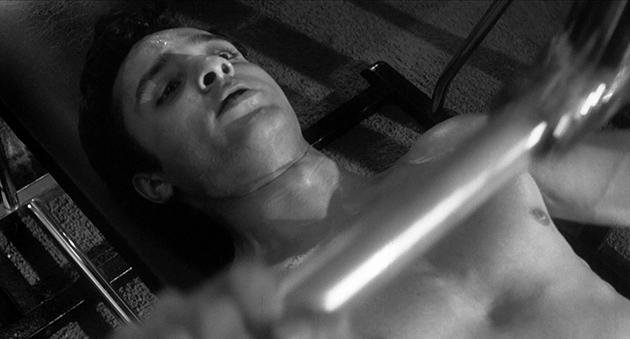
마의 계단 The Devil’s Staircase – dir. Lee Man-hee, 1964

It’s safe to say that this is one of my new favorite film noir/thrillers that has ever been made. If you know me, that’s saying a GREAT DEAL. I will now profess my new addiction to Lee Man-hee and his work, completely setting the groundwork in Korean cinema for the thrillers and horror work that everyone loves today. This film actually scared me at one point! Goddamn Exorcist does nothing to my fear tendrils. If you love Diabolique by Clouzot (1955), this film is just as terrifying in its paranoia and intensity. Again, for those interested, it is available to watch here for free thanks to the marvelous Korean Film Archive.

devils-staircase-poster-e1528931985953

Cam – dir. Daniel Goldhaber, writer Isa Mazzei, 2018

This film is tits-out incredible. Having been connected with the sex worker world for most of my teen and adult life, I have watched it change drastically based on technology. While those things evolved, the misogyny and judgey-ness stayed exactly the fucking same. For Goldhaber & Mazzei to make this brutally brilliant and powerful film that stands alone as a great thriller/horror film but also functions as critical analysis of agency and identity in an online sexual universe. HFS. I’m alllllllllllllll in. This was my kind of movie. I cannot wait to see what they do next. Tickets already bought & paid for.

화녀 Woman of Fire- dir. Kim Ki-young, 1971

I worship at the film cans of Kim Ki-young. That’s why 2 of his films are on this list. For reference, popular modern Korean directors Bong Joon-ho and Park Chan-wook both call this legendary director a huge influence on their work.

화녀 is a seriously dark and disturbing work. It’s erotic and powerful and troubling and visually fucking stunning. This film’s objective is to make you feel unsafe. Domestic bliss, familial calm, any home/hearth bullshit is tossed out the window to make room for psychosexual violence, lust and manipulation. I LOVE THIS MOVIE. Oh- and it’s also available for free here thanks to the Korean Film Archive! Have a stiff drink or some ice cream on hand. You might need it.

1971 - Woman of Fire (screenshot 3)

Akasha – dir. Hajooj Kuka, 2018

It may sound odd, but this is an incredible feminist rom-com about a small community set in the Sudan, against the backdrop of the Sudanese Civil War (which is a huge part of the narrative). If that sounds weird and crazy, it is. It has been so long since I’ve seen a film with the humor, feel and joy of 1930s screwball comedy (sans the overwhelming whiteness) that this almost put me into cardiac arrest at how divine it was. Find it. See it. Everything about this film is just amazing.

저는 영화를보고 있어요 Default / National Bankruptcy Day dir. Choi Kook-hee, 2018

Full transparency, I’m a nut for Kim Hye-soo. She’s a hellova actress. And Yoo Ah-in has been one of my main dudes since I watched him in Sungkyunkwan Scandal. Y’all loved in Lee Chang-dong’s Burning this year. You know you did (I did too, FTR). This is a pretty amazing film especially if you are not entirely well-acquainted with the HFS RAGING disaster that was the 1997 Asian Financial Crisis. Kim Hye-soo plays a financial analyst at the Bank of Korea who is beyond aware of the damages that the IMF will do and has to combat the Very Male industry that she’s in. The film doesn’t shy away from the overt sexism that businesswomen have to face in powerful positions. It’s infuriating and depressing but she is brilliant in this role.

The Night Comes for Us – dir. Timo Tjahjanto, 2018

This Indonesian blood ballet is so exceptionally choreographed and violently HELL YES that I can’t even think about how much I loved it without grinning and wanting to watch it again with other people.

Hold The Dark – dir. Jeremy Saulnier, 2018

It is extremely rare that the litany of horrors that indigenous communities have to handle on a day to day basis make appearances in what we might consider mainstream-esque (or at least a Netflix-sponsored) thriller. Hold the Dark is a difficult film to completely parse. I need to watch it again, for sure. But the fact that I can’t stop thinking about it certainly made me think: yeah, this is something I valued highly. The darknesses that this film explores are various: dying children, the inability of white folx to respect indigenous cultures and their rights, animal behavior, and more. Jeffrey Wright is incredible. And I stand by the statement I tweeted after I watched this: HTD is a Christmas movie.

어도 Iodo – dir. Kim Ki-Young, 1977

Out of all the films I watched this year (Mandy included) this is the one that really blew my fucking mind. For all intents and purposes, it is a murder mystery and a genre film done by Kim Ki-young. The extremely pithy Wikipedia synopsis reads: “When a man from an island ruled by women disappears, the man suspected of killing him investigates his past.” But that’s like saying “yeah, people die during wars” or “Having the flu makes you feel crappy.”  어도 is like if Ken Russell and Alejandro Jodorowsky were Korean, got REALLY HIGH and REALLY FEMINIST and were like: “Let’s make our version of The Wickerman, include prerequisite themes of sex, power, gender and erotics, and make a commentary on the erasure of shamanic culture in Korea.” Sound good? HAHHHHHHAHAHAHAH. It’s fucking mindbending and hot.

I love it when US films go strange places but honestly? We just don’t have the history to do it this well. Our history is racism, colonialism and fucked up power structures. Kim Ki-Young is the  goddamn master of mindfuckery in cinema and I love it. But you don’t have to take my word for it. It used to be available on the amazing Korean Film Archive’s website but sadly it is no longer there. I would advise that you somehow find and watch this amazing film though.

ieohisland-inexarchiagr3

There were plenty of other films-

도둑들 The Thieves – dir. Choi Dong-hoon, 2012  

Wild Search – dir. Ringo Lam, 1989

Destroyer – dir. Karyn Kusama, 2018

Shoplifters – dir. Kore-Eda Hirokazu, 2018

버닝 Burning – dir. Lee Chang-dong, 2018

아시스 Oasis – dir. Lee Chang-dong, 2002 (Yes, I like this film. No it doesn’t make me a monster. In fact, this is probably one of the most powerful and beautiful films I watched this year).

Sorry to Bother You – dir. Boots Riley, 2018

Skyscraper – dir. Rawson Marshall Thurber, 2018

The Ranger – dir. Jenn Wexler, 2018

And so many more.

These are the movies I can’t get out of my head and make me glad that I do what I do (watch & appreciate cinema & its interaction with human life and politics and whatnot).

I hope that maybe you’ll check out one or more of these. If you do, let me know what you think!

Once In A Lifetime: Spike Lee & Do The Right Thing

I saw a 35mm print of Do the Right Thing (Spike Lee, 1989) at the Egyptian Theater tonight with Spike Lee in attendance and it was probably one of the best film experiences I have ever had in my film life.

He is, hands-down, one of the greatest film makers that has ever existed. While I am prone to hyperbole in general, this statement is not one of my “OMG ARIEL DRAMA statements.”

The first time I saw this movie I was so embarrassed because there was nudity in it and I was watching it with my parents. On the other hand, that scene? It was one of the first times I felt any kind of erotic feelings in my body. I was also 11 years old. It is the scene where Spike Lee worships Rosie Perez’ naked body with ice. It is scorched into my brain forever and I am forever grateful to Ernest Dickerson & Lee for providing me with images of a man blessing a woman’s body, a mother’s body, for existing.

The film is loud, in charge. It’s punk fucking rock. I cried throughout the entire film.

It’s 2018 and we have seen the deaths of so many young black men and NO ONE HAS LEARNED ANYFUCKINGTHING. Did no one see this film?

What is it that allowed Sal to sit there, in silence, while his goddamn son Pino chased Smiley off right after they had a very explicit conversation about why Sal wanted the restaurant to stay in the neighborhood? Racism. By saying or doing nothing, you say and do EVERYTHING. That one scene is the key for me.

This film is more emotionally viable to me that Citizen Kane (Orson Welles, 1940), as much as I have a Welles-obsession and have since I was a baby film girl. I rocked myself back and forth in my chair and memories of the LA Riots came rushing back to me like a broken faucet as I saw this film again on a big screen as a 40-year-old woman.

Spike’s Q&A was incredible. Short answers when needed, lengthy ones when necessary. A very potent look when the subject of goddamn Driving Miss Daisy came up (and rightfully so). His exposition on the power of cinema to drive real fucking change hit me HARD, especially as a moving image archivist. He spoke of his documentary Four Little Girls (Spike Lee, 1997), its place in the National Film Registry and how it had actually  catalyzed the reopening of that court case, allowing the investigation into what happened. This is what we strive for as archivists and preservationists: ACTION. CHANGE. MOTHERFUCKING JUSTICE.

I saw things in this film I had never seen before- when I was a young girl, I thought the firemen were trying to put out the fire at Sal’s Pizzeria. Now? I saw these same images as those I recognize from Civil Rights footage/stills of firehoses being used against POC. This is a painful film, painfully powerful, painfully important.

I cannot possibly do justice to everything I am thinking tonight about my experience or everything I heard, from Spike, from the film, from my own heart.

I am also incredibly grateful to have stayed for the 35mm of Crooklyn (Spike Lee, 1994) because WOW.
Anyways, I am detailing this at 5am because I have nowhere to write this but here. I am not getting paid to write anywhere or anything like that but I really needed to document this experience. I wish you all could’ve been there with me. I wanted to hold your hand.


FilmStruck Down: Corporate Greed, “Niche” Viewership & Building A Bigger Boat

On October 18th, I wrote a piece about the Asian streaming site DramaFever and how it had announced, very suddenly, that it would be shutting down.  In the week since then, the Kdrama and Asian television online community (centered within Facebook groups, Twitter and Reddit comments) have been wildly searching for other ways to access television content legally.

It looks like a site that previously only provided TV shows in Korean (OnDemandKorea) is stepping up to the plate, advertising one of the more popular shows in recent years, Strong Woman Do Bong-soon 힘쎈여자 도봉순 as “coming soon with English subtitles” along with other programs. So it’s clear that other streaming sites know that what AT&T called a “niche audience” and cast off like yesterday’s trash is worthy of attention. Which brings me to today’s topic: the devastating news of the loss of yet another streaming site owned by WarnerMedia and their corporate parent, AT&T- FilmStruck.

Screen Shot 2018-10-26 at 8.33.29 AM

If you think that this page looks similar to the one DramaFever had, you’re right. The biggest difference is that FilmStruck is giving their members a good month’s notice instead of, oh, like 24 hoursSo if you’re a FilmStruck-er, go and watch a shitload of movies RIGHT NOW. Or at least catalog your watch list and take advantage of the amazing ORIGINAL content that they created.

So let’s say for the sake of argument that you never had FilmStruck. Or that it didn’t work for you on your platform of choice. Or you didn’t don’t care for classic/arthouse cinema. And the same with DramaFever and its offerings of Asian cinema and television. OK, totally your choice. That saidthe way these channels were removed and why they were removed and the carelessness and thoughtlessness behind the process is unforgivable. We need to start examining the way these larger corporations are eating up smaller media-providing organizations because, in my mind, destroying them is just a “quick fix” so they don’t get accused of becoming a monopoly. Or maybe it’s the opposite. Maybe the destruction of channels like DramaFever and FilmStruck solidifies their monopolistic practices.

paramount 1948

I just keep thinking about the Paramount Decree of 1948 and how that stopped the Hollywood Studio System from having total control over the films that were being shown and (equally as important, especially to the topic at hand) HOW THEY WERE BEING SHOWN. Block booking became illegal and many of the exhibition practices that the major Hollywood Studios were forcing on theaters all over the country were shown to be discriminatory towards independent theaters and were, essentially, bullying tactics.  This case…it’s still important. I feel like it’s useful here because I think AT&T is not-so-subtly removing independent media from viewer accessibility and establishing a dangerous monopolistic precedent only to jockey for first place with another corporate entity.

As I documented in my previous article, AT&T is looking to compete with Netflix. They are the parent company of WarnerMedia who, in turn, owns the streaming sites that have been dropped: Boomerang (a cartoon network) [EDIT: I read that Boomerang was going to be one of the losses in at *least* two different publications when DramaFever was axed- as of today, 10/26/2018, I could no longer find confirmation of that channel’s removal so this is an inaccuracy on my part- apologies!-AS], DramaFever (Asian television), and now FilmStruck (Classic/Arthouse Film). AT&T is chomping at the bit for what I see as “a bigger boat.” They want to create a Mega-Monster Streaming Channel with HBO at the helm (sorta as the selling point), and within the Monster Belly it will contain all the bobs and bits that have been swallowed up from the sites that they have killed in the building process.

As a media archivist I know that one of the trickiest things in our business is licensing.  Full transparency, these are only my thoughts and my musings so I haven’t done deep research on who has the streaming licenses for the films on FilmStruck but I know that there may be multiple bodies since the film content came from Warner Archive, Criterion and TCM. That said, I also know that Criterion still has content available to stream on Kanopy (a library-based media streaming site) so they may have multiple streaming licenses going (or they may have an educational license for that one?). My point with the licensing? Who has the contracts and for how long? Does AT&T own the streaming rights? Are they going to sit on those materials until they create their Monster Channel and then have a Special Classics/Arthouse section? That’s what they promised the DramaFever community.

The people in the DramaFever community have already moved on. We don’t wait for some über channel. We will find our TV shows and our community where ever and however we can. More importantly, we don’t like being treated like second-class citizens. We watch media that is high in emotion and it’s traditionally considered “trash media” since Western society is uncomfortable with the raw display of emotion. So…we’re a “niche” market.

niche meme

With FilmStruck, I hope that there can be an equal bounce back. What I would like to see happen is for Netflix, Amazon or Hulu to jump in. They could easily do it. Classic films, arthouse cinema, this community is analogous to the one I align myself with in the Korean Drama world. There are films that are high in emotion or extreme in some way- costume, language, make-up. Geez- no one talks like Katherine Hepburn anymore, amirite? And musicals? But FilmStruck has a MUCH higher draw than the dramas that I watch, and I will readily admit that.

The interesting thing about FilmStruck is that, unlike DramaFever, many (certainly not all) of the materials that are being streamed are available on DVD or Blu-ray which (of course) then begins the conversation (as usual) about viewers being “so glad” that they kept their physical media. I’ve seen the word “hoarding” being used a decent amount which…always makes me a little queasy but if that is how you want to refer to your media library, hey- who am I to stop you?
Obviously, this whole situation brings up ideas of access and economics and such. Streaming is far more economical (and thus accessible) for people who are on a lower budget which is more common in this not-so-awesome landscape right now. So it is something to keep in mind.

As an archivist, I will certainly advocate physical media 100%. But we need to look at all sides of streaming and accessibility and what digital might provide and who/what audiences it might welcome. Additionally, if AT&T is going to put all of this content behind an expensive cable paywall…that certainly doesn’t allow for the kind of openness that FilmStruck was known for.

FilmStruck-themes-500-copy

There is a great danger in not speaking up when these corporations swallow us whole. We simply don’t know what parts will be left. If they are holding the licenses to these films and we have to wait…which ones will they come back with? How long will we have to wait? Can we access only part of the package? I HAVE QUESTIONS.

To all of my wonderful friends and colleagues who have put so much work and love and goodness into FilmStruck: you are why we watch. You are why we will always watch.
I love you from the bottom of my sprocketed reel heart.

They Only Play Asian Stuff: Centering Korean Culture in LA & Regional Ignorance

Los Angeles is a funny place.
After my amazing ramen/movie night at CGV Cinemas, I went to read my Santa Cruz Noir book (OMGZ Susie, it’s SO GOOD! I’M DYING) & have a cocktail at Frank & Hank’s (thought of you, my beautiful love Michelle).

Some girl at the bar next to me asked about the book since I was having such visceral reactions to it, so I read her a passage over the pounding gangsta rap.
Girl: WOAH. THAT’S SOME BRUTAL SHIT GURL. And you’re laughing?
Me: Well, yeah. I recognize all the locations in the story and…it’s gory dark murdery stuff but…very brilliant!
*She took a picture of the book*
Girl: Imna have to get that.
Me: Oh you need to, 100%.
Girl: So what were you up to tonight?
Me: I was over at CGV down the street, watching a great movie.
Girl: The movie theater over there?!?!? *points towards the door* WHY??? THEY ONLY PLAY ASIAN STUFF. OH BUT LIKE HAVE YOU WATCHED ANY ASIAN HORROR.
Me: *having great difficulty not making life imitate art & make like one of the killers from Santa Cruz Noir*
Yeah. It was weird. And racist. And frustrating. CGV is a great theater. My favorite next to the New Beverly, actually.
I love K-town so very much. I am usually the only white person at the movies I go see and until a while back when I cut my hair into my current “punk rawk” look, I was given a lot of “What are you doing here?” expressions. I find it endlessly fascinating that my hairstyle has changed how I am treated but that’s a whole other conversation.
Back to CGV. I didn’t mind anyone looking at me with the “you don’t belong” expression. I knew that I was entering a non-white space. I belong from the perspective of being from LA and having grown up a few blocks away but…it is not my space. It is, however, the only location in LA that I can see these films and I desperately enjoy Korean cinema, from the soap operas to the gritty procedurals to the gruesome horror. I think the only genre I’m not into is the bubble-gum rom-com and even some of those I like!!! But when I go to CGV Cinemas in K-town I am very aware, as an Angeleno, that this may be my city but this is not my space.
The older Korean couples on date nights love me though. Maybe they think I’m a weirdo sitting alone with my concessions sighing and crying at that historical romcom with them. But I also think they appreciate having younger people in those movies (sometimes those films have a bit of an older draw). Maybe they just think I’m confused and I ended up in the wrong theater? I love seeing how many older couples do go to the movies together and enjoy the experience just like it was “the old days.” I feel like when I go to CGV, people there are really there for the experience and my heart soars.
I always feel really good in those theaters. Everyone there is going to the movies intentionally.
There’s a difference between going to the movies as something to do and going to the movies intentionally. You can do both (many do) but the people I see going in and out of CGV are people I want to go to the movies with. The audience for Believer last night was great. Maybe not super rambunctious like an average US action-movie audience, but they laughed loudly at funny lines and it certainly felt like a community. Which is what I need in a movie going experience and a movie theater.
CGV is really special because like many movie theaters that used to exist in Los Angeles, it offers culturally specific materials that cannot be accessed anywhere else. Korean films on the big screen. And not just on the big screen, but a REALLY DAMN BIG SCREEN. The seats are nice, the sound is great, they have 4 hours of free parking.
And, as I schooled Bar Girl, CGV doesn’t “just play Asian stuff.” More specifically, their focus is on the Asian community (the Korean community to be exact). White folks, or English-speaking anyones, are 100% secondary. But that doesn’t mean that they are not welcome or cannot attend. It just means that they are not the central audience for CGV and that is a breath of fresh air in this world. Yes, I am aware that CGV is a Korean company so obviously that is their focus but still. It’s really great to have this theater HERE IN LOS ANGELES.
Bar Girl was shocked when I told her that they are currently showing Deadpool 2 and I saw a trailer for the next Incredibles movie as well as the new Jurassic Park. She had completely tossed the theater to the side. Hi ignorance and total unwillingness to explore your own neighborhood (she said she lived in the area). Sure, these films have Korean subtitles, but that’s fucking great! This is something called ACCESS. Why shouldn’t everyone be able to see movies? And why shouldn’t we all be able to see as many amazing movies as we can? The fact that I was able to go and see Believer (Lee Hae-young, 2018), the remake of Johnnie To’s masterful Drug War from 2012 is so exciting to me! And by the way?
                      BOTH VERSIONS OF THIS MOVIE ARE AMAZING!!

They’re playing a comedy at CGV starting on June 22nd. The trailer looked INSANE. I cannot wait. So glad that they take MoviePass. I know that I sound like an ad for CGV (I don’t mind) but I’ve always said that it’s like the Korean Arclight but cheaper. And take a chance if you live in LA, come see a Korean movie with me. They are really great.

See how your calendar is looking for this beauty…. I’m excited AF.

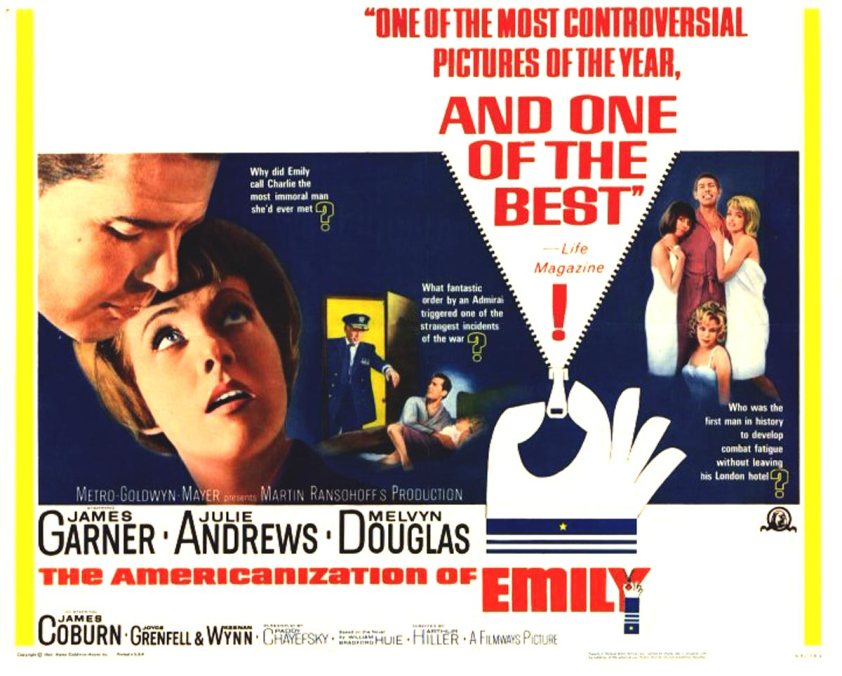
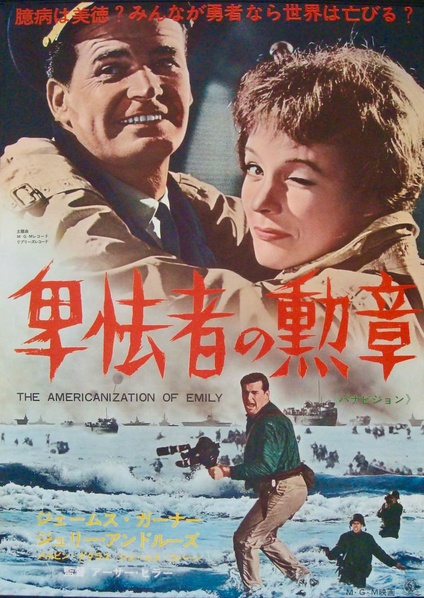
The Americanization of Emily

This post was originally published on the New Beverly Cinema blog on November 27, 2017. It is being republished here with full permission of the New Beverly. For the original post (with different artwork) please see the original post here.

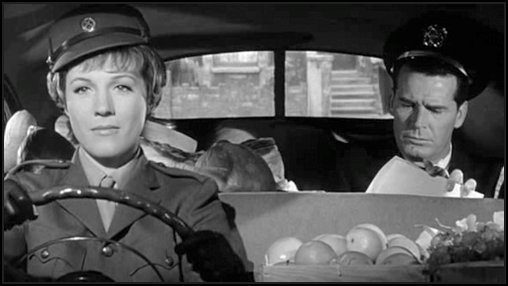
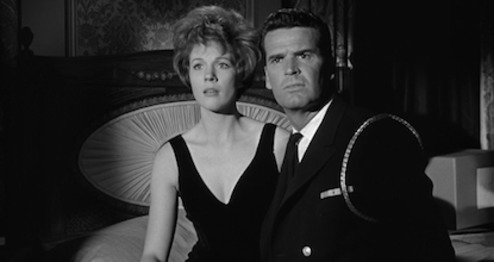
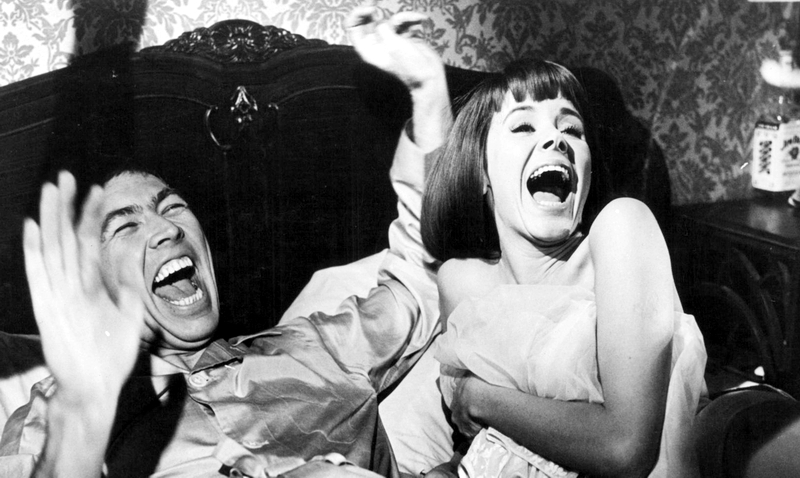
The Americanization of Emily (Arthur Hiller, 1964) was intended to be a romantic comedy until screenwriter Paddy Chayefsky got a hold of it. In his hands, this story became an acidic and expertly composed tale of war’s human fallout. Tackling women’s sexuality and emotional welfare, it examines relationships between masculinity and heroism, leading a full-scale assault on the deification of war. A comedy with surreal overtones and an unusual approach to storytelling, The Americanization of Emily suffered a lengthy period of copyright entanglement making it almost impossible to see for many years.

William Wyler was initially slated to direct, with William Holden as the star, Lieutenant Commander Charles E. Madison. However, Wyler’s high salary and diva-like requests made MGM sideline his directorship. Holden was not much different. He was pricey and difficult to please. Finally, Wyler left, and after many other directors declined the job young up-and-coming director Arthur Hiller replaced him. William Holden’s reaction to the young filmmaker was less than kind and he left.

“I was already cast as Lieutenant Commander Paul ‘Bus’ Cummings when [producer] Marty Ransohoff asked whether I would play Charlie Madison if Holden dropped out. ‘Oh, you bet!’ I said,” remarked James Garner in his autobiography, The Garner Files: A Memoir, “I knew it was a hell of an actor’s part. It was a different kind of role than I’d been doing with a brilliant script from Paddy Chayefsky from William Bradford Huie’s novel. A lot of drama and a lot of humor…a long line of directors had turned the picture down before Marty reluctantly offered it to Arthur Hiller. Marty didn’t think Arthur was ready for it because he hadn’t tackled anything so meaty. As it turned out, Marty needn’t have worried.”

Worrying is a huge part of a producer’s job. It may as well be their unofficial title (“professional worrier”). The Americanization of Emily was one production that certainly made Ransohoff work for his paycheck. You wouldn’t think that the man who helped create Filmways, Inc. and produced beloved TV shows like Petticoat Junction and Mr. Ed was up to the task of battling the MPAA and studio brass, but Marty Ransohoff was That Guy. Nicknamed “the Messiah of the New Hollywood” by Budd Schulberg, Ransohoff went on to become an independent producer for groundbreaking films like The Loved One (Tony Richardson, 1965), 10 Rillington Place (Richard Fleisher, 1971), and The Wanderers (Philip Kaufman, 1979), amongst others. The Americanization of Emily was just the beginning.

Produced by Filmways and distributed by MGM, this film went directly against Sam Goldwyn’s mantra: “Pictures are for entertainment; messages should be delivered by Western Union.” Paddy Chayefsky’s script was FULL of message, which scared the shit out of the MPAA. The concern was that, as James Garner put it, “it put US Servicemen in a bad light and [the MPAA] worried about a box-office backlash…They thought the movie was too extreme for the American public.” This also explained why multiple directors had turned down the project. It was seen as an unpatriotic movie and few filmmakers were willing to be linked to it.

As a result of MPAA issues, there was significant tension on the set and Ransohoff constantly had to deal with the “higher ups.” Arthur Hiller felt this strongly as a young director and it transferred to the way he shot the film. During production, Hiller commented that he “did a lot of scenes in one shot…a lot of that was for safety reasons…Protection, I think I mean. Many times, studios, after you finish filming, want to look and make changes and the more I did in one shot the less they could make changes on.” There had been enough back and forth with the MPAA about the amount of nudity in certain scenes and how many times James Garner could say “Damn” that Hiller didn’t want to take chances. James Coburn vividly recalls Hiller’s shooting style.

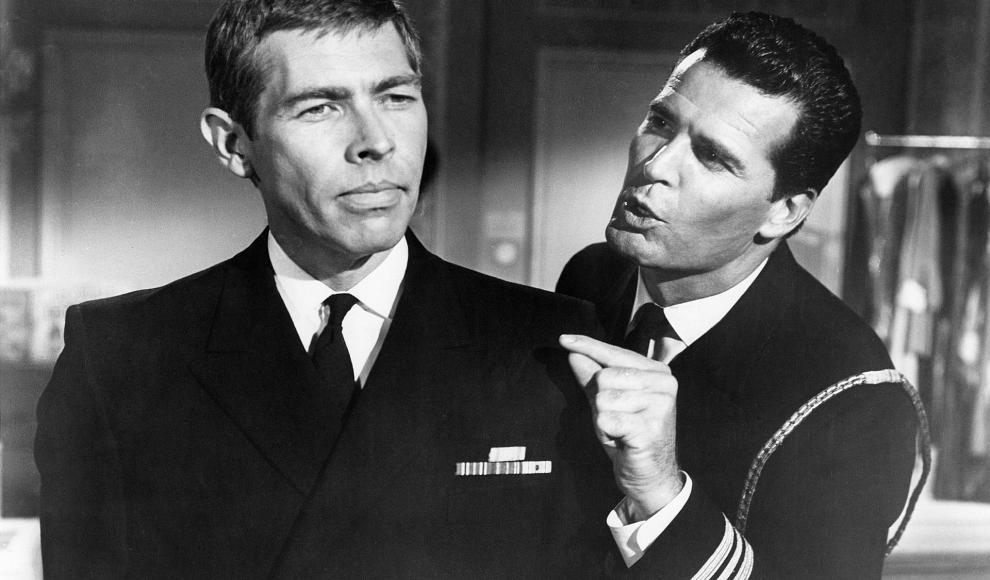
Paddy Chayefsky’s script featured Lieutenant Commander Charlie Madison (James Garner) an unrepentant champion of cowardice. Charlie celebrated his ability to live and survive, even through “amoral” means. While Emily Barham (Julie Andrews) fits the “opposites attract” love interest, Charlie and Emily come together based on the most visceral level: a desire for life to continue and the rejection of death. Their relationship is a complicated structure of mutually expressed erotic attraction and sharp, pained revelations. For the record, it is beyond refreshing to have a woman depicted as strong and complicated with a healthy sexual appetite in American cinema. Emily is a great character and Julie Andrews really shines. Thank you, Paddy Chayefsky! Charlie and Emily are honest and open in the film about their sexual relationship. Of course, it’s not just sex that Emily and Charlie connect over. It is fear, bravery and trauma. The evolution of their connection is some of the most thrilling, maddening and sexy screenwriting in cinema.

All you need to know about Bus Cummings (James Coburn) is what Chayefsky has written in the script. While it translates to the screen, the screenplay actually does an exquisite job of giving you the Real Bus Cummings. Bus has three “romantic interludes” in the film. The script lists his female companions as “Nameless Broads.” This was not because Chayefsky was a sexist asshole or because it was to reflect on the character of the women. This descriptor was meant to extrapolate on Bus, himself, showing what kind of person he is. Chayefsky asks with this aspect of the script: does anything carry meaning with Bus? How cold and exploitative is he really? The answer is revealed throughout the film, and James Coburn carries the role with sleazy panache.

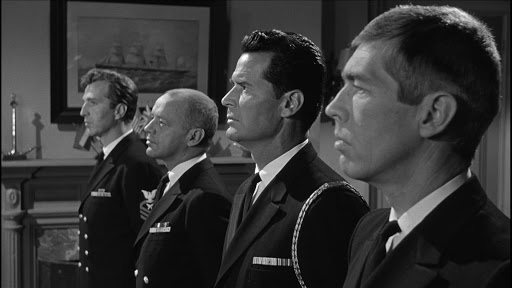
Critics like Bosley Crowther applauded the film for its bravery, but not everyone was a fan. Many charged it with being anti-military, anti-American, and anti-soldier. The film was accused of ridiculing WWII and mocking the deaths of thousands of men on D-Day (Omaha Beach is a plot point). The Americanization of Emily was castigated for what audiences felt were digs at war heroes; complaints poured in about cruel monologues that “railed” against war widows and the film’s unsympathetic portrayal of PTSD (then called battle fatigue or, as mentioned in the film, “cracking up”). The response, from critics and civilians alike, was enough to make the Navy take notice and they actively deterred the distribution of film prints to any of their bases.

After a public screening during which people expressed their dismay at the film’s content, Arthur Hiller published a response piece in the Los Angeles Times on January 3, 1965. “Goodness, virtue and nobility are so out of place in the context of war that satiric laughter is the only logical response,” wrote Hiller, “[the film shows] war for what it is, a barbaric, inhuman act of man – a miserable hell. It says that one thing we can do toward eliminating war from our world is to get rid of the goodness and virtue we attribute to war. Be grieved by death, but not proud of it. Stop naming streets after generals, stop erecting statues. It says stop applauding war. Stop celebrating war…[the fraud] is in the virtue and goodness we attribute to war. If you glorify war you create a climate for more wars.” What no one understood was that The Americanization of Emily was a dark comedy with a specific devotion to and for the men who had experienced war. The received public criticism only highlighted the unhealthy behavior in American culture that Paddy Chayefsky wrote about ad nauseum within the screenplay: the naked and unadulterated worship of warfare.

A team of war vets created The Americanization of Emily, many of them highly decorated officers. Paddy Chayefsky fought and received a Purple Heart in WWII. James Garner joined the Merchant Marines at 16 years old, just as WWII was ending. He served in Korea on a combat unit, earning two Purple Hearts. Arthur Hiller was part of the Royal Canadian Air Force during WWII, navigating for bombers on night missions, dropping bombs on Nazis. It seems insulting to these men and what they experienced that critics, the MPAA and the public dared to think that this film or those involved in it were being disrespectful, unpatriotic or making fun of war.

The vast majority of those who waged censorship battles against the creative teams had no war experience at all. The bulk of the men who made up the Motion Picture Association of America (initially the Motion Picture Producers and Distributors of America) and Production Code Administration, men like Will Hays, Joseph Breen, Geoffrey Shurlock, never went to war. A few like Eric Johnston and Jack Valenti were vets, but they certainly didn’t have any say over films like The Americanization of Emily.

Legendary actor Melvyn Douglas, who played battle-fatigued Admiral William Jessup, was a veteran of both WWI and WWII. When The Americanization of Emily was courting controversy and being excoriated for its “rude” treatment of men in war, Douglas sighed, “I often wish we were like the British, who have a capacity to laugh at themselves and their own institutions which far exceeds our own…[all organizations] should be able to look at themselves with some humor as well as with seriousness…[I have] seen first-hand some of the excesses that were exploited in the film.”

James Garner and Arthur Hiller stated that Paddy Chayefsky was the only “bonafide genius” they ever worked with. Chayefsky said The Americanization of Emily was one of his two best films. Garner and Hiller list it as their favorite, ditto for Julie Andrews and James Coburn. Marty Ransohoff also counts it as a top-tier bestie. While all these names have done extensive film/TV work, it is The Americanization of Emily that they return to as their crowning achievement.

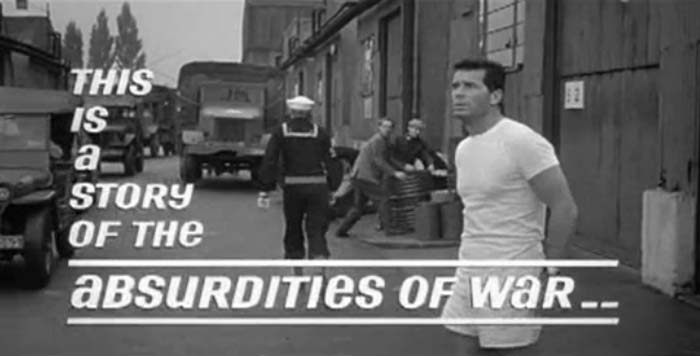
It was this kind of spirit that allowed the film to be made and gave the film such a dedicated production team. During one of the shots near the close of the film [slight spoiler], James Garner broke a few ribs in a beach scene set up to look like Omaha Beach. He fell on his canteen. It’s even in the final cut of the film. He does a small extra “flop” when he goes down. If you watch carefully, it’s in there.

The Americanization of Emily is not an anti-war film. This is a film that challenges perspectives through the complexity of dark comedy, most specifically satire. This film stands against the rabid glorification of war, one of the great All-American past-times. In this sense, it remains one of the most important films about war that will ever get made.

Kid Blue

This post was originally published on the New Beverly Cinema blog on October 12, 2017. It is being republished here with full permission of the New Beverly. For the original post (with different artwork) please see the original post here.

“I can’t imagine a film set like that again… People leaping out of second story windows, people with blood running down them. I don’t know how a foot of that film ever got shot. There was certainly acid, incredible amounts of drinking, incredible amounts of insanity… I doubt there has ever been a film that crazy.” – Lee Purcell, talking about her experience on Kid Blue

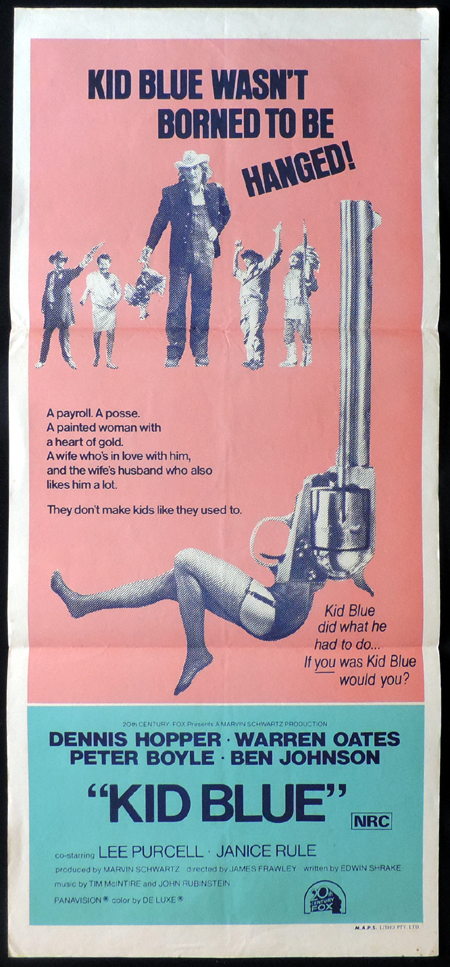
James Frawley’s Kid Blue (1973) is a magnificent film that was far too difficult to see for far too long. There are multiple reasons for a film to be considered rare (lack of promotion, right film wrong time, limited release) and all of them contribute to a film’s disappearance from cinema culture. For a film like Kid Blue to be inaccessible for as long as it has been is really depressing, though the studio quietly, finally, released the film as a manufactured-on-demand disc a few years ago. 

Usually when I research a title I can find a variety of information on the given work. But not Kid Blue. It was missing a key component and that fascinated me: there was little to nothing written on the actual content of the film. I located reviews from the time, interviews and biographical texts, but embarrassingly little parsing the film narrative. There are a few blog posts and recent discussions online but not many.  Modern takes on the film are notably positive and seem to have resulted from a screening that the writer was lucky enough to attend. This seemed odd to me only because it is a 20th Century Fox film, it’s a counterculture Western and it has big stars in it: Peter Boyle, Dennis Hopper, Warren Oates, Ben Johnson, M. Emmet Walsh. Where is all the conversation?

This absence of film criticism and discussion about Kid Blue made me even more Sherlock Holmesy-curious about it. Until I found my answer: no one saw it and if they did? They didn’t remember it. Realistically, they may have been too stoned for much cinematic recall. But it’s such a good movie! C’mon people!  As Susan Campo notes after the release, “the film all but disappeared, despite being picked up by the New York Film Festival and having a gala screening in Dallas on June 19, 1973.” Steven L. Davis corroborates this statement, “The movie made some money but did not linger in the public’s imagination. Though friends in Texas have steadfastly maintained over the years that Kid Blue is a cult classic, in truth the film has all but disappeared.”

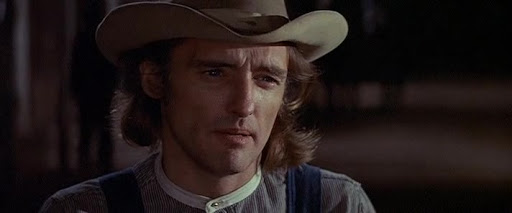
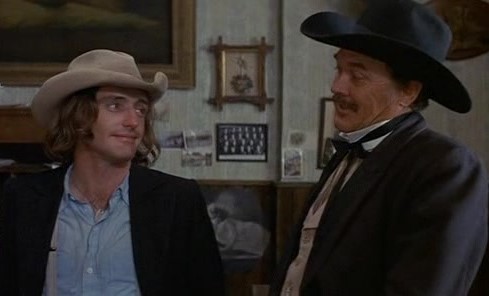
While Vincent Canby’s New York Times review from 1973 was mostly negative, he still found the heart to say, “”Kid Blue” is a well-meaning, liberal, anti-fascist Western, dressed up with some good performances by Peter Boyle, Lee Purcell and Janice Rule.” He just found the commentary too heavy-handed. Perhaps it was. But if so, fuck it. Sometimes you need to just make a point. And the points made in Kid Blue are pretty important. It’s a very funny film. Kid Blue aka Bick Waner (Dennis Hopper) wants to go straight after being a bank robber/criminal but is constantly being told that he will never amount to anything. Sheriff “Mean John” Simpson (Ben Johnson) berates him at every turn as does Drummer (Ralph Waite), one of the residents of the boarding house Bick lives in. Bick finds solace in the friendships of Molly (Lee Purcell) and Reece (Warren Oates) Ford. While that relationship soon becomes complicated, so do Bick’s work relationships, leading to an identity crisis and a whole lot more!

Kid Blue is a fascinating look at racism, politics, violence and religion. The Native American characters are brutally honest and complex. Their dialogue, while comedic, resists the white supremacist discourse that is being had all around them while their physical actions disrupt the Manifest Destiny narrative. Some of this is subtle but it’s quite radical for a studio picture. It’s possible that this aspect of Kid Blue would have been seen as problematic to the head honchos, but I did not find any documentation one way or the other. The Hollywood Reporter, however, gave Kid Blue a rave reviewcalling it “both a counterculture protest film and a comic western film.”

Director James Frawley commented that 20th Century Fox just wasn’t pleased with the outcome. Apparently, they had been sold a different kind of film at the start. He said, “I think they wanted ‘Cat Ballou’ and when they got something closer to ‘McCabe & Mrs. Miller’ they were confused and a little angry.” Frawley was an old hand at political satire and social commentary having directed the TV show The Monkees for a number of years. He would later use his gifts to work with the incomparable Jim Henson on The Muppet Movie (1979). Clearly, Frawley had a knack for comedy with a hint (or more) of sarcastic glee.

But let’s rewind and go back to the making of the film. Because it’s insane. I am authentically unsure about how this film actually got made. It seems like the entirety of that set was a coked-out, gunned-up, hallucinatory lunatic asylum that only sobered up for enough time to shoot a scene.

Kid Blue was originally titled “Dime Box” but retitled by the studio because they thought it sounded like a drug reference. A man named Edwin “Bud” Shrake wrote it. Shrake, a New Beverly Cinema favorite, also penned the scripts for Arthur Hiller’s Nightwing (1979) and William Wierd’s Tom Horn (1980), both of which played the Bev earlier in 2017.

Shrake was more than a screenwriter. He was a journalist, sportswriter, Texan, and a crazy motherfucker. Hunter S. Thompson may be legend, but Bud Shrake and his compadres were no small potatoes.  Thompson may have hung out with the Hells’ Angels and Ken Kesey, but Shrake and his crew were ready to take over a town, publish books about famous strippers and by the end of the Kid Blue shoot, their producer decided to leave Hollywood forever and become a monk.

Shrake was part of a Texan counterculture collective called Mad Dog, Inc., a group that co-founder Gary Cartwright described as “a rallying point for writers, artists, radicals, politicians, anyone who felt stifled by the times. The grander and more impossible an idea sounded the better Mad Dog liked it. We planned to open and distribute books and movies, open an all-night general store that sold 88 flavors of ice cream, and start a sanctuary for depressed greyhounds… Mad Dog really blossomed however when we traveled to Durango, Mexico for the filming of a screenplay Bud wrote called Dime Box.”  Cartwright and the Mad Dog, Inc. crew drove down to “assist” their Mad Dog homie on the set. They were initially denied entrance to Mexico due to Mad Dog member Pete Gent’s long hair. Being a creative sort and quick thinker, Cartwright told Customs that they were shooting a religious film about Jesus.  The Custom Agent quickly waved them through.

Bud Shrake wrote that making Kid Blue “was an experience that changed my life… we arrived in Durango and walked straight into a bizarre meeting at Dennis Hopper’s rented mansion where we found people on acid with pistols. And soon the chief narc of the district landed in a helicopter with armed soldiers and let us know our lives would swiftly get dangerous unless our producer, Marvin Schwartz, paid him $25,000 in protection money.”

Poor Marvin was in for a hellova time beyond paying off Mexican Officials. As usual in Hollywood, actors wanted to play with the script. Warren Oates considered his part “too homosexual” while Janice Rule wanted to shift the dynamic of her and Dennis Hopper’s seduction scene. These were minor inconveniences to the everyday battle of live non-prop firearms on-set. Oh yes, everybody had a gun at all times. And they were having shooting contests for… no reason. Just because they were drunk or stoned.

Then there was the Dennis problem. While Schwartz had hired a special stuntman to be Hopper’s “caretaker” (more or less) he couldn’t always manage. Hopper was always hanging out with Mad Dog, Inc. folks, smoking dope or drinking tequila. When he got in front of the camera, he was fine. But it was still critical to watch out for Dennis and his drunk or high antics, especially with the knowledge that he kept a loaded pistol hidden in his pocket or boot at all times.

During the first week of shooting Kid Blue, Marvin hosted a party at his place, the first of many. Hopper barreled into the house, begging to speak with Schwartz, Frawley, and Shrake. He told them, “You can’t make the movie, man! Everyone’s gotta leave Mexico now. There’s gunfire in the streets…I almost didn’t get here alive. It’s total panic and chaos and hysteria out there right now. People are getting killed right and left. The fucking noise, it’s like World War II out there!”  After a brief investigation, the situation was sorted out. As luck would have it, there was no Mexican Revolution in the streets. Kid Blue could continue shooting. Hopper had simply dropped acid and gone to a local carnival. This was Week One.

Brave Marvin Schwartz held out until the bitter end. Not only did he deal with crazy actors, political corruption and countercultural artists but he also had to handle Studio Politics. I wouldn’t have wanted to be this guy for anything in the world.

20th Century Fox was in the middle of a regime change, during the shooting of Kid Blue making Marvin’s life even more hellish. Studio Head Daryl Zanuck had green lit the project in 1971, but but was out by 1973 (date of release), replaced by new studio head Alan Ladd, Jr. The film (and Schwartz) suffered as a result. The title change (from Dime Box to Kid Blue) was a nightmare and finally drove Schwartz to call Bud Shrake and tell him, “I’ve lost the last fight that I’m going to lose over this movie. I can’t possibly lose any more fights, because as I look out the window right now, I can see they are painting my name out of my parking space. They’re going to haul my car off the lot, and that banging noise you hear is the people moving my furniture and stuff out of my office. We’ve just been bodily thrown off the lot. This movie is going to be called Kid Blue.” Schwartz then proceeded to leave the film industry altogether and became a Buddhist monk in India, calling himself Brother Jonathan.

Despite all the off-screen craziness and absurd conduct, drug-filled get-togethers and events full of “lethally laced” pot cookies, cocaine and “homemade vanilla-flavored LSD,” Kid Blue was indeed shot, edited and released!  It was likely a limited release, playing some of the larger cities like LA, NY, Boston, Dallas and a few other urban hubs, but it did get some play. It just got zero support from the studio, no push from advertising or PR and thus died a sad lonely death on its first time out, disappearing as quickly as it appeared.

The Champ (1931)

This post was originally published on the New Beverly Cinema blog on September 30, 2017. It is being republished here with full permission of the New Beverly. For the original post (with different artwork) please see the original post here.

From its very first forays into narrative storytelling, American cinema has made one thing abundantly clear: men gotta be tough. There’s little to no room for sensitivity in the world of the masculine. It makes you soft! You’re a sissy! Thus in most film schools, US film history and genre classes will look at classic American cinema and code melodramas with the feminine. While this is not entirely incorrect (most of the work made in this genre was centered on the experience of women), this trend created a cultural atmosphere that said: “men can’t cry, they can’t feel, that’s the women’s domain” it also looked at sports films and never considered that they might possibly fall into the melodrama category.

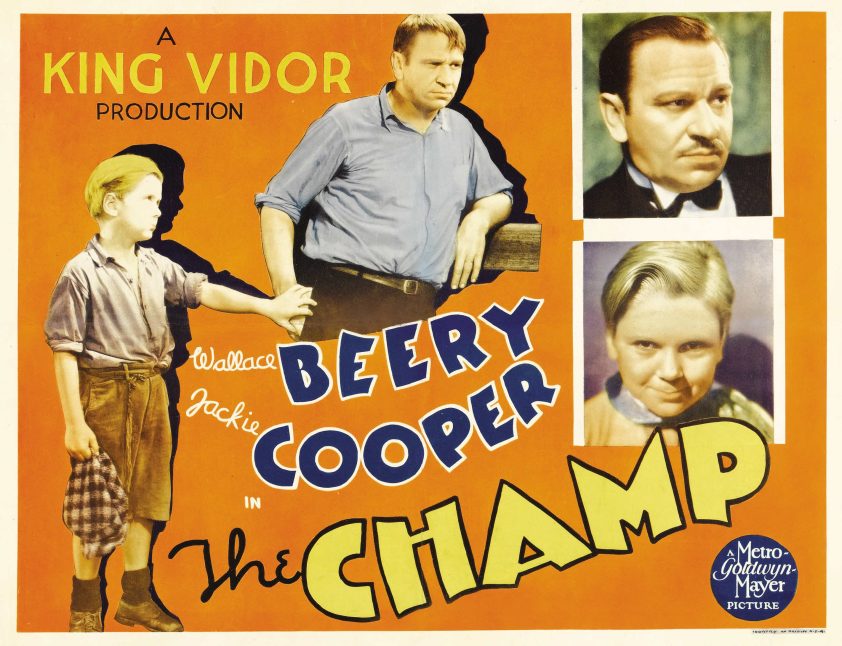
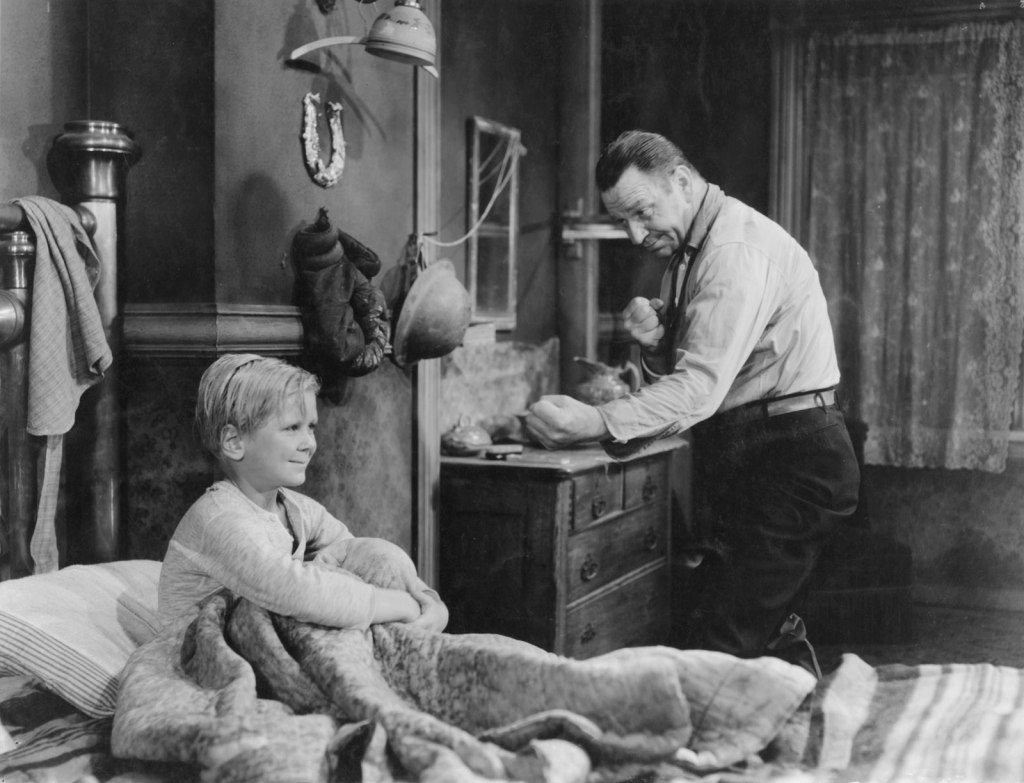
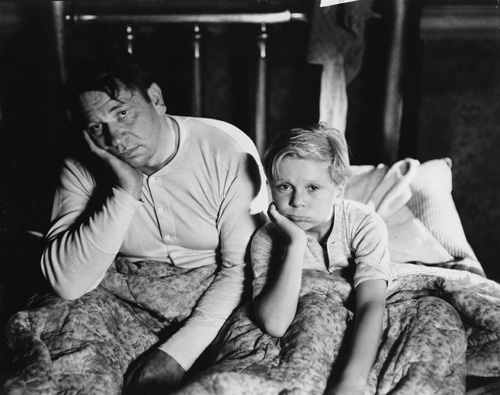
King Vidor’s excellent film, The Champ (1931), is not only a melodrama but it has been called a “male weepie.” So, whatever gender you identify with, bring a helluvalot of tissues. No matter how many times you see the film, it still punches you in the gut just as hard as Andy Purcell aka The Champ (Wallace Beery) is known to have knocked out opponents in the ring…or how he currently hits booze and gambling halls. If you’ve seen Darren Aronofsky’s 2008 film, The Wrestler, that would also count as a “male weepie.” But The Champ was really the first of this genre.

Storied to be the highest-paid screenwriter in Hollywood at the time, Frances Marion had already changed the game for women in film. An author of over 300 film stories and scenarios in her career, Marion directed films, wrote how-to film textbooks and was instrumental in advancing the careers of actresses like Marie Dressler, Mary Pickford and Greta Garbo. Significant in Frances Marion’s repertoire, The Champ was a big success upon release and has remained a classic. To this day, The Champ remains the champ of motion pictures about boxing/boxers. However, without Marion’s magic touch, this film would not have been 1/10th of what it is. Her ability to read Beery as a performer was what gave her the impetus to write the character of Champ.

Marion had designed the role of The Champ especially for Beery after his standout performances in both The Big House (George W. Hill, 1930) and Min and Bill (George W. Hill, 1930), both scripted by Marion herself. When it came time for Marion to create The Champ, there was only one person who could be cast in the eponymous role: Wallace Beery. Originally, The Champ was to be a completely different film. In a conversation with MGM production head, Irving “boy genius” Thalberg, he had suggested to Marion that she write a Western. Having made her last 2 films with her now-ex-husband George W. Hill, she wanted something to get her own name out there, and feel more independent. Thalberg suggested a genre shift and she accepted.

So Marion made her way down to Mexico for a working vacation. What she returned with was not a Western but a boxing melodrama. Frances wandered the streets of Tijuana and Ensenada for inspiration and came upon a scene that completely changed her mind and the story. As she walked through town, she saw a saloon. Suddenly, a large drunken man charged through its doors, a child trailing out after him. Marion clearly heard the young boy shout to the growing crowd, “Can’t you see the Champ needs some air?” As Cari Beauchamp writes, Frances Marion had “gone to Mexico looking for a Western but returned to Irving’s office with a self-styled tearjerker, the tale of a drunken ex-prizefighter and his son which she called The Champ.”

Nominated for a variety of Oscars at the 5th Academy Award Ceremony in 1933 including Best Director, Best Picture, and Best Production, Frances Marion won the “best story” Academy Award for The Champ while Wallace Beery walked away with a much-deserved Best Actor Oscar. This was no small thing for an actor who started his professional life as an assistant elephant trainer in the circus. Beery was notably a difficult man to work with and his personal life was not one to look into if you value his acting. But Marion and Beery had a curiously strong and valuable relationship that allowed the story that she wrote to come through in a powerful way. Thalberg’s initial response to reading Marion’s treatment of The Champ was “I’d like to own the handkerchief concession on your soap opera” and much of that is due to the sweet and sour, hard and soft, breathtakingly brilliant approach that Beery took to the character he played.

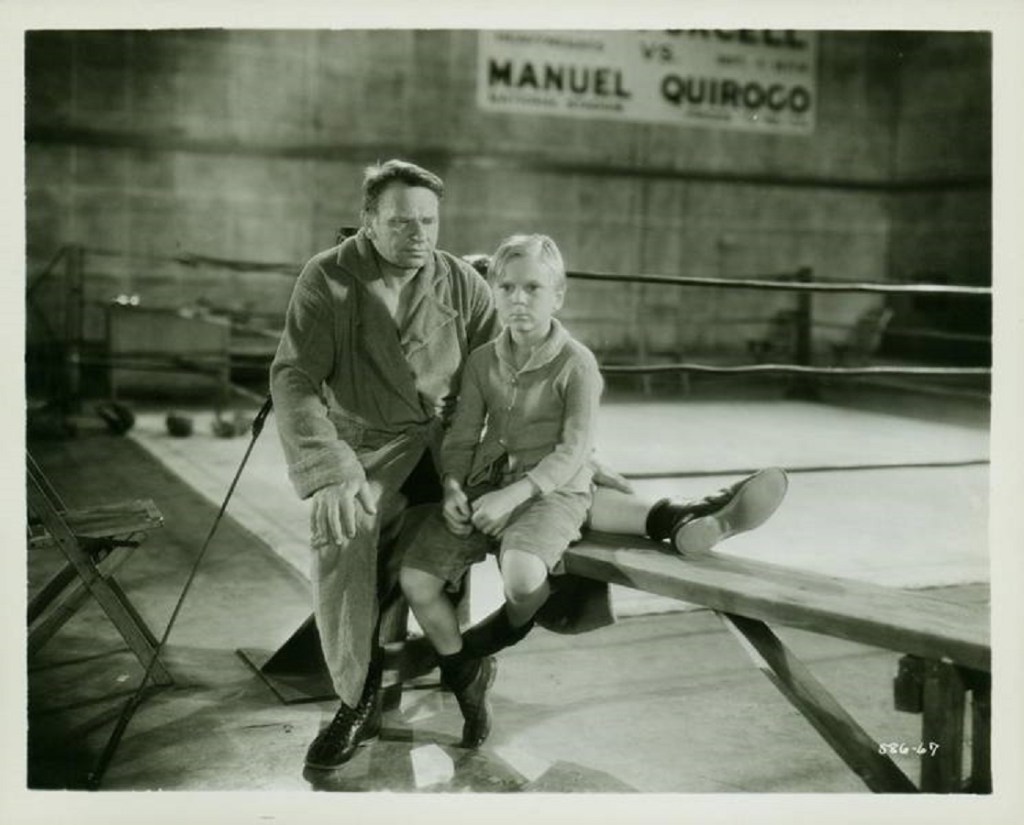
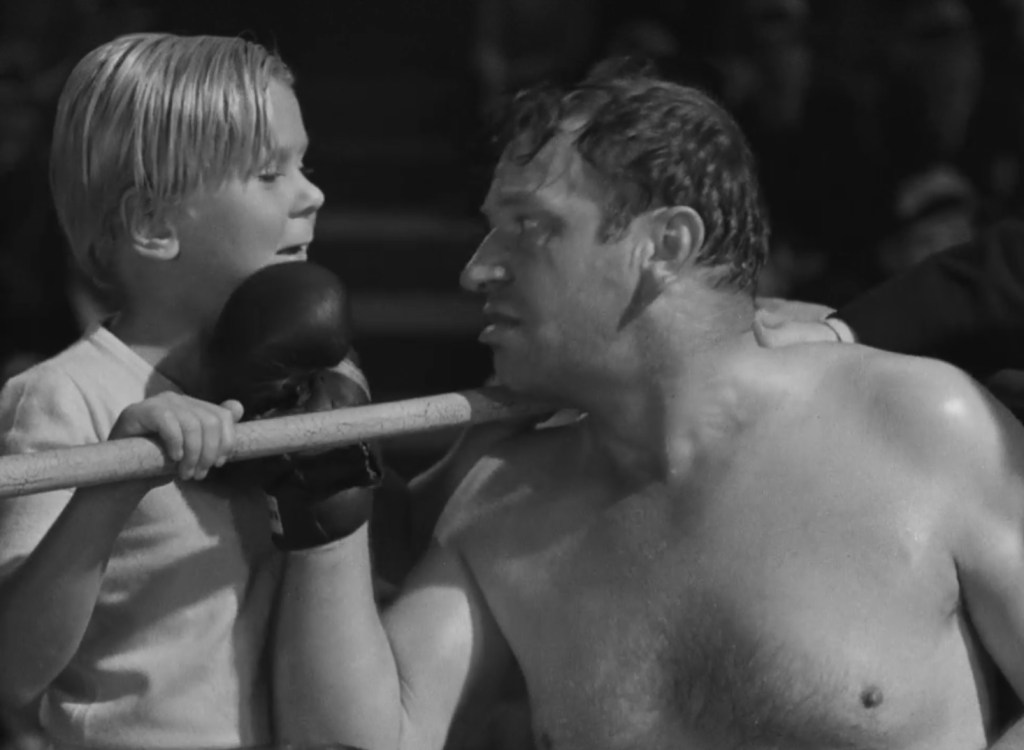
There is nothing dated in this work. That’s the glory of it. America still loves boxing, gambling, horseracing. We still have raging addiction and poverty issues. What makes this film stand out above all others is its focus on the deep relationship between a man and his son. Amongst the gambling problems, the alcoholism, Champ’s inability to keep enough money around to properly feed and clothe them both, The Champ clearly loves his kid Dink (Jackie Cooper) and Dink would be lost without The Champ.

Each time I watch it, I always wonder: where are the rest of the films about father/son relationships? Some exist, but not quite on this level. They’re either too saccharine or too “you gotta tough it out, kid!” The Champ is a great example of a film that reaches a happy medium. Sure, it’s a little dramatic, but it still gets the point across and hits home. I’ve read a few articles on this film and they talk about how it “reverses the melodrama” or “inverses maternal relationship representation” and that drives me bonkers. There IS a mother in the film. So it’s not that there isn’t maternal representation here. That’s just ludicrous. What these academics or film critics ignore is that there is a tender and beautiful bond between a father and son that is rarely (if ever) depicted in American cinema.

While their roles are ever-shifting as to who plays caretaker and who is being cared for, there is no question about the sheer amount of love that exists in this father-son pairing. So every time The Champ disappoints Dink, it’s not just heartbreaking, it’s shattering. Jackie Cooper’s performance matches Beery’s in its authenticity. Various articles at the time insist the two actors did not get along, but their professional relationship was clearly beyond any personal adversarial issues they had. Indeed, the two went on to make The Bowery (Raoul Walsh, 1933), Treasure Island (Victor Fleming, 1934) and O’ Shaughnessy’s Boy (Richard Boleslawski, 1935) together. They made an excellent cinematic team!

The male weepie is a highly underexplored genre. Recent films like Moonlight (Barry Jenkins, 2016) have not only modernized the genre but also updated it in a stunning and progressive way. The structure and emotional resonance remain unchanged. Additionally, the need for men to be able to identify and connect with their tears is just as critical. The heartbreak deep within The Champ is as hardcore as that of Moonlight. Further explicated as a masculine-coded melodrama, the male weepie is more than just a dudely tearjerker or a dramatic film with guy themes. Melodrama is defined as “a sensational dramatic piece with exaggerated characters, exciting events intended to appeal to the emotions.” By keeping this definition in mind and remembering that male weepies are essentially melodramas with a focus on the masculine, we may be able to better appreciate the value of these films as a collective force.

Every boxing, wrestling or extreme sports drama falls under the category of male weepie. This genre includes every Rocky movie, The Fighter (David O. Russell, 2010) and Warrior (Gavin O’Connor, 2011). Requiem for a Heavyweight (Ralph Nelson, 1962) is a male weepie as is Raging Bull (Martin Scorsese, 1980). One of my favorites, Fat City (John Huston, 1972), definitely qualifies and Real Steel (Shawn Levy, 2011) counts whether you like it or not. These are, of course, only the sports-related films. There are a few action-related films that fall into this category and a handful of movies that people relegate to the drama section. The importance of many of these films is that they point out the brokenness of men as well as their value. Not a single one of these films praises its protagonist or worships masculinity, saying it’s healthy. They are all extensively critical of the kind of Tough Guy Values that lead our “heroes” to these situations.

The Champ is tops in this regard. It allows every criticism of The Champ that you could think of. He’s a gambler, a loser, and an alcoholic. He’s a bad provider. He takes his kid to saloons, gambling houses and racetracks. Champ has no boundaries or rules. And when he fucks up, he fucks up bad. But he’s not the one who bears the brunt of the gaffe or misstep- it’s Dink. Dink’s entire life has been this; he doesn’t know any different. Watching their exchanges, we know that this is their narrative. But it doesn’t make it any easier to watch or any easier to swallow. Every time Dink’s face lights up, it’s like blue skies and the bright sun shining! Conversely, when Dink’s face falls due to something Champ has done, there is nothing sadder or more hopeless. Jackie Cooper gave this character something really special.

While many films came afterwards that explored the emotional territory of the parental relationship and how traditional masculinity could really fracture a man’s identity or sense of self in comparison to what he FELT, The Champ is one of the first films to identify the value of those things. These are complex discussions and (more often than not) ignored ones. It definitely took a woman to write this story, but one can only hope that men will take the much-needed and valuable lessons that it has to teach.

“The Champ” Jackie Cooper, Wallace Beery 1931 MGM

Teachable Moments: Alamo Drafthouse, Cinefamily & the Future of Repertory Cinema

So I think its time to have a little conversation about value, worth and intersectionality.

Things are pretty weird right now. I was talking with a girlfriend the other day and both of us have been in the film community for a really long time. Long enough to remember when internet-based film writing/promotion and communities didn’t rule the scene. Imagine that! But internet/no Internet, there has always been misogyny. Always been racism. The homophobia has been lesser to an extent, but…that’s entertainment. It’s still there. We all know that transphobia is awful no matter where you go so…end scene.

gender neutral robot


Let’s set the stage. Current events: if you’re a straight white male celebrity who sexually assaults women, you might want to start getting scared. James Woods found this out the hard way when Amber Tamblyn called him out on Twitter last week. She wrote two brilliant pieces on Teen Vogue and the NYT, in response to him calling her a liar after she recounted his ill-fated pick-up attempt when she was just 16. Tig Notaro’s recent season of One Mississippi dedicates 2 episodes to addressing sexual assault, which is a direct shout out to Louis CK. Tig has spoken widely about CK’s refusal to address his problem, as have other female comedians.

Screen Shot 2017-09-17 at 9.45.21 PM

Real talk: this shit has been shoved under the rug in the entertainment world since the casting couch was invented and studio heads invited women in for “lunchtime interviews,” promising them the “role of a lifetime.” But women are finally breaking their silence. Which is great. This should be supported and encouraged, especially by powerful men in the media world. But there’s a big chance it won’t be. Why not? Because making a “bold move” such as that might mean outing their friends or losing their buddies. And that’s scary and uncomfortable.

Dudes, I’m calling you out. It’s time. It’s not brave for you to step forward and join us in talking about what’s actually going on. If anyone tells you you’re “brave” or thanks you, tells you how “amazing” you are for standing up, that’s straight up bullshit. You should have always been doing this. You just finally smelled what The Rock was cooking, ok? No back pats, no OMG YOU’RE SO AWESOME!

Make a decision. Look at what’s going on and be on the right side of history. Because history does not wait and it certainly has no sympathy.

Over the last week, some straight white men in the film community have had a few real HOLY FUCKING SHIT moments. These were all heavily tied into the fact that they have absolutely zero comprehension of what VALUE means or what or who might, in fact, be VALUABLE.

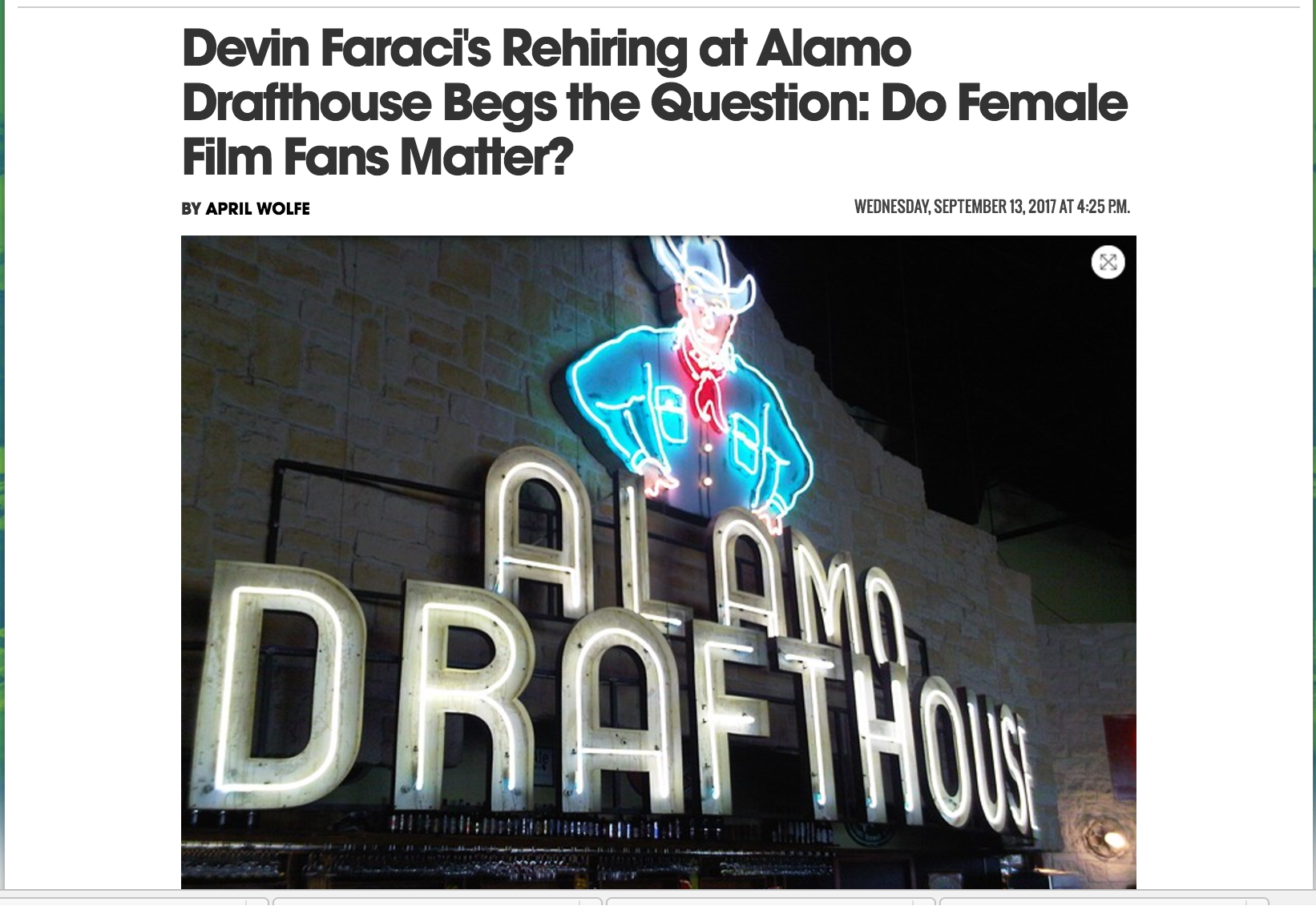
It is important to note that most of the recent conversations being had in the film world have been incredibly white and privileged conversations. We have not stopped for one second to address women/people of color, trans bodies, or any communities that might have felt equally bludgeoned by what has been happening in the repertory theater scene. And by that I mean the recent scandals at the Alamo Drafthouse and the Cinefamily.
Screen Shot 2017-09-17 at 9.51.35 PM

LA Weekly, September 13, 2017

I want to approach this discussion of VALUE on an intersectional level and include every body that has ever felt assaulted by today’s straight white male dominated film culture. It is a structure designed specifically to celebrate all that is white, male, moneyed and heterosexual and oppress all that are not. All marginalized groups-defined as women (women of color especially), people of color, queer folx; trans and non-binary identifying individuals- are considered outsiders from this Primary Group and ostracized. We may try to affiliate ourselves with those in this Clique, but the very nature of its construction denies us entry. We haven’t gotten good seats in the movie theater for quite some time.

AudreLordeSingleIssue.jpg

I have been in the world of cinema and media studies for most of my adult life. The world has changed a lot in the last twenty years, and I’ve changed with it. The one thing that has not changed is the way that marginalized groups have been treated. This is absolutely a question of VALUE. We are simply not considered to have worth.

Structures of value and worth are why women are spoken over on newscasts and televised political arenas. It’s the reason so few brown faces are protagonists in feature films, there are currently no Asian superhero movies and why black bodies have rarely been lit correctly on film and television until work like Insecure (creators: Issa Rae & Larry Wilmore, 2016) or Selma (Ava DuVernay, 2014).

11-insecure-recaps-204.w710.h473

Issa and Molly, Insecure, Photo: HBO

The incidents I will be discussing- the sexual assault troubles at LA repertory movie theater Cinefamily and the sexual assault/employment cover-up/what-have-you at the Austin-based Alamo Drafthouse- are not ones that I plan to give space to here. Please feel free to Google them at your leisure; there are tons of articles available on both subjects. I will be using them and specific details/ experiences in context that I believe to be important to this piece but I don’t believe that I need to link any articles.

Moving forward then- value has been an issue for hundreds of years in marginalized communities. Consider the following: a body’s worth measured in economics (slavery) or a body’s worth measured in marriage and reproduction (a son is good, the family name/legacy continues, a daughter is bad except for marrying off/childbearing). What about a slave body that can reproduce another slave body (a woman of color)? Think on these things. These evaluations are not done by the bodies themselves but by an outside force; an oppressor. Whether it is White Supremacy or Patriarchal Heteronormativity, dominating another body because of your self-created value structures is just fucked up.

One of the primary topics of this article is sexual assault, an act that involves our physical selves. Our bodies. Our bodies are a big part of our worth. Our bodies are physical containers but they are also reflections of our PERSONAL worth. We value ourselves and we value our bodies. So what do we do when our bodies are violated? Worse than that, what do we do when those whom we value enact violence upon our valuable, worthwhile bodies? Who do we turn to when we are viewed as so invaluable that we cannot even be consulted about intimacy? That’s a fucked up feeling.

This was something many women faced at Cinefamily and have faced for years in the film community. Who would believe that so-and-so did THAT? “He’s so coooool Are you sure you remember right? You weren’t just a little drunk?” Because then he’s off the hook. If you’re drunk, the incident didn’t happen. And if he’s got some kind of high-level rep or if he’s famous then it definitely didn’t happen.

Screen Shot 2017-09-17 at 10.09.55 PM

IndieWire Headline, Aug 22, 2017 11:21 pm

Intimate violence is visited upon our bodies and we can do nothing about it. We are not believed because we have women’s voices. Or queer voices. Or black voices. Or trans voices. While white women like Amber Tamblyn can reveal their stories and talk back to James Woods, do you think anyone would’ve believed a black trans woman who wasn’t famous?

Let’s look at social structures of VALUE. White people don’t value POC. If we did, black bodies wouldn’t be strewn lifeless throughout American streets, while the white bodies that violated them are legally allowed to move on without repercussions. Women/women-identifying folx are not valued. If we were, there would be no such term as “mansplaining.” White women are valued more than Women of Color but that in and of itself makes me cringe. And let’s be honest: trans and non-binary identifying individuals get the worst of it. It’s not just that people don’t value them. People pretend they don’t exist. Value and worth. If society, structured exclusively by White Rich Straight Older Men sees no value in you, you play no part and you are worthless.

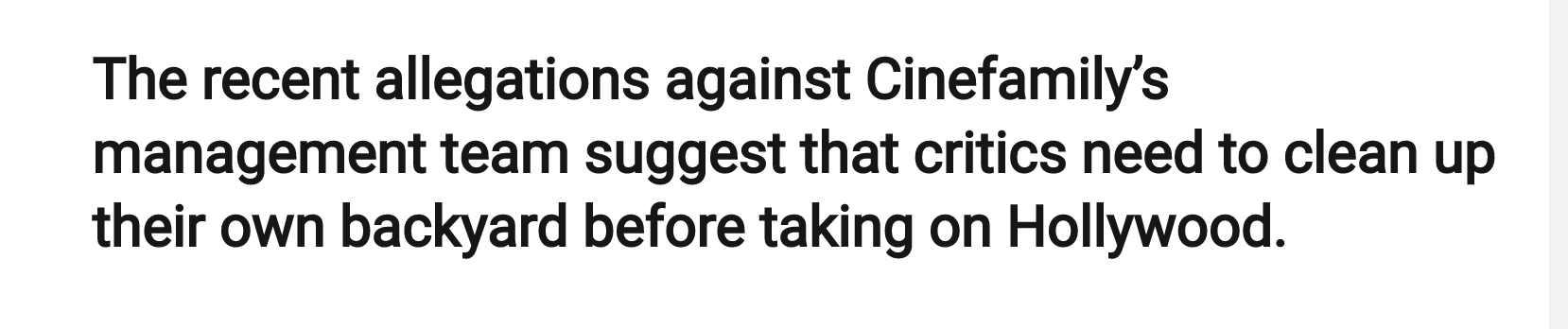
Having attended the Cinefamily for a long time, I always noticed that there were many female employees and volunteers. Like an overt amount. I knew a few of them. I also saw a huge turnover rate. I stopped going a few years ago except to certain screenings. I saw brilliant and painfully talented people get treated poorly and that left a bad taste in my mouth.
Screen Shot 2017-09-17 at 10.08.24 PM

Film School Rejects, AUGUST 25, 2017

There were a few men employed there, but for the most part, it was women and not in an “empowering women” way. Looking back, the presence of so many women employees had a display case feel. Which I thought was strange. I chalked it up to Cinefamily being an “extreme hipster” theater but that was definitely not it. Sometimes we tend to compartmentalize when we don’t want to see things that are staring us right in the face. This was one of those things.

To Hadrian (Cinefamily founder), cultivating the look and molding the culture around that theater was part of its cachet. He did a masterful job in many ways. On the other hand, other people who never received the credit did much of the work attributed to him. What is critical here is that he created an environment where the only value system at play was his own. In any other work setting, this would have been seen as abusive. In any other work setting there would’ve been a HR person to assist his employees. But his male-dominated upper management structure (which includes the board) was in charge of the entire feel and social landscape of Cinefamily, from screen to popcorn maker.

So the regular floor employees were intimidated as fuck. The value of the women had been as objects, the men as continuing the promoting of the world/culture that had been created. Sounds a little bit culty. Which has been mentioned before. But I really read this as a lot of fear and sadness and a deterioration of personal worth as you continue to be abused by a workplace situation that you used to adore.

Here’s the even shittier part: this is what the world of repertory theaters and film festivals has been like forever. So the fact that Cinefamily exploded when it did made me roll my eyes a little. I couldn’t help but think: OH FUCK. Here we go. So who’s next? And let me stress right now that I have a lot of love for a lot of people working in the film festival and repertory worlds. My archivist/preservationist world is 100% not without its horror stories. In fact, we are probably due for some explosions too. But we’ll deal with those when they happen.


Guerrilla Girls' Pop Quiz 1990 by Guerrilla Girls


As for theaters and festivals and their dreadfully loosey goosey culture…These white, straight and male-dominated events and networks have always had Questionable Incidents. In the past, they were sighed at, and “Oh, that’s just so-and-so”-ed at. It really was like Mad Men. Whispers and secret confrontations swept under the rug. It was expected and built in. But when the ladies talk behind closed doors, we’re not fucking happy about it. And we haven’t been happy about it for years.

Did you know that, guys? Or did you think things were ok? Because a lot of you had to know about a lot of the heinous shit that has happened over the last 20 years. Whether I am in academia, the film festival world, entertainment journalism or my current archiving/preservation community, I want some answers. If my girlfriends and I know, if we’ve been frustrated and angry because we couldn’t call someone out because they were Too Big Time, then you guys must know the stories too. You probably know worse stories and have laughed or just rolled your eyes about it. Every time you didn’t warn us or stop those guys or call them out or do something, you let the women in your life and in the film community know that they were not valued.

Friends. WE JUST HAD TWO NUCLEAR MOVIE HOUSE EXPLOSIONS IN LESS THAN TWO MONTHS. Think there’s something rotten in the state of theatrical? Cuz I fuckin’ do.

So let’s update. It’s 2017. Less rep houses, mostly due to the analog/digital changeover. So we’re down a lotta movie houses and up a hellovalot more film festivals. What did that do? Well, it gave us the white, straight male-dominated film culture that focuses on the White Male Film Geek as Lord King God. It is literally White Geek-Bro Supremacy. This is something that has been planted, cultivated and grown over the years, carefully and intentionally. Fed with social media and entertainment journalism, it is so large that it IS VALUE and considered something OF WORTH. Basically, these geeks bring in the bucks. But at what cost?

I’m here to tell you fuck White Geek-Bro Supremacy. There is nothing valuable that can be created by this system. It does not create communities of worth. It gives NOTHING back.  The Cinefamily, Alamo Drafthouse, Fantastic Fest are examples of this dynamic in action and each one of these has either imploded completely or fractured under the weight of its toxic masculinity.

Communities established under this structure do not value women of color who love to read comic books or cosplay because it is joyful. In fact, the communities developed by White Geek-Bro Supremacy do not center joy at all. White Geek-Bro Supremacy centers competition, bullying, and one-upsmanship instead of goodwill, respect and an infectious love for cinema. The cradle of this system is binary viewpoints (best/worst) and list-dependency (top ten most ___). It was heavily nurtured with the idea that some media was indubitably to be valued and some not to be valued, based upon a knowledgeable hierarchy that rose to the top of the message board/chat group communities and eventually published blogs and articles. Incidentally, this is how men ended up dominating authorship of Internet movie sites.
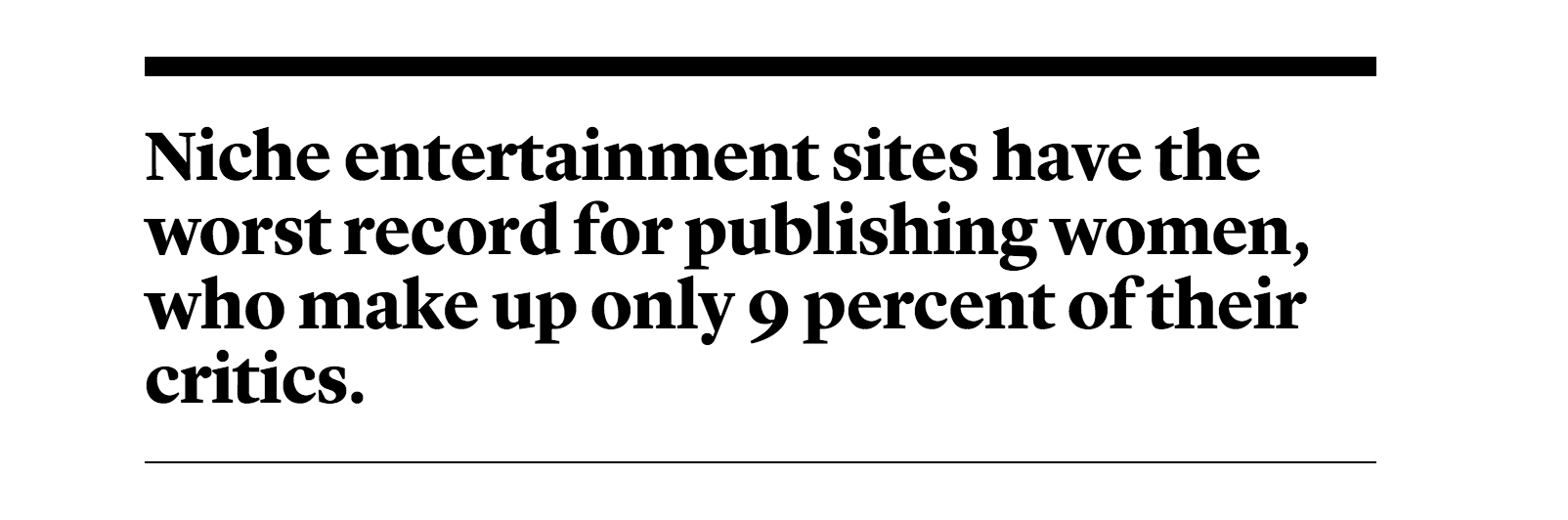
Screen Shot 2017-09-17 at 10.38.24 PM

from Katie Kilkenny’s article, “Why Are So Few Film Critics Female?” in The Atlantic, Dec 27, 2015

White Geek-Bro Supremacy is what was working overtime during the Alamo Drafthouse turmoil this week.

Many thought the mess was about a sexual assault(s) committed by a former writer for an Alamo Drafthouse publication. It was about more than that. It was about a severe lack of transparency, the preferential treatment for a pal and the willingness to risk an entire company’s reputation and national operations on an individual relationship. This speaks of a special kind of blindness: Privilege Blindness. As my friend John Wildman eloquently wrote, a large problem in the Alamo Drafthouse founder Tim League’s “crisis management” was that he never stopped to listen to those who should have been listened to.

This is a recurring theme with privilege. Those with White Privilege, Male Privilege, and Heterosexual Privilege have the idea that their privilege affords them earplugs & blinders. The definition of Privilege Blindness is “I will not make the space to listen to you because of xxxx reasons.” Guess what, honey? Not one of those xxxx reasons is valid. Grab a beer. Pop the top. Just get uncomfortable with this.

privilege.png

When you do not take the time to listen to another person, you are telling them, “You are not valuable. You are not worth anything. You have nothing to tell me of any value. I do not see you as someone who could add value to my life. Your experiences/thoughts/feelings mean nothing to me.” When you do that to someone in a marginalized group, it can be both achingly familiar (we’ve lived our whole lives not being listened to) and possibly life threatening. While the aforementioned former writer for Drafthouse certainly did lousy things, he wrote one good thing on his now-deleted Medium post: “Believe women. Especially when they are talking about you.”

What is it going to take to destroy these systems of oppression? What is it going to take to break down years of abuse? The men and women who have spoken out against the ongoing practices at the Drafthouse are mirror images of those at Cinefamily. They feel ignored, stepped on, devalued and left in the cold. They were not hip enough. Not in the cool kids club. Stories of floor staff at the Drafthouse being treated as “lesser than” because they were not within the upper echelon of the Who’s Who. And I get it: it’s largely impossible in a company that size to have some utopian vision where people are all partying together. But it is possible to have people feel appreciated and like they are part of an institution that is doing something amazing for the cinema community, which is the image that the Drafthouse outwardly projects. Bottom line: the party should never end up being more important than the people who decorated the room for the celebration.

As for Fantastic Fest… Tim League’s gotta be a little sad about that right now. His actions have put him in that funky little zone where moral values have impacted his Financial Value. Fox Searchlight pulled their film from Fantastic Fest. That’s kind of a big deal. While FF usually goes for more unusual fare, it could always use a big studio film for a bump, especially after recently launching new distribution shingle, Neon. Get rid of the testosterone-fueled boxing-matches, limit the VIP-only bashes that create such clear hierarchies and go back to what made the festival unique- its content.
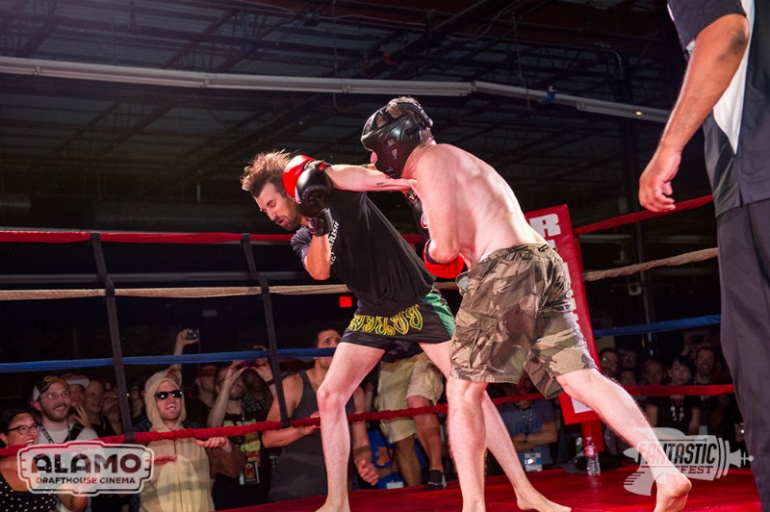
ff pic

Boxing match from Fantastic Fest 2014, Photo: Alamo Drafthouse, September 21, 2014


So this may have been a lot to get through for many of you. And it may not have made sense or connected to the Cinefamily and Drafthouse situations for some. But please trust me- it all does. Obviously right now I don’t give a shit about TL;DR. Some will read this, others won’t. I’m really pissed off. I hate that it’s taken the devastation of two cinematic institutions and one film festival in order to knock some sense into dudes’ heads and make them remember that women are people too, with feelings and needs and all kinds of INSANE THINGS.

And please know- I never wanted Cinefamily to die. However, in the form that it was in, with that board of directors (some of whom are still very active in the LA rep theater scene), it was impossible. There were amazing people at Cinefamily and amazing people are suffering unemployment now due to its closure. I also do not advocate skipping Fantastic Fest (unless you feel you need to). I think that taking the discussion to the source and holding people accountable is key. But don’t just talk the talk, walk the walk.
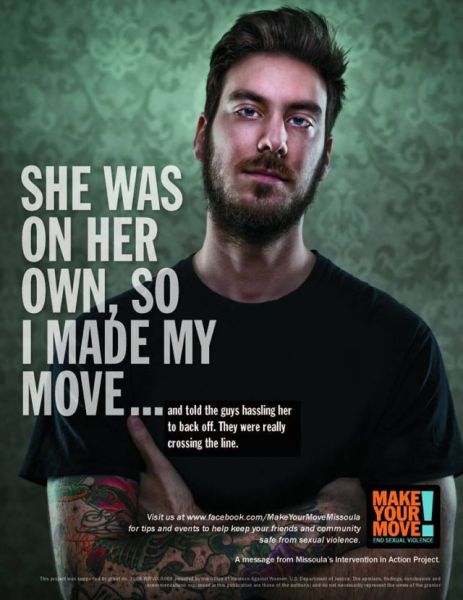
rapeculture2

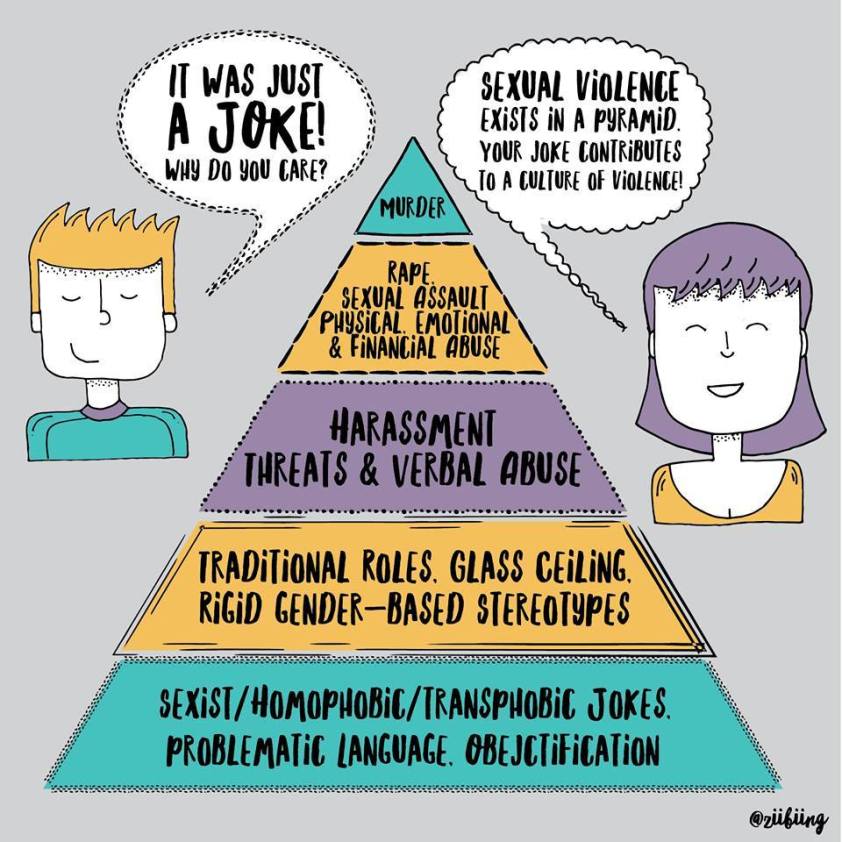
An interesting ad from an anti-rape campaign in Missoula, MT.

I don’t want to see Drafthouse go down in flames but I would like to see its encouragement of White Geek Bro Supremacy stop. This will take more than a few professional sessions with a “crisis management” team. This will mean letting real people – women, POC, queer folx, trans/non-binary film lovers- talk to you, Tim League. And you need to shut up and listen.

Turn a new page. It’s possible, but it’s going to take work. It’s going to take a lot of listening and a lot of people are going to have to get really uncomfortable. A lot of people are going to have to do some major self-reflection. But as Amber Tamblyn wrote to James Woods, “What you are experiencing is called a teachable moment. It is called a gift.”
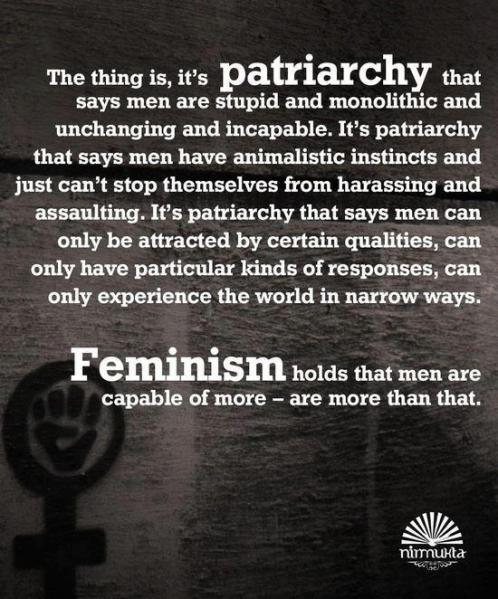
patriarchyfeminism

Women and other marginalized groups are done being quiet. We know our value and our worth, even if rich straight white dudes don’t. For many of us, discovering intersectionalism has helped. Working together we can be more powerful than by focusing on just our own separate issues. Many of us have discovered new definitions of value and worth in community organizing. But that also means that structures of white supremacy and patriarchy are in serious danger. We’re only going to get louder and more powerful.

So White Male Geek Squad? Y’all should get your shit together and clean up your act. We’re coming for you. And that’s a promise.


Hitchcock

This post was originally published on the New Beverly Cinema blog on August 29, 2017. It is being republished here with full permission of the New Beverly. For the original post (with different artwork) please see the original post here.

In 1964, Alfred Hitchcock appeared on the CBC (Canadian Broadcasting Channel) documentary series Telescope. Interviewed by Fletcher Markle, the Master of Suspense revealed one of his primary approaches to filmmaking. “Please don’t think me presumptuous if I give you the analogy of, say, a painter who paints a tree, a landscape, or even a bowl of fruit,” said the legendary director, “I’m sure that the painter is not a bit interested in the apples for themselves alone, but in the technique of his work which stimulates the emotion of the viewer of his picture. After all, all art is experience. People look at an abstract and say, ‘I hate it!’ but the mere fact that they use the word ‘hate’ means that they are going through an experience…therefore if you apply these principles to film, as I see it, it is not the pure manner of the content, in other words it is not just the story but what you do with it.”

Alfred Joseph Hitchcock was a summer baby, born on August 13, 1899. His father was a grocer and his mother had other children to raise so Hitchcock’s description of himself as a well behaved but lonely child is reasonable. Hitchcock’s nondescript yet religiously strict upbringing played a large role in many of his films later. Raised Catholic but sent to a Jesuit School, Hitchcock said to Francois Truffaut, “It was probably during this period with the Jesuits that a strong sense of fear developed – moral fear – the fear of being involved in anything evil. I always tried to avoid it.” Works such as I Confess (1952) and The Wrong Man (1952) are explicit examples of how Hitchcock utilized religious themes and visuals to provoke and examine ideas of terror in works of suspense. This skilled director was even able to centralize the benevolent precept of “love thy neighbor as thyself” and quilt it into a tale of ultimate anxiety in the Technicolor tale, Rear Window (1954).
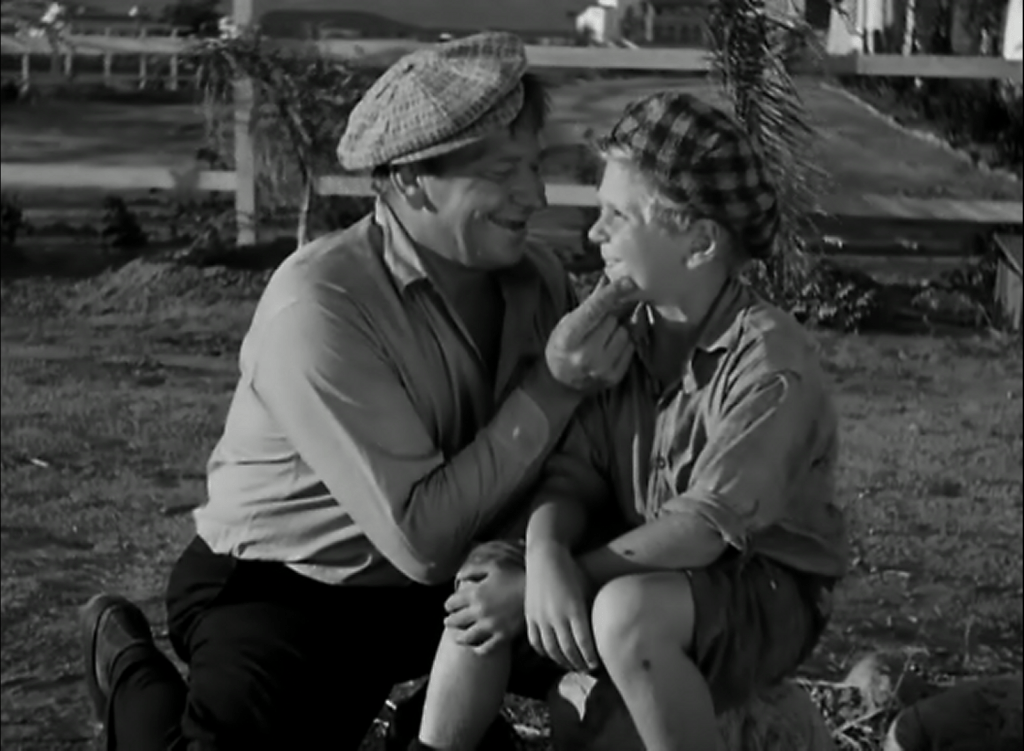
After studying art, Hitchcock became an advertising man. Many years later, career in full bloom, his past in the ad industry makes sense. No other director in film history is as commercially recognizable as Hitch. The famous 9-stroke-line-drawing of his silhouette (designed by Hitchcock himself), the portly shadow on any screen (film or TV) are enough for almost anyone to make the connection, let alone the highly publicized series of posed photographs promoting his later films like The Birds (1963) or Psycho (1960). These shoots feature him with his conspicuously expressionless face and a prop item signifying his latest production. Advertising indeed!
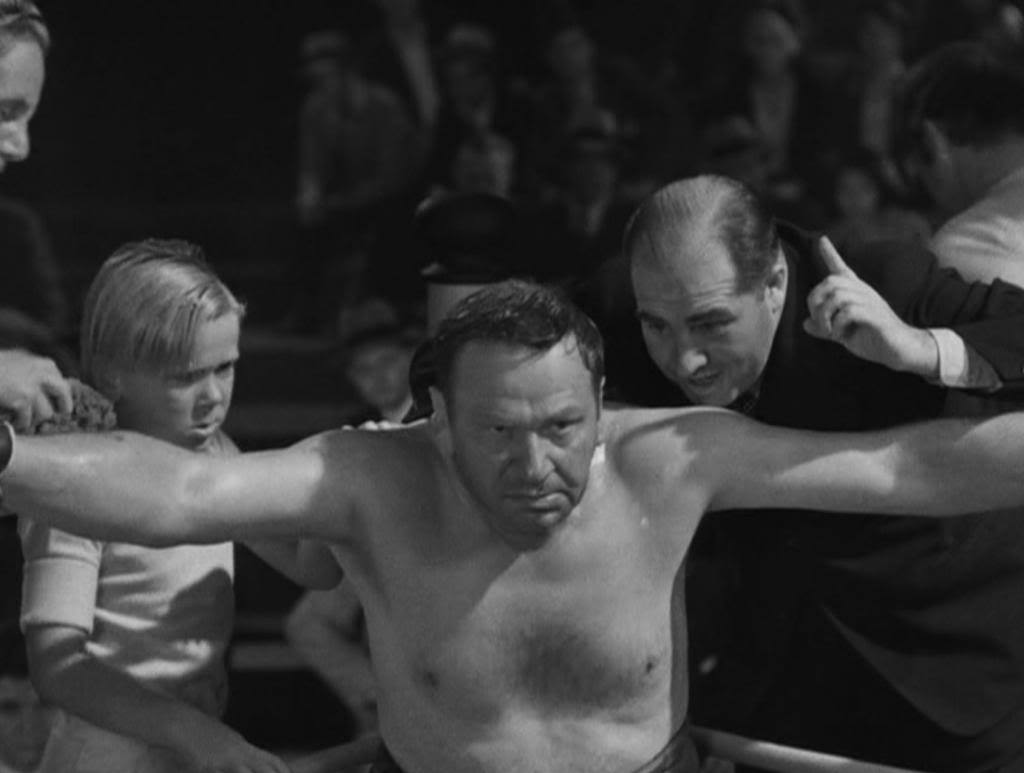
Truth be told, Paramount certainly had some weight behind the Psycho (1960) campaign, but its promotional work changed film exhibition and directorial sway for good and was truly incredible. Take a look:

Hitchcock’s gift for commercial work and talent was balanced entirely by his partner/wife, Alma Reveille. He met Alma, herself a film editor and a script girl,  just after moving on from designing the art for intertitles (the dialogue or narrative cards that accompany or assist in the continuity of silent pictures). For the rest of his/their careers, there would never be one single film that she would not advise him on. According to their daughter, Patricia, if Alma wasn’t keen on a script, Alfred wouldn’t even give it a second glance. Their team efforts provided them a happy life and a happy career. Whatever you may have heard, you have only to go to the Academy of Motion Picture Arts and Sciences and see the AMAZING home movies in the Alfred Hitchcock Collection to see the loveliness of Hitchcock family life. I particularly recommend the home movie where Hitch is pretending to “uneat” a banana.

After meeting Alma, Hitch made a few more silent films. He directed the Jack the Ripper-inspired work, The Lodger (1926), the first of his many films to look at issues of wrongly accused individuals. It began his style of recurring visual motifs and, most importantly, is a great example of Hitchcock’s tremendous capacity for thinking outside the box. His ability to translate what was inside his head to what made it to the camera’s lens was legendary. In the production of The Lodger, a plate-glass floor was specially manufactured in order to show the lodger pacing back and forth (this was shot from below). The “ceiling” also allowed for a chandelier to swing with the lodger’s stride. Later on, this would have been unnecessary – the pacing, the chandelier – could have been done with sound. But not in 1926.

The director carried this method over into other films. It was, in fact, part of what he felt was the language of cinema. Being able to tell a story with a greater concentration on image and less on dialogue is critical to understanding Hitchcock’s work. He created all kinds of props and manipulated a variety of visual cues in order to underscore the more emotive factors of a given scene. For 1938’s train thriller, The Lady Vanishes, Hitchcock had extra large glasses fabricated and shot through them in order to intensify the drama but not detract from the actors. For the highly Freudian and Salvador Dali-dream-sequenced Spellbound (1945), a gigantic hand and gun were created for a finale sequence. The infamous coffee cup in Notorious (1946) is far bigger than any caffeinated beverage container I have ever held (although I have never had the glory of being served by Cary Grant so perhaps I do not know from whence I speak).

Hitchcock’s careful attention to his visual topography was not to be outdone by those motifs that ran through his films. The aforementioned “wrong man” scenario is huge in his cinema as is the idea of guilt or a guilty conscience (he was raised Catholic, even if he did go to a Jesuit school). Explorations of male desire and sexuality can be found in every film he ever made. Many Hitchcock films examine sexual fetishes, psychoanalytic ideologies and address what is deemed as “deviant behavior” or some level of deviancy in terms of the homoerotic. While films like Rebecca (1940), Rope (1948), and Strangers on a Train (1951), are famous examples of Hitchcock’s involvement of intense queerness, other films such as Rear Window (1954) and Vertigo (1958) reveal the perversity of those men who might seem to be the “average Joe.” While Hitch’s queers are murderous, his normal dudes are voyeurs and perverts. Which is worse? The landscape that this British gentleman painted may not be comfortable, but boy howdy is it fun to dig into! As Hitchcock said about his masterful Shadow of a Doubt (1943), “What it boils down to is that villains are not all black and heroes are not all white; there are greys everywhere.”

Alfred Hitchcock may work mostly in the suspense and thriller genres but his comic ability is top-notch. It is true that the majority of his films do carry an overall serious tone and the topics that are covered are somber (murder, mystery, horror). But please note: you are allowed to laugh. And not nervous laughter either. Hitchcock is funny. INCREDIBLY FUNNY. While it would be wildly inappropriate to laugh at his films for being outdated (that’s never cool when dealing with classic cinema, folks, get with the program), what many fail to realize is there is a level of comedy included in Hitch’s darkness that allows you (as an audience member) to enjoy the film more. Whether it is the inclusion of a wacky side character or sewn into the skillful dialogue, laughing is ok. The Trouble With Harry (1956) is unapologetically a murder-comedy while To Catch a Thief (1955) and North by Northwest (1959) are truly some of the more hilarious suspense thrillers made. Every Hitchcock film includes his humor. And if you doubt his comedic intent, simply look at a few of the introductions to his television show that ran from 1955-1965 on CBS and NBC, respectively.

Who Killed Teddy Bear?

This post was originally published on the New Beverly Cinema blog on May 18, 2017. It is being republished here with full permission of the New Beverly. For the original post (with different artwork) please see the original post here.

Lurid. Sleazy. Trashy. Sordid. All words used to describe Joseph Cates’ 1965 thriller, Who Killed Teddy Bear? Is it an exploitation film? Is it part of the queer panic canon? Was this film the motion picture to inspire works like Taxi Driver (Martin Scorsese, 1976) or even Black Christmas (Bob Clark, 1974)? It is notable that practically every written review from those who have seen this film has included a kind of defense, no matter how damning their take. While discussing the film as pure filth on celluloid… they couldn’t completely hate it. Their final remarks always ended up recommending Who Killed Teddy Bear?, struggling with their own feelings on it and resolving to see it as a skillfully done art film, perhaps part of an independent cinema movement that was just beginning to be born.

It’s easy to compare Teddy Bear to Scorsese’s Taxi Driver. Not only do both films feature lengthy and explicit tours of New York’s more seedy areas like 42nd Street and Times Square (not the tourist Mecca it is today), but they also both give prominence to a character that is in deep psychological pain, aligning him with isolation and sexual deviance. The other incidental is that Michael Chapman, the man who would go on to be Martin Scorsese’s cinematographer for Taxi Driver and other films, was the assistant cameraman on Who Killed Teddy Bear?. Whether that last factoid is coincidence or something that Chapman brought with him to the Taxi Driver set, remains a mystery but…the visual and thematic parallels are incredibly strong.

In Michael Gregg Michaud’s biography of Sal Mineo, the young actor talks about the character he plays in Teddy Bear. [mild spoilers ahead] “I played a telephone freak, and we were having this problem with the censors. In some of the shots while I was on the phone they wanted to sorta suggest that I was masturbating, but I couldn’t be naked. So I was just wearing jockey shorts. It turned out that was the first American film where a man wore jockey shorts on-screen.”  Mineo’s comment here about the “problem with the censors” was a big one for this film.

This film, expertly shot by Joseph Brun, belongs to that special set of grindhouse films that were less exploitation and more Cinema On The Edge. Who Killed Teddy Bear? may offer up lesbian nightclub owners, anonymous stalker/phone callers dripping with beefcake beauty, independent lady DJs and totally over the top police detectives with axes to grind against sexual deviants (how can you miss this film, folks??) but it also has some real acting and narrative threads that are more than pure sex and shock economics.

The character of Nora Dain (Juliet Prowse) has always struck me as intensely fascinating. She’s independent, clearly the best DJ at the nightclub (the ladyboss tells the other girl to “Keep ‘em dancing, cookie!” with a judgmental raised eyebrow), and has ambition. In this 1965 film, she is told by nightclub owner Marian Freeman (played by the inimitable Elaine Stritch) “I think you’re stupid living in that silly walk-up all by yourself,” when Nora informs her of the phone calls she has started to get. As the film blossoms, we watch and, despite the deepening intimacy of these obscene phone calls, she does not want to leave her own space. Nora doesn’t want to allow this Unknown Quantity to win over what she has built for herself, all the way from Rochester. While she may eventually get convinced in small ways to spend some time with the more than a little odd police detective (Jan Murray) and his precocious daughter (Diane Moore, real life daughter of Jan Murray), Nora still maintains a sense of autonomy and self-determination.

As women, this is something that we have all had to face in the age of stalkers, creepers and Internet threat-y folks. We want to be Nora Dain and be able to stay in our houses, be brave, go to work anyway, walk to/ from bars alone, maintain. But the problem is something that Who Killed Teddy Bear? reveals in the first 20 minutes of the film: the audience is as complicit in this story as the caller. NOWHERE IS SAFE. EVERYONE IS IN ON IT. When Nora returns to her apartment after a visit to the police and begins to get undressed, Joseph Brun’s skilled camera watches her carefully. But it gently draws back and subtly aligns us with someone else’s eyes. We are not a quarter of the way through this motion picture and we have been informed that we (the audience) are as guilty of voyeurism (and more?) as the individual who is causing this woman upset?

How do we process this film? Trauma. Through the exploration of the traumatized and those who have caused it – in Who Killed Teddy Bear? those people are, sometimes, one and the same. This is a complex film about fucked-up people and while it may seem like a cesspool on the outside, it’s got genuine depth to it. While Lt Dave Madden (Jan Murray) is dead-set on helping Nora catch her caller, his obsession with abnormal psychology and deviant criminal behavior is a little, um, awkward. Even the police captain (Frank Campanella) tells him, “Dave, you’ve gone over the line. You’ve joined them.” Madden’s trauma? His wife was raped, killed and left in an alley the previous year.

Sal Mineo plays Lawrence Sherman, a young man who has clear psychological damage beyond the desire to make obscene phone calls to Nora Dain. While many might find it easy to position him as a clear-cut villain, Who Killed Teddy Bear? is not a film of such definitive good/evil standings. Even visually, the work commits itself to that cause. While most films in 1965 were shot in bursting color, this one was shot in blacks, whites and grays, moving in and out of focus, in and out of the timeline, sliding backwards/forwards, not maintaining the traditional narrative that most are used to- visually, temporally or, indeed, morally. Who Killed Teddy Bear? exists in a world of ambiguity and pain for many of its primary characters.

Even the workout scene where Mineo pushes himself to the edge of physical endurance is an example of this. In this gym sequence, Mineo revels in his own beauty, sensuality and sex; he indulges in own body as we, the audience, watch (and revel in it ourselves). This film centers on the performances of character(s) whose internal worth is damaged, broken and isolated and cannot be “worked out.” Lawrence cannot ever “work out” all of his pain, isolation or feelings through this process of attempted physical change and transformation, no matter how hard he tries. We, as audience, are willing participants in the narrative. But we are silent and we do nothing. We can do nothing. That is our role to play. We watch as the pain continues and the shattered fall to pieces and cannot regain composure. Control is a joke in Who Killed Teddy Bear? because everyone wants it but no one can have it, over themselves or others.

Who is right and who is wrong? Ambiguity reigns supreme. Yet we know exactly what behaviors are incorrect to the point of horrific. Sexual assault, murder, physical violence, these are ugly and appalling. Grotesquely painful. Joseph Cates’ film does not shy away from emphasizing this or portraying these grisly acts. This is not an easy film to sit through. But it’s damn good.